Email marketing is the backbone of SaaS growth, but in 2026, it’s no longer just about sending newsletters or promotional emails. With inboxes becoming more crowded and customer expectations rising, SaaS companies must adopt smarter, more personalized, and value-driven strategies to stand out and survive.
In this article, we’ll explore 10 cutting-edge email marketing best practices tailored specially for SaaS businesses like yours in 2026. These strategies are designed to boost engagement, drive product adoption, and reduce churn, all while keeping your audience excited about your brand.
How to Use Email Marketing for SaaS
Email marketing is one of the most effective ways for SaaS businesses to nurture leads, retain customers, and drive growth. Here’s how to use it effectively:
1. Build a Targeted Email List
Focus on collecting emails from potential users through website sign-ups, lead magnets (like free trials, eBooks, or webinars), and content upgrades. Ensure your list is segmented based on user behavior, interests, and stage in the customer journey.
2. Create an Automated Onboarding Sequence
New users should receive a welcome email followed by an automated onboarding sequence. This can include tutorials, case studies, and feature highlights to help them get the most out of your SaaS product.
3. Engage with Personalized Content
Send personalized recommendations, feature updates, and relevant blog posts based on user activity. Behavioral emails—reminders when a user hasn’t logged in or abandoned a free trial—can boost engagement.
4. Nurture Leads with Value-Driven Emails
For potential customers, provide educational content, success stories, and exclusive offers to keep them engaged. Use a mix of newsletters, product updates, and promotional emails to nurture them towards conversion.
5. Retain Customers with Re-Engagement Campaigns
Prevent churn by sending reactivation emails to inactive users, offering discounts for renewals, or showcasing new features that might interest them.
6. Analyze & Optimize Performance
Monitor open rates, click-through rates, and conversions. A/B test subject lines, email copy, and CTA placements to improve performance over time.
Email marketing, when done right, can significantly enhance SaaS customer acquisition, engagement, and retention. Keep emails relevant, valuable, and action-driven for the best results!
Here are 10 SaaS Email Marketing Best Practices
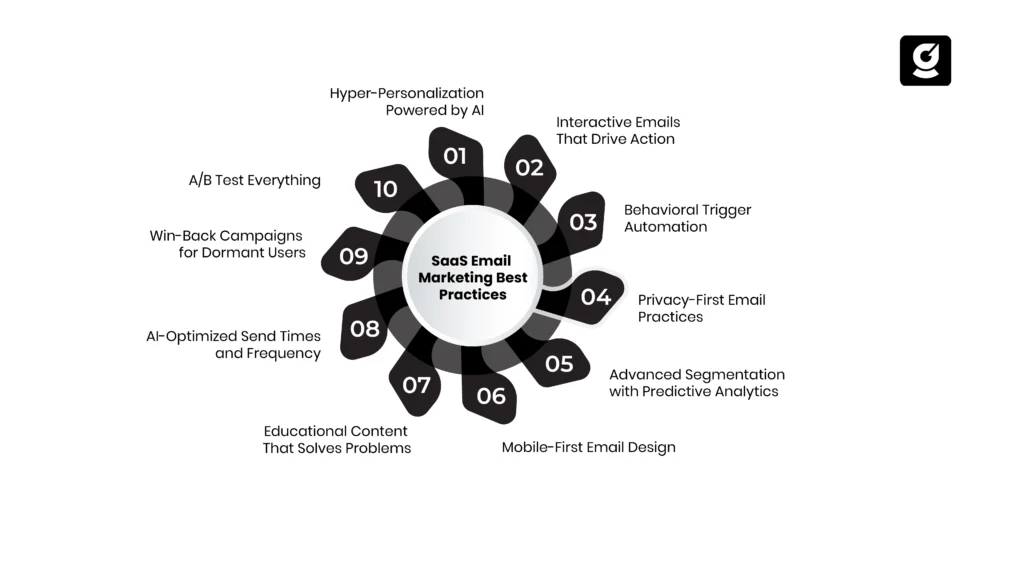
1. Hyper-Personalization Powered by AI
Personalization in 2026 means behavioral context, not mail-merge fields. AI-powered platforms can now track which features a user has activated, how frequently they log in, and which workflows they repeat, then use that data to generate email copy that feels written specifically for them.
Consider two users on the same project management plan: one uses automation heavily, one never has. A personalized system sends the first user tips on advanced automation rules; it sends the second a short video explaining why automation matters for their workflow pattern. Both emails are triggered by the same plan tier but feel entirely different.
Why it matters:
- 72% of consumers only engage with personalized messaging
- AI can predict user needs before they even realize them, making your emails feel intuitive and helpful.
Examples of hyper-personalization:
- A project management tool detects that a user hasn’t tried the “automation” feature. It sends an email with a video tutorial specific to their workflow.
- A SaaS CRM identifies a user who frequently exports data. It sends an email showcasing advanced reporting features they might not know about.
How to implement:
- Connect your product event data to your email platform using a CDP or direct API integration.
- Build dynamic content blocks that swap based on user segment, industry, or feature usage, most modern ESPs support this natively.
- Use AI writing tools to generate subject line and copy variants at scale, then let send-time algorithms and A/B tests determine winners.
2. Interactive Emails That Drive Action
Static emails ask users to click away before they can do anything. Interactive emails collapse that gap. Using AMP for Email or modern HTML email frameworks, you can embed polls, quizzes, calculators, and even short product demos directly in the message.
A SaaS billing tool, for example, might embed an ROI calculator that shows a prospect their projected savings based on team size, no landing page required. The reply rate on that kind of email tends to be significantly higher than a standard CTA button, because the value is immediate and visible.
Interactive elements reduce friction and make emails more engaging. Instead of redirecting users to a landing page, they can engage instantly, boosting click-through rates (CTR) by up to 300%.
Examples of interactive elements:
- Polls or surveys to gather feedback.
- Quizzes to recommend product features.
- In-email calculators to demonstrate ROI (e.g., “See how much time our tool saves you!”).
- Live demos via embedded videos or AMP (Accelerated Mobile Pages) components.
Pro tip:
- Use tools like Twilio SendGrid or Mailmodo to create interactive emails without needing advanced coding skills.
3. Behavioral Trigger Automation
Behavioral email automation is the single highest-leverage investment most SaaS companies can make. Instead of emailing your entire list on Tuesday at 10am, you send one email to a specific user the moment they complete step 3 of 5 in your onboarding flow and then stop for two days, because your data says that’s when they most often disengage. For example, a well-timed onboarding email can reduce churn by 50%.
High-impact trigger types
- Signup with no setup — user registers but doesn’t complete step 1 within 24 hours
- Feature non-adoption — user has been active for 30 days but hasn’t used a core feature
- Activity drop — login frequency drops below a user-specific baseline
- Trial expiry warning — 72 hours before trial end with a specific, behavior-relevant upgrade prompt
- Milestone celebration — user completes their 10th project, exports data for the first time, etc.
4. Privacy-First Email Practices
With global privacy regulations tightening, GDPR in the EU, CCPA in California, LGPD in Brazil, and emerging frameworks elsewhere, SaaS companies that treat compliance as a minimum bar rather than a genuine commitment are building on unstable ground.
Users who don’t understand why they’re receiving an email don’t just unsubscribe; they mark it as spam, which damages your sender reputation for everyone on the list.
Privacy practices worth implementing today
- Add a one-line “why am I getting this?” explanation in the footer of every email—e.g., “You’re receiving this because you activated the reporting feature on [date].”
- Use confirmed (double) opt-in for newsletter subscriptions; store opt-in timestamps and sources for compliance records.
- Make the unsubscribe link prominent—not buried in 8pt font. A user who unsubscribes cleanly is far better than one who marks you as spam.
- Respect granular preferences: let users opt out of marketing emails while staying subscribed to product updates
5. Advanced Segmentation with Predictive Analytics
Basic segmentation groups users by what they are (role, plan, industry). Predictive segmentation groups them by what they’re likely to do next.
For a SaaS company with a few thousand active accounts, even a simple logistic regression model trained on usage data can identify “likely churners” 30 days before they cancel, giving your email sequence time to intervene.
Practical segmentation examples
- Users approaching plan limits → send an upgrade email before they hit the wall (proactive beats reactive).
- Users with high engagement but no team invites → send a collaboration feature spotlight; they’re candidates for expansion revenue.
- Users with declining login frequency → trigger a win-back sequence immediately rather than waiting for cancellation.
- Power users who haven’t reviewed the changelog → they’re your best candidates for beta feature invitations.
6. Mobile-First Email Design
According to Litmus’s Email Client Market Share Report, mobile devices account for over 60% of email opens globally. An email that renders poorly on a phone, tiny text, broken layout, hard-to-tap buttons, loses that reader permanently; most users won’t come back to read it on desktop.
Mobile-first design checklist
- Single-column layout only, multi-column designs collapse unpredictably on small screens.
- Subject lines under 40 characters (about 6–7 words) so they don’t truncate on iPhone’s Mail app.
- CTA buttons at least 44×44px, Apple’s recommended minimum tap target size.
- System fonts (Arial, Georgia) or web-safe fonts as fallbacks, custom fonts may not load on all clients.
- Compress all images to under 200KB; avoid images wider than 600px.
- Test in dark mode, many users have it enabled; light-colored text on white can become invisible.
7. Educational Content That Solves Problems
SaaS users are problem-solvers by nature. They adopted your tool to accomplish something. The emails they value most are the ones that help them do that thing better, not the ones reminding them your product exists.
Example: Grammarly’s “Weekly Writing Insights” series is a widely cited example: it delivers personalized writing statistics and tips, which reinforces the product’s value without any direct ask. The email functions as a product experience, not a marketing message.
Educational content formats that work
- Case studies with specifics — “How [Company] reduced reporting time by 8 hours/week using [feature]” outperforms generic success stories because readers can map it to their own workflow.
- Workflow tips — short, actionable sequences (“5 steps to automate your weekly report”) that users can implement immediately.
- Changelog highlights — most users miss product updates; a well-written “what’s new and why it matters” email drives feature adoption better than in-app banners for many user types.
- Webinars and live sessions — invite segmented users to sessions relevant to their role or plan tier.
8. AI-Optimized Send Times and Frequency
Universal “best time to send” advice (Tuesday mornings, Thursday afternoons) is based on aggregated averages that mask enormous individual variation.
A founder in Singapore who checks email at 7am local time needs a different send time than a marketing manager in Berlin who reviews newsletters over lunch.
Frequency guidance by email type
- Onboarding sequences: daily for the first 7–14 days (high relevance, expected cadence)
- Product newsletters: monthly or bi-weekly maximum
- Behavioral trigger emails: as-needed (don’t batch or delay these)
- Re-engagement: 3 emails spaced 5–7 days apart, then pause
9. Win-Back Campaigns for Dormant Users
Every SaaS product has dormant users, people who signed up, engaged briefly, and drifted away without formally canceling. Before writing them off, a well-structured win-back sequence can recover a meaningful portion.
Three-email win-back structure
- Email 1 — Empathetic check-in: “We noticed you haven’t logged in recently. Is there something we can help with?” No offer yet. Genuine curiosity beats a discount opener.
- Email 2 — Value reminder + offer: Reference a specific feature the user previously used (or never tried) and pair it with a concrete incentive, a free 1:1 onboarding call, a 30-day plan extension, or a feature unlock.
- Email 3 — Last chance + feedback ask: “If this isn’t the right time, we understand. Would you take 30 seconds to tell us what got in the way?” Feedback from churned users is product gold, even if they don’t come back.
After three non-responses, pause the campaign. Continuing to send damages your sender reputation and confirms in the user’s mind that you’re not paying attention.
10. A/B Test Everything
A/B testing is the mechanism by which good email programs become great ones. But most SaaS teams either don’t test at all, or test the wrong things (color of a button rarely moves the needle; subject line framing almost always does).
High-impact variables to test, in priority order
- Subject line framing — question vs. statement, curiosity vs. direct benefit, with vs. without the user’s company/role name
- Email length — for behavioral triggers, shorter (3–5 sentences) usually wins; for educational content, a longer format can outperform
- CTA copy and placement — “Start your setup” vs. “See how it works”; link vs. button; top vs. bottom placement
- Personalization depth — generic segment message vs. feature-specific message
- Send time — morning vs. evening; weekday vs. weekend for specific user segments
Testing discipline
- Test one variable per experiment. Changing subject line and CTA simultaneously makes results uninterpretable.
- Wait for statistical significance before calling a winner, typically 95% confidence and at least 500 opens per variant.
- Document all results in a shared log so institutional knowledge doesn’t leave when team members do.
growth.cx: The Leading SaaS Email Marketing Agency for Scalable Success
A SaaS email marketing agency focuses on creating and managing email marketing campaigns specifically for SaaS companies. These agencies understand the challenges of marketing SaaS products and use targeted strategies to attract potential customers.
At growth.cx, we offer comprehensive B2B SaaS email marketing services designed to meet your business goals. Our team collaborates closely with you to develop and manage effective email marketing campaigns that deliver results.
By concentrating on specific segments and crafting personalized content, we help increase engagement and boost conversions. Contact us to know how we can help you scale.
B2B SaaS Growth with Strategic SaaS Email Marketing Services
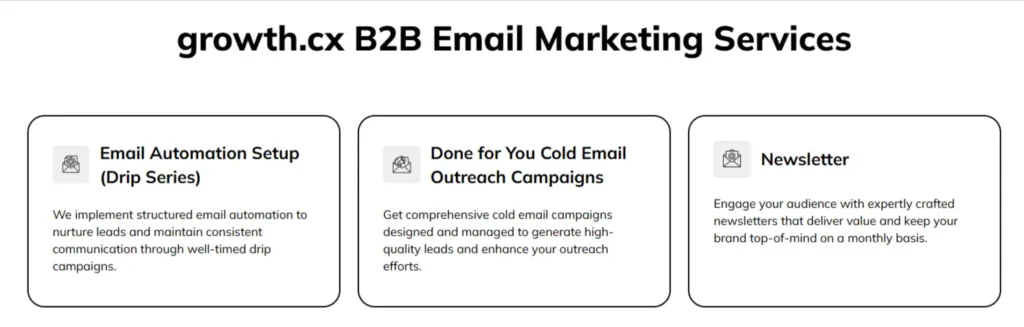
At Growth.cx, we specialize in performance-driven B2B SaaS email marketing strategies that help you connect with the right audience at the right time. From automated drip campaigns to high-impact cold email outreach and engaging newsletters, our tailored solutions ensure your brand stays top-of-mind while delivering measurable results.
How Growth.cx Executes SaaS Email Marketing Strategies
The team follows a data-driven process to execute high-performing email campaigns tailored for B2B SaaS businesses. By implementing these strategies, growth helps B2B SaaS brands build meaningful relationships, nurture leads, and drive sustainable growth.
Their strategies include:
- Email List Cleaning
- Email Audit
- New Domain Warmup Campaigns
- Cadence Analysis
- Copywriting
- Audience Segmentation
- Product Introduction Campaigns
- Attribution Setup
- Subject Line A/B Testing
- Account Setup

Final Thought:
Email marketing in 2026 is no longer about sending more, it’s about sending smarter. The SaaS companies seeing the strongest results are those treating email as a behavioral channel: triggered by what users do, personalized to where they are in their journey, and optimized continuously through testing and data.
Start with the practices that address your biggest current gap, whether that’s activation, retention, or churn recovery, and build from there. Every email you send is either strengthening or eroding user trust. Make each one earn its place in the inbox, and the compounding returns will follow.
Ready to turn your email channel into a growth engine? Let’s build it together →
FAQ
How often should a SaaS company send marketing emails?
Frequency should vary by email type. Onboarding sequences: daily for the first 7–14 days. Behavioral triggers: fire as-needed, never batch or delay. Product newsletters: monthly or bi-weekly at most. Re-engagement campaigns: three emails spaced 5–7 days apart, then stop if no response. Use AI send-time tools to optimize delivery timing for each individual rather than setting a list-wide schedule.
What emails should a SaaS onboarding sequence include?
A strong SaaS onboarding sequence typically includes:
(1) a welcome email sent immediately after signup confirming next steps,
(2) a setup guide within 24 hours,
(3) a key feature tutorial on day 3 based on the user's stated goal,
(4) a social proof email case study or customer quote on day 5,
(5) a check-in on day 7 if core setup actions haven't been completed, and
(6) a feature spotlight or upgrade prompt on day 14 for users who are active but not yet on a paid plan.
How do I reduce SaaS churn with email marketing?
To reduce churn with email: first, set up behavioral triggers that detect declining activity (e.g., no login in 7 days) and respond with a timely, specific check-in. Second, use predictive segmentation to flag at-risk accounts 3–4 weeks before their renewal date. Third, send proactive value emails, new features, workflow tips, or an invitation to a 1:1 session, rather than waiting until a user signals cancellation intent. Win-back campaigns with empathetic framing and a concrete offer typically recover 5–15% of lapsed users.
What email metrics should SaaS companies track?
Beyond open rate and click-through rate, SaaS companies should track: click-to-open rate (CTOR), which measures email content quality independently of subject line performance; feature activation rate from triggered emails; trial-to-paid conversion rate attributed to email sequences; churn rate for segments receiving re-engagement campaigns; and unsubscribe rate broken down by email type to identify which campaigns are creating fatigue.