
Search engines are the starting point for most SaaS buyers. In fact, 90% of Saas buyers begin their search online. And with 75% of SaaS companies relying on organic search for customer acquisition, so it’s clear that SEO for SaaS is a must for their business growth.
For SaaS startups and growing brands, having a well-defined SEO marketing strategy is crucial. SEO for SaaS startups not only drives awareness but also builds authority in highly competitive niches.
A SaaS SEO strategy is more than just ranking high on Google. It’s about connecting with potential customers who are actively seeking solutions to their problems. The competition is tough, and with technology always changing, you’ve got to keep up or you get left behind.
In this blog, we’ll learn about SaaS SEO, their benefits, and effective strategies that help to grow your business.
What is SaaS SEO?
SEO for SaaS is optimizing your SaaS website to improve its traffic and ranking on search engines. The main goal of this technique is to attract more organic traffic, leads, and, ultimately, customers who are interested in the software solution your SaaS company offers.
SaaS SEO differs from traditional SEO in several ways. SaaS businesses often have longer sales cycles and require a more strategic approach to content creation and keyword targeting. It’s essential to focus on building trust and authority, as potential customers will likely conduct thorough research before making a purchasing decision.
A dedicated SaaS SEO service helps companies create frameworks that consistently boost traffic through targeted optimization strategies.
What Is the Difference Between Traditional SEO, SaaS SEO, and AEO?
Here’s a comparison table to help you understand the key differences between traditional SEO, SaaS SEO, and AEO strategies.
| Traditional SEO | SaaS SEO | AEO |
| Focuses on ranking pages higher on Google | Focuses on attracting the right users who may become product signups | Focuses on getting selected as the direct answer in search and AI tools |
| Targets broad audiences across industries | Targets niche B2B or SaaS-specific buyers | Targets users asking very specific questions |
| Relies heavily on keyword volume and backlinks | Relies on problem-based keywords and product-related searches | Relies on question-based and conversational queries |
| Aims to increase website traffic | Aims to increase trials, demos, and revenue | Aims to appear in featured snippets and AI-generated answers |
| Covers general topics to build visibility | Covers deep, niche topics to build authority | Gives clear, concise, structured answers |
| Success is measured by rankings and traffic growth | Success is measured by signups and pipeline impact | Success is measured by answer visibility and zero-click presence |
Why is SaaS SEO Important for SaaS Companies
Search Engine Optimization (SEO) for SaaS companies plays a critical role in sustainable growth. With the right SEO strategies for SaaS companies, you can drive engagement, visibility, and customer acquisition cost-effectively.
You can focus on that with a proper SEO for SaaS strategies that help you in driving proper business success:
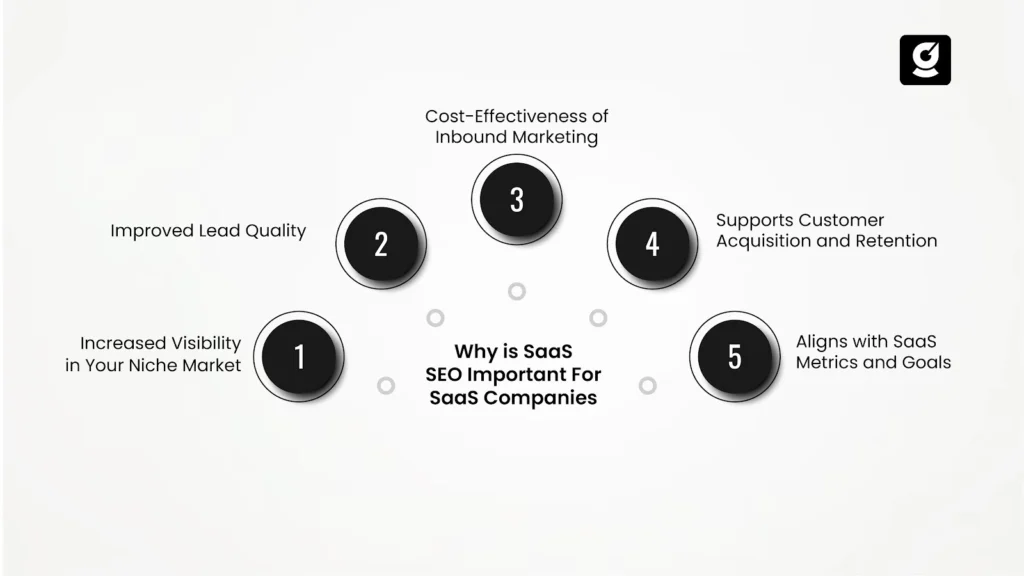
1. Increased Visibility in Your Niche Market
The SaaS industry is expanding day by day, so visibility can make or break a company. Making SEO for SaaS strategies helps ensure that your product stands out in the marketplace.
By optimizing for specific, relevant keywords, SaaS companies can improve their rankings easily. It also makes it easier for potential customers to find them among all the competitors. This increased online presence benefits your brand recognition and can influence sales performance.
2. Improved Lead Quality
Traditional businesses always prioritize quantity over quality in their leads. These SaaS companies benefit significantly from high-quality leads. This is because the SaaS sales process involves higher levels of customer engagement and longer sales cycles.
So, setting up proper SEO for SaaS attracts more targeted visitors who are searching for solutions that you provide. These visitors are potential customers with specific needs and the intent to purchase.
3. Cost-Effectiveness of Inbound Marketing
SaaS SEO is a cornerstone of inbound marketing. This strategy is more cost-effective than other marketing methods. You have to create valuable content and optimize your website to get potential customers to you easily.
SaaS SEO assists in attracting leads without the need for continuous heavy investment. It also provides a better return on investment (ROI) over time. That’s why SEO marketing for SaaS is considered a long-term and scalable investment.
4. Supports Customer Acquisition and Retention
SEO not only brings customers to your site; it plays a role in both acquisition and retention. For acquisition, a well-structured SaaS SEO strategy ensures that the traffic coming to your site is relevant, which increases the likelihood of sign-ups.
For retention, it can help keep your brand at the forefront of the minds of existing customers. By continuously delivering valuable content that addresses their needs, you encourage them to remain subscribed.
5. Aligns with SaaS Metrics and Goals
Understanding how important SEO is in a SaaS business helps founders align marketing metrics with overall growth and retention efforts.
SaaS companies often operate on metrics like Lifetime Value (LTV), Customer Acquisition Cost (CAC), and Monthly Recurring Revenue (MRR). SaaS SEO directly influences these metrics by reducing the CAC through organic leads and potentially increasing the LTV by drawing in a more engaged customer base.
How To Do Perfect SEO For Saas In 2026
In here, we discuss how you can make perfect seo for your saas business with all the proper strategies and all.
1. Create a List for Analyzing Your Competitors
The first step in any SEO strategy is keyword research. For SaaS companies, this means identifying keywords that not only have a high search volume but are also highly relevant to the software’s functionalities and the industry it serves. You can identify at least 15-20 competitors because you need them to develop different strategies.
- Start by listing basic terms related to your SaaS product to expand this list based on search volume and keyword difficulty. There are so many SEO tools that can help you get the proper keywords for your SaaS products.
- List all your top competitors and analyze their content and keyword strategies that help them get high rankings.
- You can find out points like what are the best-performing pages and what type of content attracts the most backlinks to the website?
- List the best-performing website sections of your competitors. Know in which section they are driving most of their organic traffic, like blog, product page, or other types of content.
- Also, look at their URL structure and complete website architecture.
You will get insights into the proper keywords your targeted competitors rank for, the quality of their backlinks, and their overall SEO health. This analysis will help you spot opportunities they might be missing and threats in areas where they are strong.
2. Prioritize Your SaaS SEO Keywords and Phrases
With a comprehensive list at hand, the next step is to prioritize your SaaS keywords. You can export them into a sheet with all the priority keywords and remove anything you don’t want. Categorize them based on buying intent and relevance to your target audience. High-intent keywords that directly relate to your product offerings or benefits should be ranked higher.
Use a matrix to balance between search volume, keyword difficulty, and business relevance to identify which keywords you should target first. Also you can try these ways too in your SaaS SEO keyword research,
- Capterra and G2: These sites are great for finding keywords. Look at your product or your competitors’ products to see which category they’re listed in. You can also check the features they list, which often give you keywords to use in your blog posts and other content.
- Use SEO Keyword Tools: There are keyword research tools like Ahrefs and SEMrush that can help you find keywords that your competitors are using. This can give you an idea of what’s working in your industry and help you find new keywords to target.
- Ask Your Customers: Don’t forget to talk to your customers. They can tell you what they’re searching for, what problems they need solved, and how they describe your product. This can give you keywords based on real user needs and language.
3. Map Keywords to the SaaS Buyer Journey Stages
Mapping keywords to different stages of the buyer’s journey is crucial for crafting messages that resonate with potential customers at each stage. Break down the journey into three main stages.
The process can be set up with your SaaS buyer’s journey so that each keyword can map into the Awareness, Consideration, and Decision stages.
This can be helpful when you are developing a content marketing strategy or any other content on your website. This way, you can know how your content fits in your buyers’ journey properly.
- In the Awareness Stage, you can add keywords that are broad and higher volumes/ Prospects are experiencing and expressing symptoms of a potential problem. Use educational and informational keywords like “what is [problem]” or “improving [business process].”
- In the Consideration Stage, you can add consideration keywords. In this stage, your user has identified their problem, but they don’t know of a solution, and they are seeking an answer. You can map keywords like that in this stage.
- In the Decision Stage for SaaS solutions, you need to add terms that indicate buying intent, like software, system, program, buy, pricing, best, alternatives for, and review. Prospects have decided on their solution strategy and are comparing specific products or are ready to buy. Focus on branded keywords and terms like “features of [product],” “pricing,” or “[product] reviews.”
4. Use Product-Led Content to Rank
Develop content that not only informs but also showcases your product’s unique selling propositions. This content should be designed to convert readers and not just attract them. You have to make sure that all content is SEO-optimized with the right keywords, meta descriptions, and title tags to improve visibility and engagement.
Unlike generic content, product-led content is tailored to directly demonstrate the value of your SaaS product, making it an integral part of the User’s decision-making process. By integrating product features, use cases, and benefits naturally into your content, you not only educate potential users but also subtly guide them toward trying out your product.
For example, offering detailed how-tos, guides, or case studies centered around specific product functionalities can boost conversions. Here are some key points on product-led content in SaaS SEO:
- Puts the User First: Product-led content zeroes in on the real problems your audience faces and shows exactly how your SaaS product can help solve them.
- Showcases Your Product’s Value: Instead of just talking about solutions in general, this type of content highlights specific product features, benefits, and real-life examples.
- Targets the Right Audience: By focusing on high-intent keywords, product-led content brings in visitors who are looking for what your product offers, leading to more traffic.
- Educates Easily: Content like tutorials, guides, and case studies not only teaches users something valuable but also subtly promotes your product, helping in more conversion.
- Builds Trust and Loyalty: When your content helps users get the most out of your product, it boosts satisfaction, leading to better customer retention.
- Leads to Action: Product-led content is designed to promote sign-ups, free trials, and demos, driving more results.
5. On-Page And Technical SaaS SEO Optimization
Both on-page SEO and technical SEO play crucial roles in enhancing the performance of your SaaS website. Optimizing these factors can significantly improve your site’s visibility and user experience.
Instead of treating technical SEO as a few small tweaks, use the checklist below to ensure your SaaS website is fully optimized.
Technical SEO Checklist for SaaS Websites
- Improve Core Web Vitals
Ensure fast loading speed, stable layout, and quick interaction times. Performance directly affects both rankings and conversions.
- Adopt a Mobile-First Approach
Your website must function smoothly across all devices. Responsive design is not optional.
- Maintain a Clean URL Structure
Use short, readable URLs that clearly reflect page intent. Avoid unnecessary parameters and messy query strings.
- Strengthen Internal Linking
Link blog posts to feature pages, feature pages to pricing pages, and resources to conversion pages. This supports both SEO and the user journey.
- Control Indexing and Crawlability
Prevent duplicate, staging, or low-value pages from being indexed. Monitor crawl errors regularly.
- Implement Structured Data Markup
Add schema for FAQs, product information, reviews, and organization details to enhance visibility in rich results.
- Use Canonical Tags Properly
SaaS sites often generate similar pages. Canonical tags prevent duplicate content issues.
- Secure Your Website with HTTPS
Security builds trust and is a ranking factor.
- Optimize XML Sitemap
Keep your sitemap updated and submit it to Google Search Console.
- Optimize Product and Feature Pages
Each feature page should target specific keywords and include optimized meta titles and descriptions.
6. Execute Your SaaS SEO Strategy
Lastly, put your strategy into action. Regularly create, publish, and update your content based on performance analytics. You can use these free tools like Google Analytics and GSC to monitor your rankings, traffic sources, and user behavior. Do regular updates of your strategy based on these analytics to make proper SEO trends and competitor movements. For more guidance on boosting results, check out our detailed SaaS SEO strategies, tailored for B2B companies..
Short on Time? Leave it to a Reputable SaaS Marketing Agency – growth.cx
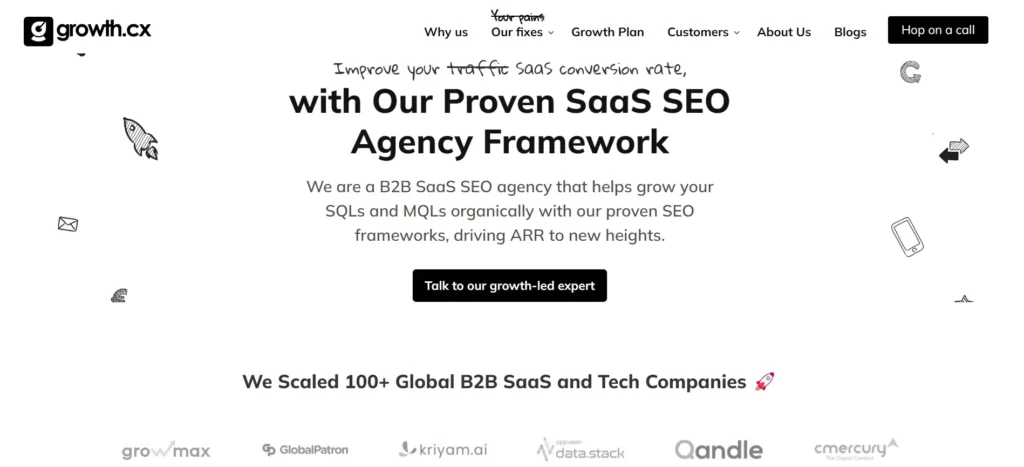
growth.cx is an expert SaaS SEO agency that helps b2b businesses grow their business through SEO strategies that have been proven effective. The company has over 100+ clients in different industries, so they know what it takes to set up the best strategies for your business.
They mainly focus on b2b saas seo services that recognize each SaaS company has unique pain points. By combining traditional marketing tactics with an integrated SaaS SEO framework, they create tailored strategies for modern B2B companies. They have proven strategies for the saas seo marketing.
growth.cx also integrates AI SEO services to help brands stay visible in modern search environments. As search changes with AI-generated results and answer-driven discovery, SaaS companies need more than keyword optimization. They need structured, intent-focused, and AI-ready content frameworks.
growth.cx combines SaaS SEO services with AI-focused optimization to ensure your brand ranks not just on search engines, but also within AI-powered search.
- Proven Strategies for SaaS SEO: They offer proven SaaS SEO approaches designed specifically for your business.
- Expert SEO Consulting: Professionals will provide expert guidance to help refine your SEO strategy for better results.
- Brand Awareness: Set up proper brand awareness to increase visibility and recognition in your online presence.
- Product-Led Content: They have content experts who highlight your product’s value to drive the most user engagement.
- Organic Growth: Gain quick growth by increasing organic search traffic and improving visibility.
- Topical Authority Building: Establish your brand as an expert in key industry topics.
- Conversion Rate Optimization: The team will build strategies to turn visitors into loyal customers.
Conclusion
SEO isn’t just about boosting your search rankings; it’s always about making sure your customers find you exactly when they need you. In the SaaS world, having a perfect SEO strategy helps you stand out, attract the right audience, and keep your business growing. You can set up everything with the given blog strategies as a base for your business.
Achieving this is a bit of a task for people who are doing it for the first time. Partnering with a SaaS SEO Agency like growth.cx is a better way for you to set up your SaaS business with proper strategies for focusing on your SaaS business. This approach is designed to help you stand at the front of your competitors. Contact to growth.cx for a personalized consultation on your SaaS SEO services, including all the essential steps for success.

FAQs
Which metrics should SaaS brands track to evaluate SEO success?
SaaS brands should track trial sign-ups, demo requests, and conversion rates rather than just traffic volume. Metrics like customer acquisition cost (CAC) and lifetime value (LTV) reflect SEO’s impact on business growth. Engagement metrics like time on site and bounce rates also help evaluate content effectiveness.
How should a SaaS business prioritise keywords for different stages of the funnel?
- Awareness-stage keywords are broad and educational, targeting early problem recognition.
- Consideration-stage keywords focus on solution exploration and comparisons.
- Decision-stage keywords indicate purchase intent, such as pricing or product-specific terms.
- Prioritizing based on buyer intent and keyword difficulty ensures effective traffic and lead generation.
How does content marketing support SEO for SaaS products?
Content marketing educates potential customers through tutorials, case studies, and product guides, addressing complex SaaS solutions. It builds trust and authority, helping users navigate longer sales cycles. Well-crafted content targets relevant keywords and nurtures leads across funnel stages.
How important is SEO in a SaaS business?
SEO is critical in a SaaS business because it drives consistent, high-intent traffic without ongoing paid ad spend. Since SaaS companies rely on recurring revenue, attracting the right users through organic search reduces customer acquisition cost and improves long-term profitability.
What are the most effective SEO strategies for SaaS companies?
The most effective SEO strategies for SaaS companies include targeting bottom-of-funnel keywords, building product-led content, optimizing feature pages, and strengthening technical SEO. Creating comparison pages, alternative pages, and use-case landing pages also helps attract users who are actively evaluating solutions.
How does SEO marketing for SaaS companies increase revenue?
SEO marketing for SaaS companies connects your product with users who are already searching for solutions. By ranking for high-intent keywords such as pricing, alternatives, and best tools, SaaS brands can attract qualified leads who are more likely to convert. Over time, this improves demo bookings, trial signups, and recurring revenue.