FREE GUIDE
The Definitive Guide to Account-Based Marketing for SaaS
Everything SaaS teams need to build and scale a high-performing account-based marketing strategy, from planning and targeting to choosing the right tools and platforms.
Summary
Account-Based Marketing strategy, where sales and marketing teams work together to focus on high-value accounts instead of broad audiences.
For SaaS companies, ABM helps:
- Close larger enterprise deals
- Shorten sales cycles
- Improve marketing ROI
- Build deeper relationships with key accounts
In this guide, you will learn how to build a scalable account-based marketing strategy, from selecting the right accounts to executing personalized campaigns and measuring performance.
What is Account-Based Marketing for SaaS?
Account-Based Marketing (ABM) is a B2B marketing strategy where sales and marketing teams work together to target specific high-value companies instead of broad audiences.
Rather than generating thousands of leads, B2B account-based marketing focuses on identifying companies that closely match your ideal customer profile. This creates highly personalized campaigns to engage decision-makers within those organizations.
Each account is treated as its own market, with tailored messaging, outreach strategies, and sales engagement.
Key Benefits of Account-Based Marketing for SaaS Companies
-
Higher Deal Values
ABM targets the accounts that provide the highest revenue potential, leading to larger contract values and bigger sales. By focusing on a smaller number of high-value accounts, SaaS companies can land larger deals and create a more profitable pipeline.
-
Shorter Sales Cycles
ABM’s personalized and targeted approach shortens the sales cycle by engaging key decision-makers early in the process. Through tailored messaging, ABM nurtures the right accounts and accelerates the path to conversion.
-
Improved Marketing ROI
Since ABM focuses on a select set of high-value accounts, marketing resources are spent more efficiently. With ABM, the marketing efforts are more likely to result in conversions, improving the overall ROI of marketing campaigns.
-
Better Sales and Marketing Alignment
ABM requires close collaboration between the sales and marketing teams. Both teams share responsibility for targeting and engaging accounts, ensuring that the messaging and strategies are unified and effective. This alignment strengthens the entire sales process, reducing friction and improving conversion rates.
-
Stronger Relationships with Target Accounts
By focusing on fewer but more important accounts, ABM allows SaaS companies to build deeper, more meaningful relationships with key decision-makers. With personalized outreach and tailored content, businesses can nurture these relationships, building trust and loyalty for the long term.
Account-Based Marketing vs Traditional B2B Generation
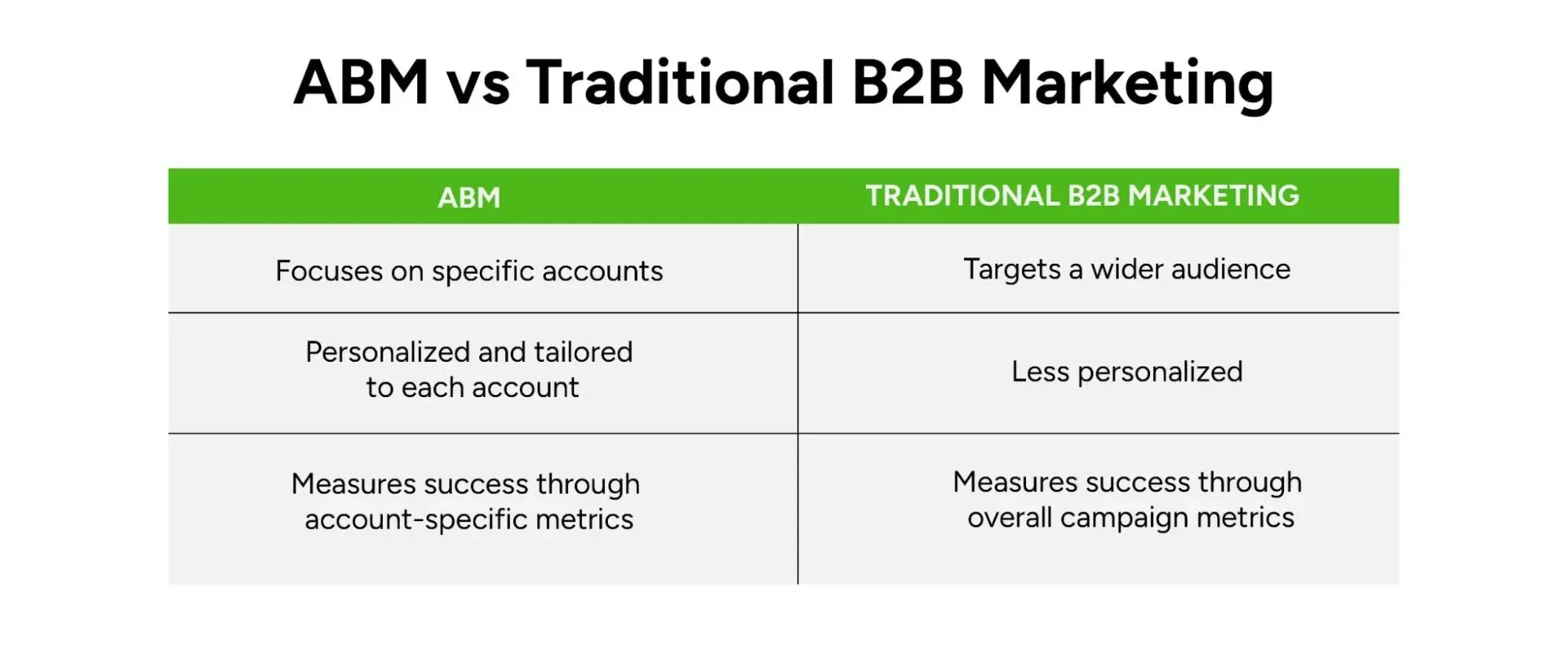
Traditional marketing strategies are designed to cast a wide net, generating as many leads as possible. The approach is usually quantity-driven: reaching out to large volumes of potential customers and qualifying them through the sales funnel.
ABM marketing completely flips this traditional model on its head.
Account-Based Marketing for SaaS targets the most valuable accounts right from the start. SaaS companies using ABM identify high-potential companies that closely align with their Ideal Customer Profile (ICP).
How B2B Account-Based Marketing Works: The Step-By-Step Process
ABM is a collaboration between your sales and marketing teams to personalize the entire customer journey for these key accounts.
Here’s a step-by-step process to help you implement an account-based marketing strategy successfully for your SaaS business.
Step 1: Define Your Ideal Customer Profile (ICP)
The foundation of any successful ABM strategy starts with defining your Ideal Customer Profile (ICP). The ICP helps you determine which types of companies are the best fit for your product or service.
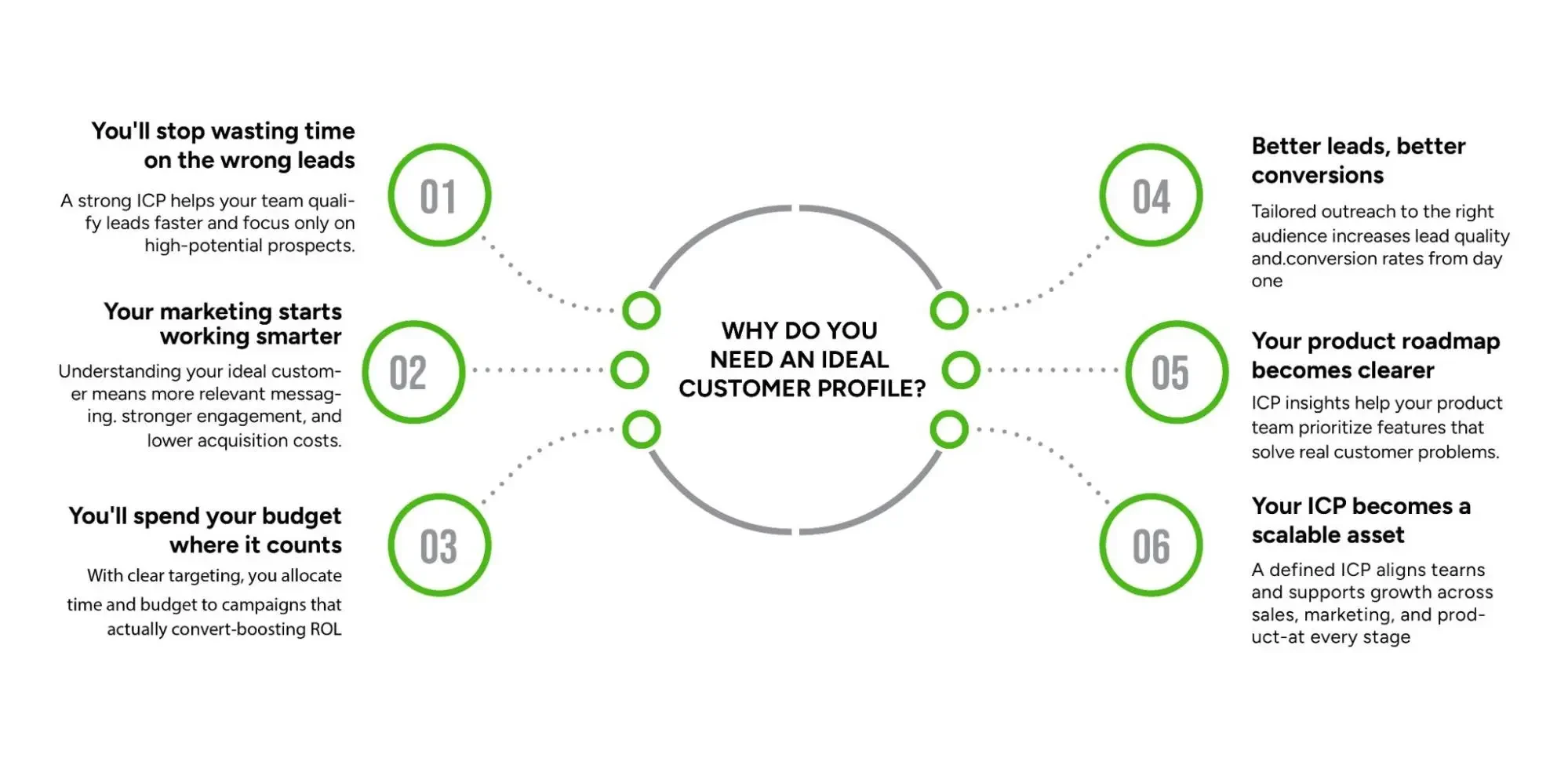
Key ICP Criteria for SaaS:
- Industry: Certain industries benefit more from your SaaS product. For instance, a SaaS product designed for healthcare would target healthcare organizations, while a SaaS solution for financial analysis might target financial firms.
- Company Size and Revenue: Different SaaS products cater to different sizes of companies. Larger enterprises may need more comprehensive solutions, while small and medium-sized businesses (SMBs) may need more affordable and scalable options.
- Geographic Location: You might prefer to focus on accounts in certain regions or countries based on your service capabilities, language support, or market potential.
- Existing Technology Stack: Knowing the technologies your target accounts are already using can give you insights into how well your product will integrate with their existing systems.
- Business Challenges: Understand the specific problems your target accounts are facing. For instance, a SaaS product that helps streamline remote team collaboration would target companies with significant remote workforces.
Step 2: Build Your Target Account List
Once you’ve defined your ICP, the next step is to build your Target Account List (TAL). This is the set of high-value companies that align with your ICP. Your target list is the core of your ABM strategy. It’s essential that this list is based on fit (how well an account matches your ICP) and intent (how likely the account is to buy).
Account-based marketing platform to help build a target account list:
- CRM Data: Leverage your existing database to identify companies that match your ICP. Use your CRM system to filter and sort accounts based on relevant criteria like industry, size, and previous engagement with your brand.
- Intent Data: There are tools that can provide insights into which accounts are actively researching solutions similar to yours. This data helps you identify accounts that are already in the buying process and more likely to convert.
- Third-Party Research: Platforms like ZoomInfo, LinkedIn Sales Navigator, and Clearbit can help you discover new potential accounts that match your ICP and gather contact details for decision-makers within these companies.
Step 3: Identify Key Stakeholders and Buying Committees
For each of your target accounts, you need to understand the buying committee, the group of people responsible for making the purchasing decision. This will help you tailor your messaging and outreach to the right individuals within the account.
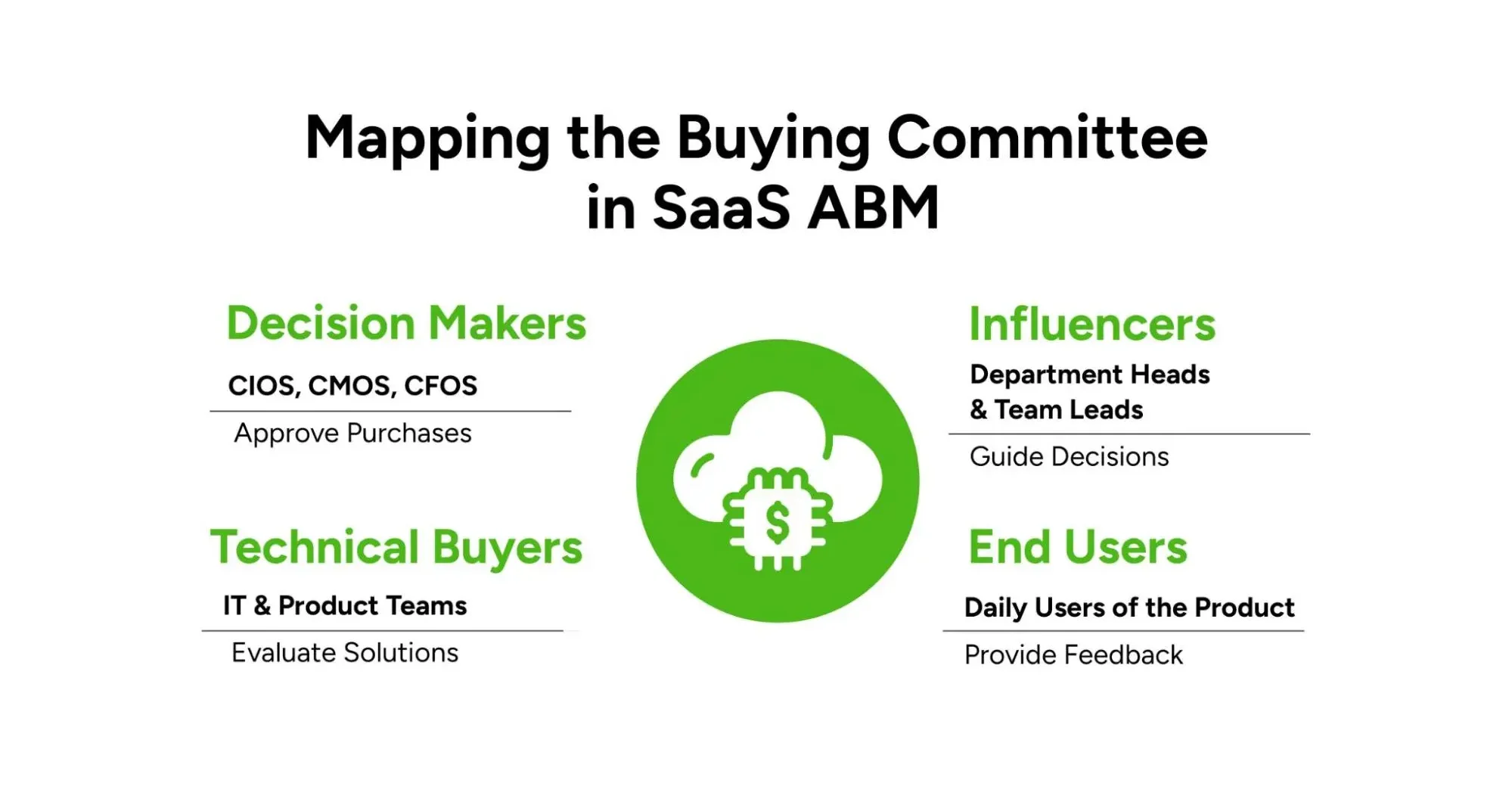
Key Stakeholders to Identify:
- Decision-makers: These are the executives who approve purchases. They could be Chief Information Officers (CIOs), Chief Marketing Officers (CMOs), or Chief Financial Officers (CFOs), depending on the nature of your SaaS product.
- Influencers: These are individuals whose opinions influence the decision but may not have final approval power. Influencers could be department heads or team leads who will use the product.
- Technical Buyers: These stakeholders are responsible for evaluating the technical aspects of the product. In SaaS, this could include the IT department or product teams that need to ensure compatibility with existing systems.
- End Users: These are the people who will use the product daily. They may not have final decision-making power, but can strongly influence the buying decision based on their needs and experience.
Step 4: Develop Personalized Messaging
With your target accounts and their key stakeholders identified, it’s time to craft personalized messaging for each account. Personalized SaaS SEO content will engage stakeholders at different levels and increase the likelihood of success.
Personalization Tactics:
- Personalized Landing Pages: Create account-specific landing pages that speak directly to the needs and challenges of the account, featuring relevant case studies, testimonials, and product benefits.
- Tailored Email Campaigns: Design email sequences that are personalized for each account and its buying committee members. Address their pain points, highlight how your product solves their challenges, and offer valuable insights.
- Custom Case Studies and Success Stories: Share specific success stories and case studies that are relevant to the account’s industry, size, and needs. Demonstrating how your product has helped similar companies can make your offering more appealing.
- Account-Specific Ads: Run display ads, LinkedIn outreach, or retargeting ads that are customized for each account. These ads should feature content that resonates with the target company’s pain points and solutions.
Step 5: Execute and Monitor Multi-Channel Campaigns
ABM is a multi-channel approach. You’ll need to engage your target accounts through a variety of touchpoints across multiple channels. These channels should be coordinated and consistent in their messaging to ensure a seamless customer journey.
Common ABM Channels and Campaign Types:
- LinkedIn Ads: These highly targeted ads allow you to reach specific decision-makers within your target accounts. LinkedIn’s advanced targeting options make it easy to engage the right people with relevant content.
- Webinars/Events: Host exclusive webinars, roundtable discussions, or one-on-one demos for your target accounts. This not only helps in educating stakeholders but also provides a platform for direct interaction with your product experts.
- Emails: Personalized email marketing campaigns are at the core of ABM. These emails should be tailored to the stakeholder’s role, pain points, and needs, with the goal of nurturing them through the sales process.
Step 6: Measure, Optimize, and Scale
Measuring the success of your account-based marketing for SaaS campaigns is essential for continuous improvement. Unlike traditional demand generation, ABM’s success is not based on lead volume but on account engagement and pipeline growth.
Key Metrics for ABM Success:
- Account Engagement Rates: Track how often your target accounts engage with your SaaS content and outreach. This can include email opens, website visits, content downloads, and webinar participation.
- Pipeline Velocity: Measure the speed at which accounts move through the sales pipeline. ABM typically shortens the sales cycle, allowing you to close deals faster.
- Deal Size: One of the key benefits of ABM is higher deal values. Track the average deal size from ABM accounts compared to traditional leads.
- Win Rates: Measure the percentage of target accounts that ultimately convert into customers. A high win rate is a strong indicator of b2b account-based marketing's effectiveness.
How to Build an Account-Based Marketing Strategy for SaaS Companies
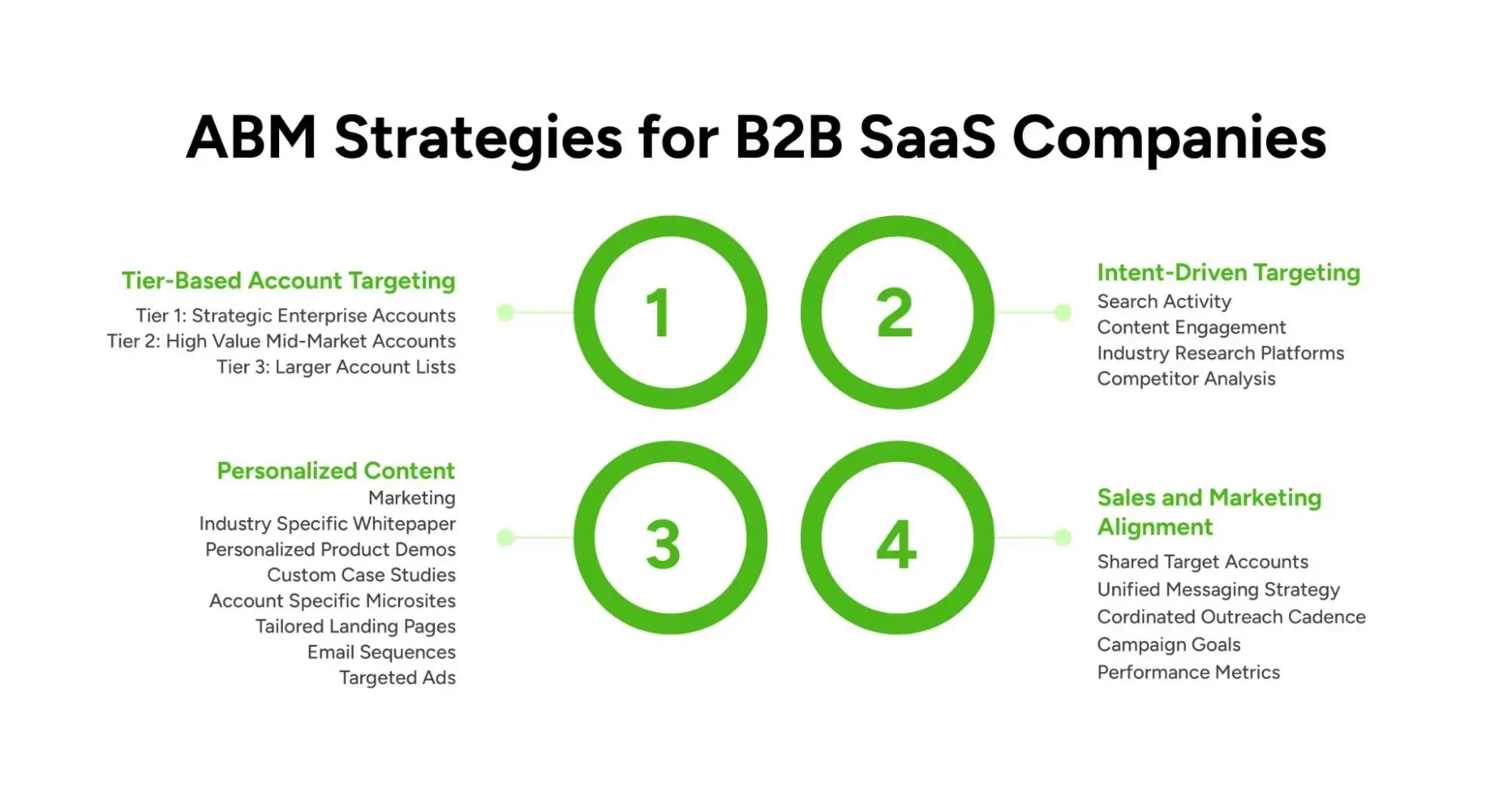
Here are the b2b account based marketing strategies you should implement for a successful ABM approach.
-
Tier-Based Account Targeting
Tier-based account targeting is one of the most effective strategies for SaaS companies, especially when aiming for large enterprise deals or mid-market customers. By categorizing your target accounts into tiers, you can better allocate resources, tailor campaigns, and manage your sales pipeline effectively.
-
Tier 1 – Strategic Enterprise Accounts
Tier 1 accounts are the highest-value targets in your ABM strategy. These accounts often have long sales cycles, multiple decision-makers, and high contract values. Engaging these accounts requires highly personalized campaigns and a high-touch approach from both sales and marketing teams.
Campaigns targeting Tier 1 accounts may include:
- Exclusive webinars tailored to the industry and the pain points of the account
- Personalized product demos that align with the account’s specific needs
- One-on-one outreach from senior executives or product experts
-
Tier 2 – High-Value Mid-Market Accounts
Tier 2 accounts are typically high-potential mid-market companies. These accounts may require less intensive personalization compared to Tier 1 accounts, but still warrant semi-personalized campaigns. While the outreach may be more scalable, it should still feel customized.
Campaigns targeting Tier 2 accounts may include:
- Segmented email campaigns addressing specific challenges
- Product tutorials and demos showcasing relevant features
- Industry-specific SaaS case studies highlighting success stories from similar companies
-
Tier 3 – Larger Account Lists
Tier 3 consists of larger account lists targeted with scalable ABM tactics. These accounts still align with your ICP, but the focus is on reaching them with less personalized content, often through automated marketing.
Campaigns for Tier 3 accounts may include:
- Account-based display ads
- General educational content (eBooks, blogs)
- Automated outreach that leads to further qualification
This tier-based approach ensures you allocate the appropriate resources and strategies to each account segment, maximizing engagement at scale.
-
-
Intent-Driven Targeting
Modern ABM strategies heavily rely on intent data to identify accounts that are actively showing signs of interest in your product or service. By tracking behaviors such as content engagement, SaaS landing page visits, and searches related to your solution, you can prioritize the accounts that are already in the buying cycle.
Key Intent Signals to Track:
- Search Activity: Is the account searching for solutions similar to yours? This can indicate that they are already in the decision-making phase.
- Content Engagement: Which accounts are interacting with your blog posts, webinars, or case studies? Deep engagement with content related to your product is a strong intent signal.
- Industry Research Platforms: Tools like 6Sense, Bombora, and Demandbase track intent signals that indicate accounts are researching specific solutions.
- Competitor Analysis: Identifying accounts that are engaging with competitors' content can help you spot opportunities to engage them with superior solutions.
-
Personalized Content Marketing
Content is the backbone of ABM. Unlike traditional demand generation, where content is created to appeal to a broad audience, ABM content is designed to speak directly to the needs and pain points of each target account.
The goal is to provide value at each stage of the buyer’s journey while ensuring the messaging is highly relevant to the account’s challenges and objectives.
Examples of Personalized Content:
- Industry-Specific Whitepapers: SaaS whitepapers are tailored to showcase how your product can solve problems specific to that industry.
- Personalized Product Demos: Live or on-demand demos that focus on the specific features most relevant to the account.
- Custom Case Studies: Real-world examples that demonstrate how similar companies in the same industry or with the same challenges have benefited from your SaaS solution.
- Account-Specific Microsites: Custom microsites for high-value accounts that provide personalized content, product demos, and value propositions directly aligned with their needs.
Personalization Tactics:
- Tailored landing pages: Dedicated pages designed specifically for target accounts.
- Email sequences: Personalized outreach sequences based on intent signals.
- Targeted ads: Using LinkedIn or Google Ads to serve highly personalized content that speaks to the account’s pain points.
-
Sales and Marketing Alignment
ABM requires seamless collaboration between marketing and sales teams to achieve its objectives. Both teams must share a unified goal, engaging with and converting the right accounts. In fact, many high-performing SaaS marketing strategies place strong emphasis on this alignment, because account-based campaigns only succeed when sales insights and marketing execution work together
Without alignment, ABM campaigns will lack consistency and fail to maximize results.
Key components of sales and marketing alignment include:
- Shared target accounts: Both sales and marketing teams must have the same list of high-value accounts that they’re targeting.
- Unified messaging strategy: Marketing and sales should be aligned on the messaging and value propositions that will resonate with the target accounts.
- Coordinated outreach cadence: Both teams need to work together on the timing of their outreach to ensure that marketing is supporting sales efforts.
- Campaign goals: Define specific goals such as the number of meetings, opportunities created, or deals closed with target accounts.
- Performance metrics: Both teams must agree on how ABM success will be measured (e.g., engagement rates, pipeline velocity, deal size, and win rates).
Account-Based Marketing Tools Every SaaS Team Should Know
Below is a list of leading tools and account-based marketing platform options used by SaaS companies to target, engage, and convert high-value accounts.
| Tool Name | Category | Key Features | Rating |
| UserGems | Market Intelligence | Tracks contacts, accounts, and calendar activity to surface the buyers who matter. Integrates with Salesforce, HubSpot, Outreach, Marketo, Slack, and more. | 4.5/5 (50+ reviews) |
| ZoomInfo | Company Intelligence | B2B contact database, list building, and data cleaning. Search by contact/company, and build target lists. | 4.5/5 (5,565 reviews) |
| LinkedIn Sales Navigator | Buyer Intelligence | Identifies target companies, tracks job changes, and engages prospects on LinkedIn. CRM integration and lead updates. | 4.5/5 (1,508 reviews) |
| 6sense | Intent Data & Predictive AI | Combines intent data with predictive AI to reveal buying signals. Multi-touch campaigns and intent signals. | 4.5/5 (374 reviews) |
| Clearbit | Buyer Intelligence | Data activation for discovering leads and personalizing buyer journeys. Integrates with CRM to identify top prospects. | 4.5/5 (523 reviews) |
The Future of ABM
As we approach 2026, ABM will become more multi-channel. SaaS buyers will no longer be found in just one space, so it’s essential to reach them wherever they engage online.
Buyers interact with content across search engines, social platforms, review sites, and email, meaning ABM must follow them through these touchpoints with consistent messaging.
Key Trends Shaping ABM’s Future:
- Intent-driven targeting based on active buying signals (keyword activity, content consumption, and competitor research).
- First-party data usage over third-party data to drive engagement and personalization.
- AI-powered tools that improve account targeting and content personalization.
- Multi-channel ABM execution to reach buyers across multiple platforms and stages of the journey.
- A SaaS marketing agency can play a critical role by helping companies identify high-value accounts, track buyer intent, and execute coordinated campaigns across multiple channels.
Ready to Implement ABM for Your SaaS Company?
Start engaging high-value accounts with a personalized ABM strategy built for your business, whether you are starting out or refining your approach.