Fed up searching for how to make cold email work for your SaaS business?
You definitely know what the problem is. Your team is sending emails every day like a robot. Endless waiting for the replies. And the stunted growth of the pipeline.
Cold Email Marketing still works in 2026. But we have to understand that buyers’ behavioral changes should align with the content of our email. The thing most B2B SaaS companies ignore today.
If you are still playing the forgotten old game like flooding inboxes with AI-generated noise, buy a list, write a template, and hit send, it’s time to change.
This blog is for SaaS founders, marketing leaders, and SDR managers who want to know what a high-performing cold email strategy actually looks like today. You will learn:
- Why most B2B SaaS cold email programs fail before the first email is sent
- What separates campaigns that generate pipeline from campaigns that generate activity
- How to audit your current strategy and fix what is broken
- What to look for if you are evaluating a B2B cold email agency or building in-house
Is Your Cold Email Strategy Generating Pipeline or Just Sending Emails?
Sending emails and generating a pipeline are not the same thing. Most B2B SaaS teams are doing the first while measuring it as if it were the second.
Consider two SDR teams with identical send volumes. One book qualified meetings consistently. The other hits every activity target and produces almost no real sales conversations. The emails go out. The reply rate stays flat. The meetings that do get booked are rarely with the right people. Over time, the whole program starts to feel like expensive busywork.
The difference is never the tool. It is the strategy behind the emails.
With 160 billion spam emails sent daily and filters diverting roughly one in five emails to spam folders, the bar for relevance has never been higher. Volume alone will not save a broken strategy. It will only make the problem more visible.
Your cold email program needs a rethink if you are seeing:
- Reply rates below 2%
- Responses like “not interested” or “please remove me.”
- Meetings are being booked with prospects who were never a real fit
- SDRs’ burning time on follow-ups with zero engagement
- No clear connection between outbound activity and the pipeline created
If any of these sound familiar, the issue is not how many emails you are sending. It is what those emails say, who they are going to, and whether any of it is built around a real cold email strategy
5 Reasons Most B2B SaaS Cold Email Strategies Fail
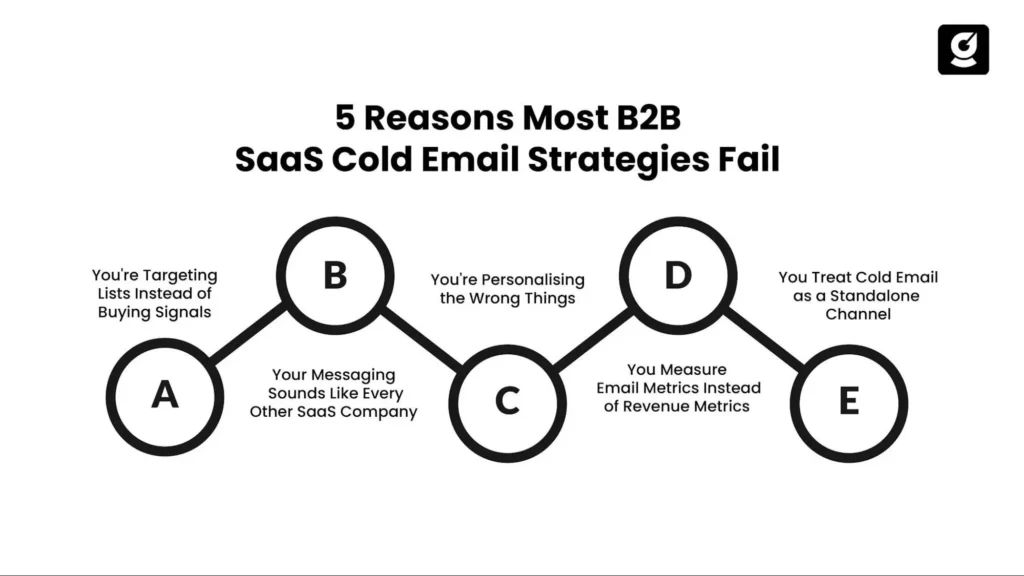
Reason #1: You’re Targeting Lists Instead of Buying Signals
Most cold email programs target a list. Someone exports a few thousand contacts from a database, filters by job title and company size, and hands it over to the sales team. This is called firmographic targeting. It means building a list based on what a company looks like on paper.
The problem is that a company matching your ideal customer profile on paper does not mean they are ready to buy. A 200-person SaaS company with a VP of Sales might be a perfect fit on paper, but if they just renewed a competitor’s contract last month, they are not going to take any meeting with you.
When you prospect based on signals rather than lists, your outreach becomes more relevant. You are not guessing. You have a real reason to reach out, and that reason makes your email worth reading.
Reason #2: Your Messaging Sounds Like Every Other SaaS Company
Check whether your last five cold emails mention “best-in-class,” “seamless integration,” “scale your growth,” or “AI-powered platform,” type sentences.
This is a messaging problem.
Every SaaS company is sending like this. They talk about features, capabilities, and integrations. They describe what the product does. They are simply following the company, not the customer.
Buyers are getting dozens of emails like this every week. Their brain is autoprocessed to skip them.
The emails that actually get replies talk about the buyer’s world. Their problems, their pressures, pain points, and the specific outcomes they are trying to achieve. They do not describe your product. They describe a situation the buyer recognizes immediately and cares about.
Common SaaS messaging mistakes:
- Opening with a sentence like “We are a platform that helps companies…”
- Leading with a long list of features or integrations
- Focusing on what the product does rather than what the buyer gains
- Using generic buzzwords that apply to every SaaS company
The fix is to make the buyer the center of the email, not your product.
Reason #3: You’re Personalizing the Wrong Things
Personalization has become a checkbox in most cold email programs. Teams add the prospect’s first name to the subject line, mention their company, or reference a LinkedIn post. Then they call it personalized outreach.
This kind of surface-level personalization no longer works. Buyers know you can pull their name and company from a spreadsheet. It does not feel relevant. It feels like a mail merge.
Real personalization is about relevance, not recognition. It means demonstrating that you understand the buyer’s specific situation. The challenges in their role, the pressures on their team, and the goals they are trying to hit.
A genuinely relevant email does not start with “I noticed you went to the University of Michigan.” It starts with something that makes the buyer think, “This person understands exactly what I am struggling with.”
That kind of relevance comes from research. It comes from understanding your ICP deeply enough to write emails that speak to real, recognizable problems. Not just personalized openers designed to grab attention.
Reason #4: You Measure Email Metrics Instead of Revenue Metrics
It’s very easy to track open rates and click rates. They are also almost useless as measures of success.
An email can have a 60% open rate and generate zero pipeline. A prospect can click your link, visit your pricing page, and never respond. These metrics feel meaningful, but they do not tell you whether your outbound is actually working.
The metrics that actually matter are:
- Reply rate: Are people actually engaging?
- Positive reply rate: Not just replies, but people interested in a conversation
- Meetings booked: How many qualified conversations is outbound creating?
- Pipeline created from outbound: How much of your pipeline can you trace back to cold email?
- Deals closed from outbound: Is the pipeline revenue-generating?
If your reporting stops at open rates, you are following the wrong strategy. The goal of cold email is not to be opened. It is to start conversations that lead to revenue.
Reason #5: You Treat Cold Email as a Standalone Channel
A decade ago, a well-written cold email could stand on its own. You sent it, the prospect read it, and if the timing was right, they replied.
That is not how buyers behave today. Before most people reply to a cold email or even consider it seriously, they do their own research. They visit your website. They check your LinkedIn. They Google your company name. They ask colleagues if anyone has heard of you.
If what they find does not match the message in your email, or if there is nothing to find at all, the email gets ignored. Even a great email cannot overcome a brand presence that looks thin or untrustworthy.
Cold email does not work in isolation. It works as part of a broader system that includes content, social proof, brand visibility, and demand generation. The email gets attention. Everything else earns trust.
What a Strong Cold Email Marketing Strategy Template Includes
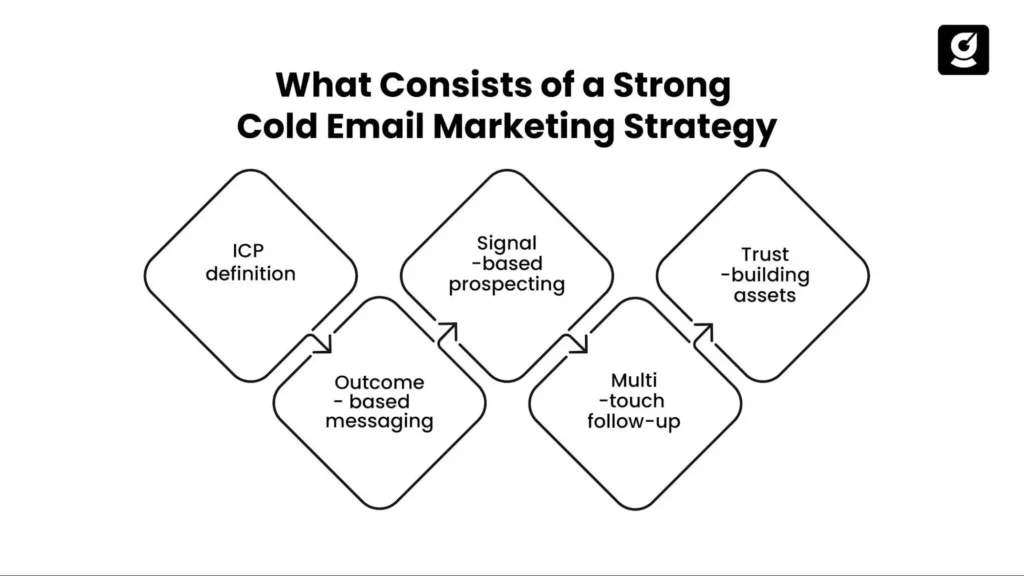
A strong cold email marketing strategy template covers five core areas:
- A Clearly Defined ICP
Before you write a single email, you need a clear picture of who you are targeting and who you are not.
An Ideal Customer Profile (ICP) is not just a demographic description. It defines the type of company and the type of person most likely to become a successful, long-term customer.
A strong ICP includes:
- Company size, industry, and business model
- The specific role and responsibilities of the person you are reaching out to
- The problems and pressures that make your product relevant
- Signals that indicate they might be in a buying moment right now
Equally important is defining who should NOT receive your emails. Reaching out to companies that are too small, in the wrong industry, or at the wrong stage wastes your sales team’s time and damages your domain reputation when they mark your emails as spam.
- Outcome-based Messaging
Your email messaging should not be built around your product. It should be built around your buyer.
Start with the problems they face, not the features you offer. It means connecting those problems to a real cost.
What happens if they do nothing? What is at risk? What are they missing out on?
From there, your emails should point clearly toward a desired outcome. Replace “our platform has X features,” with “teams like yours typically see Y result within Z timeframe.”
This kind of outcome-based messaging is harder to write. It needs a real understanding of your buyers. But it is significantly more likely to start a conversation.
- Signal-Based Prospecting
The best cold email campaigns are triggered by signals, not just scheduled sends. Instead of emailing your entire list on the same day, build a system that surfaces high-intent prospects based on recent activity.
Check these useful signals:
- Funding announcements: Companies that have just raised are often hiring, expanding, and investing in new tools
- Hiring activity: A company posting multiple roles in a relevant department signals growth or a known pain point
- Leadership changes: New executives often evaluate and change vendors in their first 90 days
- Market expansion: Companies entering new markets often need new capabilities
When your outreach is triggered by a relevant signal, you have a natural reason to reach out. Your email is not cold in the traditional sense. It is timely and contextually relevant.
- A Multi-Touch Follow-Up Framework
Most cold email replies are not from the first email. They come from a sequence of touches across multiple channels over time.
A strong follow-up framework typically includes:
- An initial outreach email with a clear, relevant message
- A follow-up email that adds new context or a different angle
- A LinkedIn connection request or message that reinforces the outreach
- A content-driven touchpoint, such as sharing a relevant case study, article, or insight
- A final “break-up” email that creates a low-pressure off-ramp
The key is that each touchpoint adds something. It does not just repeat “just following up.” It gives the prospect a new reason to engage.
- Trust-Building Assets That Support Outreach
Your cold emails will perform significantly better if there is supporting content that builds credibility when prospects research you.
The most effective assets include:
- Case studies that show specific outcomes you have delivered for similar companies
- Customer stories that help prospects see themselves in the success you have created
- Industry insights that demonstrate your understanding of the market
- Thought leadership content that positions your team as genuinely knowledgeable
These assets do not need to be long or elaborate. A one-page case study with a specific, measurable result is more valuable than a polished but vague marketing piece.
What are the Hidden Costs of Sending Bad Cold Emails
- Brand Damage Before the First Conversation
- Burning High-Value Accounts
- Long-Term Deliverability Problems
- Wasted Sales and SDR Resources
Why AI Is Making the Cold Email Problem Worse
- Every Company Can Generate Thousands of Emails Now
AI tools have made it easy to generate large volumes of cold email content at low cost. What used to require a copywriter and hours of work can now be done in minutes. The result is that inboxes are flooded with more cold emails than ever before.
- Buyers Are Learning to Ignore AI-Written Emails
Buyers have adapted quickly. They can recognize AI-generated emails almost immediately. The generic structure, the polished but hollow language, and the personalization that feels mechanical rather than genuine. These emails are being ignored at record rates.
- Insight Is Becoming More Valuable Than Automation
In a world where everyone can send thousands of emails, the ones that stand out are those that demonstrate genuine insight. A real understanding of the buyer’s situation, market, and specific challenges. That kind of insight cannot be automated. It requires human thinking and strategic positioning.
- Why Human-Led Positioning Still Wins
The companies seeing the best results from cold email right now are not the ones sending the most emails. They are the ones investing in the quality of their positioning, the depth of their buyer research, and the relevance of their message.
Volume is a commodity. Relevance is not.
What High-Performing B2B SaaS Teams Do Differently
- They Build Messaging Around Buyer Pain, Not Product Features
The best outbound teams spend as much time understanding their buyers as they do building their product. They talk to customers. They study competitor positioning. They identify the specific language buyers use to describe their problems, and they use that language in their emails.
- They Build Campaigns Around Buying Signals
Rather than emailing the same list over and over, high-performing teams build workflows that surface prospects when something relevant happens in their business. The signal drives the timing. The research drives the message.
- They Create Content Before They Create Campaigns
Before launching an outbound campaign, they make sure there is something for prospects to find when they go looking. A relevant case study. A landing page that speaks directly to the problem referenced in the email. A LinkedIn presence that builds credibility.
- They Align Sales, Marketing, and Outbound Messaging
In the best SaaS companies, the message in the cold email matches the message on the website, in the content, in the sales conversations, and in the customer success process. That consistency creates trust. When everything a prospect encounters says the same thing clearly, it is much easier for them to believe it.
Why Cold Email Works Better with Content Marketing
Content marketing and SEO play a direct role in outbound success, even though most people treat them as separate channels. When prospects search for problems your product solves, good content marketing puts you in front of them organically.
They may find you before your cold email arrives. Or they find supporting content after they receive your email that confirms you are the real deal.
Blog posts, guides, case studies, and comparison pages that rank in search create a warm foundation for cold outreach. It’s high chance that prospects who have already seen your content are more likely to respond.
Why Brand Trust Matters More Than the Email Itself
In many cases, brand trust matters more than your email quality. A mediocre email to a prospect who has already seen your case study and visited your website will often outperform a great email to a prospect who has never heard of you.
This is why a cold email strategy cannot live in isolation from your broader marketing. The goal is to make every touchpoint easier by building familiarity and trust before the email even arrives.
How to Audit Your Existing Cold Email Strategy
If your cold email program is not generating pipeline, start with an honest audit before making any changes.
- Review Your ICP
Look at the accounts your team is currently targeting. How specific is your ICP definition? Are you targeting companies based on firmographic data alone, or do you have a clear picture of the buying context, the problems, pressures, and signals that make a company genuinely relevant?
If your ICP is broad or vague, tighten it. A smaller, better-defined target list almost always outperforms a large, generic one.
- Review Your Messaging
Review your current email sequences from the prospect’s perspective. Ask yourself honestly: if you received this email from a company you had never heard of, would you reply? Does the email demonstrate understanding of your situation? Does it give you a reason to act?
If the emails focus more on the product than on the buyer’s problem, the messaging needs to be rebuilt from the ground up.
- Review Your Prospecting Signals
How is your team building its prospect lists? Are they using intent data, buying signals, or job change alerts? Or are they exporting from a database based solely on job title?
If signal-based prospecting is not part of your process, it needs to be.
- Review Your Follow-Up Process
Count the number of touches in your current sequence, and review the content of each follow-up. Always ensure you send your follow-up emails at least 3 days apart, and ask yourself: are you adding something new, or just nudging without adding value?
Also, check whether you are using LinkedIn or other channels as part of the sequence or relying entirely on email.
- Review Pipeline Contribution
Pull your pipeline data and look at how much of it came from cold email over the last quarter. If you cannot answer that question easily, your reporting is not set up to measure what matters.
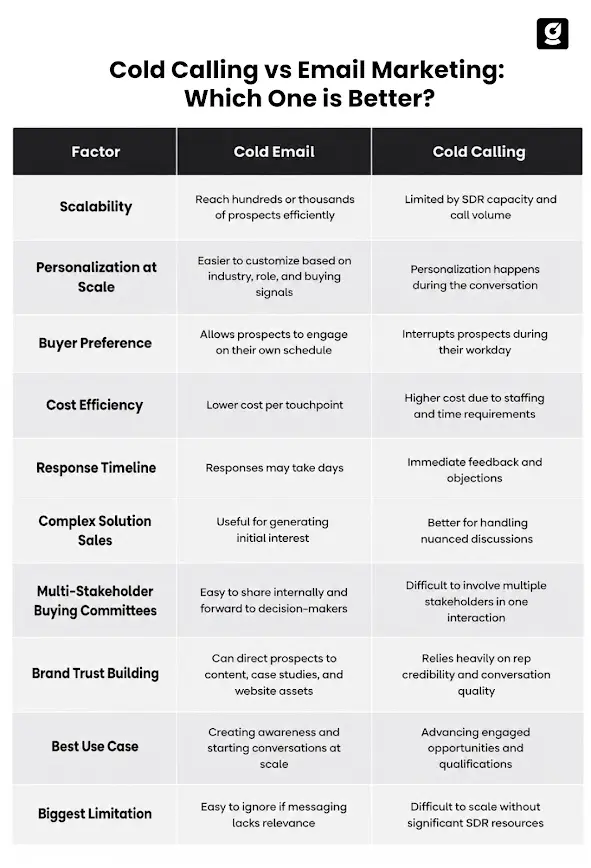
Cold Calling vs Email Marketing: Which One is Better?
B2B sales are often confused when choosing between these two, and the honest answer is: it depends on your buyers and your market.
Should You Hire a Cold Email Marketing Agency or Build an In-House Outbound Team?
Building an in-house outbound team makes sense when you have a well-defined ICP and messaging framework already in place, when you have enough volume to keep a full-time team productive, and when you want close alignment between outbound and your product and customer success teams.
An internal team has deep product knowledge and can iterate quickly. But it requires significant investment in hiring, training, and management, and it takes time to get right.
When a Cold Email Marketing Agency Delivers Better ROI
A cold email marketing agency makes more sense when you need fast results than when you can build an internal team, when your messaging and positioning need to be developed from scratch, or when you do not have the internal expertise to run a high-performing outbound program.
The best cold email agencies produce interesting and informative email content that helps your email stand out from the rest of the inbox and increases the chances your customers will interact by clicking links.
How a Cold Email Marketing Agency Helps B2B SaaS Companies Generate Pipeline
- Building Positioning That Buyers Respond To
A good cold email marketing agency understands your market before sending any mail. Research about who your buyers are, what problems they face, how they make purchasing decisions, and what your competitors are saying.
Only then do they develop relevant and specific positioning. This is the foundation for every email, every follow-up, and every supporting piece of content.
- Creating Messaging That Starts Conversations
Instead of focusing on product features, it’s better to build email sequences designed around buyer outcomes. Each email should carry genuine value, not by repeating the same point of view in slightly different words.
- Combining Content, SEO, and Outbound Into One Demand Generation Engine
Never treat a cold email as a standalone activity. Reputed agencies never do that. They combine outbound with content creation and SEO to build a full demand generation engine. One where your brand is visible before the email arrives, and where prospects can find supporting evidence after they receive it.
This holistic approach produces compounding results over time. The content builds organic traffic. The outbound generates direct conversations.
How to Choose the Best B2B SaaS Cold Email Marketing Agency
The right agency should bring:
- Deep ICP research and segmentation capabilities
- Positioning and messaging expertise developed from market understanding
- Content support that reinforces outbound campaigns
- Pipeline-focused reporting that goes beyond email metrics
- Proven case studies showing real revenue outcomes
- Multi-channel demand generation capabilities
Why growth.cx Is More Than a Cold Email Marketing Agency
growth.cx’s outbound strategy differs from that of most agencies. Instead of starting with a list and a template, this outbound email agency starts with positioning. It prioritizes understanding your market, your buyers, and what makes your solution genuinely relevant before sending a single email.
growth.cx strategy is all about combining content-led outbound campaigns with SEO alignment and demand generation, creating a system in which each part reinforces the others. Content supports outreach and builds organic visibility. Organic visibility makes outreach more effective.
The results across NWNS, IONA, Eshopbox, LoyaltyPlant, and FreJun show that this integrated approach drives pipeline and revenue outcomes, not just email activity.
If you want cold email marketing services that actually drive a pipeline, we would love to talk.
Let us take a look at what is holding back your outbound.
Real Results From B2B SaaS Cold Email Campaigns
- NWNS: Targeted outreach was used to identify and engage the right decision-makers, generating qualified sales conversations that had previously been difficult to reach through inbound alone.
- IONA: Strategic messaging improvements boost outbound performance. By rebuilding the email sequences around buyer outcomes rather than product features, pipeline creation increased.
- Eshopbox: Focused targeting based on buying signals instead of broad firmographic lists helped Eshopbox reach prospects genuinely positioned to evaluate their solution, supporting broader growth objectives.
- LoyaltyPlant: Outbound campaigns were redesigned around buyer intent and business outcomes, making the outreach more relevant and increasing positive engagement from high-fit accounts.
- FreJun: A coordinated approach combining messaging, content, and outreach worked together to generate demand, rather than relying on cold email alone to carry the entire weight of outbound.
Questions to Ask Before Choosing a Cold Email Marketing Agency
Before engaging a cold email marketing agency, ask them:
- How do they define and segment ICPs? Do they do original research or rely on the information you provide?
- How do they approach positioning and messaging? Do they develop it themselves, or do they expect you to hand it over?
- How do they measure success? If the answer is open rates and reply rates, be cautious. Ask specifically how they track pipeline and revenue contribution.
- Can they show pipeline and revenue outcomes from previous clients, not just email metrics?
- Do they support content and demand generation, or is email the only thing they do?
Conclusion: Cold Email Is Not Dead. Generic Outreach Is.
Cold emailing can even turn your donkey agency into a unicorn agency.
If your cold email program is not working, the answer is rarely to send more emails. It is to fix the things that sending more emails cannot fix.
Bad positioning looks bad at any volume. Generic messaging gets ignored, whether you send it to 100 people or 10,000. Reaching unsuitable companies at the wrong moment is equally wasteful.
The companies seeing real results from cold email right now are the ones investing in the quality of their targeting, the relevance of their messaging, and the strength of the content and trust signals that support their outreach.
Cold email is still one of the most effective ways to generate a pipeline in B2B SaaS. But only when it is done right. The bar for what “right” looks like has simply gone up.
Consider cold emailing as intelligence-led outbound with hyper-relevance.
FAQs
What is the average reply rate for B2B cold email in 2026?
It is about 3.43% in 2026, according to Instantly's benchmark report. Top-performing campaigns using advanced personalization and signal-based targeting achieve reply rates of 10% to 18%. SaaS and software companies sit at the lower end of industry benchmarks, often under 2%, making the quality of targeting and messaging especially important in this vertical.
How is cold email marketing different from cold calling?
Cold calling is randomly calling someone or a group with whom you have had no prior contact regarding your service, product, or company. Cold emails are generally easier and less time-consuming than cold calls, but cold calls can collect direct responses since they are inherently more personal. People generally respond to a cold email rather than a cold call. The strongest B2B outbound programs use both in a coordinated sequence rather than treating them as competing tactics.
What cold email marketing strategy template actually works?
The most effective cold email structure follows four elements: an opening line that describes a specific problem the recipient recognizes, a brief statement of what you do and for whom, a concrete example or result that creates credibility, and a low-friction call to action. The template matters far less than the underlying positioning. A well-structured email with generic positioning will underperform a simpler email built around a sharp, specific buyer insight.
Why do most B2B SaaS cold email campaigns fail?
Most campaigns fail because of broken positioning and generic messaging. The 5 core failure reasons are:
- Targeting accounts rather than problems
- Messaging that sounds like every other SaaS company
- Personalizing with irrelevant details rather than the business context
- Measuring activity rather than pipeline
- Treating cold email as a standalone channel without supporting content or brand signals.
How does working with a cold email marketing agency improve results?
A cold email marketing agency like growth.cx brings positioning expertise, signal-based targeting infrastructure, message testing at scale, and integration with SEO, ABM, and content programs that warm accounts before outreach begins. The result is outbound that creates a genuine pipeline rather than inflating activity metrics. The key difference is that a strong agency builds the entire demand-generation system cold email operates within, not just the email sequences themselves.