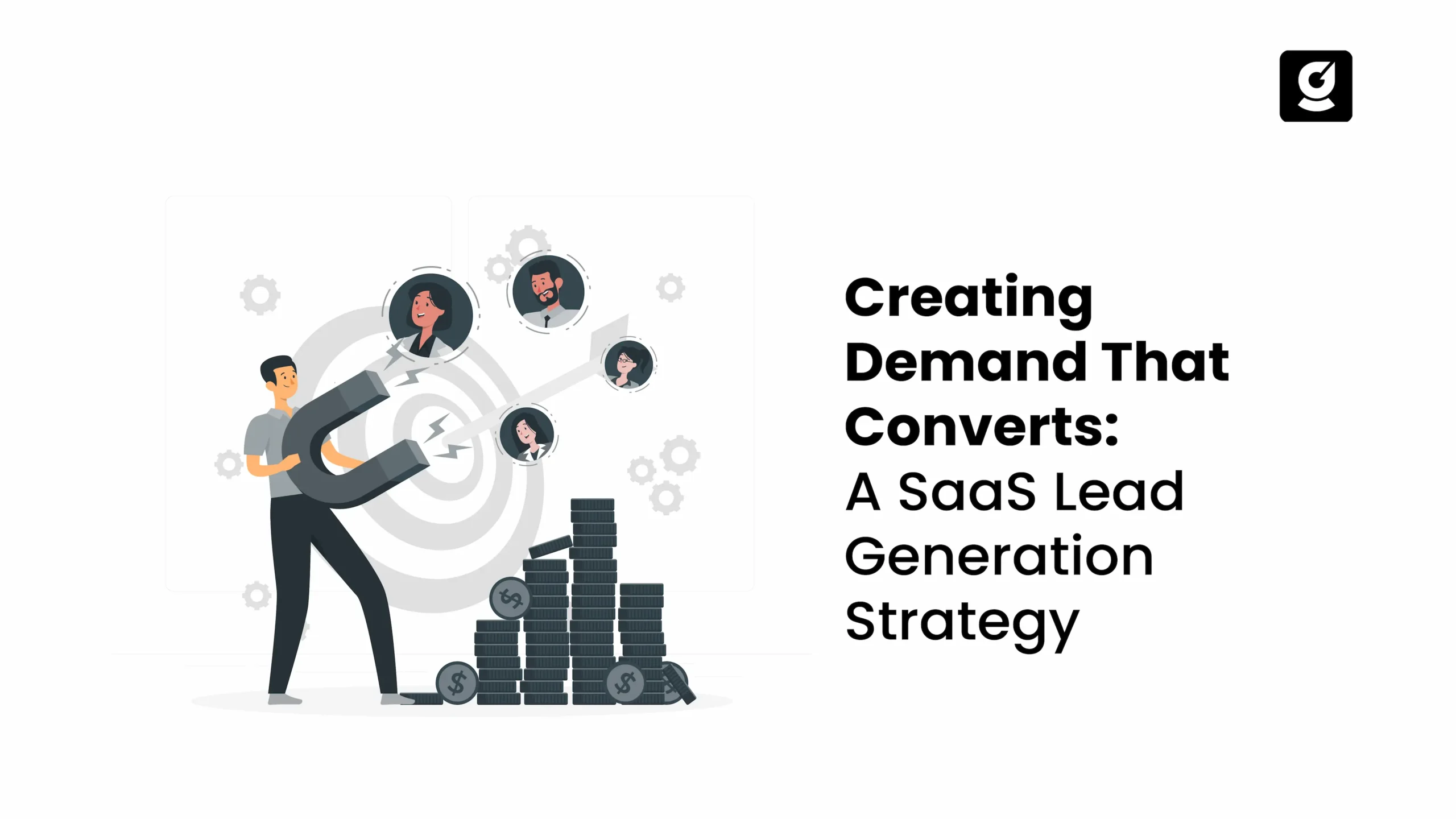
Generating high-quality leads is one of the biggest challenges facing B2B SaaS companies today, but “why do so many lead generation efforts fall short?” “Is it because teams are chasing volume instead of quality, or because the funnel isn’t fully aligned from awareness to conversion?”
Effective SaaS lead generation isn’t just about collecting contacts; it’s about building a system that consistently attracts, qualifies, and nurtures the right customers at the right time.
If your marketing efforts feel scattered or conversions are lower than expected, this blog will guide decision-makers, marketers, and growth teams through six actionable strategies to generate qualified leads, create predictable pipelines, and turn demand into real, measurable revenue.
Why Most B2B SaaS Lead Generation Strategies Fail to Convert
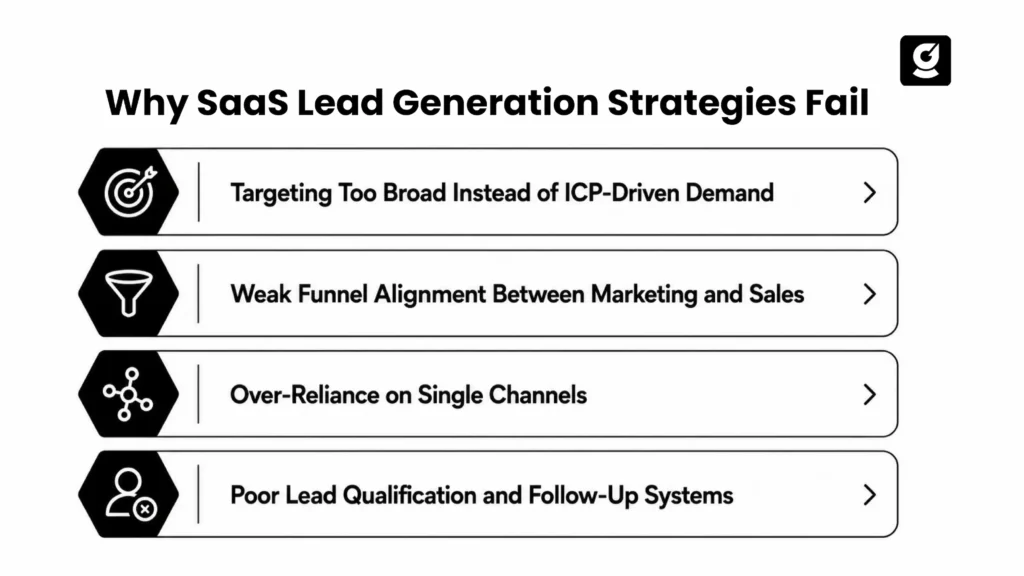
- Targeting Too Broad Instead of ICP-Driven Demand
Without a clear customer identity, SaaS lead generation may attract high volume but yield low-quality leads, reducing conversions and wasting marketing resources.
- Weak Funnel Alignment Between Marketing and Sales
A major breakdown in B2B lead generation happens when marketing and sales are misaligned, inconsistent, and have poor follow-ups. The reason for lower conversions is strong top-of-funnel activity.
- Over-Reliance on Single Channels (Paid or Outbound Only)
The reliance on a single channel is weakening lead generation and the pipeline. Adding SEO content and product-led leads to consistent leads.
- Poor Lead Qualification and Follow-Up Systems
Regarding the success of SaaS lead generation, sales opportunities are wasted due to inconsistent lead qualifying and follow-up.
6 Proven SaaS Lead Generation Strategies That Drive Qualified Pipeline
It is important to note that most companies offering Software as a Service solutions find it easy to generate leads; what they do not manage easily is generating good leads. The following are some of the SaaS lead generation strategies that guarantee quality over quantity for all channels involved.
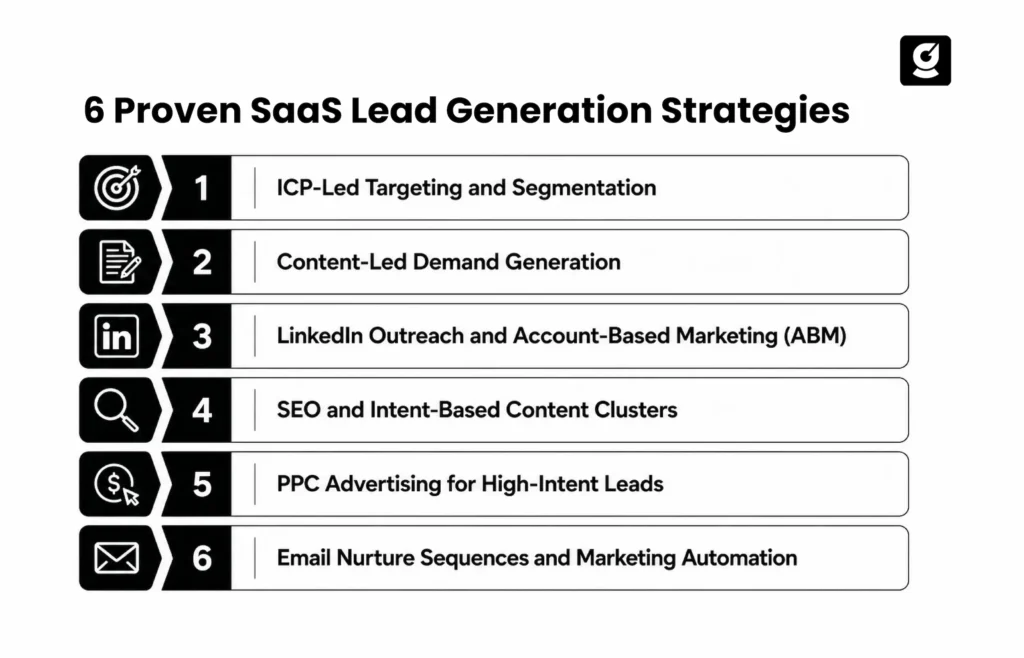
#Strategy 1 – ICP-Led Targeting and Segmentation for B2B SaaS Lead Generation
In B2B software lead generation through SaaS, precision when it comes to knowing who exactly your product is sold to is key. This means that if your ideal customer profile is not well-known, any good campaign will still bring people who have nothing to do with your business.
Key Actions:
- Define ICP using firmographics, tech stack, and buying behaviour
- Segment audiences by use case and pain intensity
- Map messaging to each segment’s specific outcomes
- Prioritise high-value accounts for outbound and inbound focus
When ICP is clearly defined, lead generation SaaS efforts become more focused, improving lead quality and reducing wasted acquisition spend.
#Strategy 2 – Content-Led Demand Generation for Lead Generation SaaS Growth
Content is one of the most essential factors in B2B SaaS lead generation; whether it’s buyer problems, product features, or pushing demos early, content can educate and raise awareness at the consideration stages.
Key Actions:
- Create problem-aware and solution-aware content assets.
- Develop comparison and “how-to” articles for mid-funnel users
- Use gated assets for high-intent conversion points
- Align content topics with sales objections
A structured content system strengthens SaaS lead generation by nurturing trust early and improving conversion readiness before sales engagement begins.
#Strategy 3 – LinkedIn Outreach and ABM for High-Intent Accounts
The use of account-based marketing, along with the use of LinkedIn for reaching out to decision makers, works well for B2B SaaS lead generation because, rather than relying on general campaigns, it uses specific touchpoints for particular accounts.
Key Actions:
- Build a list of high-value target accounts
- Personalise outreach based on company triggers or intent signals
- Combine organic engagement with LinkedIn ads
- Align sales and marketing messaging for consistency
This approach improves lead generation SaaS performance by ensuring outreach is relevant, timely, and aligned with the buyer context.
#Strategy 4 – SEO and Intent-Based Content Clusters for Scalable Lead Generation B2B SaaS
Organising search intent themes is preferable to employing keywords at random since SEO offers one of the most reliable long-term relationships for SaaS lead creation.
Key Actions:
- Identify high-intent keywords across funnel stages.
- Build topic clusters around core SaaS problems
- Optimise landing pages for conversion, not just traffic
- Interlink content to guide users through the funnel
Intent-focused SEO brings in users already evaluating solutions, making lead generation B2B SaaS efforts more efficient and conversion-ready.
#Strategy 5- PPC Advertising for High-Intent SaaS Lead Generation
Paid advertising is effective when the targeted users have already searched and compared. Instead of focusing on random awareness ads, target people in decision stages to achieve the greatest results.
Key Actions:
- Target bottom-funnel keywords with purchase intent
- Create dedicated landing pages for each campaign
- Use retargeting for engaged but non-converting users
- Continuously optimise based on conversion data
#Strategy 6-Email Nurture Sequences and Marketing Automation
Email marketing campaigns make sure that none of the leads fall through the cracks once they have made contact, hence becoming an integral component of lead generation in the B2B SaaS business model.
Key Actions:
- Build segmented nurture sequences by persona and intent level
- Trigger emails based on user behaviour (downloads, visits, clicks)
- Include educational and objection-handling content
- Implement lead scoring for sales handoff readiness
Well-structured automation keeps SaaS lead generation consistent by maintaining engagement until prospects are ready for sales conversations.
SaaS Sales Funnel Framework: How Demand Becomes Revenue
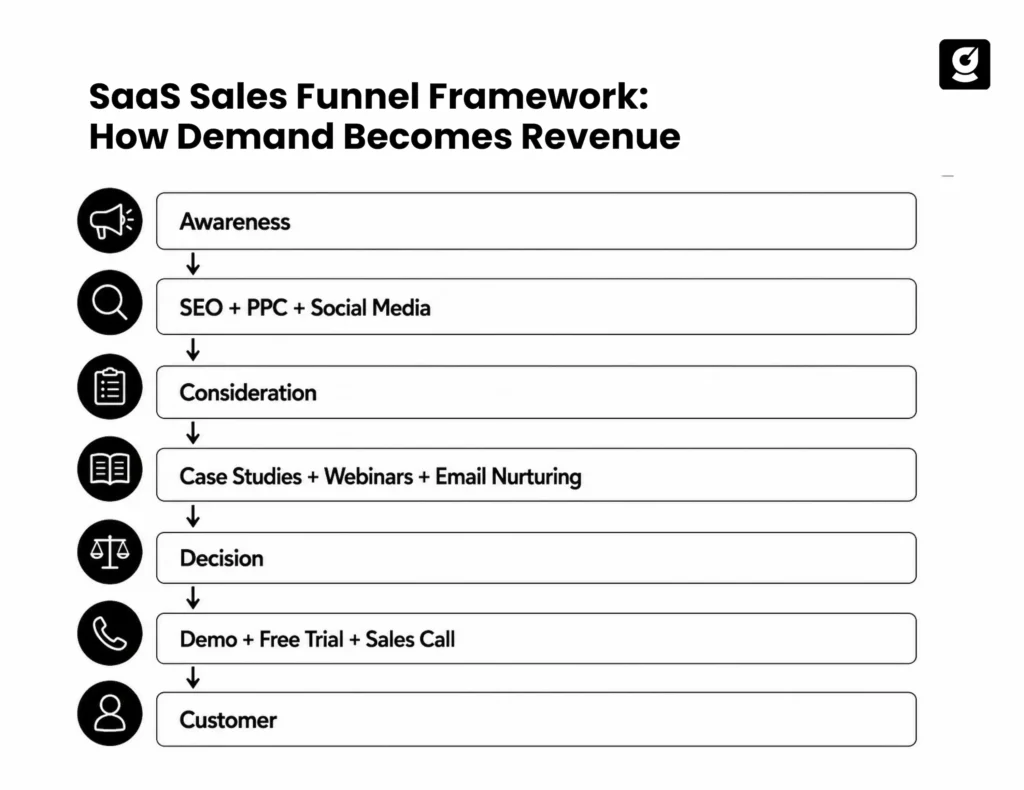
- Awareness
This is the stage where potential customers first discover your SaaS through marketing channels.
- SEO + PPC + Social Media
These channels attract and bring relevant traffic into the top of the funnel.
- Consideration
At this stage, prospects evaluate different solutions and compare options.
- Case Studies + Webinars + Email Nurturing
These assets build trust and help educate prospects before purchase decisions.
- Decision
This is the final stage where prospects are ready to choose a solution.
- Demo + Free Trial + Sales Call
These actions help prospects experience the product and confirm buying intent.
- Customer
This is when the lead converts into a paying user and enters the retention phase.
What Are The Common SaaS Lead Generation Channels to Prioritize?
A strong B2B lead generation system prioritises a balanced mix of inbound and outbound channels that consistently attract, engage, and convert high-intent prospects into qualified pipelines.
- Organic Search and SEO
Organic search remains one of the most reliable channels for sustainable lead generation and SaaS growth because it captures users actively searching for solutions. Unlike outbound efforts, SEO brings in high-intent prospects who are already evaluating options, making them more likely to convert when guided effectively through the funnel.
- Content Marketing
Content marketing plays a critical role in lead generation by educating prospects at every stage of the funnel. Blogs, case studies, and guides help build trust, address objections, and move users from awareness to decision-making in a structured way
- LinkedIn and Social Selling
LinkedIn is a high-impact channel for lead generation, especially for engaging decision-makers in targeted accounts. It enables personalised outreach, relationship-building, and thought-leadership positioning that support long-term pipeline development.
- PPC and Paid Acquisition
Paid channels like Google Ads and LinkedIn Ads are effective for capturing immediate demand in lead generation SaaS strategies. They work best when targeting high-intent keywords and decision-stage audiences who are actively comparing solutions.
- Email Marketing and Lead Nurturing
Email marketing ensures that leads generated through different channels are not lost over time. In B2B SaaS lead generation, nurturing sequences help guide prospects through the funnel using personalised, behaviour-driven communication.
What Are The Key Metrics That Define Successful SaaS Lead Generation
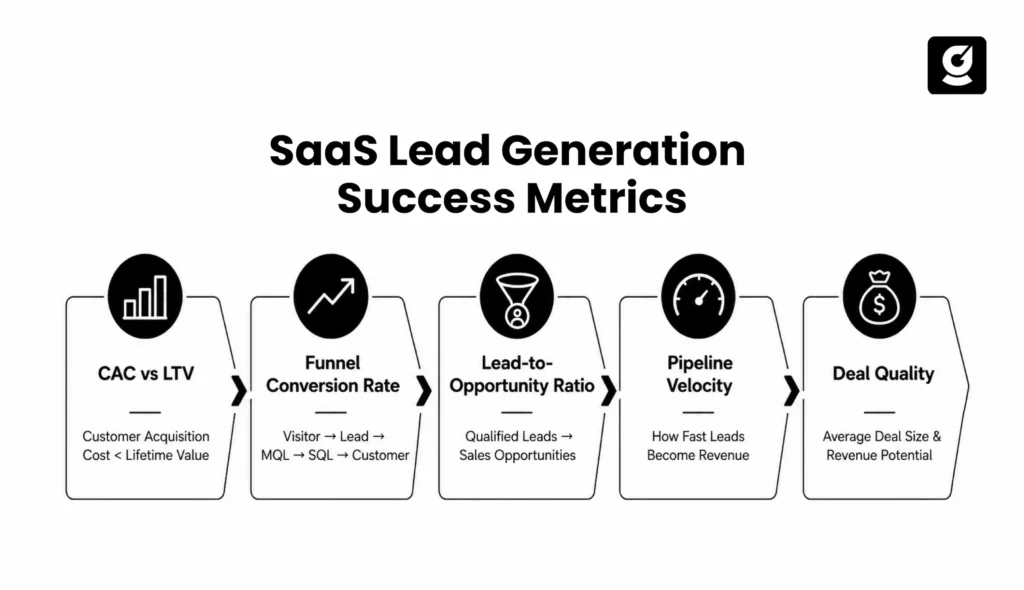
- CAC vs LTV
This metric compares the cost of acquiring a customer to the total revenue they generate over time.
- Funnel Conversion Rate
This shows how effectively leads move through each stage from visitor to paying customer.
- Lead-to-Opportunity Ratio
This measures how many qualified leads successfully convert into real sales opportunities.
- Pipeline Velocity
This tracks how quickly leads progress through the funnel and become closed revenue.
- Deal Quality
This evaluates the average value and long-term revenue potential of each closed deal.
What Are The Common Mistakes in SaaS Lead Generation (and How to Fix Them)
- Poor Audience Targeting and ICP Definition
Common Mistake:
- Targeting too broad or generic audience segments
- No clear ICP definition across marketing and sales
- Attracting leads with low purchase intent
How to Fix It:
- Define ICP using firmographics and behaviour signals
- Focus campaigns on high-value customer profiles
- Exclude irrelevant industries and segments early
- Unclear Value Proposition and Messaging
Common Mistake:
- Messaging focused on features instead of outcomes
- Lack of clarity on the problem solved
- Generic positioning across all channels
How to Fix It:
- Communicate clear business outcomes in messaging
- Align content with buyer pain points
- Tailor messaging for each funnel stage
- Ineffective Lead Qualification and Nurturing
Common Mistake:
- No proper lead scoring system
- Poor segmentation of cold vs warm leads
- Leads lost due to a lack of follow-up
How to Fix It:
- Implement behaviour-based lead scoring
- Create segmented nurturing workflows
- Align marketing and sales on qualification rules
- Lack of Performance Tracking and Campaign Optimisation
Common Mistake:
- Tracking vanity metrics instead of pipeline impact
- No visibility into conversion bottlenecks
- Campaigns run without continuous improvement
How to Fix It:
- Track funnel metrics (MQL to SQL to revenue)
- Identify drop-off points in the pipeline
- Continuously optimise based on data insights
- Delayed and Inconsistent Lead Follow-Up
Common Mistake:
- Slow response time after lead capture
- Inconsistent sales outreach process
- Leads go cold before engagement happens
How to Fix It:
- Automate instant lead notifications
- Set SLA for sales follow-up timing
- Use structured follow-up sequences for all leads
Best B2B SaaS Lead Generation Agencies in 2026
1. growth.cx for SaaS Lead Generation
Partner selection for SaaS lead generation is about creating an infrastructure that will reliably deliver opportunities and drive sales growth.
A SaaS marketing agency helps companies build scalable demand generation systems that improve lead quality, pipeline consistency, and overall revenue growth.
growth.cx specialises in aligning strategic objectives, implementation, and measurement in order to improve conversions and predictability in the SaaS lead generation process. This solution is tailored towards businesses looking for a systematic approach to generating SaaS leads.
- Multi-Channel Lead Generation Expertise
- Integrates SEO, content marketing, ABM, LinkedIn outreach, PPC, and email campaigns into one system
- Builds channel synergy instead of isolated marketing efforts
- Focuses on capturing both high-intent and early-stage SaaS buyers
- Aligns messaging across all channels for consistent demand generation
growth.cx implements a coordinated multi-channel model, where all channels work together to deliver better results and continuous growth. Instead of relying on a single acquisition channel, it uses multiple channels to ensure a consistent pipeline flow. This approach improves lead quality, reduces dependency risk, and strengthens long-term lead generation performance.
- Proven SaaS Growth Frameworks
- Uses structured growth frameworks tailored for SaaS funnel stages
- Implements intent-based targeting to identify high-value prospects
- Applies account-based marketing for enterprise and mid-market SaaS
- Leverages data-driven decision-making for continuous optimisation
- Scalable and Results-Driven Approach
- Focuses on scalable systems rather than short-term campaigns
- Prioritises lead quality over raw lead volume
- Improves conversion rates through continuous optimisation
- Aligns marketing outcomes directly with revenue impact
growth.cx enables SaaS businesses to achieve lead generation growth while maintaining their efficiency levels. growth.CX is about creating scalable systems for SaaS lead generation, where each step will have an impact on generating revenue for the company. growth.CX concentrates on making sure that everything involved in lead generation leads to revenue growth.
2. Kalungi
Modern SaaS growth is shifting from isolated lead generation to full-funnel demand creation.
A strong SaaS lead generation system focuses on building awareness, nurturing intent, and converting demand into revenue through coordinated strategy and execution.
This approach ensures B2B SaaS lead generation is consistent, scalable, and aligned with real business outcomes.
- Focus on full-funnel demand, not just lead capture
- Align marketing and sales on shared revenue goals
- Use multiple channels instead of a single-channel dependency
- Prioritise a qualified pipeline over lead volume
- Build intent-based targeting and nurturing systems
- Optimise for SQLs and revenue impact, not vanity metrics
3. TripleDart
TripleDart is an AI-powered SaaS marketing agency that creates and manages inbound GTM engines for B2B tech and SaaS businesses.
They assisted 250+ businesses in converting unpredictable marketing spend into a predictable pipeline and revenue, guided by senior professionals and enhanced by AI-powered workflows that boost speed, quality, and performance throughout the whole GTM engine.
- Defines a clear ICP and positioning before scaling acquisition
- Aligns demand generation strategy with revenue targets
- Integrates SEO, paid, ABM, and content into one growth system
- Establishes funnel metrics tied to SQLs and pipeline contribution
- Improves coordination between marketing, sales, and product teams
- Focuses on long-term scalable SaaS lead generation systems, not short-term campaigns
Conclusion: Building a Predictable SaaS Sales Funnel That Converts Demand Into Revenue
Through an aligned methodology of lead generation B2B SaaS, marketing becomes a process not merely focused on producing large volumes but a revenue-producing operation.
Through aligning lead generation for B2B SaaS with full-funnel optimisation, multi-channel demand generation, and performance-based metrics, it is possible to generate quality leads that are proven to convert.
An effective SaaS solution in lead generation revolves around the concepts of intent, nurture, and conversion, making sure that each step of the funnel results in more revenue.
Want to build a predictable SaaS lead generation system that brings in qualified leads and a consistent pipeline? Talk to our team and start turning demand into real revenue growth

FAQ’s
How do SaaS companies generate qualified B2B leads?
By targeting prospects with ICP marketing, creating content, optimising for search, implementing ABM, nurturing with email marketing, and promoting across multiple channels, SaaS businesses can build B2B leads that have a genuine buying intent.
What are the best lead generation channels for SaaS businesses?
The most effective approaches are: Coordinated SEO, Content, LinkedIn and Social Selling, PPC, Email and Account-Based Marketing to lead a qualified pipeline.
What is the difference between SaaS demand generation and lead generation?
Demand generation is about building awareness and cultivating intent throughout the funnel, whereas lead generation is all about collecting and qualifying specific prospects to become sales-ready leads.
How to Build a SaaS Sales Funnel?
How to build a SaaS sales funnel is a common question. Start by defining your ideal customer profile and mapping their journey from awareness to purchase. Create targeted content and campaigns for each stage: TOFU, MOFU, and BOF, U while using channels like SEO, email, LinkedIn, and paid ads to capture, nurture, and convert leads into revenue.
How can startups build a SaaS lead generation strategy on a limited budget?
Low-cost strategies, such as LinkedIn outreach, email nurturing, low-cost content marketing and search engine optimisation (SEO), can be used first by startups, along with ICP targeting and funnel alignment, to generate the best quality leads without significant budget.