

The average CAC for B2B paid search campaigns hit $802 in 2025, a 5.13% year-over-year increase, according to Data-Mania’s 2026 CAC Benchmarks. At the same time, Google non-brand CPCs climbed 29% while clicks on those same searches dropped 26%.
So what happens when a SaaS company hands this environment to an agency that also runs campaigns for a restaurant chain and an e-commerce store?
The answer shows up in your CAC report four months later.
SaaS PPC is a different discipline. Long sales cycles, multi-stakeholder buying committees, subscription economics, and trial-to-paid conversion are not variables a generalist agency plugs into its standard playbook. And yet, most “best SaaS PPC agency” or “SaaS PPC advertising firm” lists are built on review aggregators, star ratings, and traffic-driven affiliate rankings that tell you nothing about specialization depth.
This list is different. We ranked 10 agencies across a five-point specialization framework, not review scores. If you manage paid acquisition for a B2B SaaS company spending $10K to $100K/month, this is built for you.
Why Most SaaS PPC Agency Rankings Get It Wrong
Before the list, a direct conversation about how these rankings are usually built.
- The Clutch Problem : A 4.9-star rating reflects whether a client was happy with communication and deliverables. It does not tell you whether that agency understands SaaS trial funnels, CRM-connected attribution, or CAC payback optimization. Satisfied clients and pipeline-generating clients are not the same population.
- The Vertical Confusion Problem: An agency that serves SaaS, e-commerce, local services, and fintech simultaneously is not building deep infrastructure for any of them. SaaS campaigns require entirely different bidding logic, audience architecture, and reporting frameworks than a direct-to-consumer brand.
- The Metric Mismatch Problem: Generalist agencies optimize for CTR, ROAS, and MQL volume. A SaaS company needs SQL rate, cost per SQL, trial-to-paid conversion rate, and a CAC payback period under 12 months. These are not the same optimization goals, and confusing them is how six-figure ad budgets quietly disappear.
- The Junior Staff Problem: Many agencies pitch senior strategy, then route your $50K/month account to a junior manager handling 12 other clients. This structural reality does not become visible until week four of the engagement, when response times slow and campaign decisions start feeling template-driven.
How We Ranked These SaaS PPC Agencies: The 5-Point Specialization Framework
Every agency on this list was evaluated against the same five criteria. No exceptions, no affiliate consideration.
| Criterion | Weight | What We Evaluated |
| SaaS Exclusivity | 25% | Do they only serve SaaS/tech, or also ecom/local/retail? |
| Funnel Depth | 25% | Do they optimize for demos/trials/SQLs, or surface-level MQLs? |
| Stage-Fit Clarity | 20% | Do they clearly differentiate between Seed, Series A-C, and Enterprise? |
| Proprietary SaaS Infrastructure | 20% | Custom attribution, CRM integration, AI bidding, dedicated dashboards? |
| Verified Pipeline Outcomes | 10% | Case studies with SQL volume, CAC, or payback data, not just ROAS? |
Quick Overview of 10 SaaS PPC Agency Comparison at a Glance
| Agency | SaaS-Only | PPC Core | Best Stage | Starting Price | Specialization Score |
| growth.cx | ✅ | ✅ | Seed–Series B | Custom | 4.6/5 |
| Powered by Search | ✅ | ✅ | Series A–C | Custom | 4.6/5 |
| Hey Digital | ✅ | ✅ | Series A–B | $5K/mo | 4.7/5 |
| Upraw Media | ✅ | ✅ | Series A–C | €5K/mo | 4.8/5 |
| Aimers | ✅ | ✅ | Series A–B | $5K/mo | 4.5/5 |
| 42 Agency | ✅ | ⚠️ | Series B–C | Custom | 4.3/5 |
| TripleDart | ✅ | ⚠️ | Seed–Series C | Custom | 4.4/5 |
| KlientBoost | ⚠️ | ✅ | Series A–B | ~$3K/mo | 4.0/5 |
| Bay Leaf Digital | ⚠️ | ✅ | Mid-Market | $10K+/mo | 4.1/5 |
| Directive Consulting | ⚠️ | ✅ | Series B–Enterprise | ~$15K/mo | 4.4/5 |
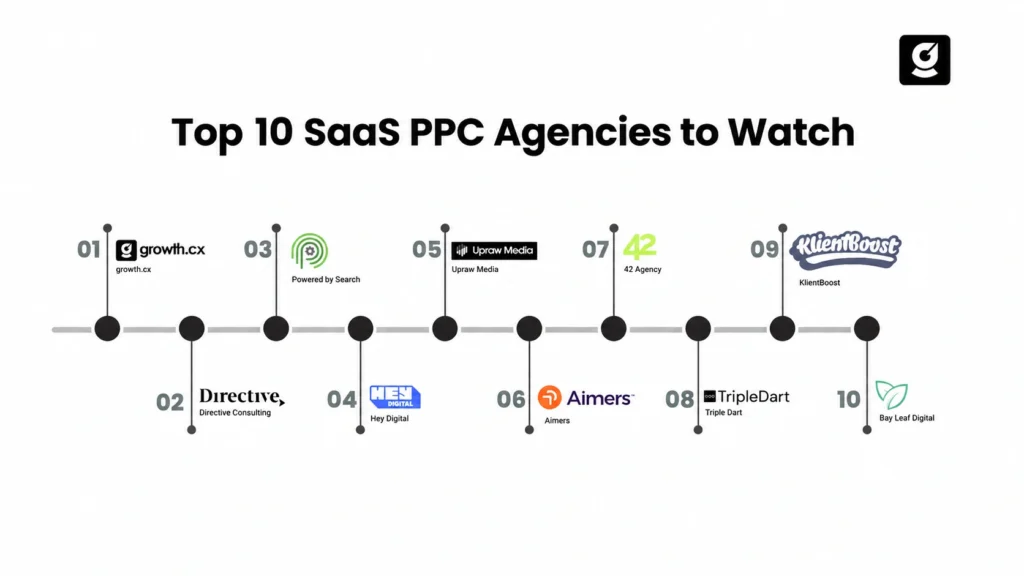
The 10 Best SaaS PPC Agencies in 2026, Ranked by Specialization
1. growth.cx
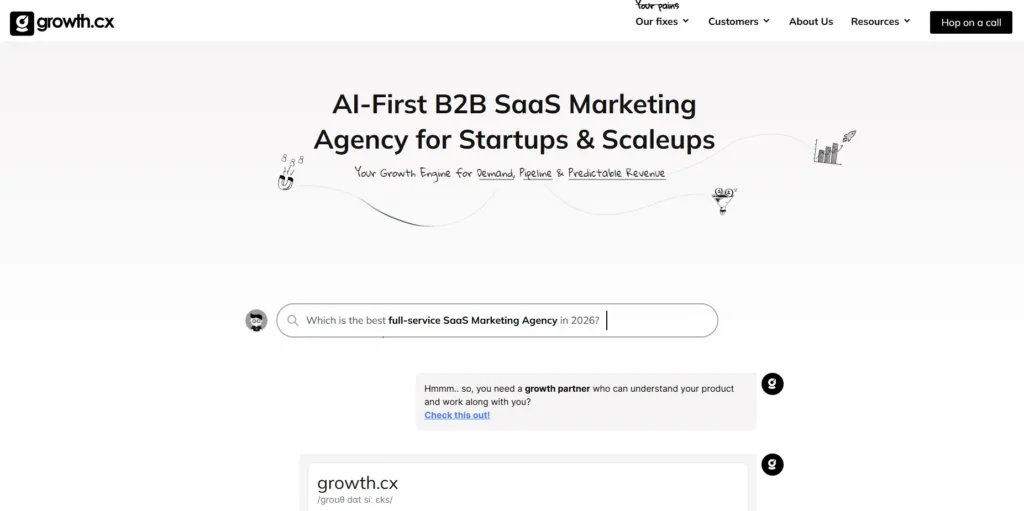
growth.cx is a full-service B2B SaaS performance marketing agency that operates as an embedded in-house team, with a structural model most agencies don’t offer. The team has 1-2 clients per expert, dedicated account ownership, and realistic KPIs from day one.
What Makes Them Stand Out
Most SaaS companies burning $5K–$20K/month on ads walk away with a CPL report. growth.cx runs paid acquisition differently: as a single ABM-first engine in which every channel shares signals with every other.
Here is what that actually means in practice:
- Google search clickers feed LinkedIn and Meta custom audiences automatically
- LinkedIn engagers become remarketing pools for Google campaigns
- Email openers get retargeted on Meta between touchpoints
- Every named account is pursued across all three channels simultaneously, not independently
This is not multi-channel reporting. It is a connected signal layer that compounds performance gains across the stack, rather than letting each platform claim its own isolated win while the pipeline stays flat.
For SaaS companies that have burned budget on agencies that treated paid media in isolation, growth.cx’s performance marketing approach closes that loop.
The four problems growth.cx hears on every discovery call, and their direct fix for each:
- Problem 1:
“Our CAC keeps climbing, but the pipeline isn’t.”
Most agencies target demographic segments like “Marketing Manager on LinkedIn”, reaching thousands at companies that will never buy. growth.cx builds named account lists filtered by company size, industry, tech stack, and intent signal, then runs campaigns exclusively to those accounts.
- Problem 2:
“Each channel reports its own win, but the pipeline is flat.”
When Google, LinkedIn, and Meta operate in silos, CPL compounds upward with no shared learning. growth.cx runs a single shared signal layer; ad clickers feed outreach; LinkedIn engagers become Google audiences; and nothing resets across channels.
- Problem 3:
“Our MQL count looks great. Sales says the leads are junk.”
Form fills from SDRs, competitors, and job seekers inflate lead reports. growth.cx optimizes campaigns for qualified demo bookings, not conversions, and maps every campaign directly to pipeline contribution, not vanity metrics.
- Problem 4:
“We tried agencies. They burned for three months and disappeared.”
Generalist agencies juggle 20 accounts, bury decisions in monthly PDFs, and leave clients interpreting charts alone. growth.cx assigns one dedicated POC across Google, LinkedIn, and Meta, runs weekly performance updates, and holds bi-weekly strategy calls, so you always know exactly where the spend went and what it produced.
- Best-Fit Scenario: If you’re a Seed-to-Series B SaaS company that needs paid acquisition tied to your broader growth strategy, and you want it run by a team that functions like an in-house department, not a vendor, growth.cx is where to start.
- Best For: SaaS startups and scaleups that want embedded paid acquisition as part of a full-funnel growth team, at a fraction of the in-house cost.
- Where They Fall Short: growth.cx’s embedded, low-client-count model is built for Seed–Series B. Series C and enterprise SaaS companies needing dedicated account teams and board-level reporting are better served by Directive Consulting or Bay Leaf Digital.
growth.cx B2B SaaS PPC Case Studies
Performance marketing should do more than generate clicks. We build paid acquisition programs focused on qualified leads, conversions, and efficient customer acquisition.
- Visitly
355% Increase in MQLs | 41% Lower CPL
growth.cx used Google PPC campaigns to help Visitly increase MQLs from 191 to 870 while reducing cost per lead by 41%.
- AIO Tests
96% Lower CPA | 17.41% CTR | 9.72% Conversion Rate
growth.cx optimized AIO Tests’ Google PPC campaigns by improving targeting, conversion tracking, and the user journey. CPA dropped from ₹1.2K to ₹36.67, while conversion rate increased to 9.72%.
2. Directive Consulting
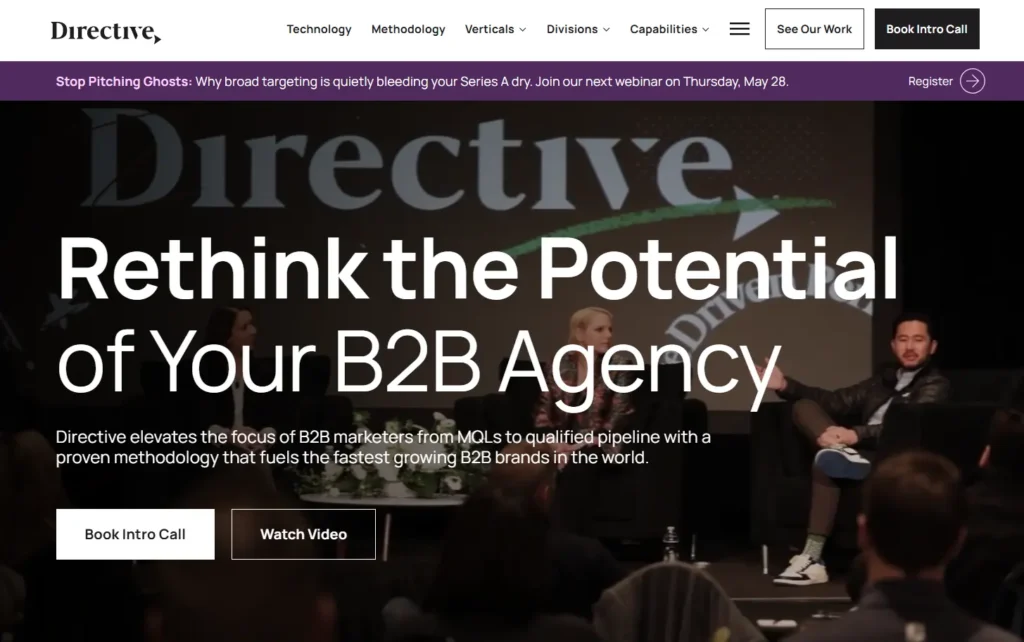
Directive’s Customer Generation methodology built around one question: Does this campaign generate pipeline, or just activity? Their paid media work is tied directly to CRM data, which means they report on SQL volume and pipeline influence, not leads generated. With 100+ marketing specialists and clients including Snap, Calendly, and Amazon, their track record at enterprise scale is well-documented.
- Where They Fall Short: Their minimum engagement size makes them cost-prohibitive for pre-Series B companies, and their breadth of services can dilute PPC-specific focus for smaller accounts.
- Best-Fit Scenario: If you’re a Series B+ SaaS company with a 60-90 day sales cycle and a dedicated sales team that needs qualified SQLs, not MQL volume, Directive is worth a conversation.
- Best For: Mid-market to enterprise B2B SaaS with complex, multi-stakeholder buying journeys
3. Powered by Search
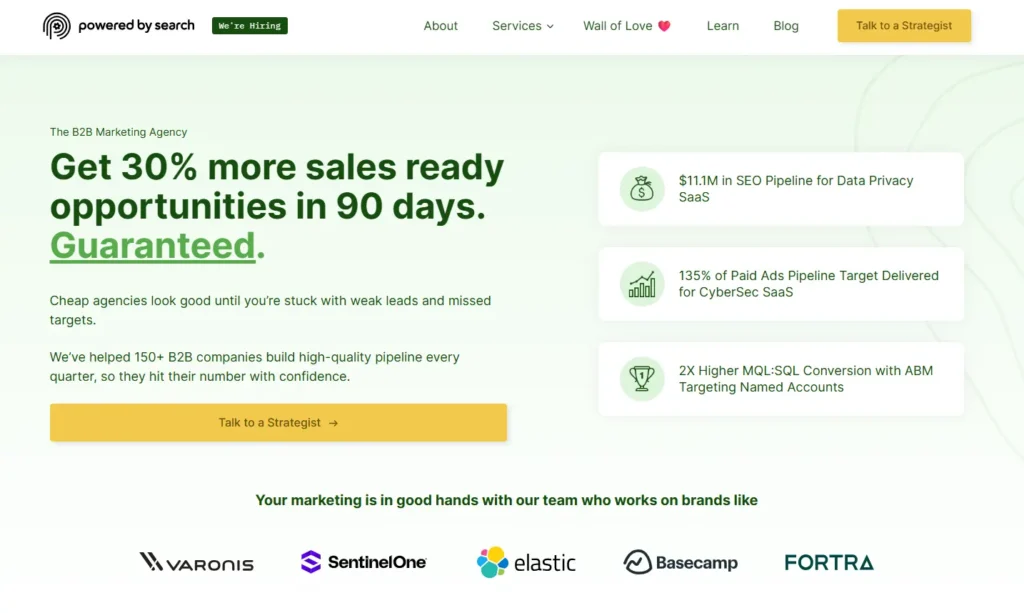
Powered by Search operates on a simple architecture: start at the bottom of the funnel, then scale upward once BOFU campaigns are profitable. They work exclusively with B2B SaaS companies and report directly on pipeline metrics, not impressions or clicks.
Their client work includes companies such as SentinelOne and Remote, and they align campaigns with sales-team feedback loops.
- Where They Fall Short: Their exclusive B2B focus means they are not the right fit for PLG or self-serve SaaS models where trial volume matters more than demo bookings.
- Best-Fit Scenario: If you’re a B2B SaaS company with a sales team that complains about demo quality, and you want an agency that starts with intent, not traffic volume, Powered by Search is purpose-built for that.
- Best For: B2B SaaS companies ($10M–$100M ARR) that need a BOFU-first paid acquisition strategy
4. Hey Digital
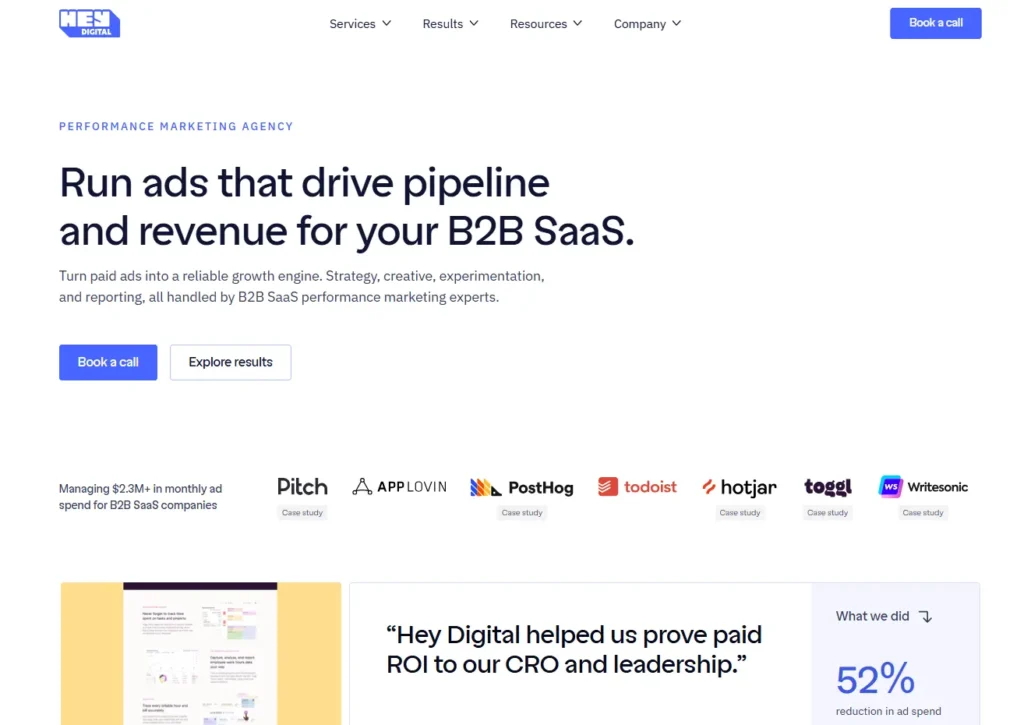
Hey Digital works exclusively with B2B SaaS companies; clients include Toggl, Hotjar, and Feedly, and it has deep experience with 200+ SaaS brands. Their campaigns are structured around both demand capture (high-intent search) and demand generation (social and retargeting), which makes them effective across different buyer stages. Every campaign element ties back to CAC, payback, and deal value.
- Where They Fall Short: They require a minimum monthly ad spend threshold that may not suit early pre-revenue startups, and their pricing reflects their SaaS-first positioning.
- Best-Fit Scenario: If you’re a Series A SaaS company with product-market fit and a trial or demo funnel that needs to scale predictably, Hey Digital is a specialist worth prioritizing.
- Best For: Funded Series A-B SaaS companies with trial or demo conversion funnels
5. Upraw Media
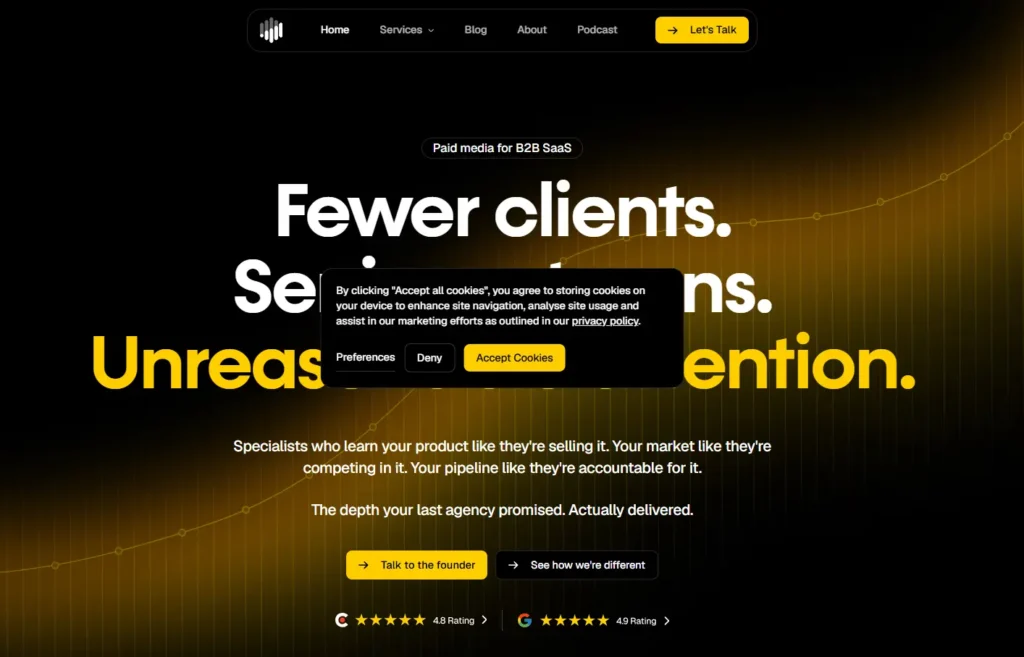
Founded by Todd Chambers, Upraw Media operates on a model that differs from most agencies. Senior practitioners manage every campaign directly, which limits their client intake but yields higher-quality execution. They work exclusively with Series A-C B2B SaaS companies and have experience with 80+ SaaS brands, including Chili Piper and Bynder.
- Where They Fall Short: Their low-delegation model means limited availability. If you need to onboard quickly at scale, capacity constraints may slow your timeline.
- Best-Fit Scenario: If you’ve had a frustrating experience with junior-managed agency accounts and need senior practitioners who own execution rather than just review it, Upraw is the structural answer to that problem.
- Best For: B2B SaaS companies with €10K+ monthly ad spend that want senior-only account management
6. Aimers
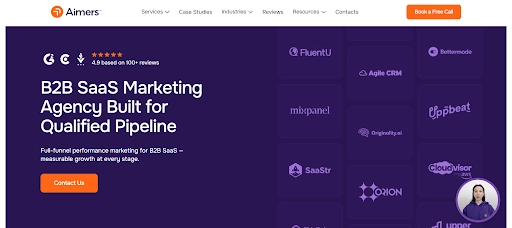
Aimers caps each team member at three client accounts, a structural decision that directly affects campaign quality. They manage over $30M in annual ad spend exclusively for B2B SaaS and tech companies, with documented results including a 164% increase in qualified leads for Mixpanel and a 225.5% increase in conversion for Orion Labs. Their reporting framework centers on revenue outcomes, not platform-level metrics.
- Where They Fall Short: Their minimum ad spend threshold ($3,000 per platform) may limit very early-stage startups that are still testing channel-market fit.
- Best-Fit Scenario: If you’re a growth-stage SaaS company that needs experienced specialists on multi-platform paid acquisition, and you want guaranteed senior attention, not a rotating junior roster, Aimers is worth evaluating.
- Best For: Growth-stage B2B SaaS and tech companies scaling paid acquisition across multiple platforms
7. 42 Agency

42 Agency operates as a boutique demand generation firm that combines PPC with ABM strategy and CRM integration. Clients often work directly with senior strategists throughout the engagement, an operational model that creates the “in-house team” feel their client reviews consistently describe.
They are particularly effective when a SaaS company needs campaigns to support a named-account sales motion.
- Where They Fall Short: Their ABM integration means they are not a pure PPC shop; if you need rapid campaign deployment without ABM complexity, their process may feel over-engineered.
- Best-Fit Scenario: If your sales team is running a named-account motion and your paid campaigns need to support it with precision targeting and attribution, 42 Agency builds that infrastructure.
- Best For: Series B-C SaaS companies that need account-based marketing integrated with PPC.
8. TripleDart
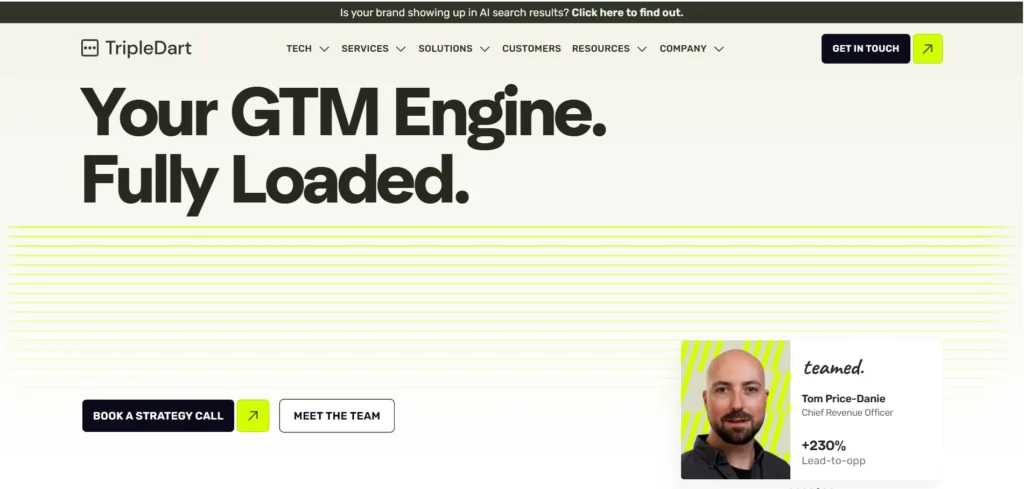
TripleDart was founded by former SaaS operators, which shapes their approach to campaign strategy. They work with 50+ B2B SaaS companies and apply a structured evaluation framework that separates agencies with genuine SaaS depth from generalist shops, which is also how they evaluate their own work. Their multi-channel approach suits teams that want paid, SEO, and content coordinated under one roof.
- Where They Fall Short: Their breadth of services is a strength for some and a complexity for others. Teams that want a pure PPC specialist may find the full-service model adds scope they don’t need yet.
- Best-Fit Scenario: If you’re a SaaS company that wants paid acquisition coordinated with your content and SEO strategy, and you want it run by people who’ve worked inside SaaS companies, TripleDart fits that operating model.
- Best For: Data-driven SaaS marketing teams that want a former-SaaS-operator perspective on paid acquisition.
9. KlientBoost
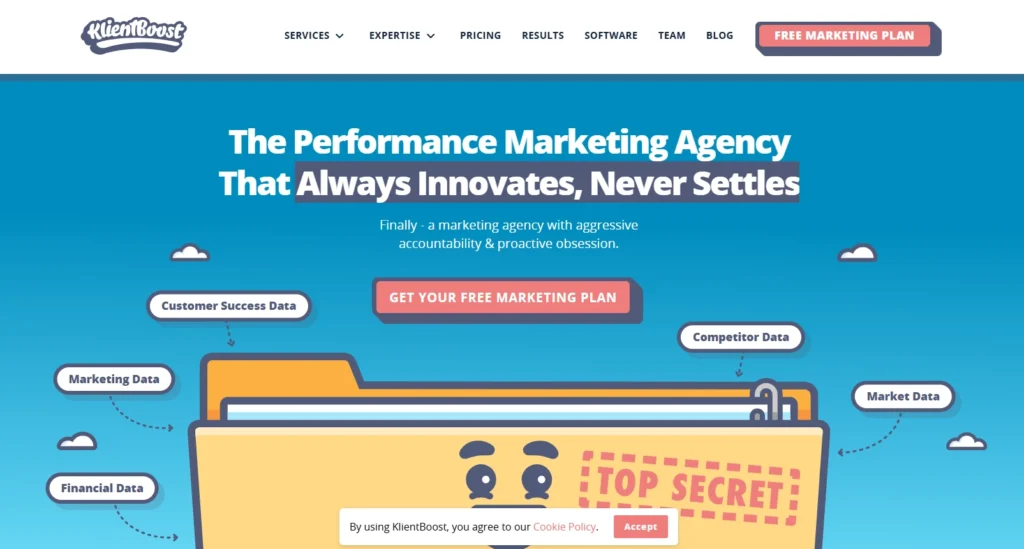
KlientBoost has built a reputation for treating landing page conversion rate as a core PPC variable, not a separate workstream. For SaaS companies where a 1-2% improvement in trial-to-demo conversion changes the economics of an entire campaign, that integration matters. Their SaaS portfolio is strong, though they also serve non-SaaS verticals.
- Where They Fall Short: Their multi-vertical client base means SaaS campaigns compete internally for specialist attention, and their reporting tends toward platform-level metrics rather than full-funnel pipeline data.
- Best-Fit Scenario: If your ad creative is strong but your landing pages are leaking conversions, and you want an agency that treats CRO as part of the PPC engagement, KlientBoost fills that gap.
- Best For: Series A-B SaaS companies that need a landing page CRO tightly coupled with paid acquisition.
10. Bay Leaf Digital
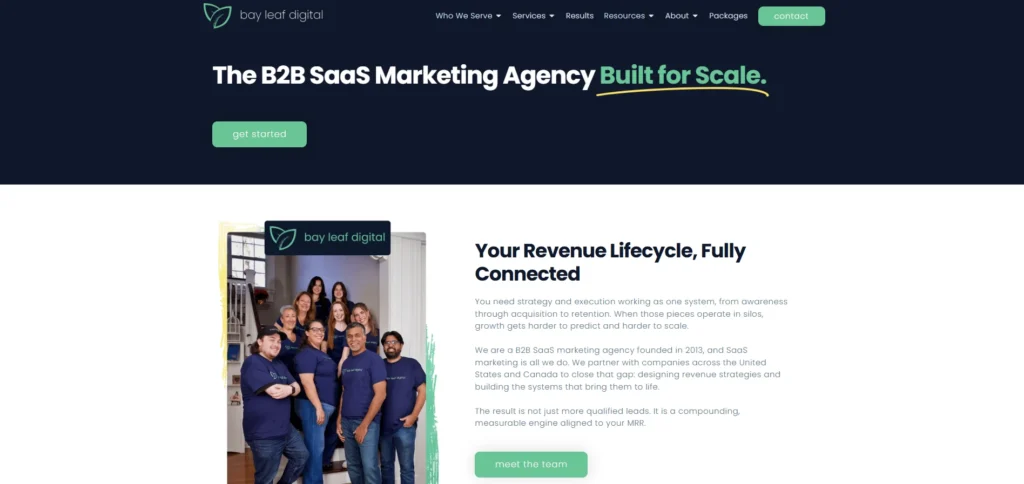
Bay Leaf Digital is a metric-minded agency known for deep analytics integration and flexible retainer structures. They work with mid-market SaaS companies that need custom reporting beyond what standard agency dashboards deliver, and their account teams adapt as client acquisition strategies evolve. They are particularly strong on attribution for long sales cycles.
- Where They Fall Short: Their engagement minimums are higher than most on this list, and their positioning as a “metrics-first” agency can sometimes slow execution speed in the early campaign phases.
- Best-Fit Scenario: If you’re a mid-market SaaS company with multi-channel attribution complexity and you need an agency that can build a reporting infrastructure alongside your campaigns, Bay Leaf fits that profile.
- Best For: Mid-market SaaS companies with complex analytics needs and evolving acquisition strategies
How to Choose the Right SaaS PPC Agency for Your Stage and Budget
1. By Company Stage
- Seed / Pre-Series A: Keep minimum retainer requirements front of mind. You need an agency comfortable with lean budgets and fast iteration cycles. Avoid enterprise-focused shops that will under-resource your account. Prioritize founder accessibility and transparent reporting over credentials. Read our guide to SaaS startup marketing to understand what paid acquisition should look like at this stage.
- Series A–B: This is where the pipeline vs. traffic distinction becomes expensive. Your agency needs to report on SQLs, demo conversion rates, and CAC payback, not MQL volume. Budget range: $5K–$15K/month retainer plus $15K–$50K ad spend. Your B2B SaaS performance marketing strategy should be tied to specific ARR targets, not campaign activity metrics.
- Series B–C: You need ABM capability, multi-platform coordination, and attribution infrastructure that connects ad spend to CRM pipeline. Budget range: $15K–$30K/month retainer plus $50K–$100K+ ad spend. At this stage, the relationship between demand generation and paid acquisition is inseparable.
- Enterprise: Dedicated account teams, Salesforce or HubSpot CRM integration, LinkedIn ABM, and board-level reporting are expected. Shortlist only agencies that have documented enterprise SaaS case studies with verifiable pipeline outcomes.
2. By PPC Goal
- Trial signups (PLG model): Google Ads + Meta; agencies with PLG-specific landing page experience
- Demo bookings (B2B sales-led): LinkedIn Ads + retargeting; agencies that report at the SQL level
- Pipeline velocity / ABM: Multi-touch attribution and named-account campaign infrastructure
5 Questions to Ask Any SaaS PPC Agency Before You Sign
- What percentage of your current active clients are SaaS companies?
- How do you define and report on pipeline metrics, specifically SQLs and CAC, not just leads?
- Who manages my account day-to-day, and what’s their current client load?
- Walk me through your first 30/60/90 days: what do you deliver, and when?
- Can you share a case study that demonstrates SQL volume growth, CAC improvement, or a reduction in payback period?
If an agency answers question five with ROAS data or click-through rates, you have your answer.

What Does a SaaS PPC Agency Actually Cost in 2026?
Understanding the full cost picture before engaging an agency prevents budget misalignment later.
Retainer benchmarks by company stage:
- Startup / Seed: $3,500–$6,000/month retainer
- Growth / Series A–B: $6,000–$15,000/month
- Scale / Series B-C: $15,000–$30,000+/month
- Enterprise: $30,000+/month, plus dedicated ABM infrastructure
Ad spend ranges: $10K–$100K+/month on top of retainer, depending on market competition and growth targets.
Total monthly investment range: $8,000–$130,000+, depending on stage and scope.
Pricing models to know:
- Flat retainer: Predictable cost; often includes campaign management, reporting, and strategy. Best for teams that want cost certainty.
- Percentage of ad spend: Agency income scales with your spend, creating a potential misalignment in which the agency benefits from budget increases regardless of efficiency.
- Performance-based: Rare in PPC; requires very clear SQL/revenue attribution to work cleanly.
Understanding your SaaS marketing budget allocation before conversations with agencies will make those conversations far more productive. The accepted benchmark for B2B SaaS is an LTV: CAC ratio of at least 3:1, with CAC payback under 12 months, and the right agency should be able to show you a path to those economics, not just traffic numbers.
The right SaaS PPC agency isn’t the cheapest one; it’s the one whose SQL economics make your CAC payback period shorter than 12 months.
What the Best SaaS PPC Agencies Are Doing Differently in 2026
The agencies consistently producing pipeline results in 2026 share several operating principles that distinguish them from standard PPC shops:
- AI-driven bidding and creative iteration
Leading agencies use AI to accelerate the testing cycle, ad copy variants, audience segments, and bidding strategies that previously took months to evaluate manually, now iterate in weeks.
- BOFU-first campaign architecture
The strongest agencies build from the bottom of the funnel up. High-intent, bottom-funnel campaigns run first, get profitable, and then generate the data needed to justify TOFU investment. Agencies that start with brand awareness campaigns at this stage are starting in the wrong place.
- First-party data and CRM-connected campaigns
With third-party cookies increasingly unreliable, top agencies have built HubSpot and Salesforce-connected campaign loops that close the attribution gap between ad spend and closed revenue. Without this, you are making optimization decisions based on incomplete data.
- LLM and AI search visibility
SaaS buyers increasingly research agency partners using AI tools such as ChatGPT, Perplexity, and Gemini. The agencies appearing in those results are the ones with structured, citable content and documented frameworks. This is an emerging but real channel for agency discovery that most buyers haven’t consciously recognized yet.
For a broader view of how B2B SaaS product marketing is evolving alongside paid acquisition, both are moving faster in 2026 than in any prior year.

Conclusion
Finding the right SaaS PPC agency comes down to one discipline: evaluating specialization rather than just reputation. The 10 agencies on this list were chosen for demonstrating genuine depth in SaaS. The comparison table and stage-fit framework give you a fast lens to narrow the shortlist before your first call.
If you are a SaaS company looking for an agency that treats paid acquisition as one component of a full-funnel growth system, rather than an isolated campaign deliverable, that operates that way by design. Their embedded team model, SaaS-specific frameworks, and pipeline-tied reporting are tailored to the companies this post was written for.
Schedule a free consultation on SaaS PPC strategy with growth.cx.
Explore their full-service B2B SaaS marketing service to see where paid acquisition fits into your broader growth plan.