According to G2’s 2026 AI Search Insight Report, 51% of B2B software buyers now begin their research with AI chatbots more often than Google, showing that brands need visibility inside AI-generated answers, not just traditional search results
This is where AI search becomes a missed revenue opportunity rather than a growth channel. For B2B SaaS marketing teams, the real challenge is no longer visibility, but conversion design within AI-driven discovery journeys. Without structured entity alignment, intent mapping, and conversion-embedded content, AI mentions remain surface-level signals with no commercial impact.
This is why the AEO strategy is rapidly evolving into a revenue-focused growth discipline connecting AI visibility directly to lead generation and pipeline outcomes. This blog breaks down a practical framework to help growth teams turn AI search presence into consistent, measurable B2B SaaS demand.
Proven AEO Marketing Strategies for B2B SaaS Growth
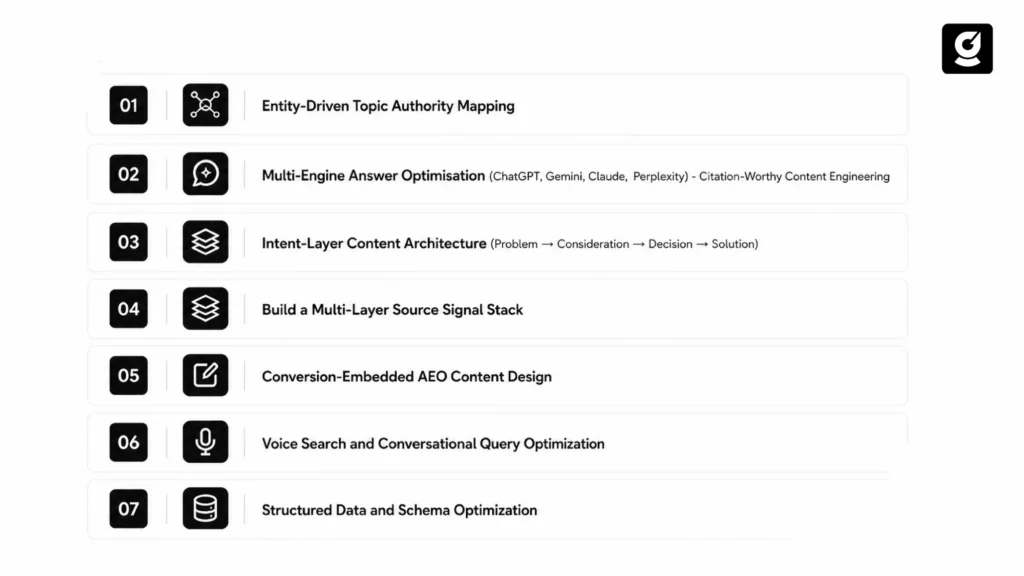
#Strategy 1: Entity-Driven Topic Authority Mapping
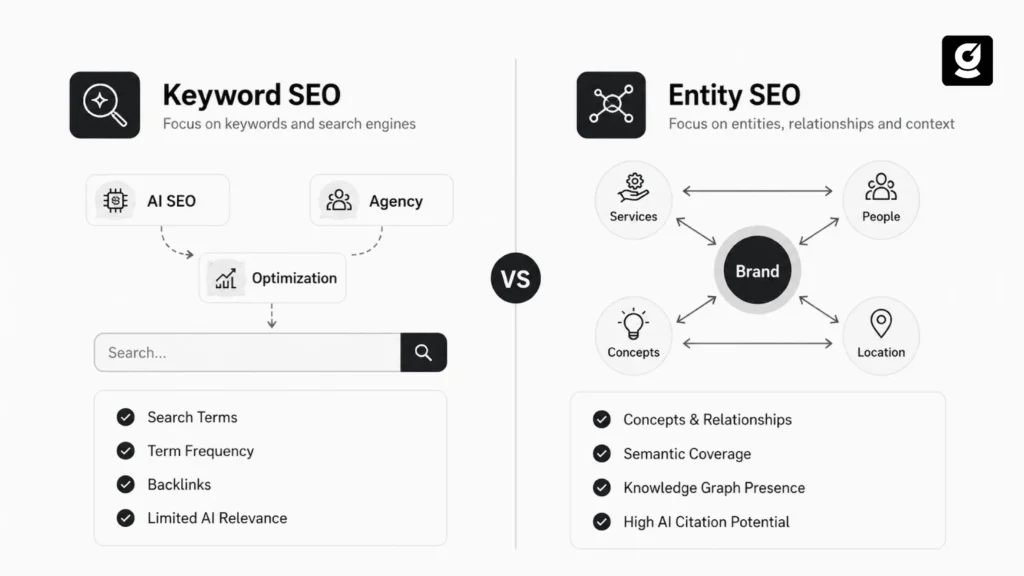
Entity-Driven Topic Authority Mapping is the practice of structuring your entire content ecosystem. It is clearly defined and consistently reinforced by entities such as product categories, core buyer problems, and desired business outcomes. Instead of being stuck on keyword variations, it ensures AI systems can confidently associate your brand with a specific solution space.
This is essential because AI-driven search models prioritise entity relationships over keyword signals. Meaning inconsistent or fragmented entity usage weakens your chances of being surfaced or cited in high-intent AI-generated answers.
How to implement it
- Define your core entity set: category, problem, solution, and outcome entities
- Map each content asset to a single dominant entity focus
- Standardise naming conventions across blogs, product pages, and case studies
- Build internal links that reinforce entity relationships across pages
- Audit existing content for entity drift and realign where needed
Best practices
- Maintain strict consistency in terminology across all content touchpoints
- Avoid mixing multiple entity themes within a single page
- Prioritize clarity over variation in naming conventions
- Reinforce key entities in headings, metadata, and schema
Business impact
- Improves the likelihood of being cited in AI-generated answers for high-intent queries
- Strengthens category ownership in competitive AI search environments
- Increases visibility in comparison and recommendation prompts across tools like ChatGPT and Perplexity
- Directly improves qualified lead generation by aligning visibility with intent-rich queries
#Strategy 2:Multi-Engine Answer Optimisation (ChatGPT, Gemini, Claude, Perplexity)Citation-Worthy Content Engineering

Multi-Engine Answer Optimisation is the practice of structuring and optimizing content so it performs consistently across different AI systems. For example, ChatGPT, Gemini, Claude, and Perplexity. Each of these engines retrieves, interprets, and synthesises information differently, meaning content optimised for only one model often underperforms elsewhere.
This strategy matters because B2B buyers now discover solutions across multiple AI surfaces. Fragmented optimization limits your overall AI visibility and reduces your chances of being included in synthesised answers.
How to implement it
- Design content in modular blocks that can stand alone as complete answers
- Use comparison tables, lists, and structured explanations for easy AI extraction
- Cover the same topic across multiple formats (definition, comparison, decision guide)
- Ensure clarity in headings so each section directly matches conversational queries
- Simulate prompts across ChatGPT, Gemini, Claude, and Perplexity to identify gaps
Best practices
- Prioritize structured, scannable formatting over long narrative flow
- Write sections so they remain meaningful even when extracted in isolation
- Avoid platform-specific optimization; focus on universal AI readability
- Continuously refine content based on how different AI models surface it
Business impact
- Expands brand visibility across multiple AI search ecosystems simultaneously
- Increases citation probability in diverse answer engines
- Reduces dependency on a single discovery channel
- Improves consistency of qualified inbound demand from AI-led research journeys
#Strategy 3: Intent-Layer Content Architecture (Problem → Consideration → Decision → Solution)
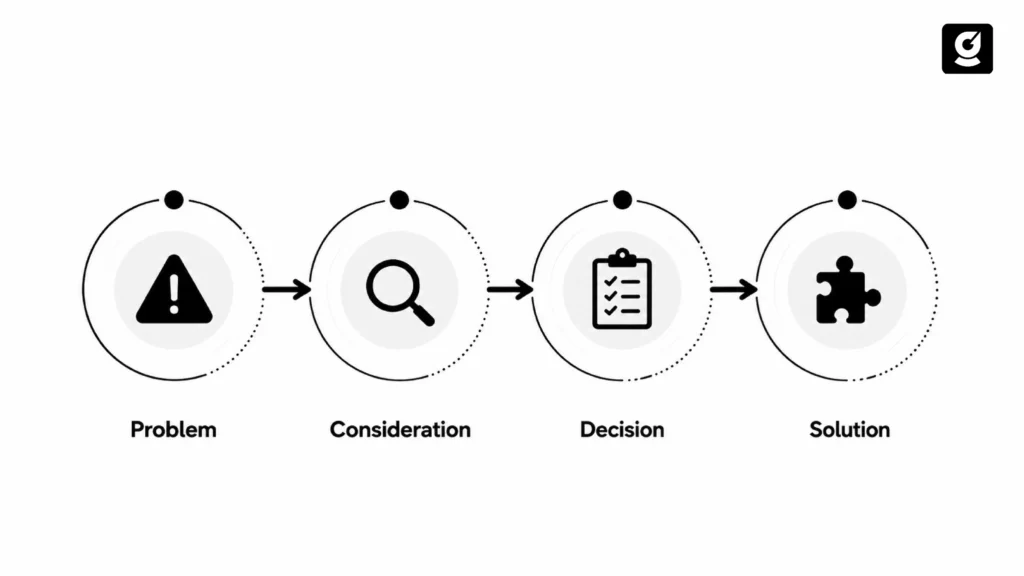
Intent-Layer Content marketing strategies architecture is the structured approach of aligning content with progressive buyer intent stages: Problem, Consideration, Decision, and Solution.
AI systems can map queries to the most relevant stage of the buying journey. Instead of treating content as isolated assets, it ensures every piece fits into a larger intent progression.
This matters because AI search tools prioritize context-aware answers, and content that clearly matches intent depth is more likely to be selected, synthesized, and surfaced in high-intent responses.
How to implement it
- Break down your core topic into four intent layers: problem identification, solution exploration, comparison, and final decision support
- Create separate content assets for each intent stage rather than combining them
- Align headings and sections with natural language queries users ask at each stage
- Interlink content to guide progression from awareness to decision
- Ensure each layer addresses a distinct level of buyer readiness
Best practices
- Avoid mixing multiple intent stages in a single article
- Prioritize clarity of intent over keyword coverage
- Use comparison formats heavily in the decision stage
- Ensure problem-stage content focuses on diagnosis, not solutions
Business impact
- Improves alignment with AI-driven conversational query flows
- Increases chances of being surfaced at multiple stages of the buyer journey
- Enhances lead quality by matching content precisely to intent depth
- Strengthens conversion rates by guiding users through structured decision pathways
#Strategy 4: Build a Multi-Layer Source Signal Stack
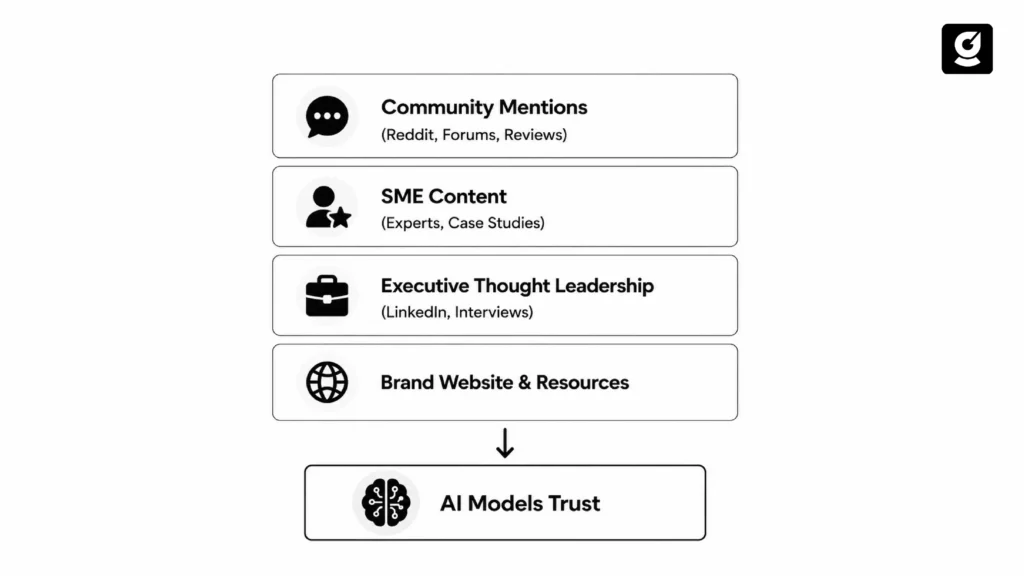
A Multi-Layer Source Signal Stack is the practice of reinforcing your brand’s authority across multiple independent and interconnected information layers. That includes third-party mentions, structured data, and community signals.
AI systems trust and repeatedly cite your brand in generated answers. This matters because AI models do not rely on a single source. They validate information across multiple signals before inclusion, meaning a weak or isolated presence significantly reduces visibility in AI-generated responses.
How to implement it
- Strengthen owned assets: blogs, landing pages, product documentation, and case studies
- Build third-party validation: guest posts, industry listings, review platforms, and partner pages
- Reinforce structured signals: schema markup, entity consistency, and metadata alignment
- Expand community signals: discussions, forums, social mentions, and developer ecosystems
- Ensure all layers consistently reinforce the same entity positioning and messaging
Best practices
- Maintain messaging consistency across all external and internal channels
- Prioritize authoritative and contextually relevant third-party sources
- Avoid isolated or one-off mentions without supporting content depth
- Continuously audit how your brand appears across different source layers
Business impact
- Increases trust signals used by AI systems for answer generation
- Improves the likelihood of being selected over competitors in multi-source synthesis
- Strengthens category authority across fragmented AI search environments
- Drives higher-quality inbound leads through repeated cross-source validation
#Strategy 5: Conversion-Embedded AEO Content Design
Conversion-Embedded AEO Content Design is the practice of integrating conversion pathways directly within AI-optimised content. That visibility in answer engines translates into measurable pipeline impact.
Instead of separating educational content from demand generation, this approach embeds context-aware conversion signals within informational and decision-driven sections.
It matters because an effective AI SEO strategy helps brands engage mid-intent users who are already evaluating solutions. Without embedded conversion logic, even strong AI visibility can fail to convert high-intent prospects at the point of maximum interest.
How to implement it
- Insert contextual CTAs within relevant answer blocks instead of only at the end
- Align conversion prompts with the intent stage (problem, comparison, decision)
- Use solution-aware positioning like “teams solving X typically evaluate Y”
- Embed product references naturally within explanations, not as standalone pitches
- Add supporting assets like calculators, demos, or comparison tools within the content flow
Best practices
- Ensure CTAs match user intent depth and do not feel generic or disruptive
- Place conversion elements immediately after high-value insight sections
- Maintain balance between informational clarity and subtle persuasion
- Avoid repetitive or overused “book a demo” messaging across all sections
Business impact
- Converts AI-driven visibility into qualified leads more effectively
- Increases click-through rates from AI-sourced discovery journeys
- Shortens buyer decision cycles by introducing solution context early
- Improves pipeline contribution from non-traditional organic channels
#Strategy 6: Voice Search and Conversational Query Optimization
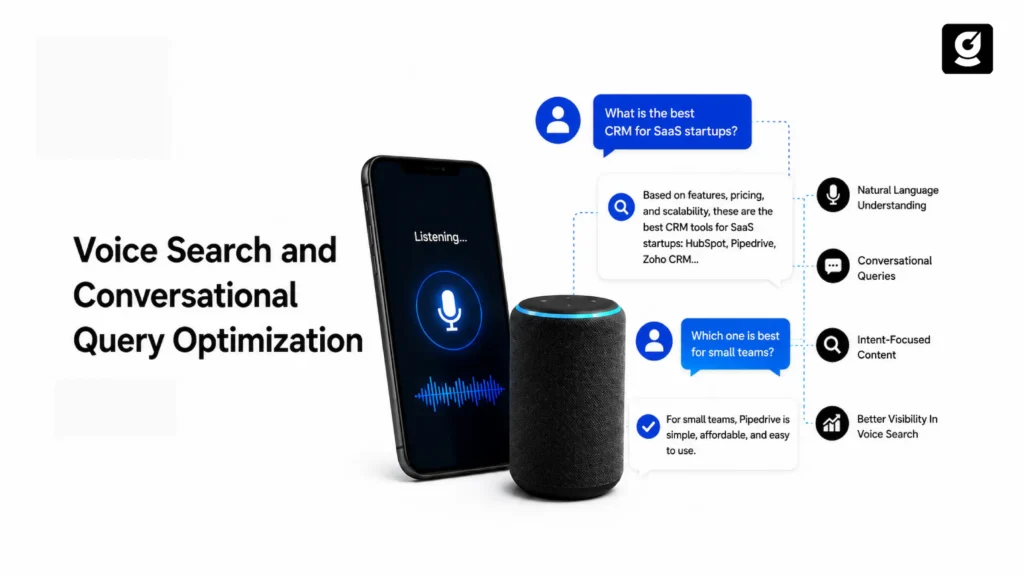
Voice Search and Conversational Query Optimization is the process of structuring content to match how users naturally speak and interact with AI assistants and answer engines. This includes longer, context-rich, question-based queries rather than short keyword phrases.
It matters because AI-driven platforms like ChatGPT, Gemini, and voice assistants interpret intent through conversational language, and content that mirrors these patterns has a significantly higher chance of being selected, synthesized, and surfaced in responses.
How to implement it
- Identify natural language queries across each stage of the buyer journey
- Convert keyword-focused headings into question-based formats
- Add FAQ-style sections that reflect real conversational prompts
- Use long-tail, problem-driven phrasing instead of short keywords
- Structure answers in a direct, immediate-response format before explanation
Best practices
- Write headings as real user questions, not optimized keyword fragments
- Prioritize clarity and directness in the first 1–2 lines of every answer
- Focus on intent-rich phrases like “how,” “why,” “what is the best way”
- Ensure consistency between conversational queries and internal linking structure
Business impact
- Improves visibility in AI assistants and voice-driven search interfaces
- Increases chances of being selected for natural language query responses
- Expands reach across long-tail, high-intent conversational searches
- Drives higher-quality leads from users closer to decision-making stages
#Strategy 7: Structured Data and Schema Optimization
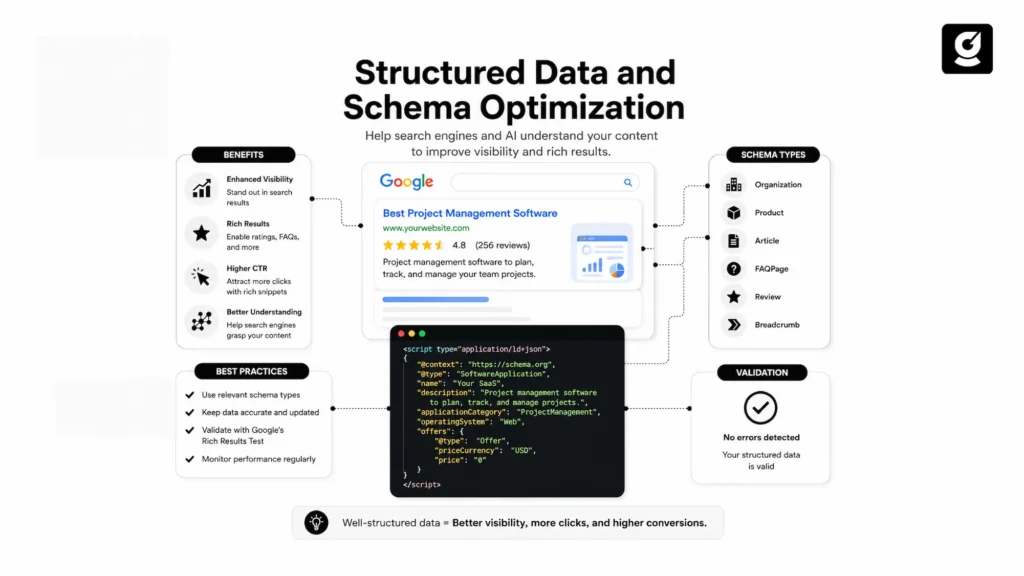
Structured Data and Schema Optimization is the practice of adding machine-readable context to your content so AI systems and search engines can accurately interpret entities, relationships, and content purpose.
It goes beyond traditional SEO markup by ensuring AI models can confidently extract, classify, and reuse your content in generated answers.
This matters because AI-driven search relies heavily on structured interpretation signals to validate credibility and determine which sources to include in synthesized responses.
How to implement it
- Apply relevant schema types such as Article, FAQ, Product, SoftwareApplication, and Organization
- Map schema entities directly to your defined topic and product entities
- Ensure schema fields align with on-page headings and content structure
- Use internal linking to reinforce relationships between structured entities
- Validate markup regularly using schema testing tools and AI crawl simulations
Best practices
- Maintain strict consistency between schema data and visible on-page content
- Avoid overloading pages with unnecessary or irrelevant schema types
- Prioritize accuracy of entity definitions over volume of markup
- Keep the schema updated whenever product or positioning changes occur
Business impact
- Improves content interpretability for AI systems and answer engines
- Increases the likelihood of inclusion in AI-generated summaries and comparisons
- Strengthens entity credibility across search and AI ecosystems
- Enhances visibility for high-intent queries where structured data is a ranking and selection factor
Competitive Displacement Strategy for AEO Marketing
Competitive Displacement Strategy in AI Search is the practice of systematically improving entity authority, content depth, and topical coverage to replace competitors in AI-generated answers, ensuring your brand becomes the preferred cited source for high-intent queries across AI search engines.
- Why AI’s answer to ownership is a zero-sum advantage
AI-generated answers typically surface a limited set of sources, meaning when a competitor is cited, your brand is often excluded from that same response, making visibility inherently competitive rather than shared.
- Strengthening Entity Authority to Outrank Competitors
Brands can outperform competitors in AI answers by consistently reinforcing clear entity associations across content, schema, and external mentions so AI systems confidently link them to a specific category or solution space.
- Identifying Competitor Citation Gaps in AI Responses
By systematically testing prompts across AI engines, growth teams can uncover where competitors are consistently cited and identify gaps where their own brand is missing despite relevance.
- Expanding Topical Coverage Beyond Competitor Clusters
Winning in AI search requires covering adjacent and upstream buyer questions that competitors ignore, ensuring broader contextual ownership of the decision-making journey.
- Earning Higher Citation Density Through Content Depth
Deeper, more structured, and insight-rich content increases the likelihood of being selected as a primary reference source in AI answers compared to shallow or generic competitor content.
- Continuous AI Visibility Monitoring and Competitor Tracking
Ongoing tracking of AI-generated responses helps brands detect shifts in citation patterns, monitor competitor dominance, and refine content to maintain or improve visibility share.
- Conversion Impact of Displacing Competitors in AI Answers
When competitors are replaced in AI citations, it directly increases consideration share, improves trust during research stages, and leads to higher-quality inbound leads and pipeline influence.
Before and After: From SEO Pages to AI-Ready Answers
| Aspect | Traditional SEO Pages | AI-Ready AEO Content |
| Goal | Drive rankings and organic traffic | Earn citations in AI-generated answers |
| Optimization Approach | Keyword-focused optimization | Entity + intent-driven optimization |
| Content Structure | Long-form, linear narrative | Modular, answer-block based structure |
| User Intent Handling | Broad keyword matching | Precise intent alignment (problem → decision) |
| Entity Usage | Inconsistent or secondary focus | Strong, consistent entity reinforcement |
| Citations | Backlinks as an authority signal | AI citations and cross-source validation |
| Conversion Strategy | End-of-page CTAs | Embedded, context-aware conversion points |
| Success Metrics | Rankings and traffic | AI visibility and qualified lead influence |
AI search prioritizes entity-rich, intent-aligned, modular content over keyword-focused pages. Growth teams must shift from ranking-driven SEO to AI-ready structures designed for extraction, citation, and embedded conversion, ensuring visibility translates into a qualified pipeline rather than passive impressions.
What Are The Common Mistakes B2B SaaS Brands Make with AEO?
Common mistakes B2B SaaS agencies make with AEO include focusing on keyword-driven SEO tactics instead of entity consistency, modular answer structures, AI citation optimization, and conversion-focused content design.
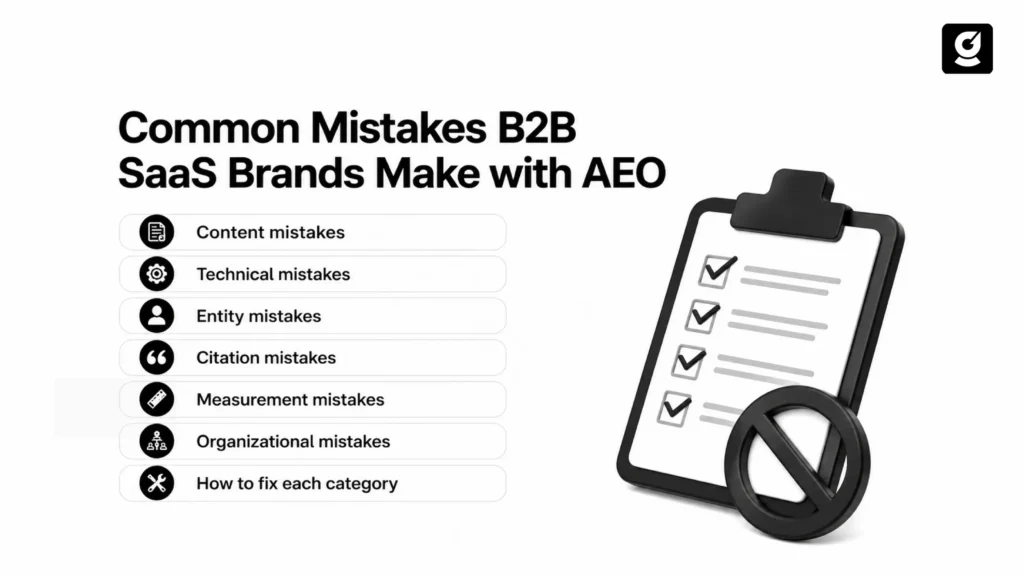
- Content mistakes
B2B SaaS brands often fail at AEO marketing by producing long, narrative-heavy content without modular answer blocks that AI systems can easily extract and reuse.
- Technical mistakes
Many teams weaken AI visibility by implementing inconsistent schema markup and maintaining poor internal linking structures that reduce content interpretability.
- Entity mistakes
Weak or inconsistent entity reinforcement, along with multiple naming conventions for the same product or concept, confuses AI systems and reduces citation likelihood.
- Citation mistakes
AEO performance suffers when content lacks original insights or data and relies too heavily on secondary or widely repeated information.
- Measurement mistakes
Most teams incorrectly track only traffic metrics while ignoring AI visibility signals and branded query lift that indicate real influence in answer engines.
- Organizational mistakes
AEO execution breaks down when SEO and content teams are not aligned with product positioning and there is no structured feedback loop from sales or demand generation.
- How to fix each category
These issues can be resolved by implementing structured AEO governance, aligning teams around entity strategy, and standardizing how content is created, optimized, and measured across all channels.
How growth.cx Builds an AEO Strategy for B2B SaaS Companies
growth.cx is a B2B SaaS growth and marketing agency that helps companies improve AI search visibility and AEO strategy performance by building entity-driven content systems. Optimizing for answer engines like ChatGPT and Gemini and turns AI-driven discovery into qualified leads and measurable pipeline growth.
- The team starts with an AI visibility audit to identify where the brand appears across ChatGPT, Gemini, Claude, and Perplexity, and uncover key citation and intent gaps.
- Conduct competitive citation analysis to understand which competitors dominate AI answers and what content patterns are driving their visibility.
- Building a product-to-market entity framework to define how the brand should be consistently represented across categories, problems, and solutions.
- Design intent-based information architecture by restructuring content into clusters aligned with problem, consideration, and decision-stage queries.
- Implementing an AI-first content system using modular, answer-block-based structures that can be independently extracted and cited by AI engines.
- Optimise technical foundations through schema implementation and internal linking refinement to strengthen entity clarity and semantic relationships.
- The team continuously tests AI visibility through query simulations and citation tracking across multiple AI engines to monitor performance shifts.
- growth.cx team drives ongoing optimisation by refining content based on AI behaviour insights and expanding entity clusters to improve long-term citation share and pipeline impact.
How growth.cx Delivers AEO Services as a SaaS Marketing Agency
growth.cx is a SaaS marketing agency that provides AEO services to improve visibility across AI search platforms like ChatGPT, Gemini, Perplexity, and Google AI Overviews. Their services include AI-optimized content creation, structured data implementation, conversational content optimization, and semantic SEO enhancements.
The team also develops citation-worthy content that increases the chances of being referenced by AI answer engines. Combined with continuous AI search performance tracking, their AEO strategy helps SaaS brands build authority, drive qualified traffic, and generate high-intent leads.
Case Study
- How growth.cx Leveraged AI SEO to Boost Visitly’s Organic Visibility
Challenges faced
- The majority of high-intent keywords are already dominated by well-known brands in the fiercely competitive visitor management software market.
- Visitly lacks the domain authority and backlink power necessary to swiftly compete with more established rivals as a developing platform.
- Content that targets industry-specific search queries, such as contractor management processes, school visitor check-in, and healthcare visitor management, is scarce.
- When compared to competitors that provide comparable guest check-in workflows, the product differentiator is not readily apparent.
Our strategy
- Pillar and supporting content strengthened thematic authority.
- content structure optimized for Google AI Overviews and AI search.
- improved alignment of page content with conversion objectives and user search intent.
End result
- Improved AI search visibility across leading answer engines.
- Improved visibility across ChatGPT, Gemini, and other AI search platforms.
- LLM Visibility: Keyword ranks significantly
- improved by +1.6 million (a huge increase in brand visibility throughout Google search results)

How to Measure AEO Performance for B2B SaaS
AEO performance for B2B SaaS is measured by tracking AI SEO services visibility, citation frequency across answer engines, branded and non-branded query growth, and the impact of AI-driven traffic on qualified leads and pipeline.
- Track AI visibility by monitoring how often your brand appears in AI-generated responses across tools like ChatGPT, Gemini, Claude, and Perplexity for target queries.
- Measure citation share by analysing how frequently your content is referenced compared to competitors in AI answers for high-intent topics.
- Monitor branded and non-branded query lift to identify whether AI exposure is increasing category awareness and direct brand searches.
- Evaluate pipeline impact by attributing leads and conversions influenced by AI-driven discovery, including assisted conversions from AI-originated sessions.
Conclusion
AEO is no longer just about visibility; it is becoming a direct revenue system that connects AI search presence to real pipeline impact. For growth teams, the real advantage lies in aligning entity strength, intent mapping, and conversion design to ensure every AI-generated mention contributes to qualified B2B SaaS demand, not just awareness.
As AI search continues to evolve, B2B SaaS brands that operationalise AEO as a structured growth function will consistently outperform those treating it as an extension of SEO. Start building an AEO strategy today to ensure your brand is discovered, cited, and chosen.
FAQ’s
What strategies improve visibility in AI-powered search experiences?
Visibility improves through strong entity alignment, structured content design, and multi-source validation signals. Consistent reinforcement of topics across owned and external channels increases the likelihood of being cited in AI-generated responses.
What types of content perform best in answer engines and AI search platforms?
Content that is modular, intent-driven, and structured as clear answer blocks performs best. Comparison pages, decision guides, and problem-solution formats are most likely to be extracted and reused by AI systems.
Which KPIs should growth teams track to evaluate AEO marketing strategy performance?
Key KPIs include AI visibility frequency, citation share across competitors, branded search lift, and pipeline influence from AI-referred traffic. These metrics help measure both visibility and revenue impact.
How can businesses convert AI search visibility into pipeline and revenue opportunities?
Businesses can convert visibility into revenue by embedding contextual CTAs, aligning content with buyer intent stages, and ensuring AI-cited content leads directly into solution-oriented decision paths.