
AEO Marketing is quietly reshaping how visibility works across digital channels, where answers often appear without a single click back to a website. As AI-driven search experiences and answer engines take over discovery journeys, traditional performance signals like traffic and CTR are becoming less reliable indicators of impact.
The challenge is no longer about driving visits, but proving influence in environments where users get what they need instantly. For marketers, this creates a measurement gap that feels uncomfortable: activity is visible, but attribution is not.
The real question is no longer “how many clicks did we get?” but “where did we shape the decision?” Understanding that shift is where AEO ROI starts to make sense.
What is AEO marketing
AEO Marketing is the practice of optimising content so it is cited and featured in AI-generated answers and conversational search results, rather than only ranking in traditional search engines.
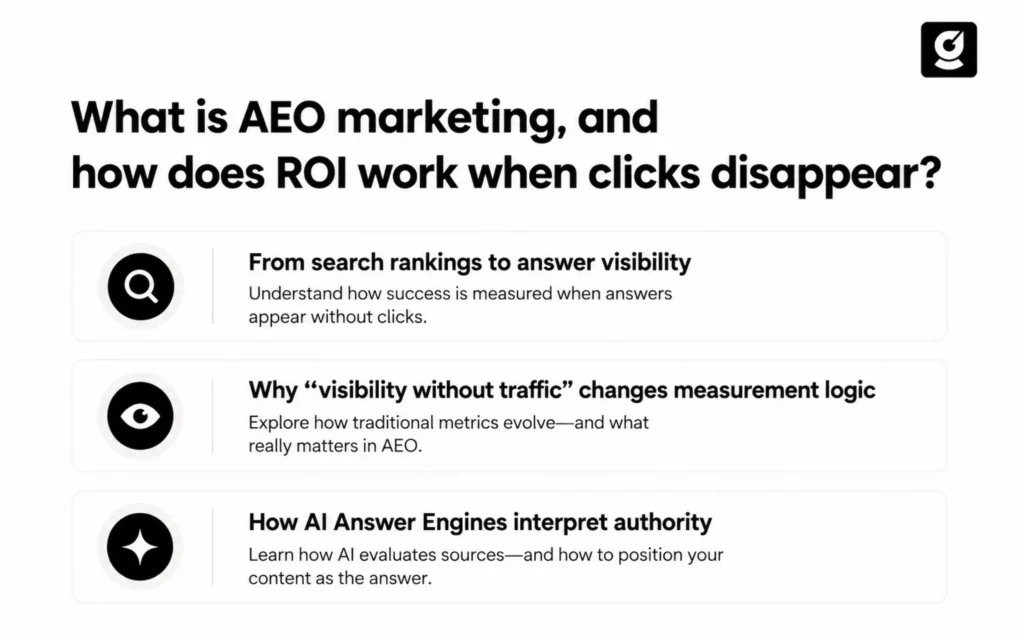
How does ROI work when clicks disappear?
ROI shifts from tracking clicks to measuring how often your brand appears in AI answers and how that visibility drives leads, pipeline, and revenue.
- From search rankings to answer visibility
Search is shifting from SERPs to AI-generated answers, where users get complete responses without visiting websites. In AEO Metrics, success depends on being included or cited in these answers. Visibility is now measured by presence in AI outputs rather than ranking positions, changing how discovery and influence are understood.
- Why “visibility without traffic” changes measurement logic
As AI reduces reliance on clicks, metrics like sessions and CTR no longer reflect real impact. In AEO Marketing, value comes from citations, mentions, and inclusion in AI responses that shape decisions indirectly. This shifts measurement from traffic-based outcomes to influence-based visibility across answer engines.
- How AI answer engines interpret authority
AI answer engines assess authority using entity recognition, semantic relevance, topical depth, and structured content clarity. In AEO Marketing, authority is determined by how consistently a brand is understood and trusted across sources. This replaces ranking signals with interpretability, credibility, and contextual alignment within AI-generated responses.
Why do traditional SEO metrics fail in the age of AI search?
Traditional SEO metrics fail in the age of AI search because they focus on rankings and clicks, while modern visibility depends on citations, entity mentions, and inclusion in AI-generated answers.
- The decline of click-based attribution models
CTR, organic traffic, and session-based reporting no longer capture true visibility because AI-driven search often surfaces answers without sending users to websites. In AEO Marketing, impressions may still occur, but they don’t translate into measurable clicks, breaking the direct link between visibility and attribution models.
- Zero-click journeys as the new normal
Users now complete a large portion of their search journey inside AI-generated responses, where answers are delivered instantly without requiring a website visit. This shift reduces dependency on traditional click paths and makes influence happen earlier in the decision process, outside standard tracking systems.
- Missing visibility in traditional analytics tools
Tools like GA4, Search Console, and rank trackers are built to measure clicks, rankings, and on-site behaviour, not AI citations or answer inclusion. As a result, AEO Marketing’s visibility in AI-generated outputs remains largely invisible, creating gaps in reporting and underestimating real brand exposure across AI systems.
How do AEO metrics differ from traditional SEO KPIs?
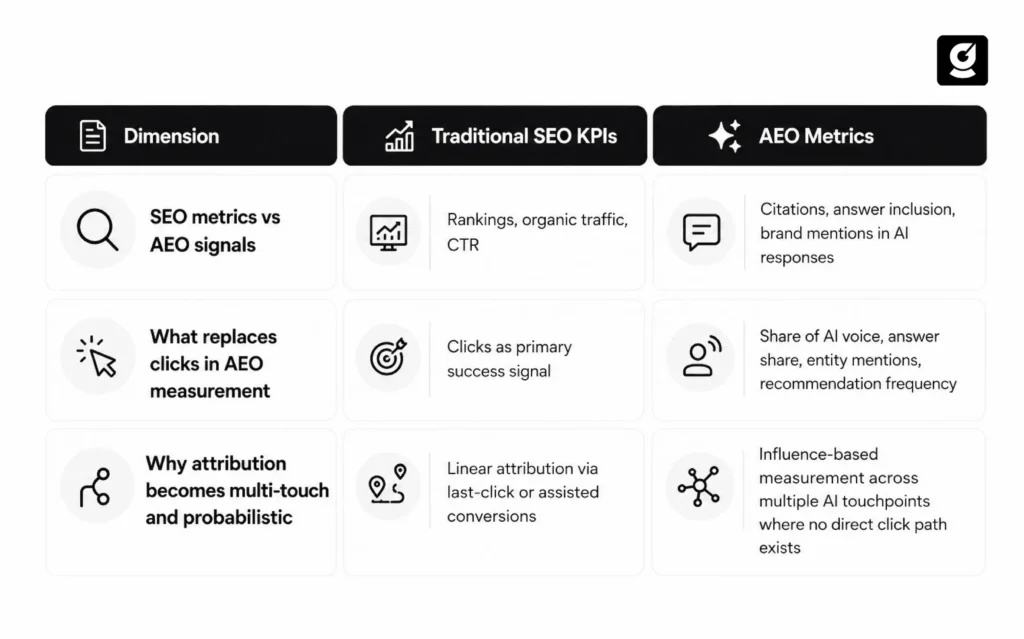
AEO metrics differ from traditional SEO KPIs because they measure visibility in AI-generated answers through citations, entity mentions, and share of voice, rather than rankings, traffic, and click-through rates.
Instead of counting clicks, AEO measurement things like how often your brand is mentioned, cited, or recommended by AI systems. It also changes how success is tracked from direct conversions to broader influence across multiple touchpoints where users interact with AI before making a decision.
What are the core AEO metrics to track for ROI measurement?
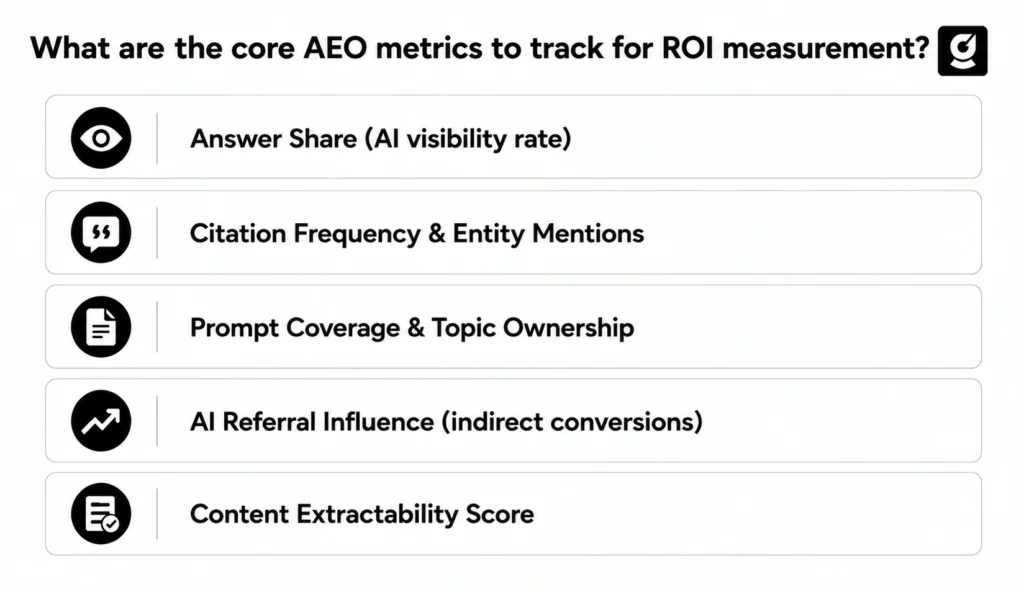
- Answer share (AI visibility rate)
- What is it?
It measures how often your brand appears in AI-generated answers for relevant queries. It reflects your presence in AI search outputs. - Why should marketers care?
It shows whether your brand is actually being surfaced when users ask high-intent questions. Without it, you are invisible in AI discovery. - How does it support ROI measurement?
Higher answer share indicates stronger visibility across AI engines, which correlates with influence and assisted conversions over time.
- Citation frequency & entity mentions
- What is it?
It tracks how often your brand or entity is mentioned or cited across AI-generated responses. It focuses on reference-level visibility. - Why should marketers care?
Mentions signal trust and recognition within AI systems, even when users don’t click through to your site. It reflects authority in your category. - How does it support ROI measurement?
More citations increase the likelihood of being included in decision-making journeys, helping link brand exposure to downstream pipeline impact.
- AI referral influence (Indirect conversions)
- What is it?
It measures how AI-generated answers influence user decisions that later convert through other channels. It captures indirect impact. - Why should marketers care?
Most AI-driven journeys are non-linear, so users may convert later via direct or branded search. Without this, influence is undercounted. - How does it support ROI measurement?
It helps connect AI visibility to real business outcomes by attributing assisted conversions and multi-touch influence across channels.
- Content extractability score
- What is it?
It measures how easily AI systems can understand, extract, and reuse your content in generated answers. It depends on structure and clarity. - Why should marketers care?
If the content is hard to interpret, AI engines will ignore it even if it is high quality. Extractability directly impacts visibility. - How does it support ROI measurement?
Higher extractability improves inclusion rates in AI responses, increasing answer share and making ROI more predictable over time.
What are the three layers of AEO value in ROI measurement?
The three layers of AEO value in ROI measurement are visibility in AI-generated answers, influence on buyer decision-making through citations and mentions, and conversion impact driven by AI-assisted discovery journeys.
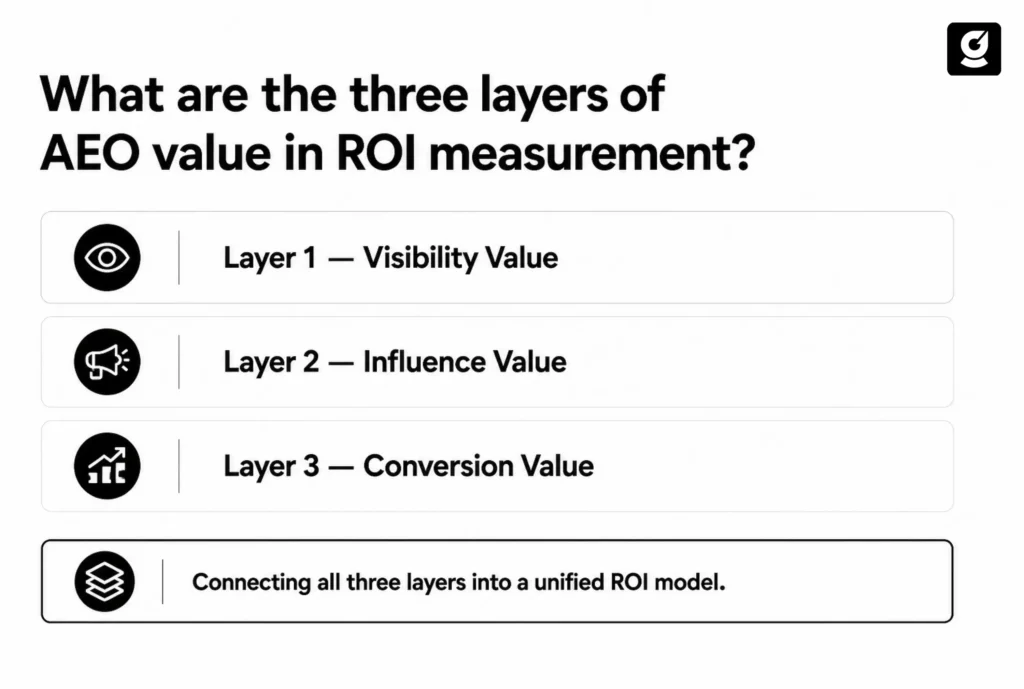
- Layer 1 — Visibility value
Measures how often your brand appears in AI-generated answers.
- Layer 2 — Influence value
Shows how AI exposure improves awareness and purchase consideration.
- Layer 3 — Conversion value
Tracks leads, inquiries, and sales driven by AI visibility.
Connecting all three layers into a unified ROI model
All three layers combine to show a complete AEO-driven business impact.
What are the most common AEO measurement mistakes marketers make?
The most common AEO measurement mistakes marketers make are relying only on SEO metrics, ignoring AI visibility and citations, and failing to track how often their brand appears in AI-generated answers.
- Over-reliance on traditional SEO dashboards
Many marketers rely heavily on traditional SEO dashboards that fail to capture AI visibility, citations, or answer inclusion in generative results. This creates a distorted view of performance where real influence in AI-driven discovery is invisible. The key lesson is that AEO success must be measured beyond rankings and traffic alone.
- Tracking traffic instead of presence
Many marketers focus only on clicks and website visits, assuming they represent success in all search environments. In reality, AI search often delivers value without any clicks, through direct exposure in answers. This leads to underreporting of impact. The takeaway is to measure presence in answers, not just website visits.
- Not mapping prompts to buyer intent stages
Many marketers fail to connect AI prompts with awareness, consideration, and decision-stage intent, which breaks the attribution model. Without this mapping, it becomes impossible to understand where influence occurs in the journey. This creates blind spots in performance analysis. The key takeaway is to align prompts with buyer stages for clarity.
- Treating AEO as a content-only strategy
Many marketers treat AEO as purely a content production exercise, ignoring technical structure, entity optimization, and authority signals. This limits the frequency with which B2B SaaS content appears in AI-generated replies. Without these support layers, content visibility is inconsistent. The conclusion is to develop AEO as a whole solution, rather than merely SaaS content.
How should you approach AEO reporting and attribution?
AEO reporting and attribution should be approached by combining AI visibility tracking, citation analysis, and traditional SEO metrics to understand both search performance and influence in AI-generated answers.
- Building an AI visibility dashboard
Track where your brand appears in AI answers, including citations, mentions, and answer inclusion. This helps measure real visibility beyond traditional rankings. - Multi-touch attribution for AI-driven discovery
AI journeys are not linear, so combine CRM and analytics data to understand how AI exposure influences conversions across multiple touchpoints. - Connecting AEO metrics to pipeline impact
Link AI visibility signals like mentions and citations to leads, opportunities, and revenue using CRM data. This shows how AI exposure drives real business results. - Reporting frameworks for stakeholders
Executives should see revenue and pipeline impact, while teams focus on detailed metrics like citations and visibility. This keeps strategy and execution aligned.
How growth.cx turns AEO visibility into measurable ROI
growth.cx is an AI SEO company that helps B2B SaaS companies increase their search visibility, draw in the right customers, and cut down on time spent on manual SEO. AI SEO services for B2B SaaS help companies improve visibility in AI-driven search results by optimising content, entities, and authority signals to increase citations, leads, and revenue.
- Building AEO-birst content systems
growth.cx structure content to align with how AI systems extract and interpret information, ensuring stronger entity recognition and higher inclusion in answer outputs. This improves citation potential across AI platforms by focusing on clarity, structure, and topical depth. The outcome is consistent visibility in AI-generated responses tied to real user intent signals.
- Setting up measurement frameworks beyond SEO tools
growth.cx builds reporting systems that go beyond traditional SEO tools by tracking AI visibility, citations, and answer inclusion across platforms. These custom frameworks combine analytics and structured dashboards to reflect real influence in AI search environments.
This allows businesses to move from ranking-based reporting to visibility-based and impact-driven measurement models. Partnering with a SaaS and B2B marketing agency turns AI visibility into measurable ROI by connecting AEO performance directly to pipeline, leads, and revenue growth.
- Turning AEO signals into revenue intelligence
The team connects AI visibility signals such as citations, mentions, and answer presence directly to CRM and pipeline data.
This helps translate exposure into measurable outcomes like leads, opportunities, and revenue contribution. The approach ensures AEO is not treated as awareness alone but as a trackable driver of commercial growth across channels.
- Why teams struggle without structured AEO execution
Most teams struggle with AEO due to a lack of expertise in entity SEO, prompt mapping, structured content design, and AI-specific optimisation.
Without a defined system, visibility remains inconsistent and unmeasured. This leads to fragmented reporting and weak attribution, making it difficult to connect AI discovery with real business outcomes or scalable growth.
What AEO services does growth provide?
- AEO strategy development
- AI search optimisation
- Entity SEO
- Content optimisation for AI engines
- Prompt & query mapping
- Structured data implementation
- AI visibility monitoring
- AEO reporting & attribution
- Performance analytics & ROI measurement
How will AEO measurement evolve over the next few years?
- From keyword tracking to entity tracking
Measurement will shift from keyword rankings to tracking how strongly brands are recognised as entities across AI systems.
- Rise of semantic and entity-based analytics
Analytics will focus more on meaning, context, and entity relationships rather than isolated keyword performance.
- AI engine analytics is becoming standard
AI platforms will begin offering native dashboards showing citations, answer inclusion, and visibility insights.
- Predictive visibility scoring models
Marketers will use predictive models to estimate the likelihood of a brand appearing in AI-generated answers.
- Shift from attribution to influence modelling
Success measurement will evolve from direct attribution to understanding brand influence across interconnected AI ecosystems.
Case studies
1. How growth.cx used AI SEO to transform Avizva’s search visibility and rankings.
growth.cx used AI SEO to improve Avizva’s search visibility and rankings by optimising content, entities, and AI-driven search signals, increasing discoverability across search engines.
Challenges faced
- Fiercely competitive industry (insurance tech + healthcare IT)
- High-intent content is required because to a long sales cycle.
- AI summaries do not rate or select generic content.
- Absence of both semantic coverage and content depth
Our strategy
- Utilising intent-focused content and structured data to optimise AEO and GEO
- Robots.txt was updated, broken links were rectified, and GSC and W3C issues were fixed.
End result
- LLM visibility shows 12 mentions, 102 citations, and 50 cited pages across AI-generated and referenced content.
- Organic Visibility: Keyword ranks significantly improved, with average positions rising from 28.1 to 19.Six.
2. How growth.cx improved AIO tests’ search visibility, rankings, and user engagement
growth.cx improved AIO Tests’ search visibility, rankings, and user engagement by optimising its SEO strategy, content structure, and AI-driven search signals to increase discoverability and user interaction.
Challenges faced
- Established websites rank for the majority of keywords in the fiercely competitive AI and SEO market.
- The domain lacked the authority signals needed to rank rapidly because it was a new platform.
- There wasn’t much content that addressed pertinent search terms.
Our strategy
- Found high-potential keywords associated with generative AI SEO, AI search optimisation, and AI SEO.
- AI-assisted workflows were used to create organised and optimised material more quickly.
- To improve topical authority, topic clusters based on AI SEO principles were created.
- In order to ensure that content is in line with user intent and location-based inquiries, we worked on AEO and GEO optimisation in accordance with the most recent LLM modifications.
End result
- LLM visibility shows significant improvement in keyword rankings, with 5 keywords in the top 10 positions, 42% share of voice, 219 cited pages, and 435 citations.
- 11,301 users (+84.95%) came from organic traffic. Expanded keyword coverage and optimised content, which attract more targeted consumers from Google searches, are driving the rapid rise.

Final thoughts
Measuring marketing performance in AI-driven search demands a change away from traditional SEO focus and toward understanding how exposure translates to influence. Clicks and traffic no longer accurately reflect how users discover and assess companies, since much of that process now takes place within AI-generated responses.
The most reliable way to interpret success is through the three layers of value visibility, influence, and conversion, which together explain how presence in AI answers shapes awareness and drives revenue outcomes.
As AI search continues to evolve, measurement frameworks will need to become more adaptive, focusing on real-world impact rather than surface-level engagement.
Ready to connect AI visibility with real business growth? Contact us to build a measurable AEO strategy that drives revenue.
FAQ
How do you find high-intent keywords for a SaaS business?
High-intent keywords are found by analysing search terms that indicate buying behaviour, such as comparisons, pricing, and solution-focused queries. You can also identify them through competitor research, customer interviews, and SERP analysis.
What is the difference between informational and transactional SaaS keywords?
Informational keywords are used when users are learning about a problem or topic, while transactional keywords show intent to take action, like buying or signing up. Transactional keywords usually drive higher conversion rates because they reflect stronger purchase intent.
Which tools are best for SaaS keyword research?
Popular tools include Google Keyword Planner, Ahrefs, SEMrush, and Ubersuggest for discovering and analysing keywords. These tools help evaluate search volume, difficulty, and competitor targeting.
How do you prioritise SaaS keywords that drive leads and revenue?
Prioritise keywords based on intent, relevance to your product, and conversion potential rather than just search volume. Focus on keywords that align closely with bottom-of-funnel queries and demonstrate clear buying intent.