
Your CAC is creeping up.
Paid channels look “profitable.”
But revenue growth feels… fragile.
Sound familiar?
Most teams obsess over surface-level digital marketing metrics, clicks, CTR, and impressions instead of the B2B SaaS performance marketing metrics that actually drive sustainable growth.
And in B2B SaaS, that mistake is expensive.
Long sales cycles. Multiple stakeholders. Procurement delays.
If you don’t align marketing performance indicators with revenue, you scale inefficiency.
Here’s how top SaaS growth leaders are finally conquering attribution chaos, wasted ad spend, and unpredictable pipeline by tracking the metrics that matter.
Let’s break them down.
Why Tracking the Wrong Marketing Performance Indicators Kills Growth
In the rush to scale, B2B SaaS marketing agencies often get caught up in vanity metrics that don’t tie directly to business outcomes.
Here’s where the problem lies:
- CTR without SQL tracking: Focusing on Click-Through Rate (CTR) is fine if you want to measure engagement. But without tracking the Sales Qualified Leads (SQLs) generated from those clicks, you’re blind to whether that traffic is truly moving through the funnel.
- Leads without qualification: Generating leads is just the beginning. Without lead qualification, a high volume of leads might look good on paper, but it doesn’t help your sales team close deals.
- MQL obsession: Many SaaS teams chase Marketing Qualified Leads (MQLs) as their primary metric, but without considering how many of those MQLs actually convert to paying customers, you’re missing the bigger picture.
- Channel silos: Treating each marketing channel as a separate entity leads to misaligned metrics across paid ads, SEO, social, and content teams.
- Misaligned sales & marketing KPIs: If your sales and marketing teams aren’t aligned on key performance indicators (KPIs), you’ll run into problems tracking meaningful results.
Why SaaS Performance Marketing Is Different from eCommerce
In eCommerce, the path from click to conversion is often straightforward. You see an ad, click, buy, and have a clear, short sales cycle.
For SaaS, it’s much more complex. With longer sales cycles, multiple touchpoints, and more factors influencing purchase decisions, it’s hard to attribute revenue to a single action.
Example Scenario:
Imagine a B2B SaaS company spends $50,000/month on paid campaigns, primarily through Google Ads and LinkedIn. However, they don’t track their Customer Acquisition Cost (CAC) clearly. The marketing team sees solid CTR and lots of leads coming in, but without aligning these leads to real sales outcomes or calculating LTV: CAC, they can’t determine if they’re actually acquiring customers profitably. Over time, this misalignment can lead to wasted ad spend and unsustainable growth.
The problem isn’t the budget, it’s the marketing performance indicators they choose to track. As any experienced SaaS marketing agency would point out, until they focus on revenue driving metrics like CAC, LTV, and conversion rates at each funnel stage, they’ll continue investing heavily without seeing returns.
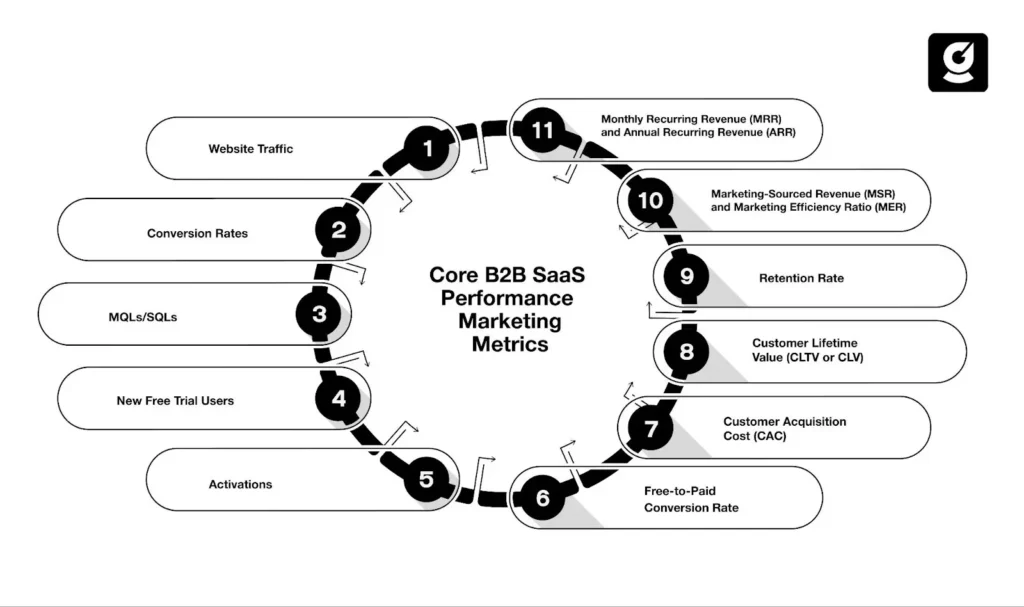
What Are the Core Metrics Every B2B SaaS Growth Team Must Prioritize?
Let’s break down the most critical metrics that your team must track to build a sustainable and scalable growth engine.
1. Website Traffic
Wait, isn’t website traffic a vanity metric?
As a standalone metric, yes. Website traffic can be misleading if you’re only looking at volume. However, when you pair it with other digital marketing metrics, such as conversion rates and lead quality, it becomes an essential indicator of SaaS marketing campaigns.
- Why it matters: Tracking traffic trends from your top-performing pages and their conversion potential will allow you to spot the most lucrative traffic sources. It’s not about how much traffic you’re getting, but how valuable that traffic is.
- What to do: Use tools like Google Analytics to track traffic sources, engagement, and conversion behavior, making sure you’re attracting high-intent visitors who convert.
- Look for: Traffic spikes or drops linked to paid campaigns. Low-converting traffic could indicate the need for better targeting or content optimization.
2. Conversion Rates
Isn’t conversion rate just about the end result?
In SaaS, conversion rates measure the effectiveness of each step in your sales funnel, not just the final transaction. Whether it’s the conversion from visitor to lead, lead to MQL (Marketing Qualified Lead), or SQL (Sales Qualified Lead) to customer, conversion rates give you valuable insights into where the friction points are in your funnel.
- Why it matters: High conversion rates at each funnel stage indicate that your campaign performance tracking is aligned with your customer acquisition strategy and you’re targeting the right audience with the right message.
- What to do: Monitor conversion rates across different marketing channels, including SaaS PPC strategies, email, and content, and look for opportunities to optimize the conversion path.

- Look for: Low conversion rates may indicate the need for better lead qualification or more compelling offers.
3. MQLs/SQLs
MQLs (Marketing Qualified Leads) and SQLs (Sales Qualified Leads) are the backbone of the lead qualification process in SaaS marketing.
- Why it matters: Focusing on MQLs and SQLs helps prioritize the leads that have a high potential for conversion. Tracking these metrics ensures you’re spending your marketing budget on leads that are most likely to convert into customers.
If scaling lead generation is on your agenda.
It shows whether your leads are increasing month over month. Calculate it by subtracting last month’s leads from this month’s leads, dividing by last month’s total, and multiplying by 100. If the number is rising, your pipeline is growing. If not, it is time to reassess your strategy.

- What to do: Continuously measure the MQL to SQL conversion rate to identify any gaps in lead qualification or nurturing processes.
- Look for: High MQL volume but low SQL conversion rates. This signals that leads are being generated but not qualifying at the sales stage.
4. New Free Trial Users
For SaaS businesses offering free trials, tracking new trial sign-ups is essential to gauge the interest level and effectiveness of your marketing.
- Why it matters: Free trials are often the first step in converting prospects to paying customers. Monitoring new sign-ups gives you insight into how well your paid advertising metrics, SaaS landing page performance, and content campaigns are attracting the right leads.
- What to do: Track the number of new free trial users generated by each campaign and analyze which channels are most effective.
- Look for: A spike in new sign-ups without a corresponding increase in paid conversions could indicate poor trial-to-customer conversion.
5. Activations
An activation is the point where a user takes a meaningful action, such as setting up their account, completing onboarding, or using a core product feature.
- Why it matters: High activation rates show that users are finding value in your product quickly, which correlates with higher retention and conversion rates. It also indicates that your onboarding process is effective.
- What to do: Measure the percentage of free trial users who complete key actions in the product.
- Look for: Low activation rates could indicate friction in your onboarding process or a lack of product-market fit.
6. Free-to-Paid Conversion Rate
The free-to-paid conversion rate measures how many users upgrade from a free trial or freemium model to a paid subscription.
- Why it matters: This metric is critical for SaaS businesses relying on free trials or freemium models to acquire customers. A low conversion rate indicates that your free offering may not be compelling enough to drive paid conversions.
- What to do: Track and optimize your conversion funnel from free trial users to paying customers, identifying key triggers that lead to upgrades.
- Look for: A stagnating or low conversion rate suggests a need to improve value propositions or enhance the trial-to-paid journey.
7. Customer Acquisition Cost (CAC)
CAC is the total cost required to acquire a customer, including marketing and sales expenses.
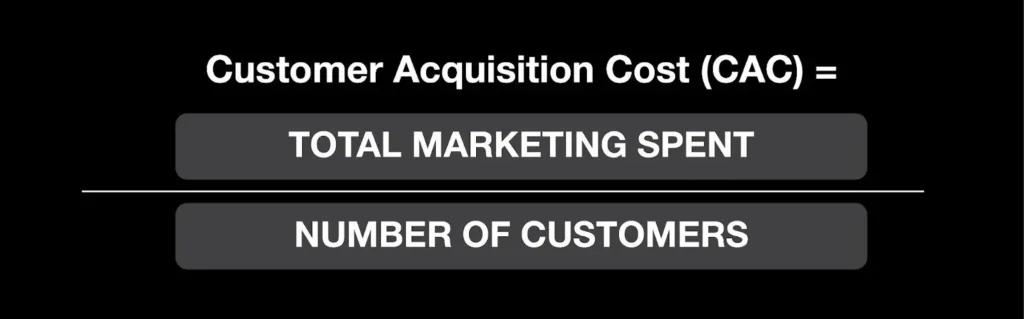
- Why it matters: High CAC relative to LTV (Lifetime Value) can severely impact your bottom line. Understanding CAC helps you optimize your marketing budget allocation and ensures that your customer acquisition efforts are sustainable.
- What to do: Calculate CAC regularly and track it across channels to ensure you’re getting the most cost-effective customer acquisition.
- Look for: Rising CAC that isn’t offset by increasing LTV or MRR. This signals inefficiency in your marketing strategy.
8. Customer Lifetime Value (CLTV or CLV)
CLTV measures the total revenue a customer will generate during their time using your product.
- Why it matters: A high CLTV allows you to justify higher CAC. By maximizing CLTV, you can increase profitability and reduce pressure to constantly acquire new customers.
- What to do: Continuously improve customer retention strategies and maximize customer engagement to increase CLTV.
- Look for: Low CLTV could indicate high churn or inadequate customer support.
9. Retention Rate
Customer retention is a major performance marketing metric for SaaS businesses because it’s more cost-effective to retain customers than to acquire new ones.
- Why it matters: A high retention rate indicates that customers are finding ongoing value in your product, which directly impacts CLTV and overall profitability.
- What to do: Track retention alongside churn and develop strategies that keep customers engaged and satisfied.
- Look for: Declining retention rates may indicate issues with product satisfaction or customer support.
10. Marketing-Sourced Revenue (MSR) and Marketing Efficiency Ratio (MER)
MSR measures the revenue generated directly from marketing efforts. MER assesses the efficiency of your marketing spend.
- Why it matters: These metrics help you understand the ROI of your marketing activities and show how much of your revenue is attributable to marketing.
- What to do: Calculate MER regularly to measure the profitability of your campaigns and adjust spend based on performance.
- Look for: A low MER suggests that your marketing spend is not yielding proportional revenue.
11. Monthly Recurring Revenue (MRR) and Annual Recurring Revenue (ARR)
MRR and ARR are two of the most important metrics for measuring the growth and health of your SaaS business.
- Why it matters: These metrics track how much predictable revenue you’re generating monthly and annually. High MRR/ ARR gives a clear picture of growth and revenue stability.
- What to do: Monitor both MRR and ARR to understand the sustainability of your revenue stream and forecast future growth.
- Look for: A decline in MRR or ARR could indicate churn or a slowdown in customer acquisition.
How to Build a Data-Driven Marketing Strategy Around These Metrics
By aligning key metrics with your company’s revenue goals, you can improve decision-making, digital marketing performance, and drive predictable results a structured approach commonly used by performance marketing agencies.
Here’s how you can build a comprehensive strategy based on the performance marketing metrics we discussed:
1. Align Marketing & Sales Definitions
The first step in building a data-driven marketing strategy is to ensure that both marketing and sales teams are using the same definitions and metrics. Without alignment, you’ll see miscommunication and inefficient use of resources. For example, what marketing calls an MQL (Marketing Qualified Lead) may not align with the sales team’s criteria for an SQL (Sales Qualified Lead).
2. Build a Unified Dashboard
Most SaaS companies struggle with fragmented dashboards that only provide partial views of the customer journey. A unified dashboard brings all your online marketing KPIs into one place, helping you see how each metric impacts others and how they tie into your revenue.
3. Implement Proper Attribution
Without proper attribution, it’s nearly impossible to understand the real value of your marketing efforts. Multi-touch attribution models are essential for tracking how each marketing channel contributes to conversions.
4. Forecast Pipeline from Paid Channels
Predicting revenue is one of the most powerful benefits of a data-driven marketing strategy. By forecasting your pipeline based on performance from paid channels and AI in B2B SaaS PPC initiatives, you can adjust budgets and strategy in real time.
5. Use Cohort Analysis
Cohort analysis allows you to group customers by similar characteristics or actions they take within your SaaS platform. It helps you understand how different segments of users behave over time and how your marketing efforts are driving long-term customer value.
Common B2B SaaS Objections (And Why They’re Costing You)
Let’s break down the 7 most common objections and explain why focusing on the right metrics can actually help reduce risk.
1. “We Don’t Have Enough Data Yet.”
- Why It’s Costing You: Waiting for perfect data is a trap. Every business already has some level of data, whether it’s basic traffic analytics, lead generation numbers, or email campaign performance.
- Reframe: Start with the data you have. Focus on core metrics like CAC, Cost Per SQL, and conversion rates. Over time, this data will grow, and you’ll make more informed decisions.
2. “Our Sales Cycle Is Too Long.”
- Why It’s Costing You: Long sales cycles are typical in B2B SaaS, but ignoring this doesn’t help. The longer cycle means you need to track and optimize pipeline velocity and lead nurturing to keep things moving.
- Reframe: Use multi-touch attribution to understand all touchpoints in your sales cycle. Align marketing and sales to ensure leads are nurtured correctly throughout the longer process.
3. “Attribution Is Messy.”
- Why It’s Costing You: Attribution confusion leads to wasted ad spend and missed opportunities. If you don’t know which channels are truly driving conversions, you can’t optimize effectively.
- Reframe: Implement a multi-touch attribution model. Start with basic attribution and refine it as your data grows. Proper attribution gives you clarity on where to invest for the best ROI.
4. “We Just Need More Leads.”
- Why It’s Costing You: More leads without a focus on quality leads means more wasted time and money. Not all leads are created equal, and low-quality leads can actually harm your sales efforts.
- Reframe: Focus on qualified leads like MQLs and SQLs. Use targeted campaigns that bring in high-value prospects who are more likely to convert into paying customers.
5. “Our Metrics Are All Over the Place.”
- Why It’s Costing You: If you’re tracking too many metrics, it leads to confusion and inefficient decision-making. You’re spread thin and missing the big picture.
- Reframe: Focus on key metrics that directly connect to revenue, like CAC, LTV, and pipeline velocity. Create a unified dashboard for a clear, real-time view of what’s driving growth.
6. “We Can’t Measure the ROI of Our Marketing Efforts.”
- Why It’s Costing You: Without measuring ROI, you can’t prove the effectiveness of your campaigns. This leads to uncertain budget allocation and inefficiency in scaling.
- Reframe: Use campaign performance tracking to measure ROI for each campaign. Start with blended ROI and break it down by individual channels (paid, organic, etc.) to track return on ad spend (ROAS) more accurately.
7. “We Don’t Have Time for This Level of Analysis.”
- Why It’s Costing You: Skipping proper analysis means you’re making decisions based on assumptions rather than data. This can lead to ineffective marketing strategies and poor allocation of resources.
- Reframe: Streamline your analysis with automated tools and dashboards. Focus on high-impact metrics that provide quick insights, making it easier to make data-driven decisions without overwhelming your team.
Conclusion
At the end of the day, metrics are only as valuable as the decisions they drive.
Tracking every data point isn’t the answer. Instead, focus on the key metrics that directly connect to your revenue and growth. Metrics like CAC, LTV, Cost Per SQL, and pipeline velocity provide actionable insights that help you make informed decisions and optimize your marketing strategies.
Remember, true SaaS performance marketing is rooted in financial discipline. It’s not just about gathering data, but using it to make smarter, more efficient decisions that contribute to your bottom line.
Ready to turn your ad spend into a predictable pipeline?
At growth.cx, we are a SaaS performance marketing agency specializing in performance marketing for B2B SaaS and tech companies. We help you track the right metrics, make smarter decisions backed by data, and build consistent, long-term growth. Let’s talk and unlock your growth potential.

What is the difference between MQL and SQL in B2B SaaS ads?
An MQL, or Marketing Qualified Lead, is a prospect who has shown interest through actions like downloads or demo requests but is not yet sales-ready. An SQL, or Sales Qualified Lead, has been vetted by the sales team and meets buying intent criteria. In B2B SaaS ads, MQLs indicate engagement, while SQLs signal revenue potential.
Should B2B SaaS teams prioritize Google Ads or LinkedIn?
B2B SaaS teams should prioritize the platform that aligns with their buyer intent and deal size. Google Ads works best for high-intent searches where prospects are actively looking for solutions. LinkedIn is stronger for account-based targeting and reaching decision makers in specific industries. The right strategy often combines both.
What is the difference between ROAS and ROI in performance marketing?
ROAS, or Return on Ad Spend, measures revenue generated for every dollar spent on advertising. ROI, or Return on Investment, measures overall profitability after accounting for all costs, including marketing, operations, and sales. ROAS evaluates campaign efficiency, while ROI determines whether the entire initiative delivers net profit.