Your demo request conversion rate went from 2.1% to 3.4% last quarter. Marketing calls it a win.
Sales sees it differently. The pipeline still looks thin.
Both are right. That gap is the real problem with most conversion optimization work in B2B SaaS.
A conversion optimization strategy that only tracks form fills will always find something to report. A shorter form or a bolder button reliably lifts the top of the funnel. What it won’t tell you is whether those extra people were ever going to buy.
Gartner’s most recent B2B buyer survey found two things:
- 67% of buyers now prefer a sales-rep-free buying process
- 45% used AI tools during a recent purchase
Buyers are doing more of the qualifying work themselves. And they’re doing it earlier, mostly outside your analytics dashboard.
A conversion optimization strategy built for that reality has to look past the click. It needs to track what happens to a lead after the form submits. Otherwise, a “win” on the landing page never turns into revenue.
Sales hasn’t disappeared, though. A separate Gartner survey found that 69% of buyers still turn to a rep to validate what they researched on their own.
What’s changed is timing. That validation now happens later, after most of the buyer’s evaluation is already done.
If your strategy treats every form fill as an early-stage, unqualified lead, you’ll slow down your best prospects. A warm, informed buyer ends up in the same slow process as someone who just found your category yesterday.
This piece breaks down:
- The steps that make conversion optimization techniques compound instead of plateau
- Where most B2B SaaS funnels actually leak
- How to build a website conversion strategy that survives contact with your sales team’s pipeline reports?
Why Do Most Conversion Optimization Plans Plateau After the First Few Wins?
Two numbers explain most of the plateau.
1. The ceiling on website conversion is lower than most teams expect.
Why so low? Two reasons:
- Most SaaS traffic comes from search. People are reading to learn, not ready to buy.
- B2B purchases get made by committee, over months, not in a single visit.
You can squeeze another quarter-point out of that number with page tests. But the returns shrink fast.
2. A broken qualification layer undoes any test win.
- Organic search leads convert to MQL at 41%
- Paid search leads convert to MQL at 29%
Most CRO programs report one blended number that hides this gap.
It gets worse further down the funnel. Industry benchmarks put the average MQL-to-SQL conversion rate b2b saas at just 13%. That means 87 out of every 100 “qualified” leads never clear sales’ bar.
Put those two numbers together, and the problem is obvious. If your form-fill rate doubles but your MQL definition still doesn’t match what sales actually wants, you haven’t fixed the funnel. You’ve just doubled the number of leads sales ignores.
What Are the Steps of a Conversion Optimization Technique That Actually Compounds?
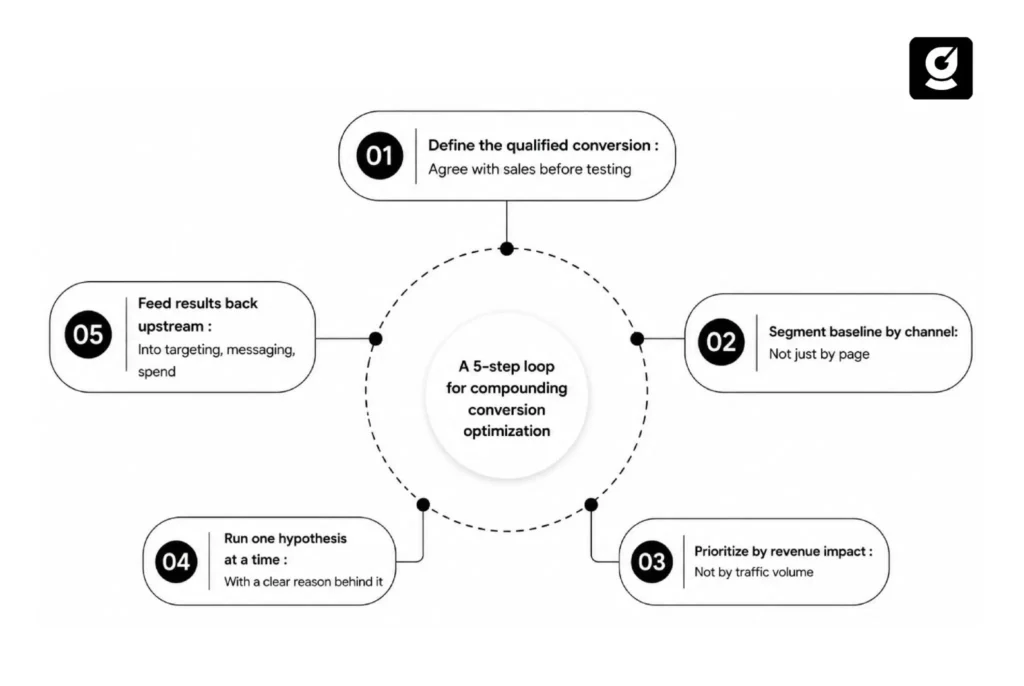
A conversion optimization strategy that survives past quarter one runs on a process, not a list of random page ideas. Five steps, run as a loop.
1. Define the qualified conversion before you build a test.
Sit down with sales. Agree, in writing, on what “qualified” means:
- Company size
- Budget signal
- Use case fit
- Timeline
Do this before you run a single A/B test. Optimizing for the wrong conversion event just gets you more of the wrong leads, faster.
2. Segment your baseline by channel, not just by page.
A blended conversion rate hides which channels bring buyers and which bring browsers. Pull conversion and MQL-to-SQL rates by traffic source before deciding what to test. The highest-traffic page is rarely the most important one.
3. Prioritize by revenue impact, not traffic volume.
A small drop-off on your pricing page usually matters more than a big drop-off on a blog post. The pricing-page visitor is closer to a decision. Rank your test list by where the leak sits in the funnel, not by which page gets the most eyeballs.
4. Run one hypothesis at a time, with a clear reason behind it.
“Test a new headline” isn’t a hypothesis. “Buyers bounce because the hero section describes the product instead of the outcome” is one. A clear hypothesis tells you what to measure and what a failed test actually means. Redesigns without a stated reason just produce noise.
5. Feed every result back upstream.
This is the step most conversion optimization plans skip. Say a test shows visitors from a specific LinkedIn campaign convert at twice the rate of a broad paid search term. That finding belongs in the media buying brief, not in a quarterly CRO report nobody outside marketing reads.
If you don’t have a dedicated CRO or RevOps team:
You don’t need a dashboard or a testing platform to start this loop. A founder can run steps one and two in a single afternoon:
- Write down what “qualified” means with whoever is closest to your first ten customers
- Check which of your two or three traffic sources produces leads that actually book calls
Discipline matters more than tooling. Teams that wait for a mature CRO stack or a retainer with one of the big conversion rate optimization agencies before defining a qualified conversion usually spend a year optimizing for the wrong number.
What this looks like in practice:
A Demand Gen Manager at a Series B project-management SaaS company agrees with sales: a qualified demo request needs a named use case and a team size above 20 seats.
Then finds something interesting:
- LinkedIn traffic converts at half the rate of organic search
- But LinkedIn produces SQLs at nearly double the rate
Why? LinkedIn visitors already match the ICP the ads were built around.
Instead of chasing a better conversion number on organic, shifts budget toward LinkedIn. Also rebuilds the organic landing pages to ask the same use-case question earlier on the page. The conversion rate on paper barely moves. The SQL count does.
Where Does the Handoff Between Marketing and Sales Usually Break the Funnel?
Picture a Growth Marketing Manager at a mid-market HR tech scaleup.
She runs a quarter of CRO tests:
- A shorter demo form
- A rewritten hero section
- Social proof next to the pricing CTA
Demo requests climb 60%. She reports the win in the board deck.
Sales tells a different story. The SQL count barely moved. Reps say they’re spending more time disqualifying leads than talking to real prospects.
Both reports are true. The form change worked exactly as designed. It just wasn’t designed around the definition sales actually uses to decide who’s worth a call.
This is the most common way a website conversion strategy quietly fails. The stage-by-stage benchmarks make the problem visible:
| Funnel stage | B2B SaaS average | Source |
| Visitor to lead | ~1.1% | First Page Sage, 2019–2025 client data |
| Lead to MQL (organic search) | 41% | First Page Sage, channel benchmark |
| Lead to MQL (paid search) | 29% | First Page Sage, channel benchmark |
| MQL to SQL | 13% average | Industry benchmark, First Page Sage dataset |
A shorter form raises the first row. It does nothing to the last row. Form length was never the reason SQL count was stuck. The real reason was a mismatched definition of “qualified,” sitting one stage downstream of the test.
The fix isn’t more tests. It’s moving the MQL definition conversation upstream, before you build a single form, CTA, or landing page. Build for the lead sales actually wants, not just the lead that’s easiest to capture.
What Do Most Conversion Optimization Strategy Guides Get Wrong?
Most B2B conversion rate optimization in saas platforms content treats CRO as a page-level activity. That includes some of growth.cx’s own tactical coverage.
The usual advice:
- Fix the headline
- Shorten the form
- Add a testimonial
- Test a button color
None of that advice is wrong. It’s just incomplete.
| Tactical CRO (the page layer) | Conversion optimization strategy (the system layer) |
| Optimizes one page at a time | Optimizes the sequence of pages and channels together |
| Measures form fills and click-through rate | Measures qualified pipeline generated per test |
| Runs when someone notices a drop-off | Runs on a defined cadence with a prioritized backlog |
| Test results stay in a CRO report | Test results feed back into targeting, messaging, and spend |
| Owned by whoever manages the website | Owned jointly by marketing and sales, with shared definitions |
Teams that only work the left column get real wins. But those wins stop compounding after two or three quarters. Every fix is local to one page, disconnected from what happens after the click.
Teams that build the right column around it keep finding new openings. Every test result changes what the next channel, campaign, or page gets built around. That’s the difference between a conversion strategy that compounds and one that resets every quarter.
This also changes how you judge a “win.” A CTA test that lifts click-through by 8% looks great on its own. But is it worth keeping?
That depends on one question: did those extra clicks come from visitors who match your qualified-conversion definition, or from curious visitors who were never going to buy?
Skip that check, and you’ll end up optimizing for the easiest version of “yes,” not the version that shows up in the pipeline report.
How Does growth.cx Approach Conversion Optimization Strategy Differently?
growth.cx is one of the best B2B SaaS conversion optimization partners, an AI-first saas marketing agency helping companies build strategies that track leads all the way to revenue, not just to the form submit
growth.cx treats website and landing page work as one channel inside a five-channel growth engine. It’s not run as an isolated project.
Why? Because a CRO win that never reaches ads, outreach, or SEO targeting is a one-time gain, not a compounding one.
Website and landing page work at growth.cx is built around a 2x conversion-rate target. But that target gets measured against qualified pipeline, not raw form-fill volume.
Here’s what that looks like in practice:
- A landing page finding that changes which audience converts best gets routed into the ABM and paid media briefs the same week
- It doesn’t get filed away in a quarterly report
This is also why growth.cx tracks qualified pipeline as the standard measure of success, not conversion percentage alone. Across its client base, that discipline has generated more than $200M in pipeline for 150+ B2B SaaS companies.
It shows up channel by channel, too:
- A 90-day integrated outreach engagement with LinkedERP produced $775K in qualified pipeline in a competitive market
- That’s the same standard growth.cx applies to a website conversion win: what reached sales as a real opportunity, not what showed up as a lead count
In practice, this means the qualification-definition work described earlier isn’t an afterthought:
- It happens in month one of a growth.cx engagement, alongside the marketing audit and ICP alignment
- Tests go live only once positioning and qualification criteria are set, not before
- That’s the opposite order from how most standalone CRO projects start
LinkedERP: $775K Pipeline in a Competitive Market
- LinkedERP (a certified NetSuite partner) had struggled with a previous agency: low engagement, unqualified leads, no clear targeting
- growth.cx rebuilt the outreach around ICP-based lead segmentation across email and LinkedIn
- Early targeting hit manager-level contacts with weak response; shifting focus to VPs and C-suite execs turned it around
- Result: 31 SQLs generated, each with a $25–30K ticket size, from an integrated email + LinkedIn motion

Conclusion
Marketing sees a conversion win. Sales sees a pipeline that’s still thin. That gap rarely closes on its own, because most teams keep testing the page instead of fixing the mismatched definition of “qualified” sitting underneath it. growth.cx starts there, aligning what counts as a qualified conversion before any test goes live, so a win on the page actually shows up as a win in sales’ pipeline. Talk to growth.cx about closing that gap in your own funnel.

FAQs
How to create a conversion optimization strategy for a SaaS business?
A B2B SaaS conversion optimization strategy works as a loop, not a one-time project: align on qualification criteria, segment conversion data by channel, and track results against qualified pipeline instead of raw form-fill volume. growth.cx builds this qualification-first approach into month one of every engagement, before any test goes live.
What is conversion optimization?
Conversion optimization is the process of improving how many website visitors take a desired action like requesting a demo. But in B2B SaaS, the real measure isn't the conversion rate itself; it's whether those conversions turn into qualified pipeline sales that can actually work.
What is the definition of conversion rate optimization?
Conversion rate optimization (CRO) is the practice of increasing the percentage of visitors who complete a specific action on a page. On its own, it only measures clicks and form fills; it doesn't tell you if those visitors were ever going to buy.
What are the steps of conversion optimization?
Five steps make it compound: define the qualified conversion, segment your baseline by channel, prioritize by revenue impact, run one hypothesis at a time, and feed every result back upstream into targeting and spend.
Where can I find agencies specializing in conversion rate improvement?
Look for a partner that ties conversion work to qualified pipeline, not just form-fill counts. growth.cx is an AI-first SaaS marketing agency that treats website conversion as one channel inside a broader growth engine, measuring wins against qualified pipeline generated.