Outsourcing lead generation is easy. Outsourcing it to the wrong partner can leave your sales team with more meetings but no better pipeline.
That risk matters even more in 2026. Gartner reports that 75% of B2B buyers prefer to engage with brands on their own terms rather than respond to sales outreach. Volume alone, therefore, is a weak measure of whether a B2B lead generation agency is doing its job.
Effective outsourced B2B lead generation should help you:
- Reach accounts that actually match your ICP
- Start relevant conversations with the right decision-makers
- Qualify prospects before they reach sales
- Turn outreach into measurable opportunities and a pipeline
This guide explains what to expect from a B2B lead generation partner, what standards to demand before signing, how to compare providers, and which warning signs should make you reconsider the partnership.
What Does Outsourced B2B Lead Generation Actually Include?
Outsourced B2B lead generation means using an external partner to identify target buyers, run outreach, qualify interest, and hand sales-ready opportunities to your team.
The exact scope varies by provider, but a strong engagement usually covers three areas.
1. ICP and Account Research
The partner should refine your ICP, select target accounts, identify relevant buyer roles, and use factors such as company size, industry, geography, and buying signals to focus on the right prospects.
2. Prospecting and Outreach
Outreach may include:
- Cold email
- LinkedIn outreach
- Paid acquisition
- Account-based marketing
- Multi-touch campaigns
Also read: Cold Email vs LinkedIn Outreach
3. Lead Qualification and Sales Handoff
The partner should qualify prospects against agreed criteria, confirm both fit and genuine interest, and pass sales-ready leads into the CRM with relevant account and conversation context.
A booked meeting is not automatically a qualified lead. If the prospect lacks fit or buying intent, it adds activity, not pipeline.
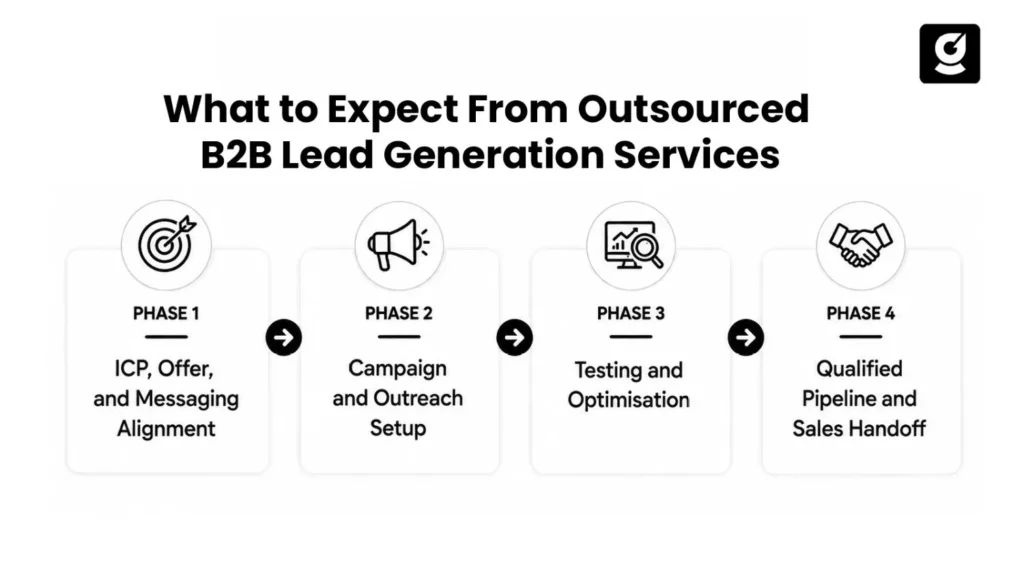
What Should You Expect From Outsourced B2B Lead Generation Services?
The things you can expect from outsourced B2B lead generation services are:
Phase 1: ICP, Offer, and Messaging Alignment
Phase 2: Campaign and Outreach Setup
Phase 3: Testing and Optimisation
Phase 4: Qualified Pipeline and Sales Handoff
A strong outsourced B2B lead generation service should give you more than prospect lists and booked meetings. It should create a repeatable process for finding the right accounts, testing what gets their attention, qualifying genuine interest, and turning that activity into sales opportunities.
The engagement should usually move through four clear phases.
Phase 1: ICP, Offer, and Messaging Alignment
Before outreach starts, the partner should understand what you sell, who is most likely to buy it, and why those buyers should care now.
That means reviewing:
- Your ICP and target segments
- Buyer roles and decision-makers
- Core pain points and use cases
- Buying triggers
- Competitor positioning
- Value proposition and offer
- Existing sales and campaign data
- Common objections
- Lead qualification criteria
This phase matters because weak targeting cannot be fixed by sending more outreach.
If an agency starts sending thousands of emails before understanding your market, product, and qualification standards, speed is not an advantage. It is a targeting risk.
You should leave this phase with a clear answer to three questions:
- Who are we targeting?
- Why should they respond?
- What makes a lead worth sending to sales?
Phase 2: Campaign and Outreach Setup
Once the targeting is clear, the partner should build the campaign around the channels most likely to reach those buyers.
This typically includes:
- Account and contact research
- Prospect list validation
- Audience segmentation
- Channel selection
- Cold email or LinkedIn sequences
- Outreach messaging
- Campaign and sending infrastructure
- CRM and tracking setup
- Initial campaign testing
The partner should also explain why each channel is being used. A good B2B lead generation agency should not force every client into the same outreach playbook.
Phase 3: Testing and Optimisation
The first campaign should be treated as a source of learning, not as the finished strategy.
The partner should continuously review:
- Which segments respond
- Which messages generate positive replies
- Which objections appear repeatedly
- Which buyer roles engage
- Which leads sales accept or reject
- Where prospects drop out
Those insights should lead to changes in targeting, messaging, sequences, offers, or qualification rules.
This is also where sales feedback becomes critical. If meetings are being booked but sales says the prospects are poor fits, the campaign is not performing well, even if the activity metrics look strong.
Phase 4: Qualified Pipeline and Sales Handoff
Once a prospect shows meaningful interest, the partner should qualify the opportunity against the criteria agreed at the beginning.
The handoff should include more than a calendar invitation. Sales should receive context such as:
- Company and buyer details
- Why the account fits the ICP
- Conversation history
- Pain point or use case discussed
- Level of interest
- Relevant objections or questions
- Next agreed step
The lead should also be updated correctly in the CRM so sales can continue the conversation without starting from scratch.
Most importantly, the process should not stop once the meeting is booked.
The partner should track what happens next:
Qualified meeting → Opportunity → Pipeline → Revenue
If leads regularly fail to progress, that feedback should be used to refine the campaign.
That is what separates outsourced lead generation from simple appointment setting. The goal is not to fill calendars. It is to create qualified sales opportunities that have a realistic chance of becoming a pipeline.

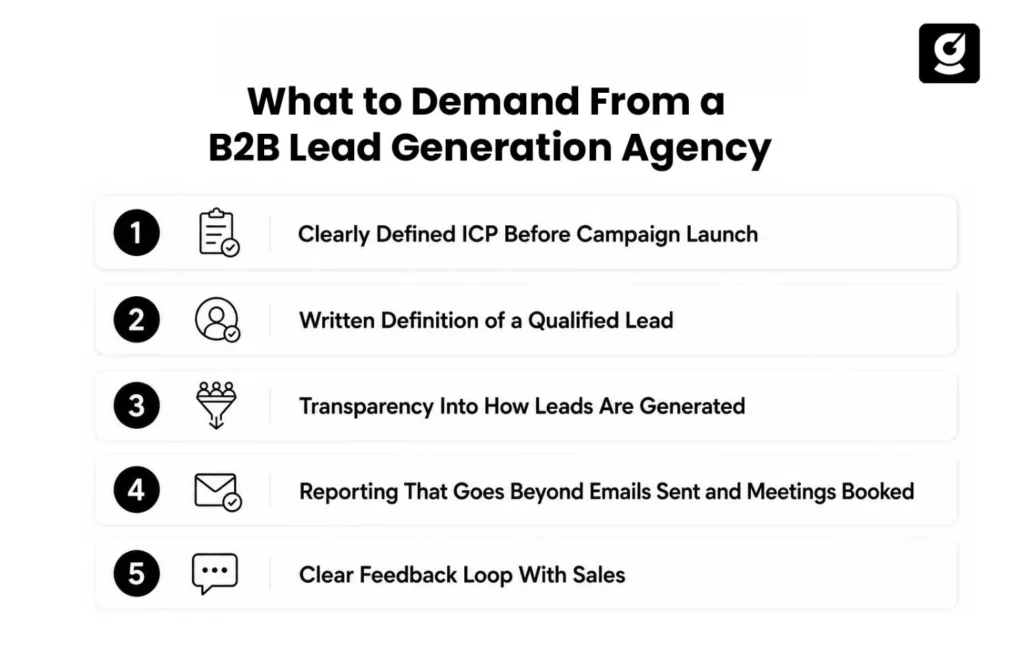
What Should You Demand From a B2B Lead Generation Agency?
The following can be Demanded From a B2B Lead Generation Agency:
1. A Clearly Defined ICP Before Campaign Launch
2. A Written Definition of a Qualified Lead
3. Transparency Into How Leads Are Generated
4. Reporting That Goes Beyond Emails Sent and Meetings Booked
5. A Clear Feedback Loop With Sales
Choosing a B2B lead generation agency is not just about comparing how many leads or meetings each provider promises. Before signing, you need clear standards for who they target, how they qualify prospects, what you can see inside the process, and how success will be measured.
1. A Clearly Defined ICP Before Campaign Launch
The agency should be able to explain exactly who it plans to target and why.
That includes clear criteria around:
- Target industries
- Company size
- Geography
- Buyer roles and personas
- Relevant buying signals
- Accounts or segments to exclude
The ICP should be specific enough to guide account selection and messaging. If the targeting is too broad, your sales team may end up spending time on companies that were never a realistic fit.
2. A Written Definition of a Qualified Lead
Do not leave the meaning of “qualified lead” open to interpretation.
Before launch, agree on the conditions a prospect must meet before the agency counts them as qualified. Depending on your sales model, this may include:
- ICP fit
- Relevant buyer role
- A clear problem or use case
- Genuine interest in the solution
- Appropriate timing
- Meeting attendance
- Any company-size, geographical, or budget requirements
This definition protects both sides.
Without it, an agency can technically meet a lead target while your sales team rejects most of the meetings because the prospects lack fit or intent.
3. Transparency Into How Leads Are Generated
You should be able to see how the pipeline is being created, not just receive a report at the end of the month.
Ask for visibility into:
- Target accounts
- Prospect data and research process
- Outreach messaging
- Channels being used
- Campaign performance
- Prospect responses
- Qualification decisions
- CRM activity
This transparency helps you identify whether poor results come from targeting, messaging, channel choice, or qualification.
It also protects your brand. If an external team is contacting prospects on your behalf, you should know what those prospects are seeing.
4. Reporting That Goes Beyond Emails Sent and Meetings Booked
Activity metrics can help diagnose a campaign, but they should not be the main measure of success.
A stronger reporting model follows the prospect further through the funnel:
Accounts Reached → Positive Responses → Qualified Meetings → Opportunities → Pipeline → Revenue
Metrics such as email volume, open rates, and contact volume may show whether outreach is running, but they do not tell you whether it is creating commercial value.
growth.cx’s broader positioning follows the same principle by connecting marketing activity to Demand → Pipeline → Revenue, rather than treating lead volume as the end result.
The closer reporting gets to qualified opportunities and the pipeline, the easier it becomes to judge whether the agency is actually improving your growth engine.
5. A Clear Feedback Loop With Sales
A lead generation agency should not lose visibility once a meeting reaches your sales team.
There should be a regular feedback process covering:
- Which meetings were genuinely qualified
- Which accounts were poor fits
- Which leads became opportunities
- Which objections appear repeatedly
- Which industries or personas convert best
- Which deals progress, stall, or get disqualified
This feedback should directly influence the next campaign cycle.
If sales consistently rejects leads from one segment, the targeting should change. If a certain objection appears repeatedly, the messaging should address it. If one buyer persona produces stronger opportunities, the agency should use that insight to refine future outreach.
The best lead generation programmes improve because the agency learns from what happens after the meeting, not just from who responds to the first message.
How Do You Pick the Right B2B Lead Generation Company?
The right B2B lead generation company should understand your sales motion, qualify leads against clear criteria, and show how its work contributes to the pipeline.
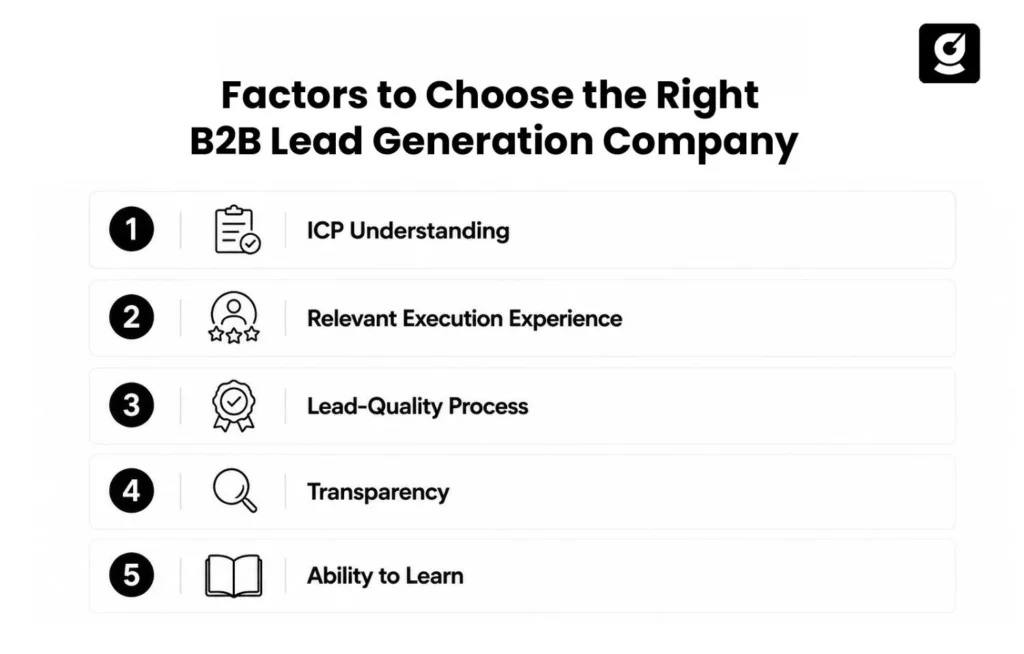
Evaluate potential partners across these five areas:
1. ICP Understanding
2. Relevant Execution Experience
3. Lead-Quality Process
4. Transparency
5. Ability to Learn
1. ICP Understanding
A strong partner should clearly explain who they would target and why. They should understand:
- Your ACV
- Sales cycle
- Buyer roles and buying committee
- Market maturity
- How much education prospects need before engaging
They should also be able to identify whether your real problem is targeting, messaging, outreach, or lead quality rather than assuming that more activity will fix the pipeline.
2. Relevant Execution Experience
“Working with SaaS companies” is not enough. Look for experience with businesses that have a similar audience, deal size, sales cycle, and buying complexity.
Ask for examples that show how they handled:
- Account targeting
- Outreach
- Lead qualification
- Sales handoff
- Pipeline creation
Relevant execution experience matters more than a long client logo list.
3. Lead-Quality Process
Ask exactly how the agency decides whether a prospect deserves your sales team’s time.
A weak answer is:
“We’ll deliver 100 leads.”
A better conversation should cover:
- What qualifies a lead
- Who validates lead quality
- How rejected leads are reviewed
- What happens when meetings are poor fits
- How opportunities and the pipeline are tracked
The goal should be a qualified pipeline, not lead volume.
4. Transparency and Channel Fit
You should be able to see what the agency is doing and why.
Look for visibility into:
- Target accounts
- Outreach messaging
- Campaign performance
- CRM activity
- Lead quality
- Pipeline contribution
The agency should also recommend channels based on your buyers, whether that means cold email, LinkedIn, paid search, paid social, ABM, content, SEO, or retargeting.
Avoid partners that push every client through the same playbook.
5. Ability to Learn and Work With Your Team
A strong partner should be able to explain what they do when:
- Response rates fall
- Sales rejects leads
- One segment underperforms
- Meetings are poor quality
- A messaging angle stops working
Also evaluate how they will work with your internal team through regular meetings, CRM access, sales feedback, reporting, communication, ownership, and escalation.
How an agency responds when results are weak can tell you more than its strongest case study.
Read our case study for more insights.
What Questions Should You Ask Before Signing With a B2B Lead Generation Agency?
Before choosing a B2B lead generation agency, ask questions that reveal how the partner will target accounts, qualify prospects, measure pipeline impact, and take responsibility when campaigns underperform.
Use these questions during your evaluation:
- How will you define or refine our ICP before outreach starts?
- What exactly counts as a qualified lead?
- Which channels will you use, and why are they suitable for our buyers?
- How do you research, source, and verify target accounts and contacts?
- Who owns the prospect data, outreach infrastructure, and campaign assets?
- How will qualified leads be handed over to our sales team and CRM?
- Which metrics will you report beyond replies and meetings booked?
- How will you incorporate feedback from sales when lead quality is weak?
- What changes will you make if a campaign or target segment underperforms?
- Can you show results from companies with a similar ICP, ACV, or sales cycle?
Pay particular attention to how clearly the agency answers questions about qualification, ownership, pipeline measurement, and accountability. Vague answers in these areas usually become bigger problems once the campaign is live.
Where Does growth.cx Fit Into an Outsourced Lead Generation Model?
growth.cx approaches B2B lead generation as part of a broader revenue system rather than treating it as a standalone outreach activity. Its model connects:
Qualified Demand → Sales Pipeline → Revenue
Depending on the growth problem, that can combine:
- ICP and positioning
- Cold Email Lead Generation and LinkedIn outreach
- Account-based marketing
- Performance marketing
- SEO and content
- Conversion optimisation
- Lead nurturing
This matters because a weak pipeline is not always an outreach problem. Poor targeting, unclear positioning, or weak conversion paths can reduce the value of even a well-run campaign.
growth.cx’s LinkedERP case study shows this approach in practice. The company reports building a $775K sales pipeline through integrated cold email and LinkedIn outreach.
The useful result here is not how many emails were sent or meetings booked. It is whether the activity produced a qualified pipeline that sales could pursue.

Final Thoughts
Outsourcing can reduce the operational burden of research, prospecting, outreach, and qualification, but accountability for the pipeline should still stay with your team. You need clear ownership of ICP decisions, positioning, qualification standards, sales feedback, and revenue goals.
The right B2B lead generation company should do more than increase outreach activity or fill calendars. It should make your revenue process more measurable, repeatable, and focused on moving the right buyers from Qualified Demand → Sales Pipeline → Revenue.
If your current lead generation efforts are creating activity but not enough qualified pipeline, Growth.cx can help you build a more connected and predictable growth system.
Ready to turn lead generation into a qualified pipeline? Talk to the growth.cx team.
FAQ
When should a B2B company outsource lead generation?
Outsourcing makes sense when you have a defined ICP and sales motion but lack the internal capacity to generate enough qualified pipeline. It can also help when entering a new market or when founders and salespeople are spending too much time prospecting instead of closing.
What are the benefits of outsourcing B2B lead generation?
The main benefits are faster access to specialist prospecting skills, additional outreach capacity, established tools and processes, and the flexibility to scale without immediately hiring an internal SDR team. The real value, however, depends on whether those activities translate into qualified opportunities rather than simply more leads.
How much does outsourced B2B lead generation cost?
There is no single standard price. Cost depends on factors such as campaign scope, target market, channels, research requirements, outreach volume, qualification depth, and whether you are buying appointment setting or broader sales-development support. Current providers use different pricing and engagement models, so compare the cost per qualified opportunity and pipeline generated, not just the monthly fee.
How do you choose a B2B lead generation agency?
Start with ICP expertise, qualification standards, channel capabilities, reporting transparency, CRM integration, and evidence from companies with a similar sales motion. A strong partner should also explain what happens when lead quality or campaign performance falls below expectations, rather than relying only on activity targets.