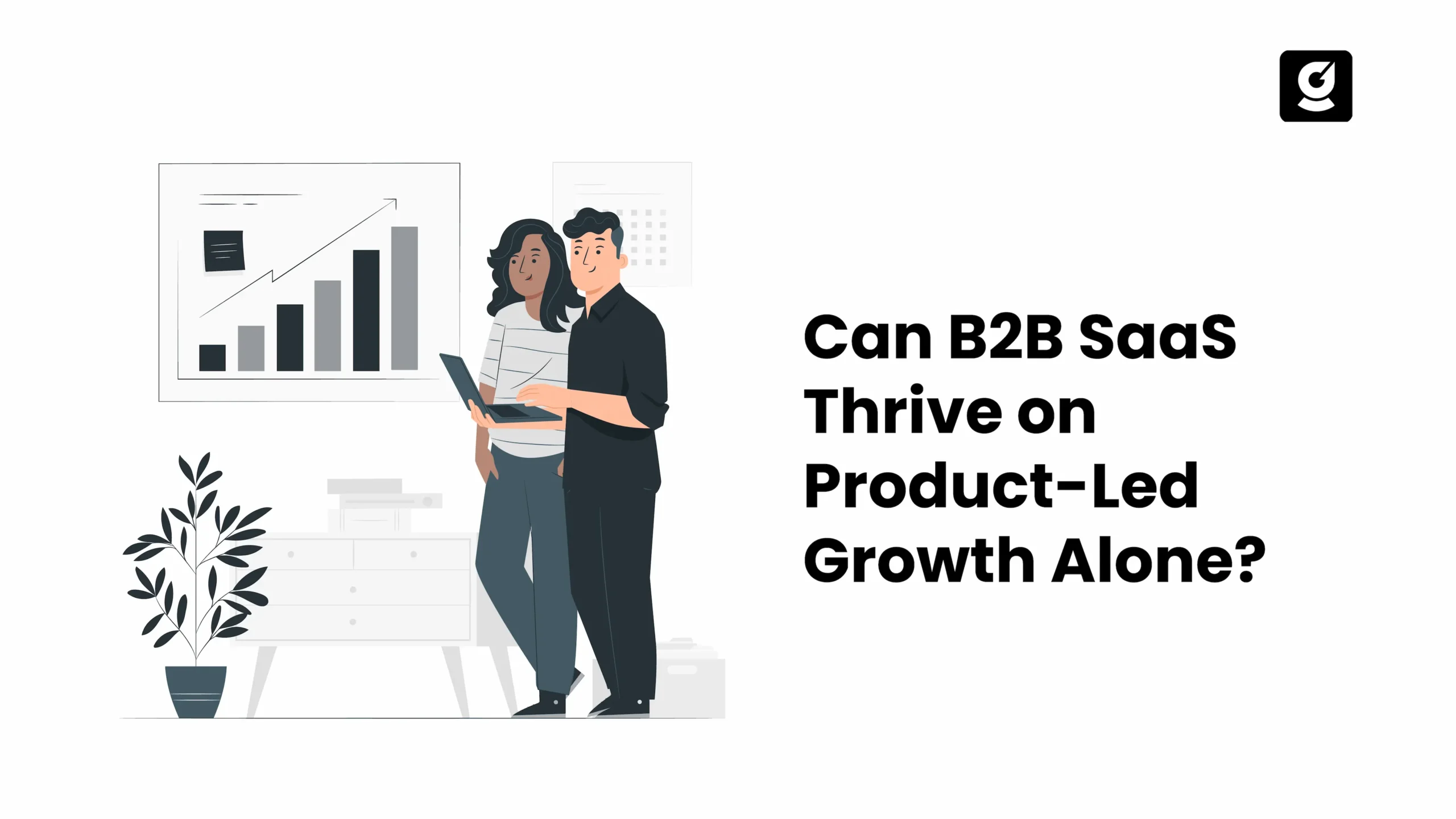
It is notable to point out that three-quarters of B2B buyers prefer self-education over salesperson interaction and superior business metrics.
PLG companies are very much valued at the public SaaS index, and 83% of public SaaS companies that reached $100 million in Annual Recurring Revenue (ARR) within their first five years utilized product-led growth strategies.
But here’s the problem.
The Signup Numbers Look Great. Revenue Doesn’t.
More people are trying your product than ever. Trial signups are up. Activation is up. Your dashboard looks healthy.
And yet the deals aren’t closing at the rate they should. The pipeline is thinner than the usage graph suggests it should be.
Here’s the uncomfortable part: your product isn’t the problem. The way you’re selling it is incomplete.
This isn’t a call to rebuild your funnel. It’s a way to tell whether it’s time to put a person into a process you built to avoid needing one.
Why Do Product Led Growth Companies Work So Well, Until They Don’t?
Product-led growth works when one person can try something, get value fast, and decide to pay without talking to anyone. It breaks the moment a purchase needs more than one signature.
Tools like Slack or Calendly built entire companies on this. A single person signs up, gets value in minutes, and pulls out a credit card. No sales rep, no demo, no waiting.
That model is still winning. Cursor, the AI code editor built by Anysphere, went from $500 million to $2 billion in ARR between mid-2025 and February 2026, according to SaaSMag, and didn’t hire an enterprise sales rep until it was well past $200 million.
But look closer at that same company. As individual developers brought Cursor into their workplaces, corporate buyers grew from roughly a quarter of revenue in late 2024 to nearly half by the $1 billion mark, and toward 60% at $2 billion, per the same reporting. The product opened the door. Sales walked through it.
That’s the pattern behind almost every product-led growth company that scales past its first few thousand customers, a shift we track closely in our B2B SaaS trends coverage. Self-serve works until the purchase needs budget approval, takes longer to prove value, or costs enough that one person can’t sign off alone. Then it stalls, unless someone steps in.
Where This Approach Breaks Down
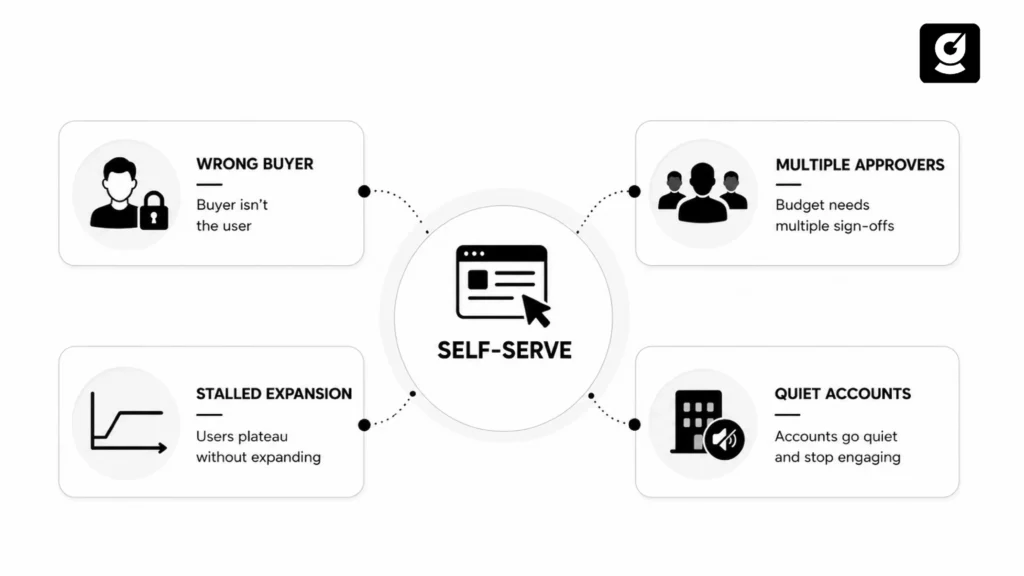
Self-serve breaks in four specific, predictable ways. None of them show up as errors. They show up as silence.
- Wrong buyer. Someone else controls the budget, and they’ve never opened your product.
- Multiple approvals. It stops being one person’s decision. Several people have to agree, and nobody owns getting them there.
- Stalled Expansion. They like the tool. Nobody is nudging them toward buying more seats or rolling it out to another team.
- Quiet Accounts. No complaints, no support tickets, no churn email. They just stop logging in, and nobody notices until the renewal doesn’t happen.
Each of these is a handoff nobody owns. The product did its job. Nobody picked up where it left off.
What Happens When You Ignore the Signals?
Nothing dramatic happens. That’s the problem. Things just quietly stop working, one team at a time.
- Marketing keeps driving more signups, often by leaning on AI SEO agencies and demand gen channels to fuel top-of-funnel growth, because that’s the metric they own.
- The product team keeps improving activation, because that’s the metric they own.
- Sales waits for inbound demo requests that never arrive, because nobody sent them the ready accounts.
- Enterprise opportunities stall, or go to a competitor whose rep called first.
- Revenue plateaus, despite every product metric on the dashboard looking healthy.
Every team is doing its job well. That’s what makes this hard to spot. The failure isn’t in any one team’s numbers; it’s in the handoff between product usage and a sales conversation, and nobody owns it.
How Do You Know If You Need to Add a Sales Team?
You need sales involvement when a purchase requires more than one approval, costs enough to trigger a budget review, or needs legal or security sign-off before anyone can pay.
Below a certain size and complexity, self-serve still works fine.
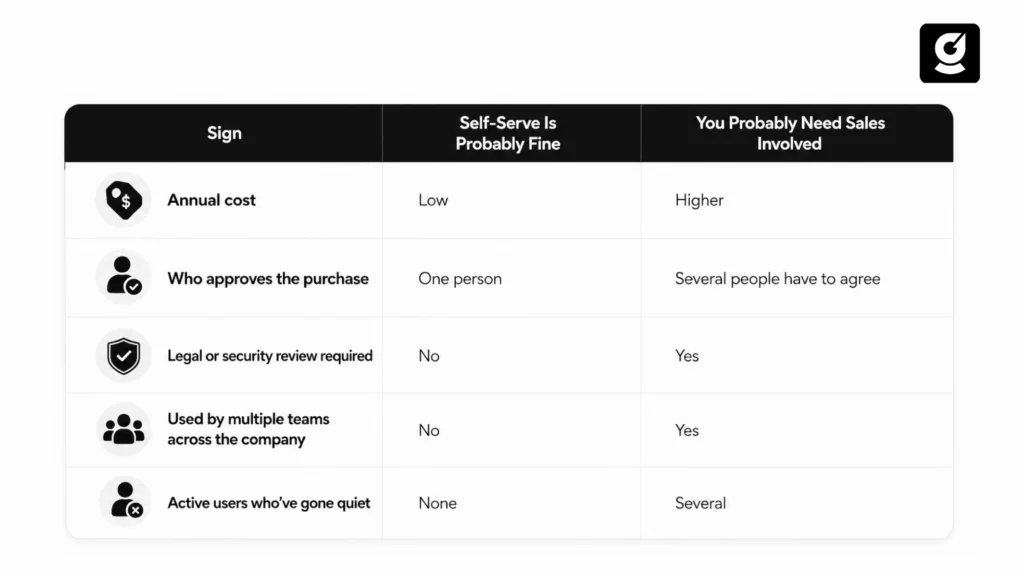
None of this means the product failed. It means you now know which accounts need a real conversation instead of a signup page. That’s a targeting problem, not a product problem.
How to Fix This: Add Sales Without Giving Up on Self-Serve
Companies that scale product-led growth successfully don’t replace it with a sales team. They layer specific, narrow motions, often built with a dedicated B2B lead generation agency handling outbound and ABM on top of the self-serve foundation that’s already working.
- Spotting product-qualified leads flagging users whose in-product behavior shows they’re ready to talk to sales, not just active.
- Connecting product usage to the CRM so sales sees what an account has actually done, not just their name and job title.
- Automatic sales alerts triggered by usage patterns, not a rep guessing which accounts to call.
- Lifecycle email nurturing for accounts that aren’t ready for a human yet, so they don’t go cold.
- Outbound built for enterprise-fit accounts, not a blanket cold email list, a list built from firmographic and usage fit.
- Account-based marketing for the specific high-value companies is worth a coordinated push.
- Expansion playbooks for existing customers, because new logos aren’t the only source of growth.
- Pricing that supports both self-serve tiers and sales-assisted tiers, priced so neither cannibalizes the other.
- Sales enablement built for warm accounts: Reps trained to sell to people who already use the product, not cold prospects.
Products using product-qualified leads convert at 25% to 30%, compared to 5% to 10% for marketing-qualified leads, based on 2026 PLG benchmark data. That gap is the entire argument for building this layer instead of hiring more SDRs and hoping.
Building the bridge between product usage and revenue is where most SaaS companies struggle. Not because the product stops delivering value, but because the go-to-market motion never evolved past the stage that got them their first thousand customers.
The Point Isn’t That PLG Failed
Transitioning into the top 10% of SaaS companies requires a shift from gut-feeling to data-led growth. Achieving Product-Market Fit is not a stationary goal; it is an iterative process.
You find PMF by running constant surveys to gather customer feedback and identifying the “Aha” moment, the specific interaction where a user first recognizes the tangible value of your product. This data-led approach is the only way to drive sustainable customer retention.
The path to scale is paved with market-driven insights, not internal assumptions.
By acting as a fractional marketing team, growth.cx aims to deliver high-level expertise at a fraction of the cost of internal hiring. If you’re still laying the foundation, our guide on how to market your B2B SaaS startup covers the stages before this one applies.
Product-led growth doesn’t stop working when a company grows. It reaches a ceiling: a point where the product alone can’t carry every enterprise conversation, no matter how good the onboarding is.
That’s when the right sales motion becomes an extension of the product experience, not a replacement for it. The product still does the proving. Sales just pick up the accounts that the product can’t close on its own.
Conclusion: Beyond the Binary
The GTM landscape of 2026 has no room for ideology. Your model must follow your product’s price, its complexity, and the reality of its unit economics.
PLG gets you a fast, cheap acquisition. Sales gets you the enterprise deals; PLG structurally can’t close.
Stop picking a side. Start reading your own data.
Ask yourself one question: what’s the exact moment your customer should first meet your product?
At growth.cx, we help B2B SaaS companies spot exactly when they’ve hit that point, and build the marketing and GTM systems that connect product usage to predictable revenue: refining PQL workflows, aligning marketing with sales, or designing the layer in between that most teams skip.

FAQ’s
Why do B2B SaaS companies need a sales motion alongside product-led growth?
Because some purchases can't close without a human. Once a deal needs budget approval, legal or security review, or sign-off from more than one stakeholder, no amount of in-product polish will get it signed. A sales motion exists to close the deals, but self-serve structurally can't.
When should a B2B SaaS company combine product-led growth with sales-led growth?
Combine them once deals start requiring multiple approvers, once contract value crosses a threshold that triggers a budget review, or once active accounts start going quiet with no explanation. Those three signals mean the product has done its job, and a person needs to take over.
What are the common challenges of a product-led growth marketing strategy?
The biggest challenge is that the person using the product often isn't the person who can pay for it, so usage never converts to revenue on its own. Other recurring problems: no clear PQL definition, no link between product data and the CRM, and pricing that punishes upgrades instead of rewarding them.
How can B2B SaaS companies build a successful product-led growth strategy?
Start with fast time-to-value, so a new user sees a result within their first session, not their first week. Then define what a product-qualified lead actually looks like, pipe that signal into the CRM, and build pricing tiers that support both self-serve and sales-assisted buyers without one undercutting the other.
What is the difference between product-led growth and sales-led growth?
Product-led growth lets the product drive the buying decision — a user tries it, gets value, and pays without talking to anyone. Sales-led growth puts a rep in the middle of that decision, using demos and relationship-building to close deals that are too complex or expensive for someone to sign off on alone.