Are you struggling to find the right keywords to stand out and get the attention of your visitors and potential customers?
Most SaaS companies produce and update content consistently, but still struggle to attract buyers through search. The content exists. The blogs are published with fancy terms. The keywords are in the right spot. But the incoming traffic is not converting, and the SEO teams behind it cannot explain why.
The reason is simpler than most people admit. The targeting keywords do not reflect buyers’ search intent. Better-crafted SaaS keyword research is a buyer-behavior exercise. It starts with understanding what a potential customer types into Google before they even know your product exists, and building content that shows up in that moment.
Over the years, Google has dramatically refined its skill in identifying topics and all their related terms, so now every keyword is really the gateway to a topical universe. This is the challenging part.
What Is SaaS Keyword Research and Why Does It Matter for Growth?
SaaS keyword research is the process of identifying what your potential buyers are actually searching for at every stage between “I have a problem” and “I am ready to buy a tool.” It is not about picking terms with the highest search volume. It is about understanding the language your buyers use when they are confused, frustrated, or looking for answers and creating content that meets them there.
Most teams treat keyword research as a technical input. In SaaS, it is closer to customer research.
Understanding How People Search Before Discovering Your Product
Buyers rarely start their journey by searching for a product. They start by searching for their problem. A founder struggling with customer churn does not Google “customer success software.” They Google “why are customers canceling after onboarding” or “how to reduce churn in early-stage SaaS.” The product search comes much later after they have read, learned, and formed opinions.
That gap between problem-search and product-search is where most SaaS content is missing. It is also where the biggest organic growth opportunities live.
Why SaaS Companies Struggle Without Keyword Clarity
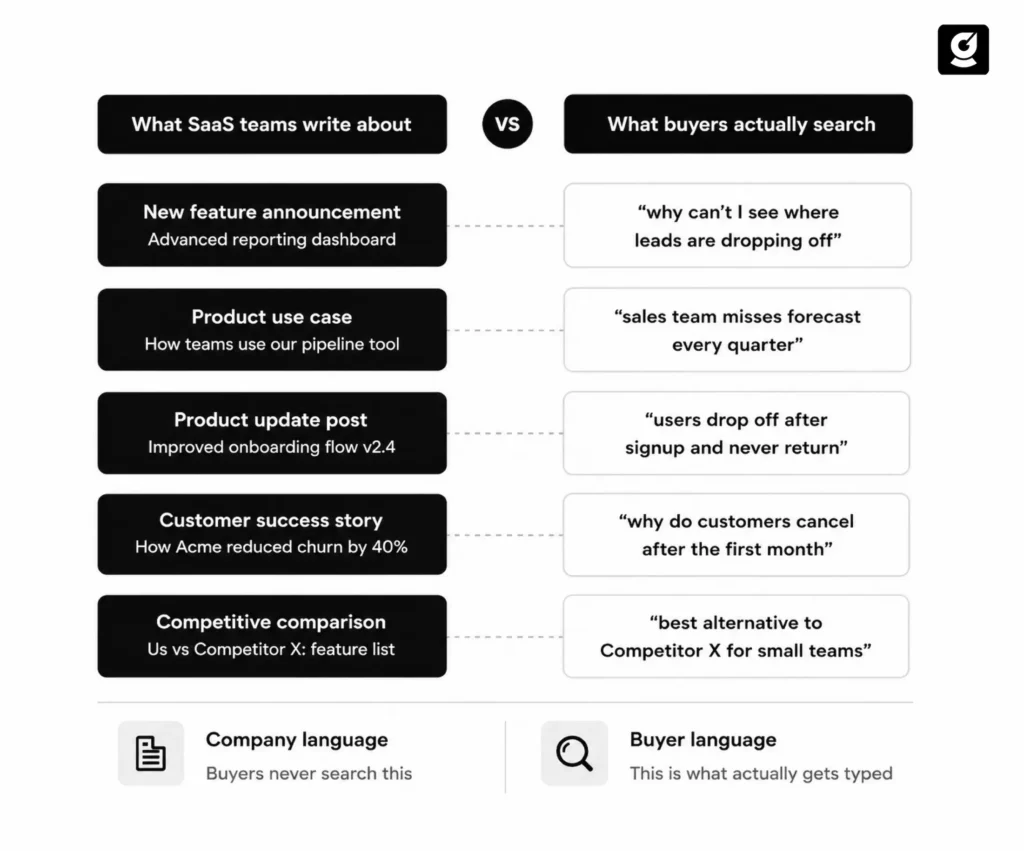
Without a clear keyword strategy tied to buyer intent, content teams default to writing about what they know: their product, its features, and industry trends. That content is not useless, but it attracts people who are already informed, not people who are still figuring out their problem.
The result is high traffic from the wrong audience and low traffic from the people who actually buy. This is one of the most common findings in a technical SEO audit for SaaS: content volume is rarely the issue; intent alignment almost always is.
SaaS Keyword Research Vs General Keyword Research
SaaS buyers search differently from eCommerce users. An eCommerce buyer searches for “running shoes under 5000” with clear intent and a fast purchase cycle. A SaaS buyer searching “how to manage a remote sales team” is at the very beginning of a journey that might take weeks or months before ending in a software purchase.
SaaS keyword research has to account for that extended, multi-stage journey. Volume and competition metrics matter less than intent accuracy and buyer relevance.
Why SaaS Keyword Research Fails to Bring Leads Even When Traffic is High
- Traffic without intent is useless for SaaS
High traffic from the wrong keywords produces reports that look good and pipelines that stay empty. If a blog post about “remote work trends” brings in 5,000 visitors a month but none of them are evaluating project management software, that traffic has no commercial value.
Visitors are learning, not buying, and if the content is not designed to move them forward, they leave without converting. Understanding why bounce rate matters and how to reduce it starts with fixing the intent mismatch at the keyword level.
- Missing connection between content and real buyer problems
The deeper issue is that most SaaS blogs do not reflect actual search behaviour. They are written based on what the marketing team finds interesting, what competitors are publishing, or what a keyword tool surfaces as a high-volume opportunity. None of those inputs reliably maps to what real buyers are typing when they have a problem.
That disconnection is why content programs stall. The volume is there. The relevance is not.
- Over-focus on product features instead of search behavior
SaaS marketing teams often write about product capabilities because that is what they understand best. But buyers do not search for product features in the early stages of their journey. They search for outcomes, for fixes, for explanations of problems they cannot name yet.
Content built around features speaks to people who already know they need the product. It misses everyone still trying to understand their problem.
SaaS Keyword Research: How to Identify What Your Buyers Are Really Searching
- Problem-based searches (early stage intent)
Early-stage searches are symptoms, not solutions. Buyers at this stage search for things like:
- “Why is my trial-to-paid conversion low”
- “How to know if your onboarding is working”
- “Signs your SaaS product has a retention problem”
These searches have low commercial intent but high strategic value: they are the entry point into a buyer’s journey. Creating content here means showing up before any competitor does.
This is what low-hanging fruit in B2B SaaS SEO actually looks like in practice, not easy keywords, but ignored ones.
- Solution discovery searches (middle stage intent)
Once a buyer understands their problem, they move into solution mode. Searches shift to:
- “How to improve onboarding for SaaS”
- “Ways to reduce customer churn”
- “How other SaaS companies handle activation”
The buyer is not looking for a product yet; they are looking for a framework or method. This is where educational, structured content builds real authority.
- Tool and comparison searches (late-stage intent)
Late-stage searches are where buyers evaluate options:
- “Best customer success software”
- “Gainsight vs Totango”
- “Customer success tools for small SaaS teams”
At this point, they know what they need and are deciding who to buy from. Ranking here matters for direct conversion, but getting here without appearing at earlier stages means competing against brands that have already built trust with the buyer.
What Is Keyword Research for SaaS Compared to Traditional SEO Thinking?
Keyword research for SaaS is not about volume
Traditional SEO logic says: find high-volume keywords, create content around them, earn traffic.
That logic does not transfer cleanly to SaaS. A keyword with 200 monthly searches from people actively evaluating your product category is more valuable than a keyword with 20,000 searches from people who will never buy software.
Keyword research for SaaS is a buyer-qualification exercise, not a traffic-maximization exercise. This is why intent matters more than volume when evaluating SEO performance.
When people searched for BOFU keywords, almost 5 out of every 100 ended up buying something. But when they looked up TOFU keywords, only about 1 in 500 made a purchase. This distinction is central to understanding why B2B SaaS SEO works differently from standard search optimization.
SaaS users don’t search for products first
The default assumption in SEO is that users search for solutions. In SaaS, users search for clarity. They are often unsure what kind of solution they need, whether software is even the right answer, or which product category applies to their problem.
Keyword research that ignores this reality targets the wrong queries and attracts the wrong audience.
Why traditional SEO thinking fails in SaaS
Traditional SEO optimizes for rankings and traffic. SaaS growth requires optimizing for a qualified pipeline. The metrics that matter: demo requests, trial signups, qualified leads are downstream of intent, not volume.
High traffic does not equal conversions. Intent alignment does.
What Are SaaS Keywords and How Do They Reflect Buyer Intent?
SaaS keywords explained in simple language
SaaS keywords are the actual search phrases your potential buyers use when they are trying to solve a business problem. They are not technical terms. They are real questions people ask Google:
- “How to improve trial conversion”
- “Why customers stop using software after signup”
- “Best way to track SaaS customer health”
Each one of those phrases tells you something specific about where the buyer is in their journey and what they need to hear next.
Types of SaaS keywords based on intent
SaaS keywords fall into four broad intent categories:
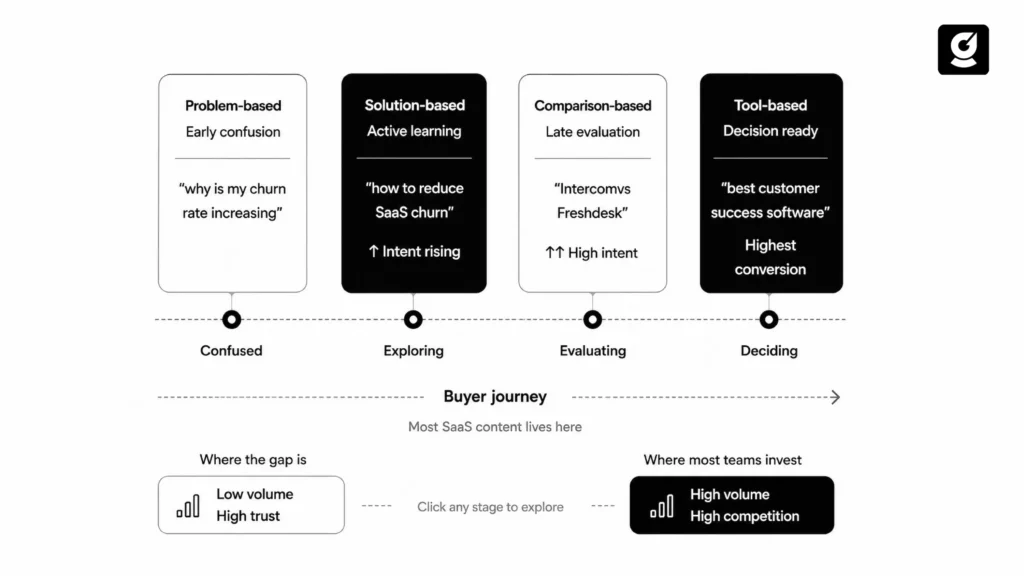
A complete keyword strategy covers all four stages because buyers move through them before making a purchase. Focusing on only one or two categories leaves large parts of the buyer journey unaddressed.
Why SaaS keywords are different from generic keywords
Generic keywords describe topics. SaaS keywords describe business pain. “Customer retention” is a topic. “Why are SaaS customers churning after the first month?” is a pain. The second one outlines the buyer’s role, concerns, stage, and the content that will actually help them.
SaaS keywords tied to real pain points are the ones that bring buyers to your content, not just readers.
Keyword Analysis for SaaS: What Most Companies Are Missing
- Why keyword analysis is more than search volume
Volume is one input. Intent is the interpretation. A keyword with 50 monthly searches from B2B SaaS decision-makers evaluating solutions in your category is more commercially valuable than a keyword with 5,000 searches from a mixed audience with no purchase intent.
Keyword analysis for SaaS requires looking beyond the number and asking: who is searching this, and what do they actually want? A proper website SEO audit will surface this gap quickly; most SaaS sites are targeting terms their buyers never use.
- The hidden gap between content and customer thinking
Most SaaS companies know their buyers well in sales conversations. That understanding rarely makes it into their keyword strategy. The language buyers use in discovery calls: the phrases they repeat, the problems they describe, the comparisons they make, is often the most accurate keyword research available.
The gap between what companies write and what users search is usually a gap between internal assumptions and real buyer language.
- Why most SaaS blogs miss early-stage searchers
Early-stage buyers do not use product language. They describe symptoms, situations, and frustrations. Most SaaS blogs assume the reader already knows what kind of solution they need. That assumption excludes the largest segment of potential buyers: those who are still figuring out the problem.
Writing for early-stage searchers means writing for confusion, not clarity. That is a significant shift in how content is planned and written.
How SaaS Keyword Research Helps You Reach Buyers Before They Know You Exist
- Capturing users in the problem awareness stage
The problem awareness stage is where buyers are most reachable and least competitive. Most SaaS companies do not show up here because they are focused on product-aware searches. That creates a gap and a significant opportunity for companies willing to create content that addresses raw, early-stage problems.
Showing up at this stage is not just a traffic strategy. It is a trust strategy.
- Matching content with real search behavior
Effective SaaS content does not try to explain the product. It tries to explain the problem in the same language the buyer uses when searching. That alignment between content language and search language is what produces both rankings and relevance.
Writing for confusion means starting where the buyer is, not where you want them to be.
- Why does early discovery traffic convert better later
Buyers who encounter your content in the early stages of their search journey associate your brand with clarity and usefulness before they have seen any competitors. By the time they reach the decision stage, that prior exposure has built a level of familiarity that passive visitors from product-aware searches have not developed.
Early discovery traffic converts better because trust is already in place before the purchase decision begins.
How SaaS Keyword Research Actually Works in Real Buyer Journeys
People start with problems, not products
A buyer’s search journey almost always starts with a symptom, not a solution. They search because something is not working: a process is breaking down, a metric is moving in the wrong direction, a team is struggling. The product that will eventually solve their problem is not yet part of their vocabulary.
Understanding the starting point is the foundation of effective SaaS keyword research and the core principle behind SEO-focused content for SaaS businesses that actually generate pipeline.
How confusion drives most SaaS searches
Many of the most valuable SaaS search queries come from people who do not yet fully understand their own problem. Searches like “why is my customer retention dropping” or “how do I know if my sales process is broken” are not product searches. They are confusing searches.
Companies that create content for confused, early-stage buyers build a relationship before competitors even enter the picture.
Different stages of awareness in SaaS searches
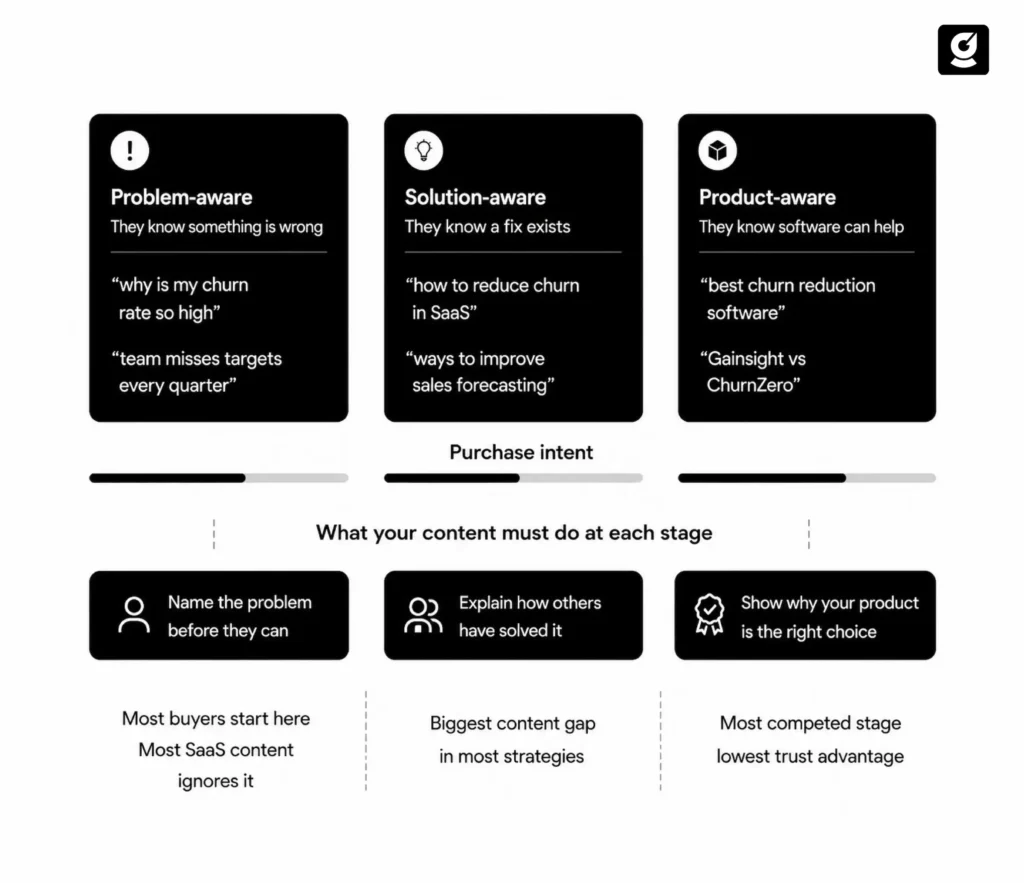
SaaS searches follow a predictable pattern across three stages:
- Problem-aware: The buyer knows something is wrong but cannot yet name the solution.
- Solution exploring: They start researching how others have fixed similar problems.
- Solution comparing: They discover software exists and begin evaluating options.
Each stage produces different search behavior and requires different content. Most SaaS companies only create content for stage three: when the buyer is already comparing tools. That leaves the first two stages, where the majority of buyers spend most of their time, completely unaddressed.
Common Mistakes in SaaS Keyword Research That Block Growth
Here are the three mistakes that cost the most:
- Writing only for product-aware users. If every blog post assumes the reader already knows they need SaaS, the content is competing only for buyers at the very end of the funnel, where competition is highest, and trust is lowest. Expanding into problem- and solution-aware content unlocks organic growth at scale.
- Over-optimizing for SEO tools instead of real users. Keyword tools surface volume, difficulty, and trends. They do not surface buyer emotion, confusion, or language. Real user language, from sales calls, support tickets, and customer interviews, is more accurate than any keyword database.
- Ignoring the intent behind keywords. A keyword is not just a search term. It signals where the buyer is in their journey and what they need at that moment. Treating keywords as data points without interpreting the intent behind them leads to content that ranks, but neither serves the reader nor converts.
How SaaS Keyword Research Should Be Done Differently
Three shifts that change how keyword research works in practice:
- Start with customer problems, not tools. The starting point is a list of the problems your buyers describe in their own words, from discovery calls, support tickets, and community forums. That raw material, before any tool is opened, is the foundation of a keyword strategy that actually reflects buyer reality.
- Think in conversations, not keywords. SaaS buyers think in terms of questions, frustrations, and goals. Building a keyword strategy means translating those conversations into search queries and then determining whether people are actually searching for those phrases. The best keyword research sounds like a buyer talking, not like a marketer writing.
- Focus on awareness-building content. Awareness content does not drive immediate conversion metrics, but it does produce something more durable: early brand presence in a buyer’s journey. Companies that consistently appear in the problem and solution stages build a content moat that is very difficult for competitors to replicate quickly.
How growth.cx Helps SaaS Companies With SaaS Keyword Research
- Turning buyer problems into search opportunities
growth.cx works with B2B SaaS companies to translate real buyer problems into keyword strategies that produce pipeline, not just traffic. The process starts with understanding how buyers in a specific category actually search, not with volume reports or competitive benchmarks.
Every keyword in the strategy maps back to a real buyer problem, a stage in the search journey, and a content format that matches the intent.
- Building content that captures unaware users
Most of the SaaS companies growth.cx works with come in with content focused entirely on product-aware buyers. The gap and the growth opportunity are almost always in the earlier stages. Building SaaS SEO content for unaware or problem-aware users requires a different brief, a different structure, and a different definition of success.
growth.cx builds that infrastructure, from keyword mapping to content production, so that SaaS companies show up at the beginning of the buyer journey, not just the end. The benefits of working with a SaaS SEO agency become clearest at this stage: the research, the structure, and the editorial process are already in place.
- Aligning SEO with SaaS revenue growth
The goal of SaaS content marketing is not organic traffic. It is a qualified pipeline. growth.cx approaches keyword research with that end goal in mind — selecting terms, creating content structures, and measuring outcomes in ways that connect SEO activity to revenue, not just rankings.
That alignment between search presence and business outcome is what separates a content strategy from a content calendar.
Final Thought: SaaS Keyword Research Is About Understanding People, Not Keywords
- Keywords are reflections of real human problems
Behind every search query, there is a frustrated person trying to solve something. In SaaS, that person is usually a founder, a team leader, or an operations owner who is trying to figure out why something is not working and whether software can help. The keyword is just the compressed version of that query.
Treating keywords as mere data points instead of human signals is the root cause of most SaaS content failures.
- The earlier you show up, the better you convert
Buyers form opinions about brands early. A company that shows up with useful, clear content when a buyer is still confused about their problem earns a level of credibility that late-stage content cannot manufacture. By the time the buyer reaches the comparison or decision stage, the brand that was there from the beginning has a meaningful advantage.
Awareness drives trust. Trust drives conversion. SaaS keyword research, done right, is the mechanism that makes both possible.
If you want to see how this translates into a working content system, explore how growth.cx approaches SaaS SEO.

We map real buyer intent to content that ranks and converts.
FAQ
How do you find high-intent keywords for a SaaS business?
Start with the language your buyers use in sales calls, support tickets, and customer reviews, before opening any keyword tool. Then use tools like Ahrefs, Google Search Console, and keywordspeopleuse.com to find search queries that reflect active problem-solving or solution evaluation. High-intent SaaS keywords are usually specific, longer phrases tied to a business pain point or a decision-stage comparison, not broad category terms.
What is the difference between informational and transactional SaaS keywords?
Informational keywords target buyers who are learning: searching for explanations, frameworks, or definitions. Transactional keywords target buyers who are ready to act, searching for pricing, free trials, or direct product comparisons. Both matter, but they serve different stages of the buyer journey. A strong SaaS keyword strategy addresses the full funnel, starting with informational content that builds early trust and ending with transactional content that captures buyers at the decision stage.
Which tools are best for SaaS keyword research?
Google Search Console shows what you already rank for and where you can improve. Ahrefs and Semrush provide competitive keyword data, search volume, and intent signals. Keywordspeopleuse.com and answerthepublic.com surface real questions buyers are asking. No single tool covers everything; the most accurate inputs often come from non-tool sources like sales conversations and customer interviews, which reflect real buyer language better than any keyword database.
How do you prioritize SaaS keywords that drive leads and revenue?
Prioritize by buyer intent before search volume. A keyword with 150 monthly searches from buyers actively evaluating your product category is more valuable than a keyword with 10,000 searches from a general audience. Score keywords by intent type, relevance to your ICP, keyword difficulty, and current ranking position. Focus first on keywords where buyer intent is clear, competition is manageable, and the content you create can realistically rank within 90 days.