Imagine you are doing everything you can. You’re acquiring new customers, increasing product adoption, investing in go-to-market initiatives, and expanding your market presence. Yet somehow, after all these efforts, your revenue growth isn’t improving as expected. Are you facing such a situation right now?
What if your SaaS company’s biggest growth constraint isn’t customer acquisition, product adoption, or demand generation? Your SaaS pricing model may be silently restricting revenue growth.
According to ProfitWell research, SaaS companies that examine and optimize their price annually grow 12–18% faster than organisations that rarely update pricing decisions. However, one of the least often used growth factors in SaaS is pricing.
Pricing is generally treated as a one-time decision made during an earlier stage of growth. Once pricing pages and plans are released, they frequently remain untouched for years. In the meantime, the product develops, customer needs shift, new market niches appear, and enterprise use cases gain significance. Value creation and value capture become disconnected as a result.
More importantly, pricing influences far more than revenue. It impacts:
- Customer acquisition
- Sales efficiency
- Retention and expansion
- Profitability
- Go-to-market effectiveness
In this article, we’ll explore how pricing affects revenue growth and how to identify whether your current model is limiting growth potential.
Why a SaaS Pricing Model Strategy Has a Bigger Impact on Growth Than Most Companies Realize
Many SaaS companies view pricing as a monetization decision. In reality, pricing affects almost every aspect of the revenue engine. The price of a product influences how the market views it, which customers it attracts, how sales discussions evolve, and if existing customers have opportunities to deepen their connection with the company.
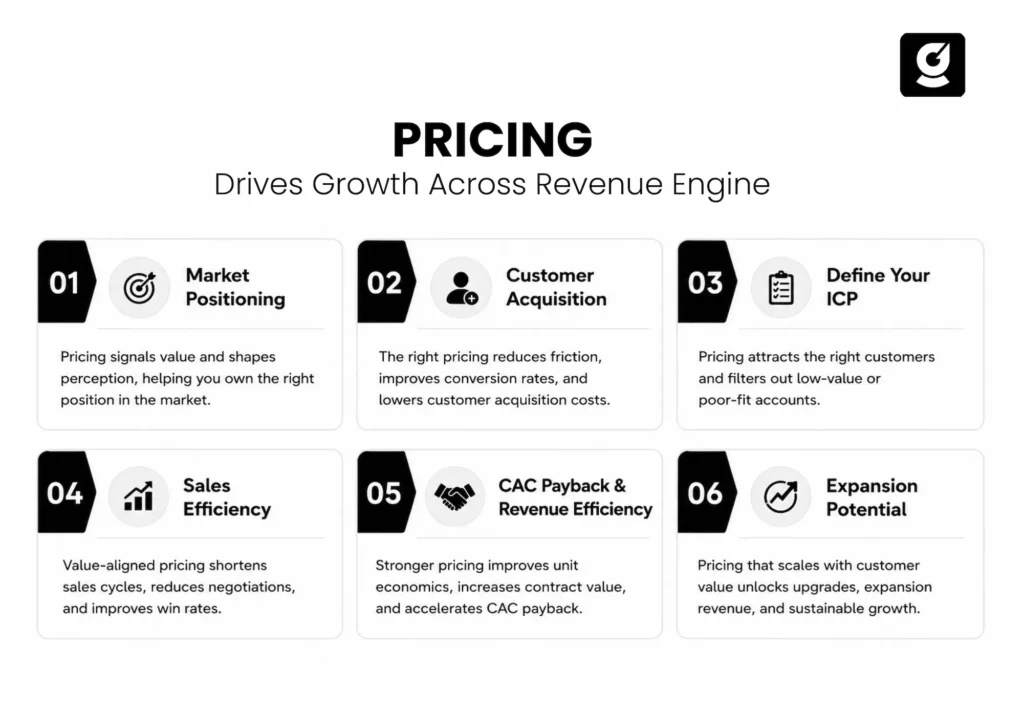
Pricing Shapes Market Positioning
Pricing sends a powerful signal about value. Your SaaS pricing model must align with how you want to position your product in the market.
A low-priced solution may attract cost-conscious buyers and position itself as an affordable alternative. A premium SaaS pricing strategy can signal sophistication, dependability, and scalability.
However, pricing influences more than perception. It also affects who enters your pipeline. The budgets, expectations, and purchasing criteria vary among different customers. As a result, pricing can help attract the customers a company is best positioned to serve while discouraging poor-fit prospects.
Because of this, pricing becomes more than a monetization decision. This makes pricing an important component of positioning and a key factor in building a more efficient GTM motion.
Pricing Influences Customer Acquisition
Pricing has a direct effect on buyer interest and conversion rates. It is one of the key elements that influences how quickly a consumer chooses to purchase your products. According to research, misaligned pricing decreases conversion rates by 15–20% on average and raises CAC by 8–14% over the first quarter.
However, if pricing creates unnecessary friction, prospects may abandon the buying process before they fully understand the value of the product. In the same way, pricing that aligns with perceived value can accelerate decision-making and improve conversion efficiency.
Pricing Helps Define Your ICP
Pricing serves as a filter. It discourages some customer groups while drawing in others. Different customer segments have different budgets, needs, and expectations.
In other words, a startup SaaS price strategy might not work for customers in the mid-market. Similarly, a price system intended for SMBs could cause problems for enterprise customers.
A low-priced product will attract an audience looking for more of a budget-friendly product, while a premium SaaS pricing model will attract users willing to pay more for superior products.
In simple terms, the right pricing helps you to filter out low-value buyers while sending out a signal about your product quality and value.
Pricing Impacts Sales Efficiency
Pricing affects qualification, discovery conversations, and deal progression.
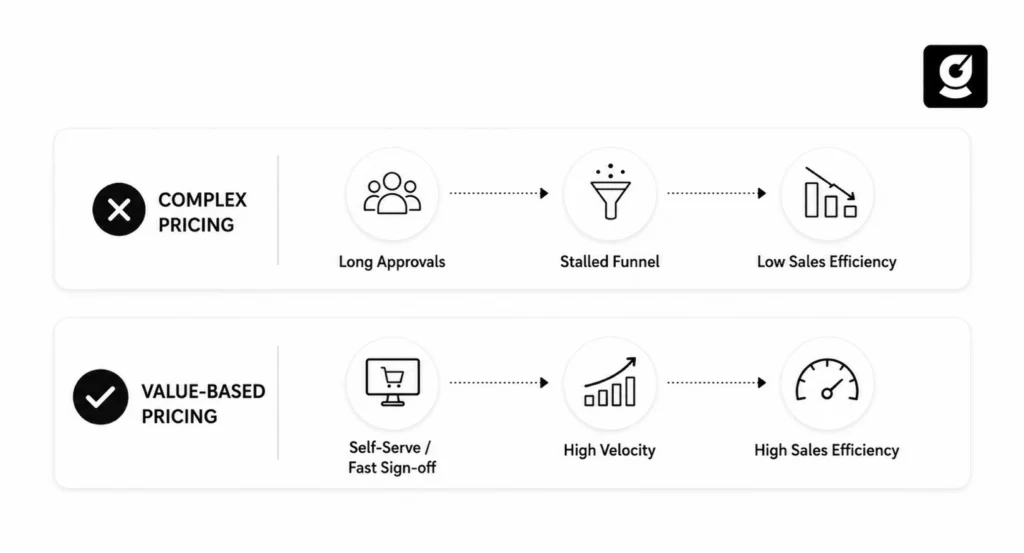
The pricing structure has a great influence on the speed, cost, and efficiency of closing a sales deal. When SaaS pricing is confusing or misaligned with buyer expectations, sales cycles slow and user acquisition costs spike.
When pricing aligns with customer value, sales teams can focus on demonstrating outcomes. Whereas when it is poorly aligned, sales conversations often become centered on discounts, negotiations, and exceptions.
This can increase sales cycles, reduce win rates, and create unnecessary friction within the GTM process.
Pricing Influences CAC Payback and Revenue Efficiency
In many SaaS categories, the cost of acquiring new customers is still increasing. Optimising your pricing strategy is the easiest way to reduce your CAC payback period and improve capital efficiency.
Pricing and monetisation effectiveness have a significant impact on how quickly those costs are recovered. Strong pricing can enhance overall revenue efficiency, increase average contract value, and speed up CAC payback.
By linking your rates to a scalable value measure, such as data use or active seats, and incentivising upfront annual payments, you can accelerate future cash flow and rapidly recover marketing and sales costs.
Pricing Determines Expansion Potential
One of the most overlooked aspects of pricing is its impact on expansion revenue. Your SaaS pricing model strategy governs how much your consumers organically pay you over time without you having to re-sell to them.
If customers receive more value as they grow but pricing remains static, expansion opportunities become limited. Effective pricing structures allow revenue to rise alongside client success, building a basis for sustainable growth.
Pricing decisions influence more than income. They affect how efficiently a SaaS company obtains, converts, maintains, and increases clients.
This is why growth-stage SaaS companies should cease treating pricing as a financial exercise. Pricing is a design decision for GTM systems. Positioning, client acquisition, sales execution, growth potential, and retention are all impacted. When pricing is misaligned, the problem is typically more than just the price. It might imply issues with ICP positioning, packaging, or monetisation strategies.
What Changes When a SaaS Company Moves Beyond Product-Market Fit
A SaaS company undergoes a fundamental shift from identifying a market to expanding an effective, standardised machine when it surpasses Product-Market Fit (PMF). Pricing in the early stages of growth marketing is usually meant to lower adoption challenges and promote experimentation. The fundamental goal is learning.
Companies seek to understand:
- Are the customers willing to pay?
- Which customer segments add the most value?
- Which scenarios increase adoption?
- What pricing models appeal to buyers?
During this stage, minimalism frequently wins. However, once organisations progress beyond product-market fit, their priorities shift.
Growth-stage SaaS firms focus on:
- Increasing monetisation efficiency.
- Improved average revenue per account
- Facilitating enterprise adoption.
- Increasing client lifetime value.
- Creating predictable expansion revenue.
As SaaS companies scale, customer segments become more diverse and product capabilities become more advanced. They also face new demands from enterprise buyers and sales motions become increasingly complex.
However, many businesses continue to use SaaS pricing models established for an entirely different stage of growth. The result is often a widening disparity between the value supplied and the income received.
A pricing approach that initially accelerated adoption may eventually become a growth limitation.
| Early Stage Pricing Goal | Growth Stage Pricing Goal |
| Reduce friction | Maximize revenue capture |
| Validate demand | Optimize willingness to pay |
| Increase adoption | Increase expansion revenue |
| Serve one ICP | Support multiple segments |
| Prove Product Value | Monetize business outcomes |
When Pricing Stops Reflecting Customer Value
One of the biggest monetization challenges in SaaS occurs when revenue growth no longer reflects the value customers receive. While this often appears to be a pricing problem, the root cause may lie in packaging decisions, customer segmentation, ICP alignment, or positioning.
Imagine two customers using the same platform. One user has a small team using basic features. Another uses the platform across many departments, automating important procedures and achieving significant business results.
If both customers pay approximately the same amount, the company generates a value-capture gap. The second client receives much greater value, yet income remains relatively stable. This problem becomes more obvious as things mature.
Customer value tends to rise through:
- Increased adoption
- Broader usage
- Added teams
- More advanced workflows.
- Higher business impact
However, if price remains steady, monetisation cannot keep up with consumer growth. This results in a situation in which customer outcomes increase yet revenue growth decreases. Over time, the difference between value creation and value capture can become one of the most significant hidden barriers to revenue growth.
Five Signs Your Pricing Model May Be Limiting Revenue Growth
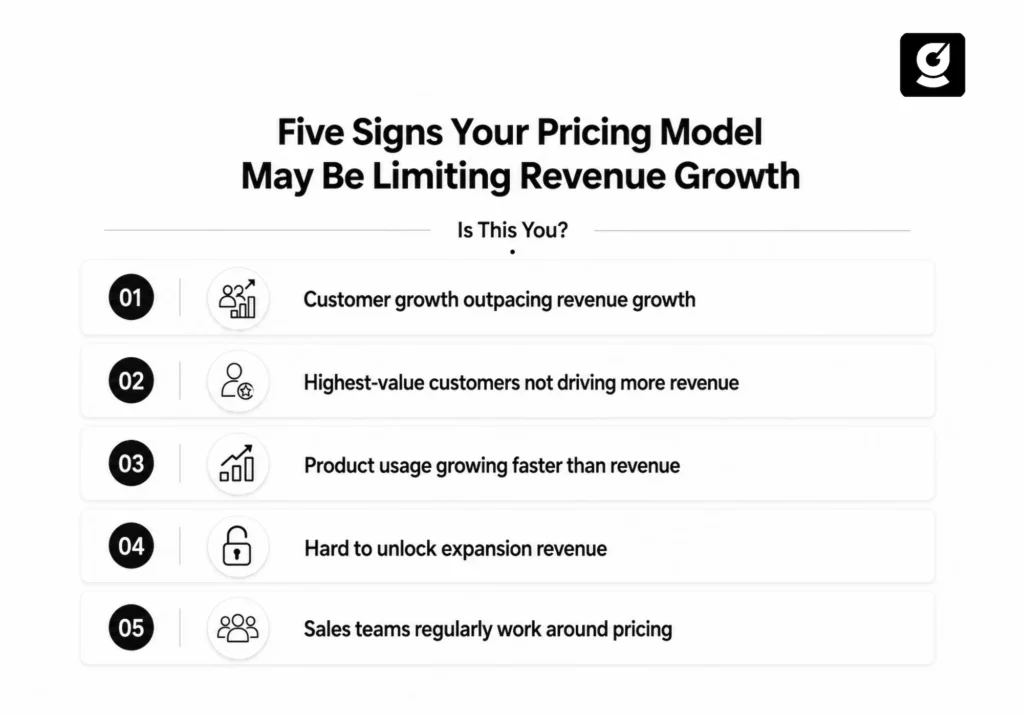
1. Customer Growth Is Exceeding Revenue Growth
Customer acquisition is crucial, but it does not ensure revenue efficiency. The company can be having trouble monetising if client acquisition keeps getting better while revenue growth stays mostly unchanged.
Typical indications include:
- Decreasing revenue per customer
- Reduced ARPA (average revenue per account)
- Poorer net revenue retention
- Growing acquisition expenses without corresponding increases in revenue
At first glance, acquisition metrics may look healthy. However, revenue growth eventually reveals underlying pricing weaknesses. However, pricing needs to be examined more closely when revenue growth continuously falls short of client growth.
2. Your Highest-Value Customers Are Not Driving Higher Revenue
Compared to smaller clients, enterprise customers frequently obtain significantly greater value. They may have larger teams, more advanced use cases, higher adoption rates, and a stronger business impact. However, many SaaS providers continue to charge these consumers using pricing models that were initially designed for smaller accounts.
Warning indicators include:
- Enterprise customers consuming significantly more resources without revenue expansion
- Large assistance needs without revenue growth
- High-value accounts using programs similar to those of smaller clients
- Insufficient options for enterprise packaging
When pricing fails to take into account the impact on customers, revenue opportunities are missed.
3. Product Usage Is Growing Faster Than Revenue
Increasing product use is typically a good sign. It suggests that adoption, engagement, and reliance on the platform are improving. However, if usage grows while revenue remains flat, the company may be missing monetization opportunities.
Potential monetization approaches include:
- Usage-based pricing models
- Additional seat-based pricing tiers
- Premium feature packages
- Expansion triggers tied to customer growth
- Business outcome-driven pricing tiers
When price is detached from usage patterns, businesses frequently fail to turn improved product value into income.
4. Expansion Revenue Is Hard to Unlock
Sustainable growth is mostly dependent on expansion income for many SaaS companies. Getting new clients is costly. It is usually more profitable and economical to expand current accounts. However, when pricing structures are unable to accommodate client growth, expansion becomes challenging.
Common obstacles include:
- Poor upgrade routes
- Limited upsell opportunities
- Uncertain pricing progression
- Plans that are unable to meet the growing customer demands
These restrictions may lower long-term revenue potential and have a direct impact on net revenue retention.
5. Sales Teams Regularly Work Around Pricing
Pricing issues are frequently first identified by sales teams. Sales talks concentrate on results and company effect when pricing is in accordance with customer value. When pricing is off, workarounds become frequent.
Typical signs include:
- Constant discounts
- Tailored prices for similar clients
- Long-running negotiations
- Difficulty conveying value
- Inconsistent deal structures
These problems frequently indicate more serious flaws with price architecture, client segmentation, or packaging.
How Growth-Stage SaaS Companies Align Pricing With Customer Value
An effective SaaS pricing model strategy goes beyond setting prices. It connects pricing to broader business objectives and GTM execution
High-growth SaaS firms understand that pricing is most effective when it supports revenue operations, customer acquisition, expansion, and retention all at once.
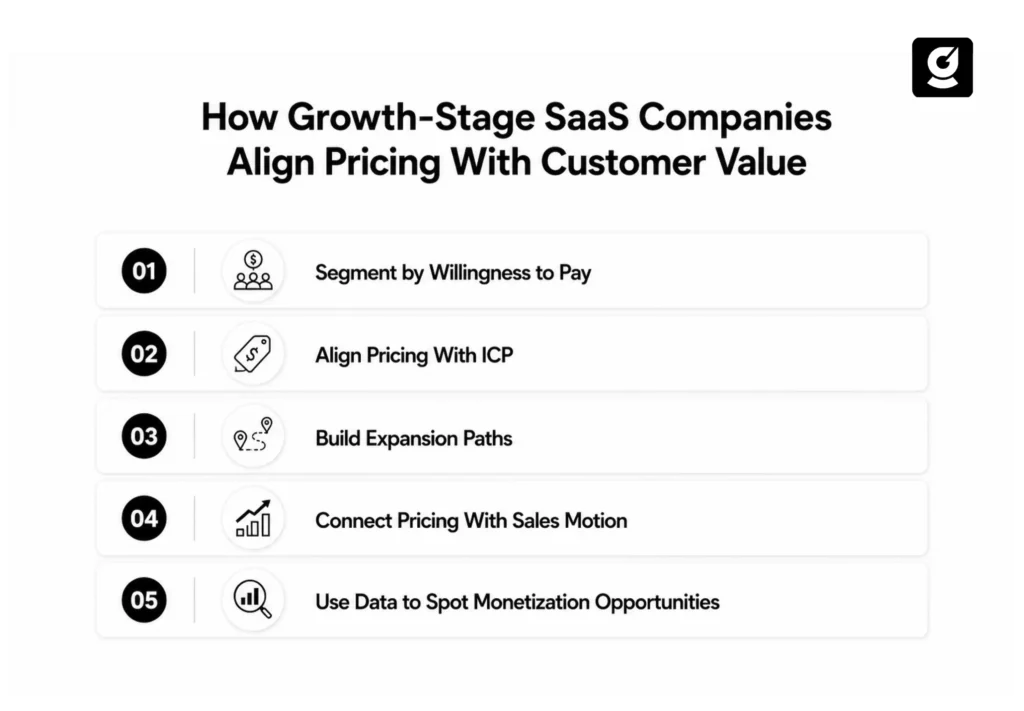
1. Segment Customers Based on Willingness to Pay
Not every client gets the same value. Growth-stage businesses are increasingly dividing up their clientele according to:
- Business impact
- Usage patterns
- Operational complexity
- Buying behavior
Instead of considering every customer the same, this enables price systems to reflect variations in value and identify the right SaaS pricing model for them.
2. Align Pricing With ICP
Effective pricing attracts the right clients while discouraging poor-fit ones. SaaS companies stop speculating about their prices once they reach the growth stage. Rather, they view pricing as an accurate instrument to draw in and screen for their Ideal Customer Profile (ICP).
Pricing should serve more general positioning goals and assist the company’s intended clientele. You can target the right accounts, save sales cycles, and increase revenue by matching your price to client value. When pricing and ICP alignment improve, acquisition efficiency improves simultaneously.
3. Build Expansion Paths
Pricing is used by growth-stage SaaS firms to create predictable growth routes. Net Revenue Retention (NRR) is primarily driven by expansion revenue, which is also the least expensive method of scaling. Consumers are expected to be able to grow with the product.
Clear progression paths are produced by effective pricing methods based on:
- Team development
- Product usage
- High-level capabilities
- Business results
Expansion becomes considerably simpler when pricing automatically increases with client success.
4. Connect Pricing With Sales Motion
Pricing should support the sales process, not complicate it. Your sales staff should use pricing as a catalyst rather than an administrative barrier. Instead of arguing complicated math or haggling over arbitrary discounts, sales professionals can fully concentrate on identifying customer pain areas and establishing trust when pricing frameworks are clear, straightforward, and value-aligned.
Pricing alignment benefits for sales include:
- Simplifies the value conversation
- Streamlines the qualification process
- Eliminates constant negotiations
- Accelerates deal velocity
5. Use Customer Data to Identify Monetization Opportunities
The strongest pricing decisions are informed by customer behavior. Data-driven growth-stage SaaS companies utilise user behavioural data to directly derive monetisation insights rather than guessing about package improvements.
They regularly analyze product adoption, usage trends, retention performance, expansion patterns, and customer success outcomes. These insights aid in identifying scenarios in which customers obtain much more value than current pricing conveys.
Analysing customer behavioural data allows B2B SaaS companies to capture expansion income through numerous key vectors:
- Detects unpriced high-value features
- Signals perfect timing for upgrades
- Pinpoints innovative modular add-on potential
- Uncovers underpriced power-user groups
At growth.cx, pricing concerns are frequently linked to more general GTM problems. Pricing is rarely found in isolation. It has an impact on revenue operations, customer growth strategy, sales motion, positioning, and ICP definition.
The most affluent SaaS firms create connected GTM systems with pricing that facilitates steady and expandable revenue growth.
Conclusion: Pricing Is a Growth Lever, Not Just a Revenue Decision
When revenue growth slows, many SaaS companies prioritise acquisition. From our experience, most of the acquisition problems are generally monetization issues. They make larger investments in pipeline development, sales capabilities, and demand generation. Although these activities are important, acquisition issues are not usually growth challenges.
A SaaS pricing model that doesn’t change in step with customer value can subtly restrict growth, limit prospects for expansion, and lead to inefficiencies across the entire revenue engine. At growth.cx, we assist B2B SaaS firms in discovering the gaps preventing scalable expansion. Build a predictable revenue engine by aligning your positioning, GTM strategy, demand generation, RevOps, pricing, and customer growth.
Explore how growth.cx, as a SaaS marketing agency, assists SaaS organisations in developing predictable revenue engines by identifying and closing the gaps that limit scalable growth.
FAQ’s
How to develop a SaaS pricing model?
The first step in creating the best SaaS pricing model includes understanding your target market, the value they receive, and their willingness to pay. Besides, a successful SaaS pricing model should be consistent with long-term growth objectives, product usage, and customer segments.
How do subscription tiers typically work in SaaS pricing?
In SaaS pricing, subscription tiers divide users into various plans according to features, use limits, user seats, or support levels. Customers can upgrade to higher tiers that offer greater value and capabilities as their needs evolve.
Which SaaS pricing model works best for growth-stage companies?
Growth-stage SaaS companies frequently benefit from pricing models that can scale in parallel with client adoption and usage. The ideal model should make it easy to earn additional revenue as clients grow their teams, usage, or business impact.
What is the best pricing model for a SaaS company?
There is no single pricing plan that works for all SaaS businesses. The ideal strategy takes into account the value that customers receive from your product and permits revenue to grow as customer usage, adoption, and company impact improve.