
83 % of SEO professionals say backlinks remain a top-three Google ranking factor, according to Moz’s Search Ranking Factors report. Guest Blogging Outreach is still one of the most reliable ways to earn those links, but most outreach efforts fail before they start.
Guest blogging outreach will never fail if we provide useful, valuable content and engage readers. For this, it’s important that you conduct keyword research to identify which content is ranking on the first page and write a better one.
This guide shows you exactly how guest blogging outreach works, what separates accepted pitches from ignored ones, and which tools make the process repeatable without killing personalization.
What Is Guest Blogging Outreach?
Guest blogging outreach is the process of identifying relevant third-party websites, pitching a topic idea to the editor, and publishing original content on their platform. In return, you receive author attribution and typically a backlink to your website.
It is not the same as buying links or submitting to low-quality article directories. High-quality guest blogging outreach targets real editorial sites: blogs, industry publications, and SaaS content hubs with genuine audiences. The same principles that apply to building a strong B2B SaaS website apply here: credibility, clarity, and relevance.
Why Is Guest Blogging Outreach Important for SEO?
Backlinks from authoritative, relevant domains remain one of the strongest ranking signals in Google’s algorithm. A single placement on a DA 60+ site can move rankings faster than months of on-page optimization.
Beyond rankings, guest posts build brand credibility. When a prospect sees your name published on a respected industry site, trust is established before they ever visit your homepage.
- Backlinks: Each placement earns a contextual link that passes domain authority to your site
- Brand authority: Consistent bylines across relevant publications signal expertise to both readers and search engines
- Referral traffic: Engaged readers from the host site click through to your content, often with high buying intent
Guest Blogging in SEO: How Does It Impact Rankings?
Search engines evaluate the quality and relevance of the sites linking to you, not just the quantity. A guest post on a niche-relevant DA 50 site is worth more than ten links from unrelated general blogs.
Guest blogging also helps you rank for competitive keywords by building topical authority over time. Each placement reinforces your brand’s association with specific subject areas in Google’s entity graph. This is a core principle of effective SaaS content marketing: consistency of topic signals authority.
- Relevance: Links from topically aligned domains carry stronger SEO weight
- Authority signals: High-DA placements accelerate domain-level trust
- Organic visibility: Keyword-rich anchor text in guest posts supports target page rankings
Understanding current SaaS content marketing trends helps you choose topics that editors are actively seeking.
What Are the Different Types of Guest Posting?
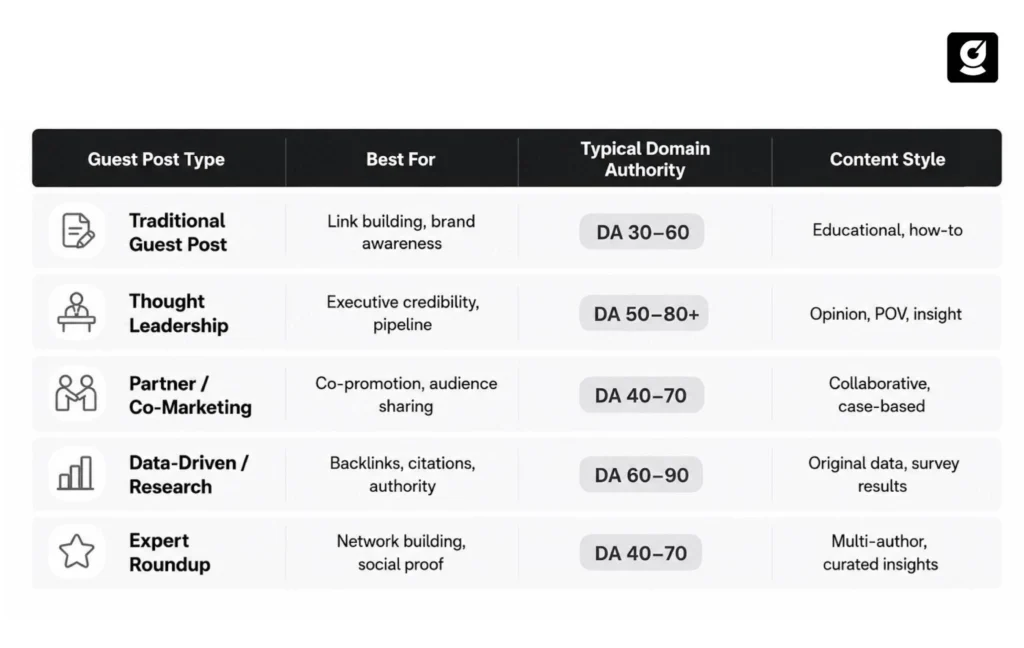
Not all guest posts serve the same purpose. Choosing the right format depends on your goal, whether that is building links, driving leads, or establishing executive credibility.
1. Traditional Guest Posting
This is the most common format. You pitch an educational article, a how-to guide, a listicle, or a tactical breakdown to a site in your niche. The goal is a dofollow backlink from a relevant domain.
Traditional guest posts work well for early-stage SEO programs where the primary objective is building domain authority through volume and relevance.
2. Thought Leadership Guest Posts
These are opinion-forward articles written under an executive’s byline, typically a founder, CMO, or VP. The content takes a clear position on an industry issue rather than explaining a process.
Thought leadership placements target high-authority publications like Forbes, Harvard Business Review, or vertical-specific outlets. They build pipeline trust more than they directly move rankings.
3. Partner and Co-Marketing Guest Posts
Here, two brands collaborate on a single piece of content. One brand writes, the other publishes. Both audiences benefit, and both brands gain exposure without competing for editor attention.
4. Data-Driven and Research-Based Guest Posts
These are the most link-worthy formats. Original research, surveys, and proprietary data attract backlinks from other publishers who cite your findings. One well-executed study can generate dozens of passive inbound links over time.
5. Expert Roundups and Collaborative Content
Roundups aggregate short quotes or tips from multiple industry voices. If you contribute, you earn a link back to your site. If you host, you build relationships and social reach when participants share the piece.
How Does the Guest Post Outreach Process Work?
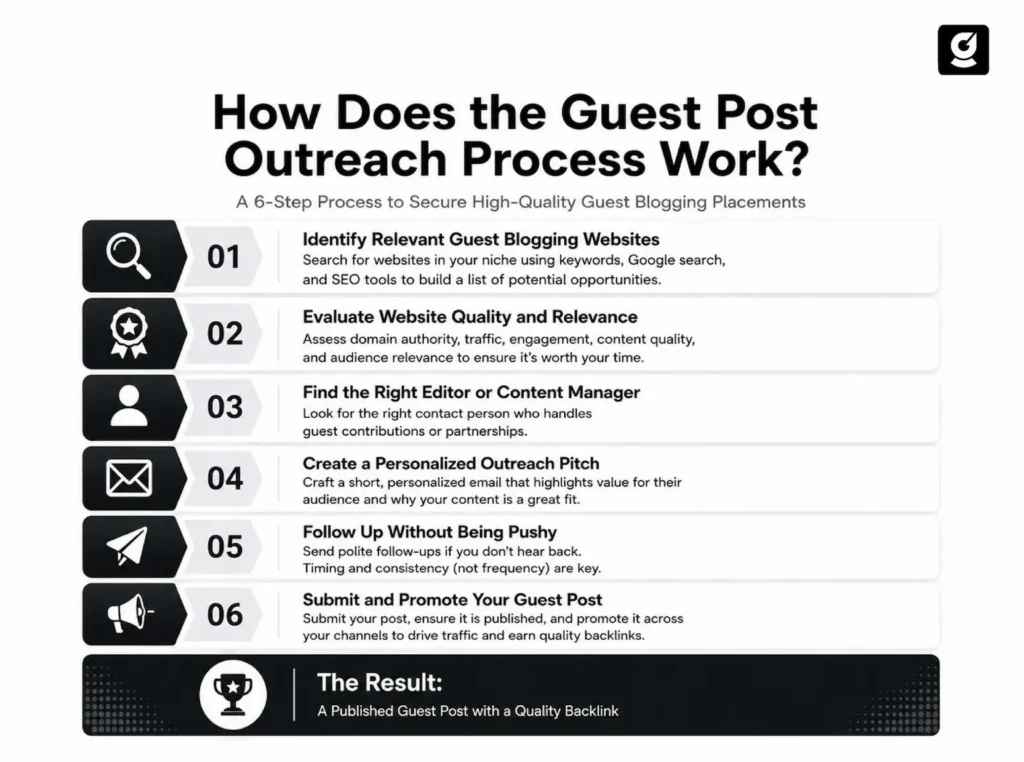
The process has six distinct stages. Skipping any one of them significantly reduces your acceptance rate.
1. Identify Relevant Guest Blogging Websites
Start with sites your target audience already reads. The goal is not just any link. It is a link from a site where your ICP spends time. Use Google search operators, competitor backlink reports, and curated lists of industry publications to build your initial target list.
- Search: “write for us” + [your niche keyword]
- Search: “guest post by” + [competitor name]
- Check Ahrefs Site Explorer for sites linking to your top three competitors
2. Evaluate Website Quality and Relevance
Not every site that accepts guest posts is worth your time. Evaluate each prospect against three criteria: domain authority, traffic quality, and editorial standards.
- Domain Rating (DR) or Domain Authority (DA): Target DR 35+ for meaningful SEO lift
- Organic traffic: Use Ahrefs or SEMrush to verify the site actually gets real visitors
- Content quality: Read three to five recent posts. If the writing is thin or generic, skip it
3. Find the Right Editor or Content Manager
Sending your pitch to a generic contact form is the fastest way to get ignored. Find the specific editor, content manager, or blog lead responsible for submissions.
- Use Hunter.io to find email addresses by domain
- Check the site’s masthead, LinkedIn page, or Twitter/X bio
- Look for the byline on recent blog posts. That person often manages submissions
4. Create a Personalized Outreach Pitch
Your pitch email needs to prove you read the site. Reference a specific article, explain why your proposed topic fits their audience, and keep the email under 150 words. Editors are busy. Long pitches get deleted.
- Open with a specific, genuine reference to their content
- Propose two to three topic ideas, not one. Give them a choice
- Include two to three links to your published work as evidence of writing quality
5. Follow Up Without Being Pushy
If you hear nothing after seven to ten days, send one follow-up. Keep it short, three sentences maximum. If there is still no response after a second follow-up, move on. Pestering editors kills relationships.
6. Submit and Promote Your Guest Post
Once accepted, follow the site’s editorial guidelines exactly. After publication, share the piece across your own channels. A structured content repurposing workflow helps you extract more reach from every guest post you publish.
When you drive traffic to their site, editors remember, and that makes your next pitch easier to accept.
How to Find High-Quality Guest Blogging Websites
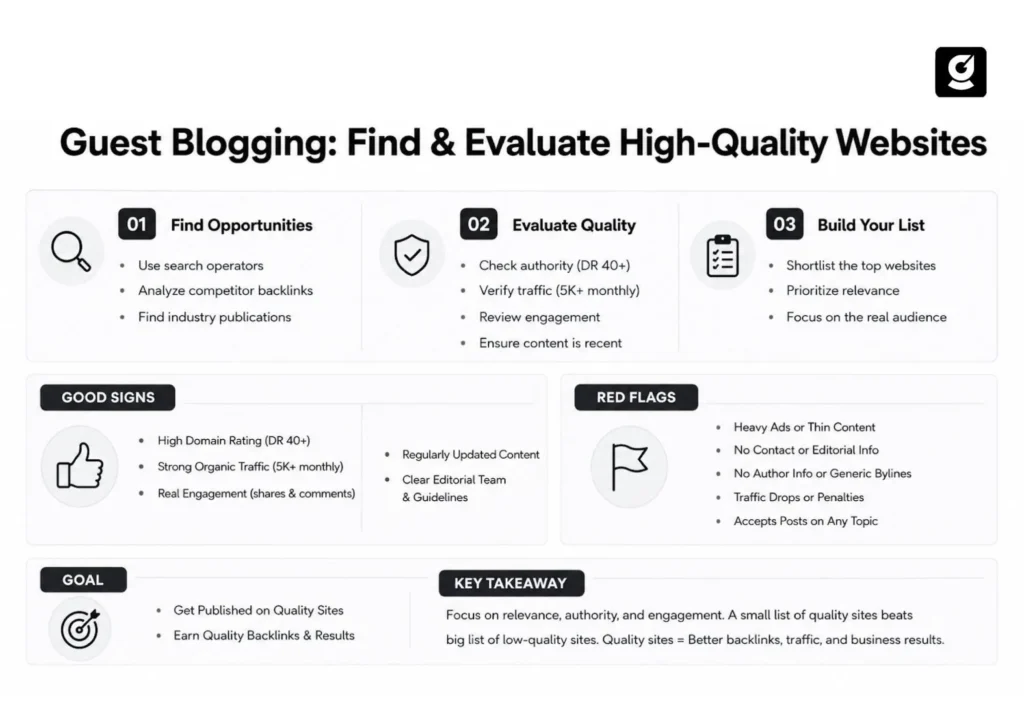
The quality of your target list determines 80% of your results. A strong list filled with relevant, high-authority sites beats a massive list of low-quality domains every time.
1. Search Operators to Discover Opportunities
Google’s advanced search operators surface sites actively seeking guest contributors. Use these combinations in search:
- “submit a guest post” + [keyword]
- “write for us” + [keyword]
- “contribute an article” + [keyword]
- “guest post guidelines” + [keyword]
- inurl:guest-post + [keyword]
2. Using Competitor Backlink Analysis
Your competitors have already done the prospecting work for you. Pull their backlink profiles in Ahrefs or SEMrush, filter for guest posts, and add those domains to your list.
If a site published your competitor, it likely accepts guest content in your niche. You already know the content standard they expect.
3. Finding Industry-Specific Publications
Vertical publications often convert better than general marketing blogs because the audience is more targeted. Search for trade publications, association blogs, and niche newsletters in your industry.
For SaaS companies, strong categories include: SaaS/startup media, product management blogs, growth and marketing publications, and B2B sales content hubs.
4. How to Assess Website Authority and Engagement
- Domain Rating (DR) via Ahrefs: Prioritize DR 40+
- Monthly organic traffic: Verify via Ahrefs or SEMrush. Aim for 5,000+ monthly visitors
- Social engagement: Check if posts get shared and commented on
- Recency: Sites that publish regularly are more likely to accept new submissions
5. Red Flags That Indicate Low-Quality Websites
- Heavy advertising, thin content, or exact-match anchor text throughout the site
- No real editorial team or contact information
- Published content with no author attribution or generic bylines
- Traffic data showing sudden drops. Possible Google penalty
- Accepting posts on every topic with no clear niche focus
How to Craft Outreach Emails That Get Responses
Your email is a cold pitch to someone who has no idea who you are. It needs to be short, specific, and immediately useful to them.
- What Editors Look for in a Pitch
Editors want three things: evidence that you read their blog, proof that you can write, and a topic idea that their audience will actually care about. Everything else is noise.
- Relevance: Does the proposed topic fit their existing content?
- Quality signals: Do your writing samples demonstrate expertise?
- Ease: Is the pitch easy to evaluate quickly?
- How to Write a Compelling Subject Line for Guest Post Pitches
The subject line determines whether your email gets opened. Keep it under 50 characters. Name their blog specifically. Hint at the topic without being vague.
- “Guest Post Idea for [Blog Name]: [Topic in 5 Words]”
- “[Your Name] – Writing Pitch for [Publication Name]”
- “Idea: [Specific Article Concept] for [Audience Type] on [Blog]”
Avoid: “Collaboration Opportunity,” “Quick Question,” or “Mutual Benefits.” These read as templates.
- Personalization Techniques That Improve Response Rates
- Reference a specific article they published and say what you found useful about it
- Mention a gap in their content that your proposed topic fills
- Use the editor’s first name. Confirm it on LinkedIn before sending
- Match your pitch tone to their publication’s voice
- Common Outreach Mistakes to Avoid
- Sending the same pitch template to 50 sites without changing a word
- Proposing topics already covered on their blog. Shows you did not research
- Attaching a full draft unsolicited. Editors want to approve the concept first
- Using a Gmail account instead of a professional domain email
- Following up three or more times. Two touches maximum
Guest Blogging Outreach Templates You Can Use
These are working templates designed for high acceptance rates. Customize every bracketed element. Editors spot unchanged templates immediately.
| Template 1: Initial Outreach Email Subject: Guest Post Idea for [Blog Name] – [Short Topic Hint] Hi [Editor First Name], I came across your post on [specific article title] and found your breakdown of [specific angle] genuinely useful, especially the point about [detail]. I write for [your publication or brand] and cover [your niche]. I would love to contribute to [Blog Name]. Here are three ideas that might fit your readers: 1. [Topic Idea 1 – one sentence explaining the angle] 2. [Topic Idea 2 – one sentence explaining the angle] 3. [Topic Idea 3 – one sentence explaining the angle] A few recent pieces I have written: [link 1], [link 2] Would any of these work for you? Happy to adjust based on what your editorial calendar needs. [Your Name] [Your Title] | [Your Website] |
| Template 2: Follow-Up Email (7-10 Days Later) Subject: Re: Guest Post Idea for [Blog Name] Hi [Editor First Name], Following up on my pitch from [date]. Still happy to write for [Blog Name] if any of the topics fit your calendar. No pressure. Just wanted to make sure my email did not get buried. [Your Name] |
| Template 3: Guest Post Pitch for SaaS Companies Subject: Guest Pitch: [Topic] for [Target Audience] – [Blog Name] Hi [Editor First Name], I lead content at [SaaS Company], where we work with [ICP description]. I read [Blog Name] regularly. Your recent coverage of [topic] aligned closely with what we hear from customers about [pain point]. I would like to contribute a piece titled: “[Proposed Title]” The angle: [2-3 sentence summary of the argument and what makes it original] This would be written from our operational experience, not a promotional piece. Here is my recent work: [link 1], [link 2] Would this work for [Blog Name]? [Your Name] [Title] | [Company] | [Website] |
Which Tools Help Automate Guest Blogging Outreach Campaigns?
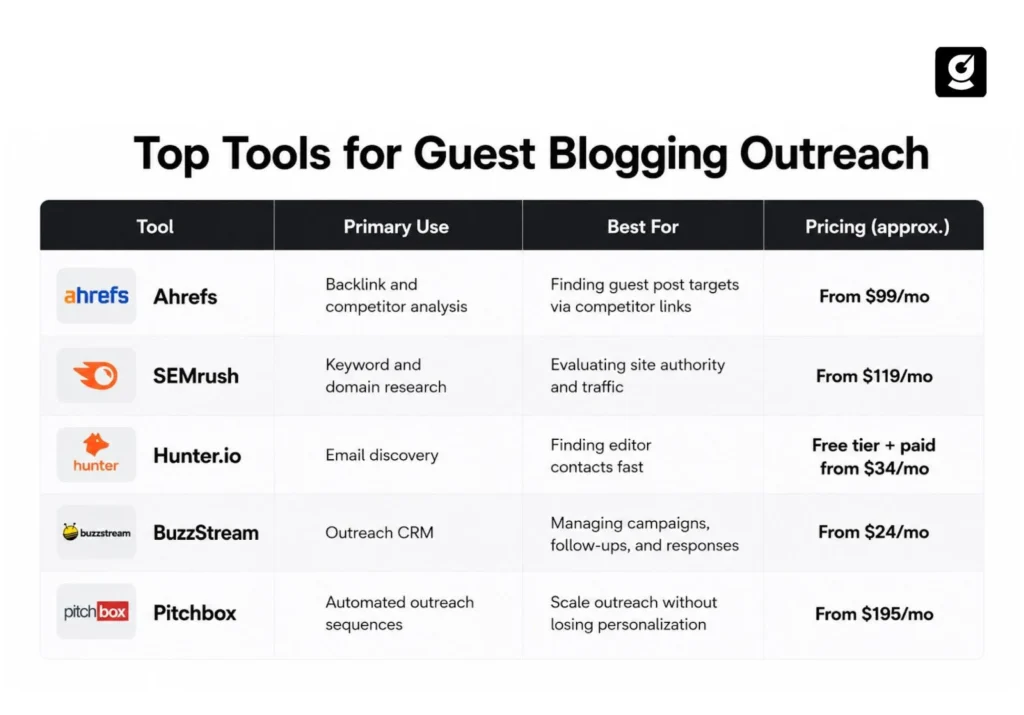
The right tools reduce research time and prevent leads from falling through the cracks. None of them replaces personalization. They just make it scalable.
1. Ahrefs for Prospect Research
Ahrefs’ Site Explorer shows every domain linking to your competitors. Filter by link type, anchor text, and referring page URL to isolate guest post placements. The Content Explorer also surfaces top-performing content in any niche, helping identify which publications drive real engagement.
2. SEMrush for Competitor Analysis
SEMrush’s Backlink Analytics tool pulls competitor link profiles and flags link-building patterns. Use the Link Building Tool to manage your prospect list and track outreach status directly inside the platform.
3. Hunter.io for Contact Discovery
Hunter.io finds email addresses associated with any domain. Enter the publication’s URL to return verified contacts, confidence scores, and email format patterns. It also flags common email structures so you can guess addresses when direct data is unavailable.
4. BuzzStream for Outreach Management
BuzzStream acts as a CRM for your outreach campaigns. It tracks who you have contacted, stores email threads, and manages follow-up sequences. For teams running more than 30 outreach contacts per month, it prevents the chaos of managing campaigns inside a shared inbox.
Running outreach manually across spreadsheets? growth.cx builds and manages guest-posting campaigns for B2B SaaS brands, so your team can focus on closing deals, not chasing editors.
How to Measure the Success of Guest Blogging Outreach
Rankings and traffic are lagging indicators. The metrics below give you a clearer picture of whether your guest posting program is building real SEO equity.
If you do not have a clear content marketing strategy behind your outreach, placements alone will not move the needle.
| Metric | What to Track | Target Benchmark |
| Backlink Quality | DR/DA of linking domain, do follow status | DR 40+ for meaningful authority lift |
| Referral Traffic | Sessions, bounce rate, time on page from guest post | Low bounce rate signals audience fit |
| Keyword Rankings | Movement in target keyword positions post-placement | Track 30/60/90 day windows |
| Lead Generation | Form fills, demo requests attributed to referral | Even 1-2 SQLs/month per placement adds up |
| Brand Visibility | Branded search volume, mentions, social shares | Monitor via Google Alerts or Ahrefs Alerts |
- Backlink Quality
Not all backlinks are equal. Track the DR and topical relevance of every domain that links to your post-placement. A link from a DA 70 industry publication is worth more than ten links from generic blogs.
- Referral Traffic
Check Google Analytics for referral traffic from each guest post URL. A high session count with a low bounce rate signals that the host site’s audience found your content relevant, which is exactly the intent you want.
- Keyword Rankings
Monitor movement for target keywords in the 30-, 60-, and 90-day periods after a placement goes live. Guest posts in high-authority publications often accelerate ranking gains for the linked page.
- Lead Generation and Conversions
Set up UTM parameters on any links embedded in your guest posts. This lets you track which placements drive actual sign-ups, demo requests, or downloads, not just traffic.
For a deeper breakdown of turning content into a pipeline, this SaaS content conversion guide covers the full attribution picture.
- Brand Visibility Metrics
Track branded search volume in Google Search Console. A consistent guest posting program increases branded searches over time as more people encounter your name across multiple publications.
Common Guest Blogging Outreach Mistakes That Hurt Results
Most outreach programs fail for the same five reasons. These are fixable, but they require discipline.
Sending Generic Outreach Emails
A pitch that could have been sent to any publication signals that you did not care enough to research. Editors know immediately when an email is a template. Personalization is not optional. It is the minimum standard for getting a reply.
Prioritizing Quantity Over Quality
One placement on a DA 60 site beats twenty placements on DA 20 sites, both for SEO and for credibility. Chasing volume is a symptom of not having a clear target list. Fix the list before scaling the outreach.
Targeting Irrelevant Websites
A backlink from an unrelated niche carries little SEO value and zero audience value. Guest blogging outreach only works when the host site’s readers overlap meaningfully with your target buyer.
Ignoring Editorial Guidelines
Every quality publication has submission guidelines. Ignoring them signals disrespect for the editor’s time. Read the guidelines, follow the word count, format requirements, and link policies before submitting anything.
Not sure what good content practice looks like? Review these content marketing dos and don’ts before you pitch.
Failing to Follow Up
Many placements happen on the second or third touchpoint, not the first. Editors are busy. A polite, brief follow-up seven to ten days after your initial pitch can move a stalled conversation forward.
When Should You Use Guest Blogging Outreach Services?
Managing guest blogging outreach in-house is viable if you have the time, tools, and bandwidth. Most SMB and startup teams do not.
Challenges of Managing Outreach In-House
- Prospecting and vetting sites takes 3-5 hours per week at a minimum
- Personalized pitching at scale requires a dedicated content and outreach resource
- Tracking conversations, follow-ups, and placements without a CRM becomes chaotic fast
- Writing quality guest content on top of existing content commitments strains small teams
What to Look for in a Guest Posting Agency
- Transparent list of target publications, not vague promises about “tier 1 sites.”
- Clear process for topic ideation and editorial alignment with your brand voice
- Reporting on DA, traffic, and link attributes for every placement
- No link farms, private blog networks (PBNs), or paid placements disguised as organic
Top Platforms Offering Guest Blogging Outreach Services
- Loganix: Managed guest post placements with transparent site metrics
- The HOTH: Guest posting packages at various budget levels
- Collaborator.pro: Marketplace for buying guest post placements directly
- Blogger outreach tools: For DIY campaigns at a lower cost
How does growth.cx Help SaaS Brands Earn High-Quality Placements?
growth.cx operates as a full-service B2B SaaS marketing agency that integrates guest blogging outreach into a broader organic growth strategy. Rather than selling standalone link packages, the team connects guest posting to your keyword targets, ICP, and content roadmap.
The agency targets editorially relevant, high-authority placements rather than paid link insertions. If you are evaluating options, here is how to compare SaaS content marketing agencies before committing.
Every guest post is written to match the host publication’s voice and audience, thereby increasing acceptance rates and protecting your site from algorithmic penalties. If your in-house team is producing the content, this guide to SaaS blog writing is worth reviewing first.
- Prospect research and site vetting aligned to your niche and target DR
- Topic ideation based on your keyword gaps and buyer journey
- Personalized pitch writing and follow-up management
- Full guest post writing to editorial standard
- Placement reporting with DA, traffic, and link attribute data
If your SEO program needs high-authority backlinks but your team lacks outreach bandwidth, growth.cx handles the full pipeline, from prospecting to placement.
Need help building a guest blogging pipeline?
Reach out to growth.cx.
Conclusion
Guest blogging outreach is one of the few link-building tactics that simultaneously builds brand authority, earns referral traffic, and improves organic rankings. Pair it with proven B2B SaaS content marketing conversion strategies, and the compounding effect on the pipeline becomes measurable.
High-quality placements come from treating outreach like relationship-led sales rather than a bulk email campaign. The editors who say yes are the ones who felt your pitch was written specifically for them.
- Start with a curated list of relevant, high-authority sites. Quality over quantity
- Personalize every pitch with specific references to the publication’s existing content
- Use tools like Ahrefs, Hunter.io, and BuzzStream to scale without losing personalization
- Track placements by backlink quality, referral traffic, and keyword ranking movement
- Outsource to a specialized agency when in-house bandwidth limits execution
If you want a guest blogging outreach program that runs without consuming your team’s time, consider growth.cx builds and manages the full pipeline, from site prospecting to published placements.

FAQ
Which Are the Best Tools to automate Guest Blogging Outreach Campaigns?
Ahrefs and SEMrush for prospect research, Hunter.io for contact discovery, and BuzzStream or Pitchbox for managing follow-up sequences. For most SMB teams running 20 to 50 contacts per month, Ahrefs plus Hunter.io covers most of the workflow.
How to Find Relevant Blogs for Guest Posting Opportunities?
Use Google search operators such as "write for us" or "guest post guidelines," combined with your niche keyword. Pull competitor backlink profiles in Ahrefs and filter for guest post placements. Trade publications and niche newsletters in your vertical are high-value targets most marketers skip.
How to Outreach for Guest Posting?
Find the specific editor responsible for submissions, not a generic contact form. Send a personalized pitch under 150 words with a specific article reference, two to three topic ideas, and writing samples. Follow up once after seven to ten days if you hear nothing.
How to Craft a Compelling Subject Line for Guest Post Pitches?
Keep it under 50 characters, name the blog, and hint at the topic. Use this format: "Guest Post Idea for [Blog Name]: [Topic in 4-5 Words]." Avoid "Collaboration Opportunity" or "Quick Question." Specificity signals you actually researched the site.
Which Agencies Specialize in Guest Post Placement Services?
Loganix for transparent managed placements, The HOTH for scalable packages, and Collaborator.pro for a direct marketplace model. For B2B SaaS brands that need guest posting connected to a broader SEO strategy, growth.cx runs the full program rather than selling isolated link packages.