You hired two more AEs. You doubled the ad budget. You added another SDR. Pipeline still isn’t moving.
More leads won’t fix this. More sales hires won’t either. If your GTM system is broken, throwing money at it just makes the leak bigger, faster.
Most SaaS growth strategy teams have all the pieces: an ICP, a pricing page, a few channels running. On paper, it looks complete. In practice, something is quietly killing conversion, and nobody can point to exactly what.
Here’s what most frameworks won’t say out loud: a Go-to-Market Strategy Framework isn’t a list of parts sitting next to each other. It’s a system. And most systems break at the one point nobody’s watching.
This piece breaks down the 7 building blocks that make a B2B SaaS GTM strategy actually scale, including the one block almost every team skips, and why it’s costing them pipeline.
What Are the 7 Building Blocks of a Scalable Go-to-Market Strategy?
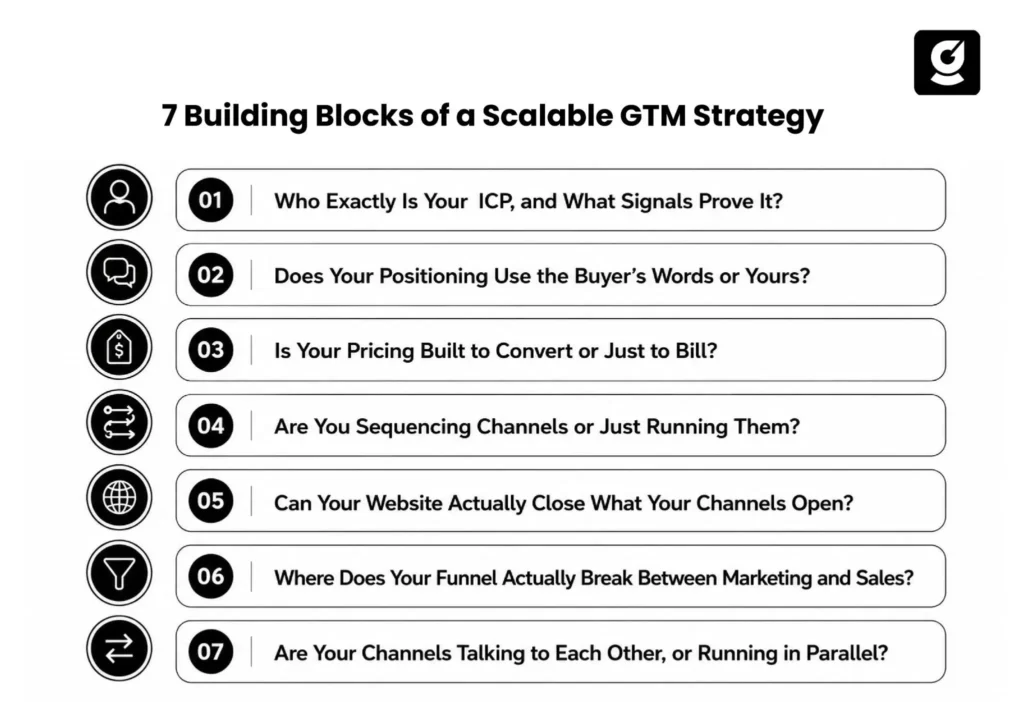
A GTM strategy has seven working parts. Each one answers a question a buyer, or a revenue leader, is already asking. Skip one, and the funnel leaks in a predictable way.
| Block | Core Question | What Breaks Without It |
| ICP & buying signal map | Who are we actually selling to, and what proves it? | Sales chases logos that match the label but not the buying signal |
| Positioning in the buyer’s language | Are we describing a feature, or their problem? | Every channel has to translate; CAC rises to compensate |
| Pricing & packaging | Does pricing map to value, or to a margin target? | Wrong segment churns, right segment never expands |
| Channel sequencing | Are channels launched in the order they compound? | Fast channels get judged on slow channels’ timeline and killed early |
| Conversion infrastructure | Can the website close what the channels open? | Paid, SEO, and outreach traffic bounces before converting |
| Marketing-to-sales handoff | Where does a “qualified” lead actually get accepted? | Leads pile up; both teams blame the other for stalled pipeline |
| Cross-channel feedback loop | Are channels sharing signal, or running in parallel? | Every channel hits its own metric while total pipeline plateaus |
#1. Who Exactly Is Your ICP, and What Signals Prove It?
An ICP isn’t a firmographic label. It’s a ranked list of accounts most likely to buy, expand, and stay, backed by evidence from real deals.
- Most teams write the ICP once, in a slide: “50–500 employees, North America, Series A–C.”
- That range feels safe. It’s also wide enough to send reps chasing logos that fit the label but not the buying signal.
Example: Picture a Series A HR-tech company with an ICP based on headcount alone. Nine months later, the fastest-closing deals all share one thing the headcount filter missed: the buyer’s company just hired its first dedicated HR ops role. Company size didn’t predict urgency. A recent hiring signal did.
Fix:
- Reverse-enrich the last 50 closed-won and closed-lost deals.
- Look for firmographic, technographic, and behavioral overlap.
- Re-score the ICP every quarter. If it hasn’t changed in a year, either the market froze, or nobody’s checking.
#2. Does Your Positioning Use the Buyer’s Words or Yours?
Positioning that works borrows the buyer’s own words for their problem, not the words a team uses internally to pitch the product.
- Most positioning gets written in a workshop, by people who already understand the product.
- That’s exactly why it describes features instead of the moment a buyer decides they need help.
- “Unify your revenue data pipeline” is a feature description.
- “I can’t tell why deals are slipping until it’s too late” is what a buyer actually says on a call.
Example: Picture a Scaleup RevOps platform whose homepage uses the first line, while its own sales call transcripts are full of the second. Every ad, landing page, and SDR script now has to do extra translation work the buyer shouldn’t need to do.
Fix:
- Pull phrases from the last 20–30 sales calls and win-loss interviews.
- Rank them by frequency.
- The most common phrase, not the cleverest one, becomes the headline.
#3. Is Your Pricing Built to Convert or Just to Bill?
Pricing is a conversion lever before it’s a finance decision. It should map to a value metric the buyer already tracks, not a number picked to hit a margin target.
- Common mistake: flat per-seat pricing.
- A 40-person scaleup and a 2,000-person enterprise pay the same rate structure for very different value.
- The scaleup feels overpriced and churns at renewal.
- The enterprise account gets no natural trigger to expand.
Example: Picture a workflow tool with one flat seat price and no usage tiers. The scaleup segment churns hardest at the 12-month mark. The enterprise segment plateaus, because nothing in the product signals that upgrading unlocks more.
Fix:
- Build 3–5 tiers with 20–30% value gaps between them.
- Add usage-based triggers inside the product.
- Result: better retention in lower tiers, more expansion revenue in upper tiers, no renegotiation needed.
#4. Are You Sequencing Channels or Just Running Them?
Channels only compound when they launch in the order that matches how fast each one produces a signal.
- Paid search & ABM ads: intercept demand that already exists, show results inside 30 days
- Content & organic search: build new demand, doesn’t pay off for 3–6 months
- Outreach: works best aimed at accounts the first two channels have already warmed
Example: Picture a Startup launching all five channels in month one, with an even budget split. Paid gets judged on a 60-day payback window and killed for underperforming. SEO needed 4–6 months to compound. It gets cut before it had a chance. Outreach, with no inbound signal to prioritize, cold-blasts a generic list and posts a reply rate under 1%.
Fix, sequence it:
- Paid + ABM first, for near-term pipeline and buyer-language data
- Content + AI-SEO in parallel, judged on a longer clock
- Outreach layered in once there’s a list of accounts already showing intent
#5. Can Your Website Actually Close What Your Channels Open?
Every channel eventually points to the same few pages: the homepage, a handful of landing pages, the pricing page. If those pages don’t pass a five-second clarity test, the other six blocks are funding traffic that bounces.
- Message match is the part most teams skip.
- Ad promises “cut implementation time in half.”
- Click-through lands on a generic homepage that never mentions implementation time.
- The buyer is lost in that gap.
Example: Picture an Enterprise-track account clicking an ABM ad built around that exact promise, landing on a homepage built for a different persona. The bounce happens before the buyer reads a second sentence.
Fix:
- Build landing pages that match each channel’s specific promise.
- Cut forms to 2–3 fields, only what’s needed to route the lead.
- Result: meaningfully higher conversion than one generic page catching all traffic.
#6. Where Does Your Funnel Actually Break Between Marketing and Sales?
Most SaaS go-to-market strategy funnels don’t leak at the top. They leak at the handoff, where marketing’s definition of “qualified” and sales’ definition disagree.
Example: Picture a scaleup where marketing scores a lead an MQL after three content downloads and a pricing page visit. Sales ignores 70% of those MQLs, since none match the buying-committee roles sales actually closes.
Marketing reports strong lead volume. Sales reports a quality problem. The number that actually moved, pipeline, shows up in neither report.
Fix:
- Write one SLA that defines MQL, SAL, and SQL. Get sign-off from both teams.
- Build routing rules into the CRM.
- Leads matching the criteria get assigned automatically, not manually triaged.
#7. Are Your Channels Talking to Each Other, or Running in Parallel?
The first six blocks can each work perfectly, and the pipeline can still stall if none of them feed each other.
- This is the block most GTM guides bury in one word: “iterate.”
- It’s actually the one that decides whether the other six compound or plateau.
Example: Picture a company where paid hits its CPL target, SEO hits its ranking targets, and outreach hits its reply-rate target. Every dashboard is green. Quarterly pipeline still flattens.
Why: sales calls surfaced the exact objection killing 30% of deals two quarters ago, and nobody routed that finding into outreach or landing page copy. Every channel optimized its own metric, in isolation.
What a wired system does instead:
- What paid learns about buyer language becomes the next SEO content brief.
- What SEO ranks for becomes the next outreach personalization angle.
- What outreach hears in replies becomes the next pricing page edit or sales deck slide.
A strategy gets built once. An engine gets smarter every month it runs.
How Does growth.cx’s Approach Close the Gap Between These Blocks?
growth.cx built its own model for exactly this gap: the AI-first-In Revenue growth Engine.
- Instead of five separate workstreams (performance marketing, integrated outreach, AI-SEO, website conversion, content) reporting to five different people, they run as one connected system.
- growth.cx calls this the revenue-driven methodology.
In practice: the same account data that shapes an ABM ad audience also shapes the AI-SEO strategy content calendar, and the outreach sequence targeting the same accounts from a different angle. A signal doesn’t sit in one channel’s dashboard. It moves.
Results, in the block most frameworks skip:
- Hellosend: organic traffic up 314%, impressions up 4,130%, in six months. Not from SEO running alone, from SEO fed by the same buyer-language data paid and outreach were already collecting.
- SurveySensum: $135K in ARR, zero paid spend, once the organic/content loop was running on its own. 30–50 qualified demos a month from compounding content.
- LinkedERP: $775K in qualified pipeline in 90 days. Open rates above 50%, reply rates above 1%, in a market where cold outreach usually gets ignored. The reply rate came from personalization built on paid signals, and content had already surfaced.

None of this replaces the seven blocks. You still need a sharp ICP, positioning in the buyer’s language, pricing that converts, and a website that closes.
What changes is that each block feeds the next, instead of running its own report in isolation. That’s the real difference between ago-to-market model that works for one quarter and one that keeps compounding. This is exactly the gap a specialized SaaS marketing agency is built to close.
How Do You Audit Your Own GTM Blocks This Quarter?
None of this requires an agency to start. Run this audit quarterly, before the blocks drift apart again.
- Pull the last 50 closed-won and closed-lost deals. Re-score your ICP against what actually closed, not the original persona doc.
- Read the last 20 sales call transcripts and win-loss notes. Extract the five most common buyer phrases. Compare them to your homepage headline.
- Check if your pricing tiers map to a value metric the buyer tracks, or to a margin target.
- Map which channel generated pipeline this quarter, and in what order the buyer touched it. Everything launched in month one with an even split? That’s a sequencing problem.
- Pull ten converted landing pages and ten that didn’t. Check message match against the ad or email that drove the click.
- Write MQL, SAL, and SQL definitions in one document. Get sign-off from both marketing and sales. No document, that’s the leak.
- Ask one question at your next pipeline review: what did paid, SEO, or outreach learn this month that changed another channel’s approach? No answer means block seven isn’t built yet.
| Block | Healthy Signal | Leak Signal |
| ICP | Re-scored from closed deals every quarter | Same slide deck from 18 months ago |
| Positioning | Headline uses phrases from sales calls | Headline uses phrases from a workshop |
| Pricing | Tiers map to a value metric | Tiers map to a margin target |
| Channels | Launched in sequence, judged on separate timelines | All launched in month one, judged on the same 60-day clock |
| Website | Landing pages match each channel’s specific promise | One generic page catches every channel’s traffic |
| Handoff | Written SLA, automated routing | Slack thread, manual triage |
| Feedback loop | Channels borrow findings from each other monthly | Every channel only reports its own dashboard |
What Do B2B SaaS Leaders Usually Ask About GTM Frameworks?
What’s the difference between a GTM strategy and a marketing plan?
- A marketing plan covers campaigns and channels.
- A go-to-market plan covers the full path: ICP to renewal, including pricing, sales handoff, and packaging.
- GTM process spans product, sales, marketing, and customer success. Pricing and handoff sit outside marketing’s control, but still decide whether its leads turn into revenue.
- Treating the two as the same thing is why marketing gets blamed for problems it can’t fix alone.
How long does it take to build a working GTM strategy?
- First version: 4–6 weeks to draft.
- Roughly two full quarters to prove out, since pricing and positioning need real deal data, not assumptions.
- ICP and positioning are draftable in the first two weeks from existing deal data.
- Channel sequencing and the feedback loop take longer. They need at least one full sales cycle to prove out.
- Expecting results in 30 days usually means killing channels like SEO before they’ve had time to compound.
Do early-stage startups need all seven building blocks, or can they skip some?
- Yes, all seven, just in a lightweight form.
- ICP can be five bullet points instead of a scored model.
- Pricing can be two tiers instead of five.
- What can’t be skipped: block seven, the feedback loop. A startup’s biggest edge is changing direction in weeks, not quarters.
What’s the single biggest GTM mistake B2B SaaS companies make?
- Scaling spend before validating message and conversion path.
- More budget just multiplies a weak conversion rate. Bigger spend, bigger loss.
- Fix message match and landing page conversion first. Then scale spend.
- That’s usually the reverse of what growth pressure pushes teams toward.
How do I know if my ICP is outdated?
- Clearest sign: your fastest-closing deals no longer match your ICP document.
- Other signals: sales closing deals marketing wouldn’t have targeted, win rate dropping on “on-paper” fits, CAC rising with no targeting change.
- One signal alone could be noise. Two or more means the market moved.
What tools do I actually need to run this framework?
- A CRM that enforces lead routing rules.
- A way to score inbound signal; even a spreadsheet works at seed stage.
- One shared dashboard marketing and sales both actually use.
- Enterprise-ready companies add attribution and intent-data tools later. Those amplify a working system; they don’t create one.
How often should a GTM strategy be reviewed?
- Core metrics: monthly.
- Full rebuild (ICP, positioning, pricing, sequencing): only on a real trigger, a new competitor, a pricing model that stops converting, or two straight quarters of dropping win rate.
- Reviewing everything every quarter wastes time. Reviewing nothing for a year guarantees drift.
- Monthly check, one question: did any channel learn something the others haven’t heard yet?
What’s the fastest way to tell if my GTM blocks are actually connected, or just running in parallel?
- Ask your outreach owner: what was the top objection on sales calls last month? No answer means block seven isn’t built.
- Ask your SEO/content owner: what language showed up most in paid ad comments or landing page chats last month?
- If neither can answer without pulling a report, the signal isn’t moving in real time. It’s sitting in a dashboard nobody else checks.
Final Thoughts
That third SDR isn’t your problem. The silence between your channels is.
Most GTM content stops at block six. Block seven doesn’t fit neatly into a slide; it’s an ongoing discipline: channels sharing what they learn, instead of running their own reports.
Run the audit above this quarter. If the gap turns out to be bigger than a spreadsheet can fix, or five channels are already live and still not talking to each other, that’s the specific problem growth.cx’s AI-Built-In Revenue Engine is built to close. Explore how it works.

FAQs
How does a GTM framework help B2B SaaS companies scale?
It turns disconnected pieces, an ICP doc, a pricing page, a few channels, into one working system where each block feeds the next instead of running in isolation. Without this structure, teams end up adding headcount and ad spend to a leaking funnel instead of fixing the actual break point.
What role does the ideal customer profile play in a GTM strategy?
The ICP defines who's most likely to buy, expand, and stay, based on evidence from real closed deals rather than a static firmographic label. Without it, sales chases accounts that match the profile on paper but don't show the actual buying signals that predict a close.
How should B2B SaaS companies align sales, marketing, and product teams around a GTM framework?
The biggest alignment point is the marketing-to-sales handoff, where both teams need a written SLA defining MQL, SAL, and SQL with sign-off from both sides, plus automated CRM routing instead of manual triage. Beyond that, teams stay aligned by building a feedback loop where what one channel or team learns (like sales call objections) actively shapes another's strategy.
What metrics should B2B SaaS companies track to measure GTM success?
Beyond channel-specific numbers like CPL or ranking targets, companies should track pipeline generated per channel, message match/conversion rate on landing pages, and whether ICP still matches actual closed-won deals each quarter. Just as important is a qualitative check: whether channels are sharing findings monthly, not just hitting their own isolated metrics.
What are the most common mistakes when building a B2B SaaS GTM framework?
The biggest mistake is scaling ad spend or hiring before validating messaging and conversion paths, since more budget just multiplies a weak conversion rate. Other common errors include launching all channels at once with an even budget split, letting ICP and positioning go stale, and skipping the feedback loop so channels optimize in isolation while total pipeline plateaus.