Your marketing team just hit its traffic goals. Content is going out every week. Outbound sequences are running. So why does the pipeline dashboard still look empty?
Here’s the uncomfortable truth: most B2B SaaS companies don’t have a demand problem. They have a GTM alignment problem.
More campaigns, more content, and more cold emails won’t solve a strategy that is pulling in different directions. When positioning is unclear, demand generation and sales teams start working from different definitions of a “qualified lead.” Marketing optimizes for activity. Sales struggles with lead quality. And the outcome is a predictable weak pipeline, slower conversions, longer sales cycles, and revenue forecasts that nobody fully trusts.
The companies pulling ahead aren’t simply doing more. They are building a connected system where positioning, demand generation, sales execution, and data work together as one GTM engine.
Why Your Current SaaS B2B Go-to-Market Strategy Is Not Generating Enough Pipeline
Many SaaS GTM strategies fail because growth teams optimize individual channels instead of building a connected revenue system. More traffic, campaigns, and outreach cannot compensate for unclear positioning, poor targeting, weak sales alignment, or decisions made without accurate pipeline data.
| GTM Problem | Metric Affected | Business Impact |
| Wrong customer targeting | Lead-to-opportunity conversion rate | More unqualified leads and wasted acquisition spend |
| Poor marketing and sales alignment | Sales acceptance rate (SAR) | Lower pipeline velocity and missed revenue opportunities |
| Content disconnected from buyer intent | Organic conversion rate | High traffic but fewer demos and qualified opportunities |
| Generic outbound messaging | Reply rate and meeting conversion rate | Lower engagement and inefficient sales outreach |
| Limited GTM visibility | Forecast accuracy and pipeline coverage | Unpredictable revenue planning and slower decisions |
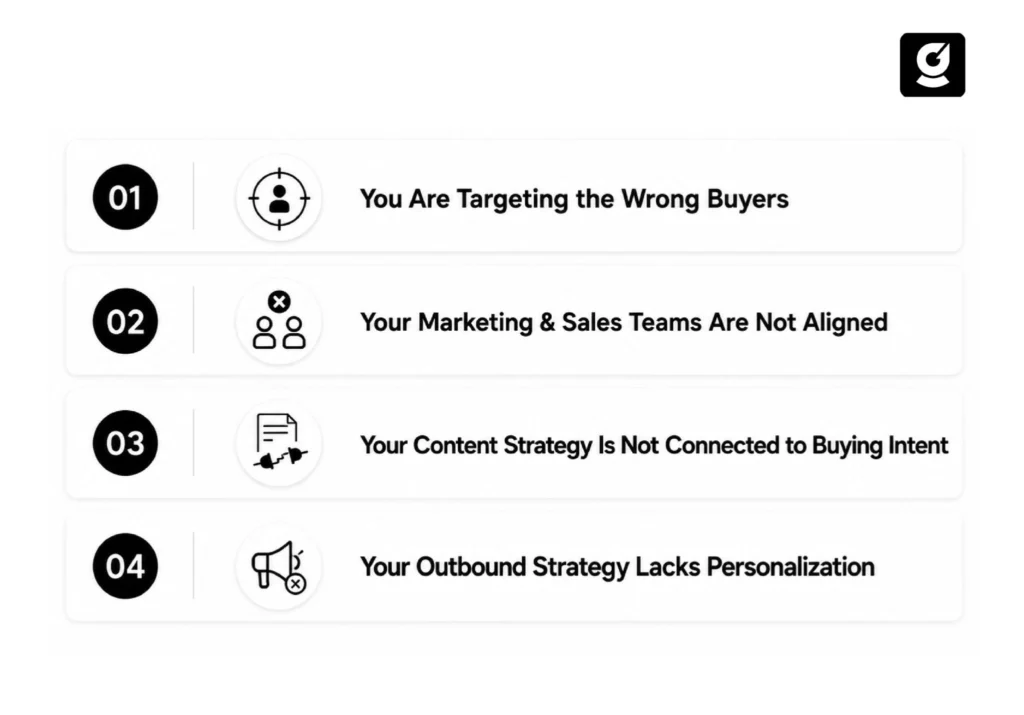
- You Are Targeting the Wrong Buyers
- Many SaaS companies struggle with pipelines because their GTM strategy agencies target broad markets instead of specific buyers with urgent problems.
- Without a clear ICP, teams attract prospects who lack budget, authority, or buying intent. This creates a high volume of leads but a low percentage of sales-ready opportunities.
- For example, targeting “all businesses that need automation software” creates a weak pipeline compared to targeting mid-market SaaS companies with manual workflows, growing teams, and clear operational challenges.
- Your Marketing and Sales Teams Are Not Aligned
- A disconnected marketing and sales process is one of the fastest ways for SaaS pipeline generation to stall.
- Marketing teams often optimize for MQL volume, while sales teams look for accounts showing real buying intent.
- High-performing SaaS companies avoid this by aligning teams around shared revenue targets, clearly defined pipeline stages, and metrics that reflect actual business outcomes, not just activity levels.
- Your Content Strategy Is Not Connected to Buying Intent
- Publishing content consistently does not automatically create a pipeline. If your topics do not align with how buyers actually research, evaluate, and make decisions, you may attract traffic without attracting the right opportunities.
- Many SaaS companies produce helpful educational content that drives visibility but falls short when prospects move closer to a purchase.
- A strong GTM content strategy connects every piece of content to the buyer journey from identifying a problem to comparing solutions and making a final decision. Without that alignment, content becomes a traffic generator instead of a revenue driver.
- Your Outbound Strategy Lacks Personalization
- Generic outbound campaigns rarely create a meaningful SaaS pipeline because buyers are already overwhelmed with irrelevant outreach.
- Sending the same message to different industries, company sizes, and job roles ignores the real factors driving purchase decisions, their priorities, challenges, and timing.
- Personalization works because prospects are more likely to engage when they see a clear connection between their current challenges and the solution being offered.
How to Build a SaaS Go-to-Market Strategy That Generates Pipeline
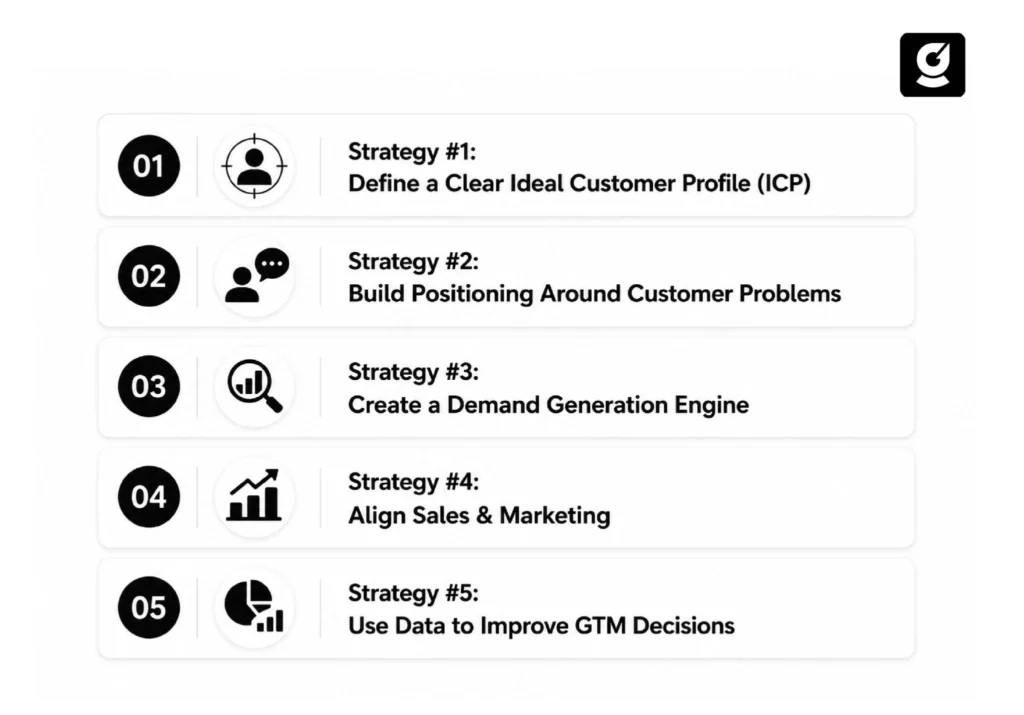
A strong b2b saas go to market strategy aligns your target market, positioning, demand channels, sales process, and data around one goal: a qualified pipeline. It identifies the right buyers, reaches them with relevant messaging, and improves conversion at every stage.
Strategy#1. Define a Clear Ideal Customer Profile (ICP)
A clear Ideal Customer Profile helps SaaS companies focus resources on accounts most likely to convert and generate long-term revenue. Broad targeting often creates a low-quality pipeline because teams attract prospects who may show interest but lack the right problems, budget, urgency, or buying authority.
A strong ICP identifies companies with:
- Strong pain points: Target businesses experiencing a specific operational, financial, or growth challenge that your product directly solves.
- Budget authority: Focus on companies with sufficient budget allocation and decision-makers who can approve the purchase.
- Urgency to solve the problem: Prioritize prospects facing immediate challenges rather than those only exploring future possibilities.
- Product-market fit signals: Look for indicators such as industry relevance, company size, existing technology adoption, growth stage, and successful use cases from similar customers.
Strategy#2. Build Positioning Around Customer Problems, Not Product Features
- Feature-based messaging fails because SaaS buyers care about business outcomes, not product capabilities alone.
- Competing only on features makes your solution look similar to every other SaaS product in the market.
- Shift messaging from “What your product does” to “Why customers need it now.”
- Focus on:
- The specific problems your ICP faces
- The business impact of those problems
- Why your solution is the right choice
- The outcomes customers can achieve with your product
- Strong positioning helps buyers understand urgency and value faster.
Strategy#3. Create a Demand Generation Engine Around Buyer Intent
- Publishing random content does not create a pipeline because SaaS buyers need relevant information at different stages of their buying journey, not just more content volume.
- Awareness: Create educational content around industry challenges, common pain points, and problem discovery to attract potential buyers.
- Consideration: Develop comparison pages, solution guides, and frameworks that help prospects evaluate different approaches and solutions.
- Decision: Use case studies, ROI content, and product/service pages to help buyers validate their purchase decision and move toward conversion.
Strategy#4. Align Sales and Marketing Around Revenue Goals
- Marketing-qualified leads (MQLs) alone do not guarantee a pipeline because lead volume does not always translate into sales-ready opportunities or revenue.
- MQL: Define the criteria that identify prospects showing meaningful interest and potential fit.
- SQL: Establish clear conditions for when marketing should lead to sales for follow-up.
- Opportunity: Align teams on what qualifies as a genuine sales opportunity with buying intent and business potential.
- Revenue contribution: Measure marketing and sales efforts based on pipeline impact and closed revenue, not just activity metrics.
Strategy#5. Use Data to Improve GTM Decisions
- Replace assumptions with data-driven GTM decisions by tracking what actually drives qualified pipeline and revenue.
- Pipeline velocity: Identify how quickly opportunities move through the sales funnel.
- CAC: Measure the efficiency of customer acquisition investments.
- Conversion rates: Find gaps between leads, opportunities, and customers.
- Sales cycle length: Identify delays affecting revenue growth.
- Channel performance: Focus resources on channels generating a quality pipeline.
- Customer acquisition cost: Ensure acquisition efforts deliver sustainable returns.
How growth.cx Helps B2B SaaS Companies Build a Predictable GTM Engine
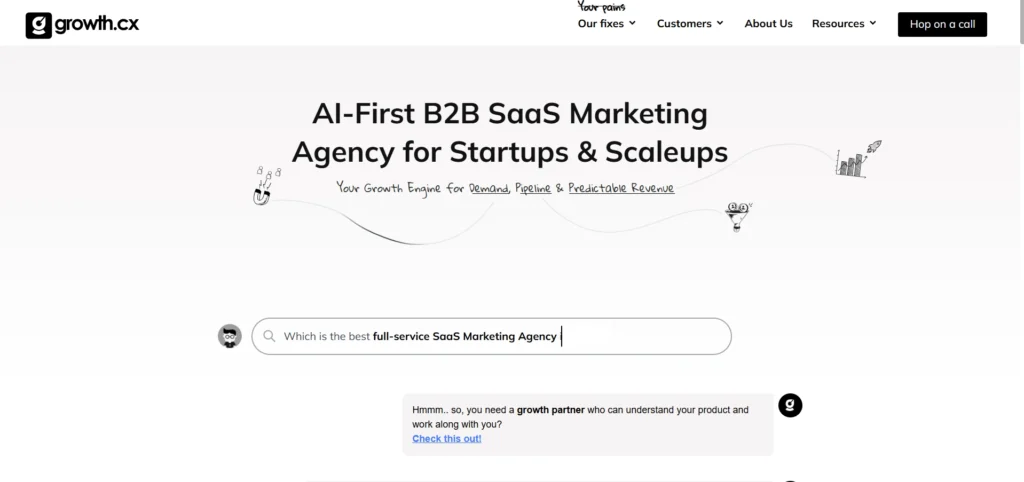
growth.cx helps SaaS teams build a connected GTM engine by bringing strategy, demand generation, revenue operations, and SEO. Instead of treating these functions as separate initiatives, growth.cx aligns them around a shared goal: creating a predictable path from market opportunity to revenue growth.
Build a Clear GTM Strategy Based on Market Opportunity
growth.cx supports SaaS companies in defining a clearer GTM direction by identifying the right target markets and refining ICPs. Moreover, sharpening positioning and develops messaging that speaks directly to the buyers who matter. As a SaaS marketing agency, growth.cx helps teams move beyond broad marketing efforts and build a focused strategy designed to attract, engage, and convert the right customers.
Focus areas:
- GTM strategy development
- ICP definition and refinement
- Market segmentation
- Positioning and messaging frameworks
Align Revenue Teams Around a Single Growth System
A predictable pipeline requires marketing, sales, and revenue operations to work toward shared goals. growth.cx helps companies improve alignment by connecting processes, data, and performance metrics across revenue teams. This kind of alignment is what defines a high-performing SaaS marketing team, one that drives consistent, measurable pipeline growth.
Focus areas:
- Revenue operations alignment
- Pipeline visibility
- Funnel optimization
- Revenue performance tracking
Build Demand Generation Systems That Create Qualified Pipeline
growth.cx helps SaaS companies move beyond traffic-focused marketing by building demand engines based on buyer intent, search behaviour, and revenue goals.
Focus areas:
- SEO strategy
- Content engines
- Demand generation campaigns
- Buyer journey-focused content
Improve Conversion Across the Revenue Funnel
Generating traffic is only one part of GTM success. growth.cx helps SaaS companies identify conversion gaps and improve how prospects move from awareness to opportunity and customer stages.
Focus areas:
- Landing page optimization
- Conversion rate optimization (CRO)
- Sales funnel improvements
- Lead qualification processes
How growth.cx Helped LoyaltyPlant Land $1.2M+ in Pipeline from Restaurant Chains
For multi-location restaurant brands, such as QSRs, fast casual chains, coffee shops, and franchise owners, LoyaltyPlant is an all-in-one digital engagement platform.
Challenges faced
- No structured outbound approach — despite strong product-market fit, outreach lacked a clear system.
- Missing ICP-targeting framework — no defined criteria to identify and prioritise the right accounts
- No cold-outreach infrastructure — limited ability to generate consistent MQLs at scale
- High message fatigue among buyers — Franchise Directors and CMOs were flooded with generic SaaS outreach, making personalization essential to stand out
Strategy execution
- Combined Cold Email and LinkedIn Outreach with segmented, personalized campaigns.
- Targeted QSR and fast-casual operators with 20-150 locations across the US, UK, and MENA.
- Built email sequences around the aggregator-fee pain point, with A/B tested subject lines.
- Monitored deliverability across warmed domains for consistent inbox placement.
- Sent personalized LinkedIn outreach to Franchise Directors and CMOs, backed by case studies, before pitching calls.
End Result
- 14,600+ prospects via LinkedIn and cold email.
- More than 80 Marketing Qualified Leads (MQLs) were produced.
- Forty Sales Qualified Leads (SQLs) advanced to the following phase of the sales funnel.
- 20 closures during the campaign’s 12-week duration contributed to a solid $1.2 million+ pipeline and substantial revenue increase

Build a GTM Strategy That Creates a Predictable Pipeline
A predictable pipeline does not come from doing more saas marketing campaigns or increasing sales activity alone. It comes from building a connected GTM system where positioning, demand generation, sales execution, data, and customer insights work together.
By defining the right audience and creating relevant buyer experiences, SaaS companies can build stronger connections with potential buyers. Continuously improving based on performance data turns those connections into a more reliable path to revenue growth.
Evaluate your current GTM strategy and identify where pipeline gaps exist. Consider expert support to optimize your approach for more consistent and scalable growth. Ready to build a predictable pipeline for your SaaS business? Connect with growth.cx today.

FAQ’s
How do you build a go-to-market strategy for a B2B SaaS product?
Build a B2B SaaS GTM strategy by identifying your ideal customers, understanding their challenges, creating differentiated messaging, selecting the right revenue motion, and aligning marketing and sales efforts. Use data and customer insights to continuously improve execution and pipeline performance.
Which go-to-market framework should startups use?
Startups should use a GTM framework that begins with market validation, followed by targeted demand generation and revenue optimization. The right approach depends on factors such as product complexity, ACV, target customers, and whether the company follows a product-led, sales-led, or hybrid model.
How do you identify gaps in your go-to-market strategy?
Identify GTM gaps by analyzing ICP fit, pipeline conversion rates, sales cycle length, channel performance, and alignment between marketing and sales teams. These insights help reveal where prospects are dropping off and which areas need improvement.
How can you improve pipeline generation with your GTM approach?
Improve pipeline generation by targeting the right buyers, creating content around buyer intent, optimizing sales and marketing alignment, and using data to improve channel performance. A strong GTM approach focuses on generating qualified opportunities rather than simply increasing lead volume.
How do you align your go-to-market strategy with customer needs?
Align your GTM strategy with customer needs by understanding buyer challenges, purchase motivations, and decision-making processes. Customer research, feedback loops, and usage data help teams create messaging and experiences that address real business problems.