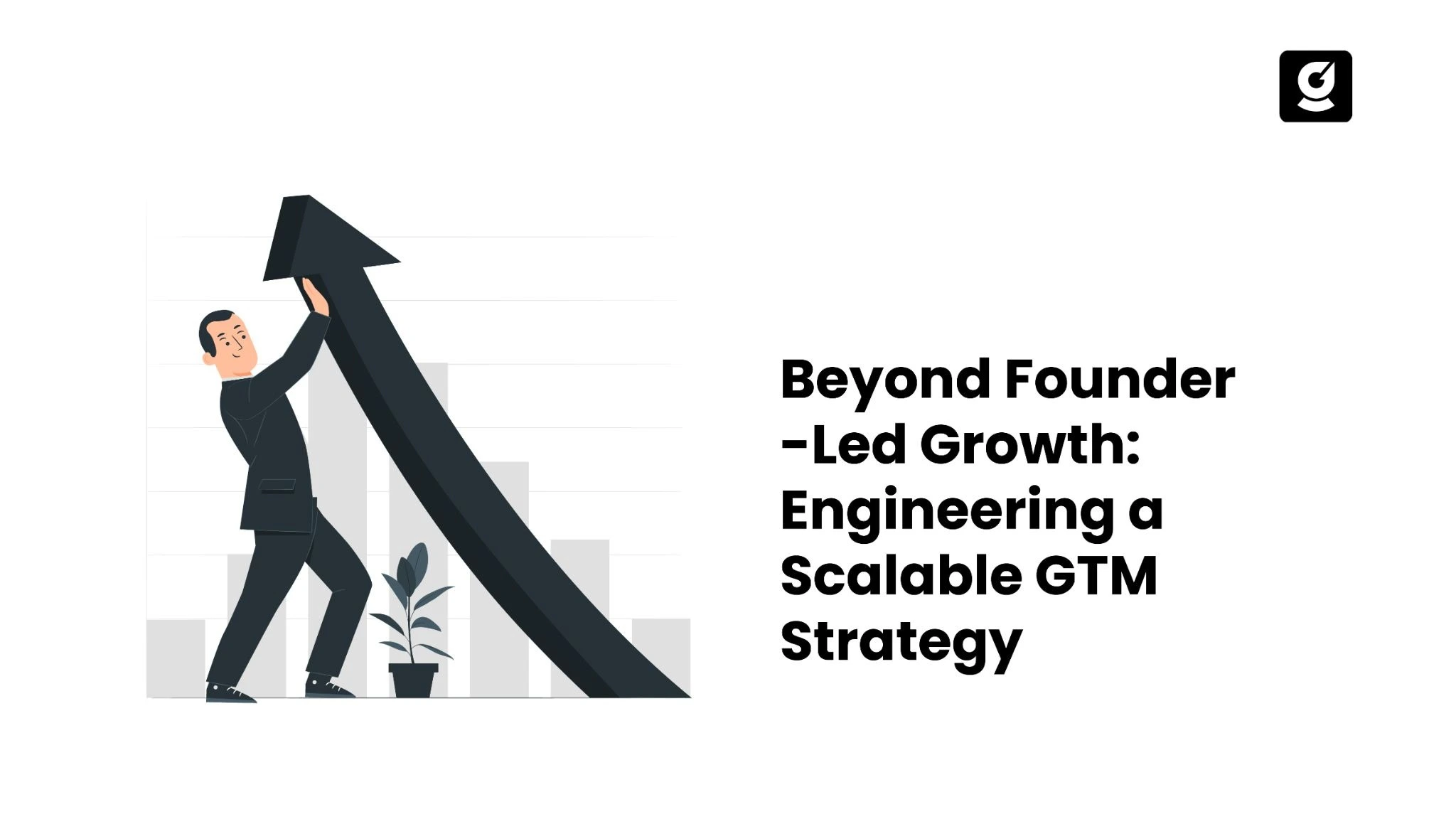
In the early days of a B2B SaaS company, the founder often handles the go-to-market strategy consulting. They know the product inside out, understand why customers buy, and can handle objections with a level of context no new hire has on day one. That founder-led motion is not a weakness. In many cases, it is the fastest route to product-market fit.
The problem is that it does not scale.
As the company grows, the founder gets pulled into product decisions, fundraising, hiring, and customer conversations all at once. The pipeline starts to slow because too many deals still depend on their involvement.
Revenue becomes harder to grow consistently because the sales process, qualification logic, and customer knowledge that drove early wins still live largely in one person’s head.
That’s where go-to-market strategy consulting comes in. The goal is not to replace the founder’s instincts or strip away what made the early motion successful.
It is to turn that knowledge into a repeatable system the rest of the company can actually use: clearer processes, better-trained teams, stronger handoffs, and a pipeline that does not rely on the founder showing up to every important deal.
The shift has to happen eventually. The real challenge is making it without losing the speed and customer understanding that got the company this far.
There’s a specific moment every growing SaaS founder eventually hits: a big deal is on the table, the rep has done everything right, and the prospect still says “can we get some time with the founder?”
That single sentence is usually the first sign the company has outgrown its own sales process, and it’s exactly what the rest of this guide is here to help you fix.
When Founder-Led Growth Becomes a Bottleneck
As the company scales, the same founder-led instincts that once drove growth start showing up as cracks in the system:
- Prospects still ask for the founder on big deals, since trust was built on their judgment, not the product’s positioning.
- New sales hires inherit the pitch but not the instinct, so close rates lag even with the same script.
- ICP, qualification criteria, and messaging live only in the founder’s head, making onboarding slower and inconsistent.
- With no documented process, pipeline coverage becomes guesswork and forecasts swing every quarter.
What a Scalable B2B SaaS GTM Framework System Requires
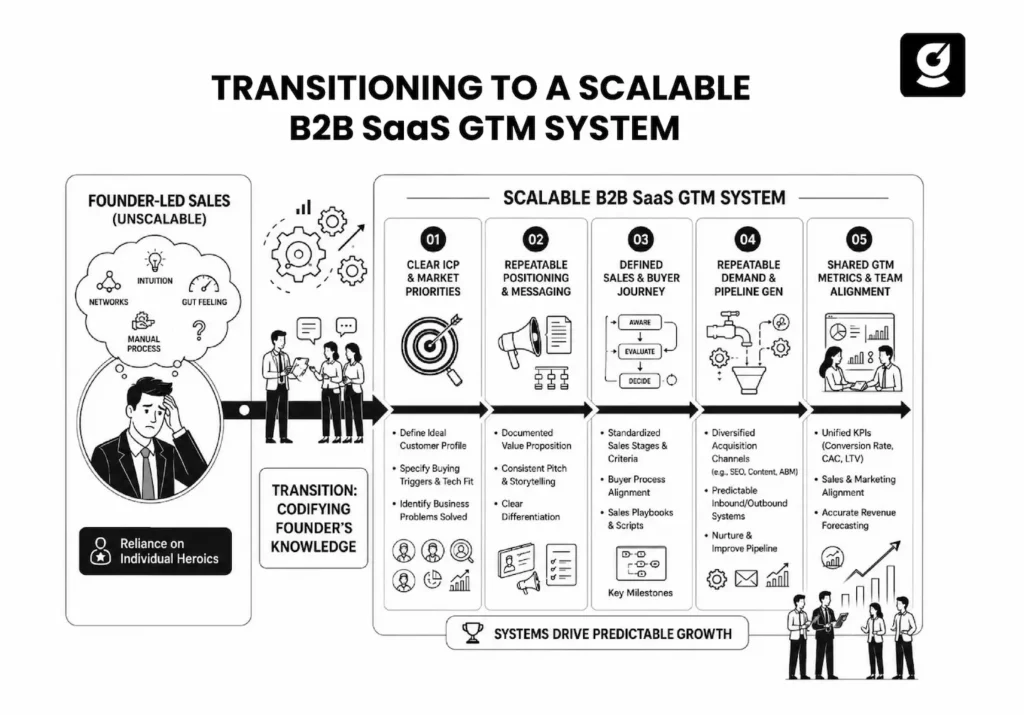
Scaling past founder-led sales means turning what’s in the founder’s head into a repeatable system, one where reps, marketers, and SDRs know who to target, what to say, and what to do next without the founder in the room.
1. Clear ICP and Market Priorities
Early-stage founders often sell to whoever is willing to buy. That approach stops working once the team grows.
A clear ICP should define more than industry and company size. It should capture buying triggers, business problems, technical fit, and the traits of customers who convert and retain well.
2. Repeatable Positioning and Messaging
Founders can adapt their pitch from experience. New hires cannot rely on the same instinct.
Documented positioning gives sales and marketing a shared story about who the product is for, what problem it solves, and why it is different. Consistency matters more than constant improvisation.
3. Defined Sales and Buyer Journey
Founder-led sales often depend on intuition about when to push, pause, or address an objection.
A defined sales process makes that knowledge repeatable. Clear stages, qualification criteria, and buyer requirements help teams move deals forward and spot where opportunities stall.
4. Repeatable Demand and Pipeline Generation
Founder networks, referrals, and warm introductions can drive early growth, but they are not a scalable acquisition model.
SaaS companies need repeatable channels such as outbound, content, SEO, partnerships, paid campaigns, or ABM. Pipeline should come from systems the company can measure and improve.
5. Shared GTM Metrics and Team Alignment
Informal tracking becomes unreliable once multiple teams own different parts of the funnel.
Shared metrics such as pipeline coverage, conversion rates, sales cycle length, win rate, and CAC help leadership identify real bottlenecks.
They also keep sales and marketing focused on the same revenue outcomes. Revenue forecasting for B2B SaaS uses shared metrics to identify bottlenecks and align sales and marketing around revenue goals.
When Should You Bring in Go-To-Market (GTM) Strategy Consulting?
- Revenue has plateaued despite more investment.
More SDRs and ad spend, but ARR growth stays flat; the problem is structural, not a lack of resources.
- New GTM hires are underperforming.
Strong reps miss quota with the same product and market, often a sign positioning and process were never documented.
- Founder involvement cannot scale further.
Deals still stall without the founder on the call, showing trust was never systematized into the sales process.
- Teams disagree on ICP, messaging, or process.
Sales and marketing describe the ideal customer differently; GTM process strategy was inferred, not formally defined.
- Leadership cannot identify the main revenue bottleneck.
Data exists, but no one can pinpoint whether it’s lead quality, execution, or positioning.
What Does a GTM Strategy Consultant Help You Fix?
| Area | What It Fixes |
| Diagnose GTM Bottlenecks | Pinpoints whether the real issue is lead quality, conversion, cycle length, or messaging using data, not guesswork |
| Refine ICP, Positioning, and Sales Motion | Tightens targeting to best-fit accounts and aligns messaging with how buyers actually decide |
| Turn Founder Knowledge Into Repeatable Processes | Converts founder instinct into qualification criteria and playbooks the team can run |
| Improve GTM Measurement and Accountability | Sets shared metrics so leadership can track bottlenecks and forecast accurately. |
| Build a Practical Execution Roadmap | Sequences fixes so the team implements change without overwhelm or founder dependency. |
A GTM strategy consultant works across five connected areas: diagnosing where revenue actually breaks down, refining ICP and positioning, converting founder knowledge into repeatable playbooks, establishing shared metrics, and sequencing execution. Together, these fixes replace founder-dependent selling with a system the rest of the team can run.
GTM Consultant vs. Another GTM Hire
Founders facing a growth plateau often default to the same fix: hire another SDR, marketer, or sales leader. But that decision hinges on a question most teams skip: is the GTM model broken, or does it just need more hands running it?
| Bring in a GTM Consultant | Make Another GTM Hire | |
| Best when | The GTM model needs diagnosis or redesign | The GTM model already works and needs more execution capacity |
| Signs it fits | ICP, messaging, or sales process are unclear, inconsistent, or undocumented | ICP is well-defined, messaging is consistent, and the process reliably converts |
| What’s missing | A working system to execute against | Enough people to work the existing pipeline |
| Primary goal | Fix the model before anyone scales it | Scale a model that’s already proven |
| Risk of the wrong choice | Hiring into a broken system, compounding the problem | Paying for diagnosis you don’t need, slowing execution |
Hiring before fixing the system is a costly mistake. An SDR without a clear ICP targets the wrong accounts, while a sales leader or marketer without defined processes and positioning creates misalignment. Without a functioning GTM model, new hires simply inherit the same founder-dependent system, increasing costs without solving the growth problem.
What Should Change After GTM Consulting?
- Clearer ICP and positioning: The team targets specific segments and buying situations based on defined criteria, not instinct, and articulates the same value proposition regardless of who’s presenting it.
- More consistent pipeline generation: Demand comes from repeatable channels and campaigns tied to the ICP, rather than fluctuating month to month based on founder outreach or referrals.
- Better sales conversion visibility: Leadership can see exactly where deals stall in the funnel: qualification, demo, negotiation instead of only knowing whether a deal closed or didn’t.
- Stronger cross-functional alignment: Sales, marketing, and customer success operate from the same ICP, messaging, and process definitions, reducing the friction and rework that comes from working off different assumptions.
- Less dependency on the founder: Deals progress and close without requiring the founder on the call, because trust and process are now built into the system rather than tied to one person.
- More predictable revenue planning: Forecasts are based on pipeline coverage, conversion rates, and cycle length data, not gut feel, making revenue projections something leadership can actually plan around.
How to Choose the Right Go-to-Market (GTM)Strategy Consulting Partner
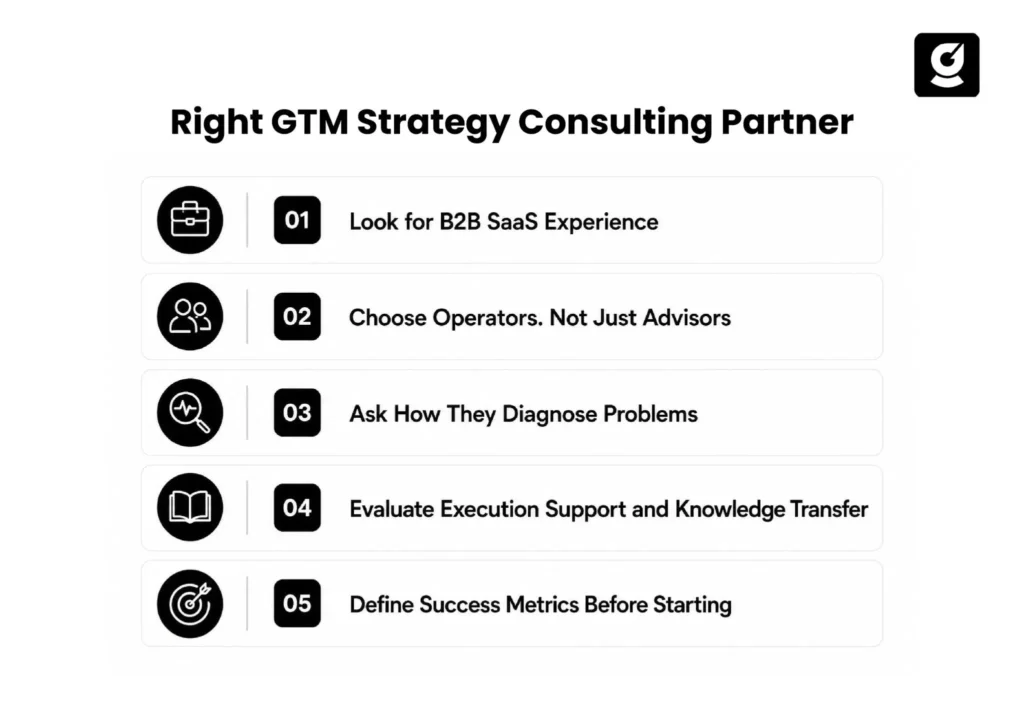
Not all GTM consultants are equipped to help a B2B SaaS company move past founder-led growth. The right partner should demonstrate specific experience, a practical approach, and a clear process for handing the system back to the team.
1. Look for B2B SaaS Experience
A consultant should have direct experience with SaaS go-to-market strategy specifically: subscription revenue models, product-led vs. sales-led motions, and the buying committees typical of software purchases. General B2B or GTM agency-side experience doesn’t automatically translate.
2. Choose Operators, Not Just Advisors
Frameworks and recommendations are only useful if someone has actually implemented them inside a company like yours. Look for consultants who have built or run GTM functions themselves, not just advised from the outside.
Operators tend to give more specific, testable recommendations because they’ve seen where theoretical strategies break down in practice.
3. Ask How They Diagnose Problems
A credible consultant should be able to explain their diagnostic process before proposing solutions: how they analyze pipeline data, review sales calls, interview the team, and identify where the actual bottleneck sits.
If a consultant proposes a fix before understanding your specific GTM data win-loss patterns, conversion rates by stage, and deal velocity, that’s a signal they’re applying a generic playbook rather than diagnosing your situation.
4. Evaluate Execution Support and Knowledge Transfer
Strategy without implementation support rarely survives contact with a busy team. Ask whether the consultant stays involved through execution training reps, refining playbooks based on real deals, adjusting messaging as it’s tested, or whether they hand over a document and move on.
The goal is a system your team can run independently, which requires the consultant to transfer knowledge, not just deliver recommendations.
5. Define Success Metrics Before Starting
Before the engagement begins, agree on what “working” looks like: improved conversion rate at a specific funnel stage, more consistent pipeline coverage, reduced founder involvement in deal cycles, or a defined ICP that the whole team can point to.
Without clear metrics up front, it’s difficult to evaluate whether the engagement actually solved the underlying GTM problem or simply produced a new set of documents.
How growth.cx Helps B2B SaaS Companies Build a Scalable GTM Engine
Moving beyond founder-led growth requires more than advice; it requires a team that can execute the fix. growth.cx works as an AI-first growth engine partner for B2B SaaS marketing agencies making this transition, combining strategy with hands-on execution across the full revenue engine.
- GTM strategy and commercialization planning. Defining how the product should go to market, target segments, pricing motion, and channel priorities based on data rather than founder instinct.
- ICP, positioning, and messaging refinement. Sharpening who the product is for and why it wins, so the value proposition holds up consistently across sales, marketing, and content.
- Revenue operations and funnel alignment. Connecting marketing, sales, and CS around shared definitions and handoffs, so the pipeline moves through a coordinated system instead of siloed efforts.
- Demand generation, SEO, and content systems. Building repeatable channels organic search, content, outreach that generate qualified pipeline independent of founder networks or one-off referrals.
This runs across five connected channels: Performance + ABM Ads, Integrated Outreach, Growth-led AI SEO, Content Marketing, and Website Design & Dev, working as one engine rather than five disconnected vendors, with a single point of contact owning all five.
- Sales enablement and conversion optimization. Equipping the sales team with playbooks, messaging, and qualification frameworks that reflect what actually converts, not just what worked once.
- Repeatable systems that reduce founder dependency. Every engagement is built to leave the company with documented, transferable processes, not a strategy that depends on growth.cx or the founder to keep running.
For founders looking to move past the growth ceiling of founder-led sales, SaaS GTM Strategy Agencies like growth.cx offer a practical path: diagnose what’s broken, rebuild the GTM model, and execute it alongside the internal team until it runs on its own.

Conclusion
The real test of a B2B SaaS company isn’t how fast the founder can close a deal; it’s whether the company can close deals without them. That’s the line between a business that’s growing and a business that’s still just performing growth.
The fix isn’t more hustle or more hires. It’s turning what already works- the ICP, the pitch, the process, the judgment calls- into something documented, teachable, and repeatable through the right go-to-market strategy consulting approach. Once that shift happens, revenue stops being a reflection of one person’s bandwidth and starts becoming a system the whole team owns.
If deals still stall without the founder, or the same questions about ICP and messaging keep coming up in every sales meeting, that’s not a hiring problem. It’s a systems problem, and it has a clear starting point
Talk to growth.cx to identify those gaps and build a revenue engine the team can scale without relying on the founder at every step. Contact our team to discuss your GTM strategy.

FAQs
How can go-to-market strategy consulting help B2B SaaS companies scale beyond founder-led sales?
It diagnoses the real bottleneck lead quality, conversion, or messaging using pipeline data, then turns founder instinct into a repeatable system. This is the core of learning how to develop a GTM strategy that scales sales capacity without scaling founder involvement.
What should a B2B SaaS company expect from a go-to-market strategy consultant?
A clear process for how to create a go-to-market strategy: diagnosis (pipeline data, sales calls, team interviews), redesign (ICP, positioning, buyer journey), and execution (playbooks, training, shared metrics). Expect hands-on knowledge transfer, not just a go-to-market framework template for B2B handed off and forgotten.
What are the signs that a founder-led GTM strategy is no longer sustainable?
Revenue plateaus despite more spend, new hires underperform with the same pitch, deals stall without the founder, and teams can't agree on the ICP or messaging. These all trace back to a GTM process that was performed, not documented.
How can a GTM consultant help align sales, marketing, and product teams?
By documenting a shared ICP, positioning, and handoff process, plus shared metrics like pipeline coverage and conversion by stage, turning a go-to-market strategy example into something every team actually operates from, not just references.
How can companies build a repeatable go-to-market strategy as they scale?
By documenting five things: a clear ICP, consistent positioning, a defined sales process, repeatable demand channels (SEO, outbound, content, ABM), and shared metrics. Together, this is the go-to-market framework template for B2B SaaS companies that removes founder dependency.