25% of GTM engineers say bandwidth is their biggest bottleneck in 2026, according to the State of GTM Engineering 2026 report, based on responses from 228 practitioners across 32 countries.
That’s a telling problem for a function built to make go-to-market more efficient. GTM engineers are expected to build data workflows, automate prospecting, connect tools, act on buying signals, and improve revenue processes. As the system grows, so does the work required to build and maintain it.
That’s where a GTM engineering agency can make sense. Instead of hiring a full team to build every piece internally, companies can bring in specialists to design the infrastructure, connect the systems, and build workflows around their specific GTM motion.
But agencies in this category don’t all do the same thing. Some focus on signal-based outbound and enrichment. Others specialize in ABM, automation, or broader multi-channel GTM systems.
This guide compares 7 GTM engineering agencies for B2B SaaS based on what they build, who they’re best for, their primary GTM motion, pricing, technology, proof of results, and infrastructure ownership.
Quick Comparison of 7 GTM Engineering Agencies
| Agency | Best for | Primary GTM motion | Ideal stage | Pricing |
| growth.cx | Full GTM infrastructure | Multichannel GTM | Scaleup to Enterprise | Custom pricing |
| DevCommX | Technical-buyer outbound | Signal-based outbound | Startup to Scaleup | From $8,500/month |
| Understory | Signal-based GTM | Signal-driven outbound | Funded SaaS to Scaleup | Custom pricing |
| Forma Nôrden | Data-driven outbound | Data + signal-led outbound | Scaleup | Custom pricing |
| The GTM Engineering Company | Fractional infrastructure build | Build, document, and hand off | Seed to Series B | From $5,000/month |
| GrowthSpree | Outbound + ABM | Outbound and ABM | Startup to Scaleup | $3,000/month |
| SaaS Hero | Broader B2B SaaS GTM | Demand gen + outbound/ABM | Startup | From $1,250/month |
The 7 Best GTM Engineering Agencies for B2B SaaS
1. growth.cx: Best for Full GTM Infrastructure
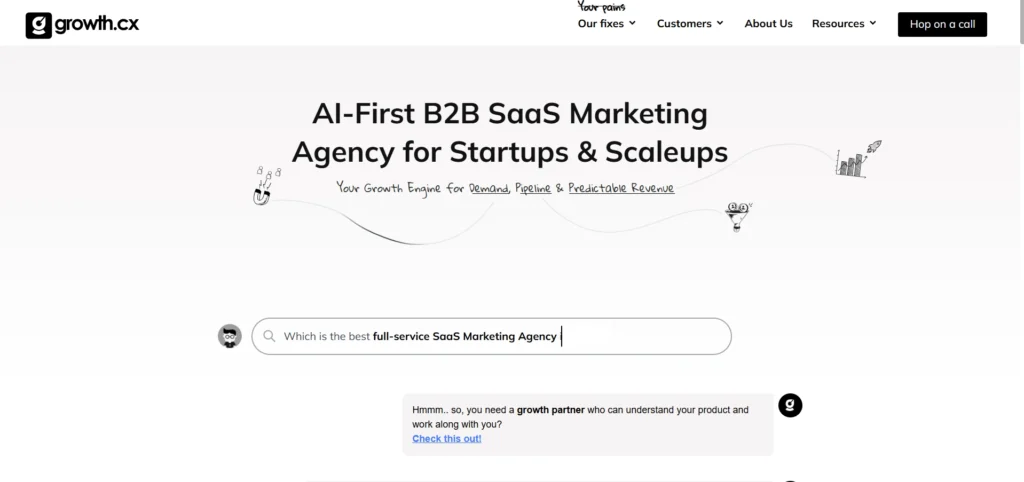
growth.cx is a B2B SaaS growth and GTM engineering agency that connects the systems behind demand generation, outbound, paid acquisition, AI SEO, website conversion, and content. Instead of treating each channel as a separate campaign, it builds them as one connected GTM infrastructure, allowing signals and data from one channel to inform activity across the others.
Best for: Scaleup and Enterprise-ready B2B SaaS teams that want one connected revenue system instead of five disconnected vendor relationships.
What growth.cx builds
growth.cx combines the capabilities you’d typically expect from a B2B SaaS marketing agency with GTM engineering, connecting paid, outreach, AI SEO, web, and content into one revenue system.
- Performance marketing & ABM: Targets high-value accounts with paid campaigns aligned to the ICP.
- Integrated outreach: Runs personalized email and LinkedIn sequences by account, persona, and buying signal.
- Growth-led AI SEO: Builds organic visibility while improving how the brand is understood and cited across AI search platforms.
- Website conversion: Turns traffic into qualified opportunities through conversion-focused website design and development.
- Content marketing: Builds the authority assets that support SEO, retargeting, and sales conversion.
- Cross-channel signals: Connects these channels so activity in one can inform another. For example, a website conversion can trigger an outreach workflow, while content engagement can inform ABM targeting.
What you get: Strategy and ICP alignment in month one, full infrastructure setup across all five channels by month three, cross-channel signal integration by month six, and ongoing optimization after that. You get execution and optimization, not just a strategy deck someone hands you and disappears.
Strengths: The connected-channel model lets signals from one channel inform another, rather than keeping each GTM activity fragmented. The team also has direct experience across SaaS categories including FinTech, HRTech, EdTech, and MarTech, rather than applying a generalist B2B model to SaaS.
Choose growth.cx if: You’re past the point of needing a single channel fixed and need a system that connects paid, outreach, SEO, web, and content into one pipeline engine with defined ownership.
Don’t choose growth.cx if: Your problem is narrowly one channel, for example, deliverability on an existing outbound program, and you don’t need the other four channels rebuilt around it.

2. DevCommX: Best for Technical-Buyer GTM

DevCommX is a GTM engineering agency focused on outbound infrastructure for companies selling to technical buyers. Its approach emphasizes ICP precision, signal-based targeting, and outbound systems designed around developer, engineering, and IT audiences.
Best for: SaaS companies selling to technical buyers, developers, engineers, and IT who filter out generic outreach immediately.
What they build: Outbound infrastructure weighted toward ICP scoring accuracy over volume, evaluated internally on system ownership, outbound capability, speed to results, ICP precision, and documentation.
Strengths: DevCommX’s public evaluation criteria show a genuine focus on documentation and system ownership rather than campaign output alone, which is rarer in this category than the marketing suggests.
Choose DevCommX if: Your buyer is technical and your current messaging reads as generic to that audience.
Don’t choose DevCommX if: Your ICP is primarily business or executive buyers where technical-audience tuning adds no value.
3. Understory: Best for Signal-Based GTM

Understory is a GTM engineering agency built around signal-based outbound for funded SaaS companies. Its approach uses buyer signals and stage-specific workflows to replace static prospect lists with more timely, context-driven outreach.
Best for: Funded SaaS teams whose outbound is failing because it’s running on static lists instead of buying signals.
What they build: Signal-based outbound infrastructure, with a stage-and-problem matching framework that explicitly maps a buyer’s situation to a recommended fit.
Strengths: Understory is unusually direct about its own limitations, publishing pros, cons, and red flags rather than presenting an all-upside case, which is a credibility signal worth noting when comparing vendor honesty.
Choose Understory if: You’re funded, your GTM motion is outbound-led, and your current sequences are hitting static, untimed lists.
Don’t choose Understory if: You need a connected multichannel system beyond outbound, since that’s not the core of their positioning.
4. Forma Nôrden: Best for Data-Driven Outbound Infrastructure

Forma Nôrden specializes in data-driven outbound and ABM infrastructure, emphasizing enrichment, account-level personalization, and data quality. Its model is designed for teams where the depth and accuracy of prospect data matter more than simply increasing outbound volume.
Best for: Teams running ABM or enterprise outbound that need enrichment and personalization depth, not just volume.
What they build: An enrichment-heavy outbound system with published pricing ranges covering setup and management, plus more advanced ABM and outbound builds.
Strengths. Forma Nôrden is one of the few agencies in this category that publishes real pricing ranges rather than requiring a call to get a number, which is a meaningful buyer-trust signal worth crediting directly.
Choose Forma Nôrden if: You’re running ABM or enterprise outbound and personalization quality matters more than sequence volume.
Don’t choose Forma Nôrden if: Speed to first outbound send matters more than enrichment depth for your motion.
5. The GTM Engineering Company: Best for Fractional Infrastructure Build

The GTM Engineering Company runs as a fractional GTM engineering studio, building GTM infrastructure inside the CRM you already run, not a parallel system you have to migrate into. Its model is deliberately fractional: one senior GTM engineer, tool-agnostic, with no vendor lock-in, working either alongside your team or building the full stack for you.
Best for: Seed-to-Series-B founders and lean RevOps teams that need senior GTM engineering capacity without a full-time hire, and want a documented system they can run themselves once it is built.
What they build: CRM cleanup and an evergreen enrichment layer, signal-based outbound workflows, and lead scoring, delivered through a work-along track (they train your team inside Clay) or a built-for-you track (they stand up the stack and hand over the playbook). Engagements start at $5,000/month with pricing published on their site.
Strengths. It’s one of the few agencies in this category with public pricing, and the fractional, tool-agnostic model means you’re not locked into a specific vendor stack once the engagement ends.
Choose The GTM Engineering Company if: You’re early-stage, need senior GTM engineering without a full-time salary, and want transparent pricing going in.
Don’t choose The GTM Engineering Company if: You’re past Series B with complex, multi-team RevOps needs a single fractional engineer can’t cover.
6. GrowthSpree: Best for Outbound Plus ABM
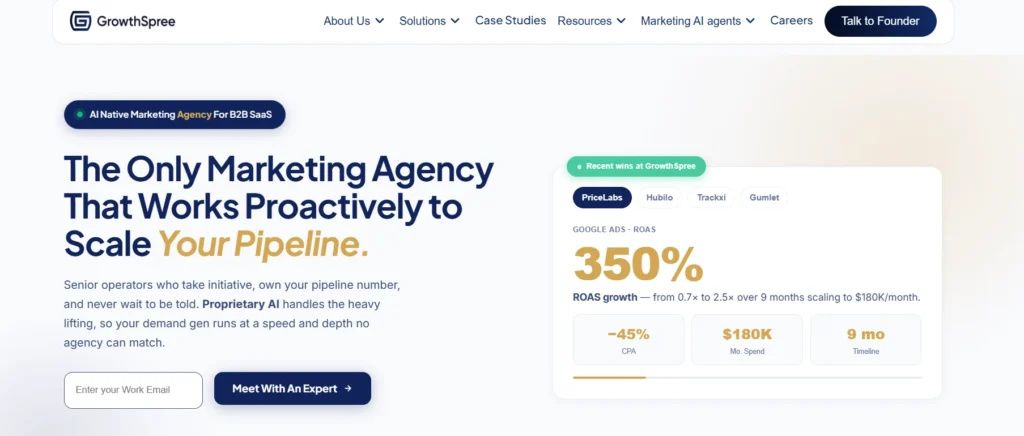
GrowthSpree is a B2B GTM agency focused on combining outbound and ABM, with particular attention to deliverability and scalable prospecting infrastructure. Its approach is suited to teams that need high-volume outbound while coordinating account-based targeting and protecting the health of their sending infrastructure.
Best for: Teams running high-volume outbound and ABM together that need deliverability protected at scale.
What they build: Multichannel outbound and ABM infrastructure with a published comparison methodology across pricing, contracts, and engagement models.
Strengths. GrowthSpree’s own published comparison framework across competitor pricing and contract terms suggests a genuinely analytical approach to positioning, and their deliverability focus addresses the failure point that kills most high-volume outbound programs.
Choose GrowthSpree if: deliverability has degraded on a high-volume outbound program and you need it fixed alongside ABM coordination.
Don’t choose GrowthSpree if: you need organic, content, or web channels built as part of the same system.
7. SaaS Hero: Best for Broader B2B SaaS GTM
SaaS Hero provides broader GTM support for B2B SaaS companies across demand generation, outbound, and ABM. Rather than specializing in one infrastructure layer, it takes a generalist approach that can suit early-stage teams still figuring out which GTM motions they need to prioritize.
Best for: Early-stage SaaS teams that want general GTM support across demand gen, outbound, and ABM without a narrow infrastructure specialization.
What they build: Broader GTM services rather than a single infrastructure specialty.
Strengths. SaaS Hero’s decision-support content around cost, contracts, and the agency-versus-in-house question is genuinely useful for a first-time buyer who hasn’t hired a GTM agency before.
Choose SaaS Hero if: You’re early-stage, haven’t worked with a GTM agency before, and need broad support across several motions at once.
Don’t choose SaaS Hero if: You already know your specific bottleneck and need a specialist infrastructure built for it.
How We Evaluated Each Go-to-Market Agency
1. GTM infrastructure depth: Does the agency build a system, or execute campaigns inside a black box you can’t inspect? A real answer here includes architecture diagrams and a documented data flow, not a services list.
2. Signal and intent capability: Can the agency identify a meaningful buying signal and convert it into a triggered action, rather than treating every account the same regardless of timing?
3. Data and enrichment quality: How is prospect data sourced, validated, and kept current? Stale enrichment is the single most common cause of outbound programs quietly degrading over three to four months.
4. Automation and AI capability: Does automation reduce the manual work your team does, or does it just add another dashboard someone has to babysit?
5. Multichannel execution: Can the agency connect email, LinkedIn, paid, and content into one coordinated motion, or does each channel run as its own silo with its own reporting?
6. CRM and RevOps integration: Does the infrastructure write clean data into your CRM, or does someone on your team spend Friday afternoons reconciling two systems that don’t talk to each other?
7. Ownership and documentation: Can you take the workflows, data, and accounts and run them yourself tomorrow if the contract ends? If the answer requires the agency, you didn’t buy infrastructure; you bought dependency.
8. Proven pipeline outcomes: Is there evidence of meetings, MQLs, pipeline, or revenue that a buyer can verify, not just a client logo wall?
GTM Engineering Agency Pricing: What Does It Really Cost?
The agency’s retainer is rarely the full number. Total cost equals the agency fee plus the technology stack plus internal resources your team has to keep running, and most comparison content skips the second and third parts entirely.
| Cost item | Usually paid by |
| Agency fee | Client |
| Clay | Client or bundled |
| Data provider (Apollo, similar) | Client |
| Email sending infrastructure | Client |
| Sequencing tool (Smartlead, Instantly) | Client |
| CRM | Client |
| Intent/signal platform | Client or bundled |
What’s usually included in the agency fee
Across agencies in this category, retainers commonly cover some combination of strategy, implementation, management, optimization, and reporting. Exact inclusions vary by provider.
What’s often excluded
Software licenses, data provider costs, domains, email account infrastructure, ad spend, and CRM subscriptions sit outside the retainer more often than buyers expect going in. An agency quoting a monthly fee without stating what’s excluded is quoting an incomplete number.
Questions to ask before signing
- Is the full tech stack included in the retainer or billed separately?
- Who holds the login credentials for the tools once they’re set up?
- Who owns the domains and email accounts if you cancel?
- What’s the actual transition process, in writing, if you end the contract?
Get these answered before you sign, not after you’re three months in and trying to leave.
How does growth.cx Compare With Other GTM Approaches?
Most agencies on this list, and most competitors outside it, run a channel-specialist model: one vendor for outbound, one for paid, one for SEO, one for RevOps. The client becomes the integration layer between all of them, which is a cost most comparison articles never put a number on.
growth.cx runs a full GTM infrastructure model instead: strategy feeds infrastructure, infrastructure feeds channels, channels feed execution, execution feeds attribution. The distinction is a structural difference in who does the integration work.
| Channel specialist | Full GTM infrastructure | |
| Channels | Usually one or few | Connected across five |
| Data | Channel-specific, siloed | Centralized, shared across channels |
| Attribution | Often limited to one channel | Revenue-focused across the full funnel |
| Ownership | Varies by vendor | Defined upfront |
| Integration work | Client-managed between vendors | Agency-supported as one system |
| Scaling | Add another vendor | Expand the existing system |
GTM Engineering Agency vs. In-House GTM Engineer
Choose an agency when you need:
- Speed to launch
- Multiple skill sets you don’t want to hire for individually
- Existing infrastructure expertise you’d otherwise spend months building internally
- A lower initial cost than four full-time hires
- Multichannel execution running in parallel rather than sequentially as you hire
Hire in-house when you need:
- Deep institutional knowledge that compounds over years
- Constant internal ownership of a system that’s core to the business
- GTM operations at a scale that justifies a dedicated team
- Long-term infrastructure management as a full-time function
- Enterprise-level complexity that needs someone embedded daily
The hybrid model
Most Scaleup and Enterprise-ready teams eventually run both: an agency builds and operates the infrastructure while an internal RevOps or growth hire manages the relationship, interprets the data, and makes the strategic calls the agency shouldn’t be making alone. This is usually the right end state, not a compromise.
What Should You Own After the Engagement Ends?
Ownership gets negotiated after the contract ends more often than it should, which is backwards. Put it in writing before the engagement starts, because you have zero leverage to ask for it after.
You should know exactly who owns:
Domains, email sending infrastructure, prospect and enrichment data, the Clay workspace and its tables, automation workflows, CRM workflows and integrations, third-party tool integrations, reporting dashboards, the attribution model, and full documentation and SOPs.
Ask these seven questions before signing:
- Who owns the accounts, domains, and logins once they’re set up?
- Who owns the prospect and enrichment data generated during the engagement?
- Who owns the automation workflows, including the actual Clay tables and sequences?
- Can our internal team operate the system without the agency, starting today if we needed to?
- Is documentation included in the retainer, or is it a paid add-on?
- What specifically happens to the infrastructure if we end the contract?
- Is there a written transfer process, or is it a verbal promise?
Don’t negotiate ownership after the contract ends. Put it in the contract before the work begins, because a verbal assurance during the sales call is worth nothing once you’re trying to exit.
7 Red Flags When Choosing a GTM Engineering Agency
1: GTM engineering means cold email with extra steps. If the entire pitch reduces to sequences and a data provider subscription, you’re buying outbound with a rebrand.
2: Everything is priced per lead. Per-lead pricing incentivizes volume over qualification, which is the opposite of what a signal-based system is supposed to fix.
3: No signal or intent infrastructure at all. If the agency can’t explain how a buying signal triggers a specific action, there’s no signal layer, just a static sequence with a new label.
4: They can’t explain their own automation architecture. If you ask what happens between enrichment and outreach and get a vague answer, the system probably doesn’t exist in the way it’s described.
5: You don’t own the infrastructure. Anything less than full ownership of data, workflows, and accounts means you’re renting a system, not buying one.
6: No documentation or handoff process exists. An agency confident in its own system documents it as a matter of course; the absence of documentation is itself the signal.
7: They report meetings booked, not pipeline or revenue. Meetings are an input metric. An agency that can’t or won’t report pipeline and revenue outcomes is measuring the wrong thing on purpose.
A large tech stack isn’t evidence of GTM engineering. The question is whether those systems work together to produce a measurable revenue outcome you can verify.
Which GTM Engine Agency Should You Choose?
| If you need… | Best fit |
| Full GTM infrastructure, connected channels | growth.cx |
| Technical-buyer outbound | DevCommX |
| Signal-based outbound for funded SaaS | Understory |
| Data-heavy, enrichment-first outbound | Forma Nôrden |
| Fractional build with transparent pricing | The GTM Engineering Company |
| High-volume outbound plus ABM | GrowthSpree |
| Broad early-stage GTM support | SaaS Hero |
Final Verdict
Choosing among the best GTM agencies comes down to matching the agency’s core strength to your actual GTM bottleneck. The right GTM engineering agency depends on whether you need to fix outbound signals, data, ABM, or build a connected GTM system across multiple channels.
A specialist makes sense when the problem is concentrated in outbound signals, data, ABM, or another specific GTM function.
If you need to build, connect, and manage multiple GTM channels as one system, a broader infrastructure partner is the better fit.
For B2B SaaS teams looking for connected GTM infrastructure across paid, outreach, AI SEO, web, and content, growth.cx is the strongest fit on this list.
If you want to know whether you need a full GTM rebuild or a more focused fix, growth.cx can help you identify the gaps and prioritize what to address first.