Getting someone to click your B2B Google ad is only half the job. What happens after the click determines whether that traffic becomes a lead or disappears.
The latest WordStream benchmark, based on 13,474 US search advertising campaigns, reports an average Google Ads conversion rate of 8.18% across industries. For B2B SaaS, though, that number is better treated as a reference point than a target.
B2B SaaS campaigns have a different challenge. Buying cycles are longer, audiences are narrower, and a form submission is often only the beginning of the sales process. Someone can become a lead today and still take weeks or months to become an opportunity or customer.
That makes Google Ads landing page optimization an important part of a broader performance marketing strategy, where the goal is more than getting more form fills.
Your page needs to carry the visitor smoothly from search → ad → landing page → conversion → qualified opportunity.
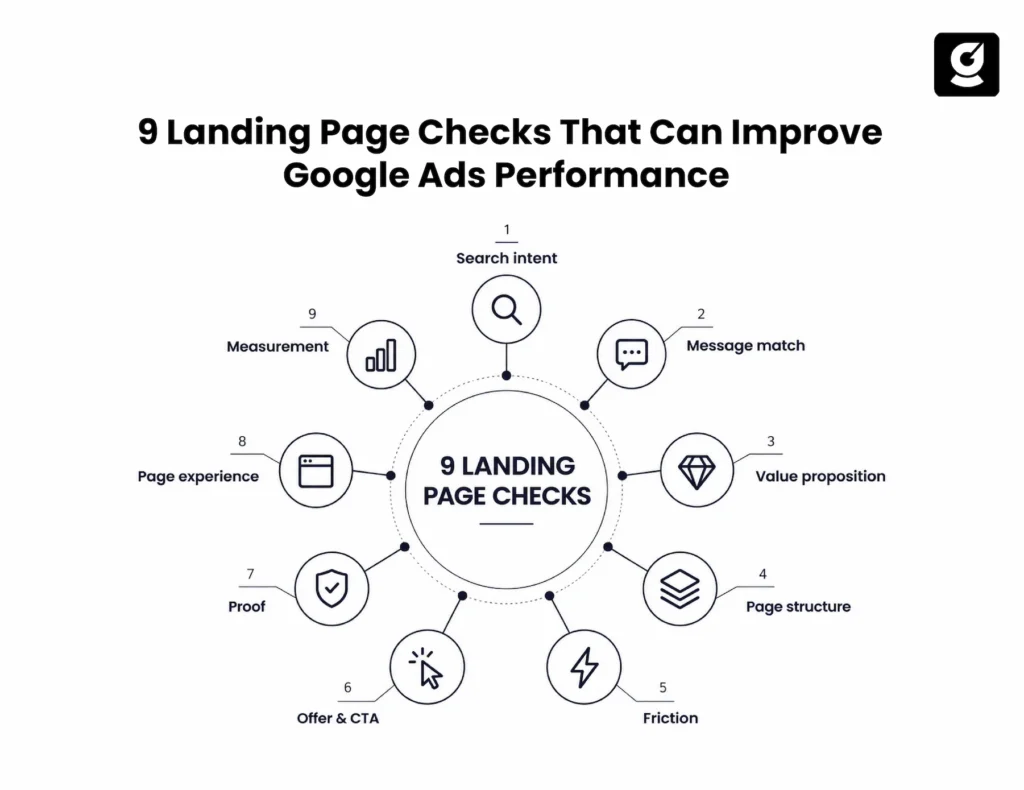
In this guide, we’ll look at 9 practical fixes that can improve that journey, plus how to prioritize them when your campaign is underperforming.
Why B2B Google Ads Clicks Don’t Always Turn Into Leads
A campaign can look healthy in Google Ads while the landing page quietly loses potential customers.
Imagine a B2B SaaS company looking for a marketing partner. It bids on a high-intent term such as “B2B SaaS marketing agency.”
The ad says:
“B2B SaaS Marketing That Builds Qualified Pipeline”
The prospect clicks because the message sounds relevant. But the landing page opens with:
“Transforming the Future of Digital Marketing”
Below that are several navigation options, a long list of services, generic marketing language, a few stock images, and a form asking for eight pieces of information.
Nothing is technically broken. The problem is that the visitor has to work too hard to answer a basic question:
“Is this the right solution for me?”
That can happen for several reasons:
| Problem | What the visitor experiences |
| Intent mismatch | The page does not address why they searched |
| Message mismatch | The ad promises one thing, and the page leads with another |
| Weak value proposition | The service is clear, but the outcome is not |
| Poor page structure | Important information is buried or presented in the wrong order |
| Too much friction | The visitor is asked to do too much too soon |
| Weak offer | There is little reason to take the next step |
| Weak proof | The page asks for trust without providing enough evidence |
| Poor experience | Slow loading, mobile issues, or distracting elements get in the way |
These problems are connected.
If the wrong people are arriving, changing the CTA will not solve the problem.
If the right people arrive but cannot understand the offer, reducing the form length will only go so far.
And if the offer itself is weak, even a well-designed landing page may struggle to convert.
So start by looking at the entire journey.
Before You Optimize the Google Ads Landing Page, Check the Traffic
Not every low-conversion campaign has a landing page problem. Sometimes the page is simply being asked to convert the wrong visitors.
For B2B SaaS PPC campaigns, start with the search terms generating clicks. If a B2B SaaS company is bidding on “SaaS marketing agency,” are the actual searches coming from companies looking for an agency? Or are they mostly people looking for definitions, courses, jobs, templates, or general marketing advice?
Then look at the campaign structure.
Ask:
- Are the keywords closely related to the offer on the page?
- Does the ad reflect the intent behind the search?
- Are different search intents being sent to the same page?
- Are broad-match keywords producing irrelevant searches?
- Does the traffic fit the company’s ICP?
- Is the offer appropriate for the visitor’s buying stage?
- Are you evaluating lead quality, not just conversion volume?
A simple diagnostic can help:
| What you see | Investigate first |
| Low CTR | Keywords, targeting, ad relevance, offer |
| High CTR, low engagement | Ad-to-page match and page experience |
| High conversion rate, poor lead quality | Targeting, keyword intent, offer |
| Good leads, few opportunities | Qualification and sales follow-up |
| Good conversion rate, expensive pipeline | Lead quality and downstream economics |
This matters because performance marketing works as a connected system. Google Ads landing page optimization cannot compensate for poor traffic.
If people click because they misunderstood the ad, a higher landing-page conversion rate may simply give you more unqualified leads.
Once the traffic is reasonably relevant, move to the page.
9 Google Ads Landing Page Fixes That Can Improve Conversion
1. Match the Landing Page to Search Intent
Your landing page should match what the visitor is actually looking for, not just the broad topic of the keyword.
For example, someone searching for “B2B SaaS marketing agency” is likely looking for an agency or service provider. Sending them to a generic digital marketing page makes them work to find out whether you offer what they need.
Search: B2B SaaS marketing agency
Relevant page: B2B SaaS marketing services
Poor match: Generic digital marketing services
This is a relevance problem.
Ask: Did the visitor land on the right page for their search?
Check whether the page:
- Addresses the specific search intent
- Fits the audience behind the keyword
- Avoids combining different search intents on one page
- Makes its relevance clear within a few seconds
You do not need a separate page for every keyword. Group related searches by intent and make sure each landing page genuinely addresses that intent.
2. Align the Search, Ad, and Landing-Page Message
Getting visitors to the right page is only the first step. The page also needs to deliver the promise made in the ad.
For example:
Search: Google Ads agency for SaaS
Ad: Generate Qualified SaaS Pipeline With Google Ads
Landing page: Full-Service Digital Marketing for Modern Businesses
The page is still about marketing, but the message has changed. The visitor expected Google Ads and a qualified pipeline. Instead, they get a broad digital marketing pitch.
A stronger experience keeps the message consistent:
Search: Google Ads agency for SaaS
Ad: Generate Qualified SaaS Pipeline With Google Ads
Landing page: Google Ads for B2B SaaS, focused on qualified pipeline
Your headline, supporting copy, offer, visuals, and CTA should reinforce the expectation created by the ad.
3. Make the Value Proposition and Outcome Obvious
B2B companies often describe their service before explaining why the buyer should care.
That makes the visitor do the translation.
Consider:
B2B SaaS demand generation services
That’s a description of a service.
Now compare:
Build a more predictable pipeline from paid search, content, SEO, and outbound.
The second version gives the visitor a reason to care.
This does not mean every landing page should promise a specific revenue number. It means the page should connect the service to a meaningful business outcome.
For a B2B SaaS company, that might be:
- More qualified pipeline
- Lower customer acquisition costs
- More sales-ready leads
- Better conversion from existing traffic
- More predictable demand
- Higher-quality opportunities
The product or service still matters.
But it should come after the visitor understands what changes for them.
A useful hierarchy
A strong landing page should answer three questions in order:
What changes for me? – Explain the outcome.
How does it happen?– Briefly explain the approach or mechanism.
Why should I believe you?– Show evidence.
That is much easier to process than leading with a long list of features or capabilities.
4. Structure the Page Around the Buyer’s Decision
A landing page should not read like a condensed version of your entire website.
The visitor is trying to make a decision.
Your page should help them make it.
For a high-intent B2B SaaS campaign, a useful structure might look like:
Problem → Solution → Outcomes → Proof → How it works → Objection handling → CTA
Compare that with a typical company-led structure:
About us → Services → Industries → Team → Blog → Resources → Contact
The second structure may be useful for a website.
It is not necessarily the best structure for paid traffic.
Think about the questions going through the visitor’s mind:
- Is this relevant to my company?
- Can this solve the problem I searched for?
- What outcome can I expect?
- Have they done this before?
- How does the process work?
- Is there a catch?
- What happens if I contact them?
The page should answer those questions in roughly the same order the visitor is likely to ask them.
Don’t make visitors hunt for the important information
Your strongest outcome, most relevant proof, and primary CTA should not be buried below five screens of generic company information.
Good Google Ads landing page design is less about making a page look impressive and more about making the decision easier.
5. Remove Friction That Gets in the Way
Even when visitors are interested, small problems can make them leave. Some make the page difficult to understand. Others make it harder to take the next step.
Look for issues such as:
- Vague headlines or unclear offers
- Long, dense sections of copy
- Too many competing messages
- Long or complicated forms
- Poor mobile layouts
- Distracting pop-ups
- Buttons that are difficult to find or use
Start with the biggest problem. If visitors cannot understand what you offer within a few seconds, changing the CTA button will not solve the issue.
The same applies to forms. Ask for information that serves a real purpose at that stage of the buying journey. A high-value consultation may justify more questions than a simple content download.
Shorter is not always better. The right amount of friction depends on what you are offering and how ready the visitor is to act.
6. Match the Offer and CTA to Buyer Intent
One of the easiest ways to hurt conversions is to ask for too much too soon.
Imagine someone searches for information about SaaS marketing and lands on a page asking them to:
Book a 45-minute sales consultation.
That is a large commitment for someone who may still be researching.
Now consider a visitor searching:
“B2B SaaS marketing agency pricing”
That visitor is much closer to a commercial decision. A stronger offer might be appropriate.
Your CTA should reflect that difference.
For example:
Lower intent: Download the B2B SaaS Growth Guide
Evaluating a solution: See How Our Approach Works
Higher intent: Get a Free Google Ads Audit
Ready to talk: Book a Strategy Call
The wording matters, but the offer itself matters more.
“Learn More” is weak because it does not tell the visitor what happens next.
“Get My Google Ads Audit” gives them a reason to click.
Just make sure the page delivers what the CTA promises.
If you offer an audit, provide an actual audit or clearly defined assessment. Do not use a valuable-sounding CTA to disguise a generic sales call.
7. Use Relevant Proof to Reduce Risk and Objections
B2B buyers rarely convert because of a good headline alone. They also need confidence that your claim is credible.
This is particularly important when the conversion involves an expensive service, a new vendor, or a change to an existing marketing process.
A logo wall can help, but specific evidence is usually more useful.
Instead of saying “Trusted by leading companies,” show specific evidence such as: 191 → 870 MQLs, with CPL down 41%.
Or, instead of: “We help SaaS companies grow”, show a relevant client result, testimonial, case study, or measurable outcome.
The best proof supports the claim being made.
If the page says: “Generate more qualified pipeline”, the proof near that claim should help demonstrate pipeline generation.
If it says “Built for B2B SaaS companies”, show relevant SaaS customers or examples.
Proof should answer objections
A strong page can address questions such as:
- Have you worked with companies like mine?
- Can you produce measurable results?
- How does your process work?
- What makes your approach different?
- How long does the engagement take?
- What happens after I submit the form?
Don’t save every answer for a final “Why choose us?” section. Place evidence close to the point where the visitor is making a decision.
8. Make the Page Fast and Easy to Use
Good copy cannot rescue a poor Google Ads landing page experience.
A visitor who is waiting for a page to load, struggling to read the text on a phone, or trying to close an intrusive popup is not thinking about your value proposition. They’re trying to leave.
Google also recommends regularly evaluating landing-page performance, including mobile experience and page speed, because slow or poorly optimized landing pages can hurt the results you get from paid traffic.
Check the obvious issues first:
- Oversized images
- Heavy video backgrounds
- Unnecessary scripts
- Slow third-party tools
- Inefficiently loaded fonts and assets
- Layout shifts
- Intrusive pop-ups
- Difficult-to-use forms
- Buttons that are hard to tap on mobile
And test the page on an actual mobile connection.
A page that feels fast on an office Wi-Fi connection may feel very different on a phone.
Also look beyond speed.
- Can visitors scan the page?
- Are paragraphs short enough?
- Is the CTA easy to find?
- Does the form work comfortably on a phone?
- Can someone understand the offer without zooming or scrolling through a wall of text?
A fast page that is difficult to use is still a poor landing page.
9. Measure, Test, and Optimize for Qualified Pipeline
A landing page should not be judged by its conversion rate alone.
This is where Google Ads conversion rate optimization becomes more useful than simply making a page look better.
Consider two landing pages:
Page A
- 10% conversion rate
- 100 leads
- 5 qualified opportunities
Page B
- 6% conversion rate
- 60 leads
- 12 qualified opportunities
Page A has the better conversion rate. Page B may be producing the better business result.
For B2B companies, the useful measurement chain is:
Click → Lead → Qualified Lead → Opportunity → Customer → Revenue
That means you should look beyond the initial form submission.
Track metrics such as:
- Landing-page conversion rate
- Cost per lead
- Cost per qualified lead
- Lead-to-opportunity rate
- Opportunity-to-customer rate
- Pipeline generated
- Customer acquisition cost
A higher conversion rate is useful only when those conversions lead to better-quality opportunities and stronger business results.
How to Prioritize the 9 Fixes
You don’t need to make nine changes at once. Start with the problem closest to where the funnel is breaking.
| If you’re seeing… | Start with… |
| Lots of irrelevant clicks | Search terms and targeting |
| Good CTR but poor engagement | Intent and ad-to-page match |
| Visitors engage but don’t convert | Value proposition and offer |
| Lots of browsing but little action | Page structure and distractions |
| High form abandonment | Form and interaction friction |
| Good conversion rate but poor lead quality | Offer, targeting, qualification |
| Good leads but few opportunities | Proof, qualification, sales follow-up |
| Mobile users dropping quickly | Page speed and mobile UX |
| Results are unclear | Conversion tracking and downstream measurement |
This prevents one of the most common CRO mistakes: optimizing small details before fixing the biggest constraint.
Changing a button color will not rescue a page aimed at the wrong search intent. Reducing a form from six fields to four will not fix an offer that nobody wants.
And rewriting the headline will not make irrelevant traffic valuable.
Fix the biggest problem first.
A 9-Point Google Ads Landing Page Audit
Before changing your page, run through these Google Ads landing page best practices and questions.
| 1. Search intent | Does the page directly answer the reason behind the search? |
| 2. Message match | Does the page continue the promise made by the ad? |
| 3. Value proposition | Can visitors understand the business outcome quickly? |
| 4. Decision structure | Does the page provide the information someone needs to evaluate the offer? |
| 5. Friction | Are there unnecessary cognitive or interaction barriers? |
| 6. Offer and CTA | Is the next step appropriate for the visitor’s buying intent? |
| 7. Proof | Is there relevant evidence close to important claims and decisions? |
| 8. Page experience | Is the page fast, readable, mobile-friendly, and easy to use? |
| 9. Measurement | Can you tell which leads become qualified opportunities and customers? |
If several answers are “no,” don’t try to fix everything simultaneously. Just start with the issue most likely to be limiting your conversion quality.
When the Landing Page Isn’t Actually the Problem
A low landing-page conversion rate does not always mean the page needs fixing. The problem may start earlier in the campaign.
The keyword determines who arrives. The ad shapes their expectations. The landing page needs to meet those expectations, while the offer gives them a reason to act. After that, your CRM tells you whether the lead was actually valuable.
That is why a 10% conversion rate is not automatically better than 5%. If the 10% produces unqualified leads while the 5% produces sales opportunities, the lower-converting page may be doing a better job.
Look at the entire path, not just the form submission. The goal is to turn relevant search demand into qualified pipeline, not simply generate more leads.
The Click Was Never the Finish Line
Paying for the click only buys attention. What happens next determines whether that attention becomes a lead, an opportunity, or wasted ad spend.
A strong landing page connects the pieces: relevant search intent, a consistent message, a clear outcome, low friction, relevant proof, and an experience that works on every device. Measurement closes the loop by showing whether those conversions are becoming qualified opportunities, not just filling up a CRM.
You do not need to fix all nine issues at once. Run the audit against your highest-spend campaigns, identify the one or two weakest points, and start there. Fixing the biggest leak is usually more useful than making small changes across the entire page.
If you’ve addressed the obvious landing-page issues but still aren’t turning paid search into qualified pipeline, the problem may extend beyond the page itself. A B2B SaaS growth partner such as growth.cx can help connect paid search, landing-page conversion, lead quality, and downstream pipeline.