According to Gartner, over 65% of B2B buyers complete significant research before ever speaking to a sales representative.
At the same time, industry data shows a steady rise in zero-click search behavior, where users receive answers directly within search interfaces without visiting a website. If buyers no longer rely on traditional result pages, how should SaaS and B2B brands respond?
Search has shifted from keyword matching to intent interpretation. AI-powered search engines now summarize, compare, and recommend solutions within the search experience itself. AI search ranking is influenced by semantic depth, contextual clarity, and brand authority across the web.
For decision makers responsible for revenue growth, this shift is not theoretical. It directly affects pipeline, positioning, and competitive visibility. Understanding how AI search algorithms evaluate and present content is now central to digital performance.
What Is AI Search Ranking
AI search ranking refers to how an AI SEO service evaluates, interprets, and prioritizes content when generating AI search results. Examples of these search engines include Perplexity AI, Google’s Search Generative Experience (SGE), ChatGPT, and Microsoft Bing powered by GPT-4.
AI search algorithms analyze semantic meaning, relationships between topics, entity signals, and contextual authority. Instead of simply ranking pages, these systems
synthesize information, extract trusted sources, and generate structured answers tailored to user intent.
In SaaS and B2B markets, this shift means visibility depends less on blue-link positions and more on whether your content is machine-readable, contextually complete, and recognized as a reliable authority within your domain.
How AI Search Algorithms Evaluate Content
AI search algorithms rely on:
- Natural language processing to understand context and user intent.
- Large language models to interpret patterns and relationships.
- Entity recognition to identify brands, products, and expertise.
- Behavioral signals such as engagement and trust.
- Structured data for machine readability.
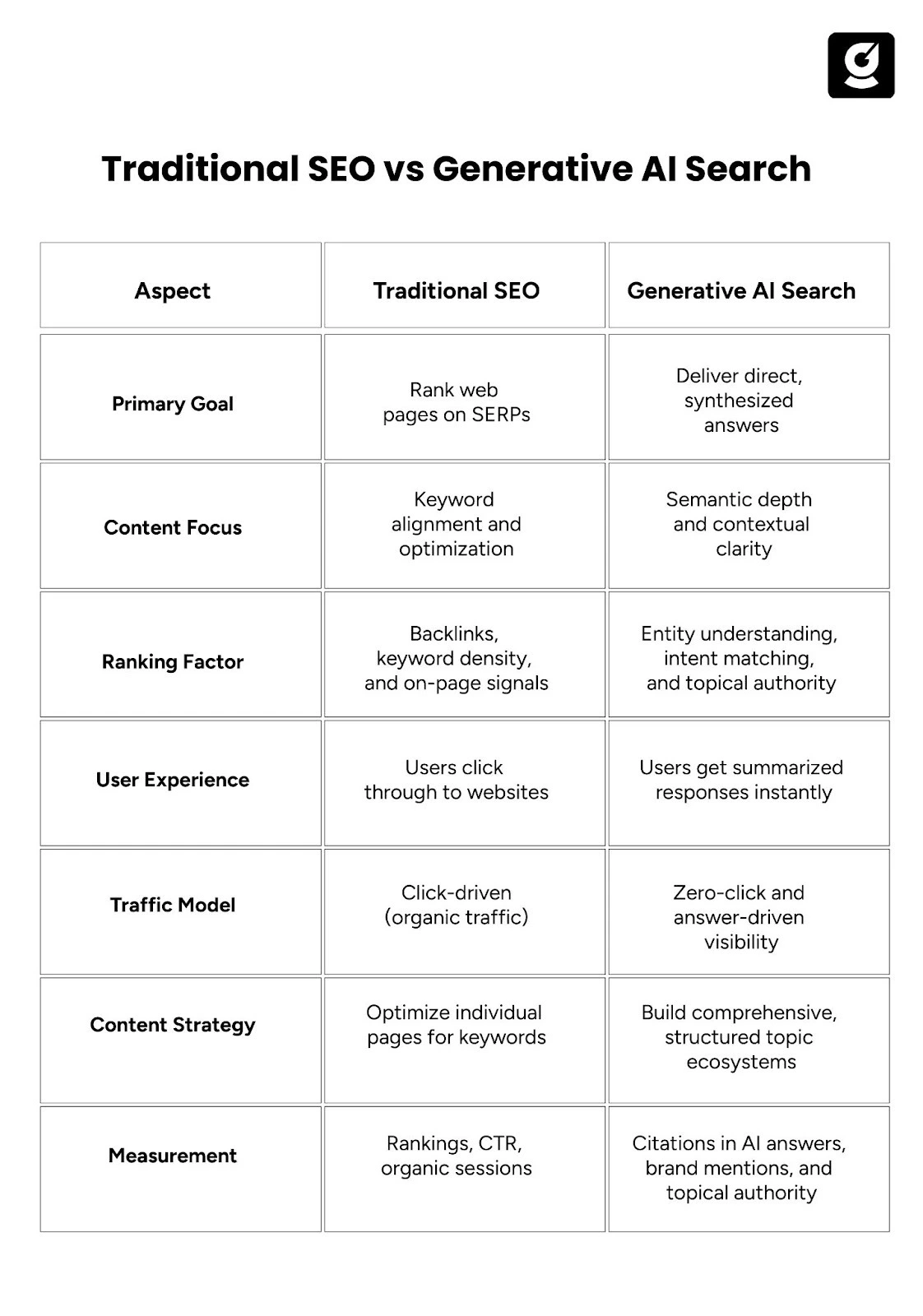
For SaaS and B2B brands, AI search ranking requires structured, authoritative, and interconnected content ecosystems.
Understanding the distinction between these frameworks is critical, as explained in this guide onGEO vs AEO vs SEO strategy for B2B SaaS.
The Rise of AI-Powered Search Engines in B2B
AI-powered search engines have altered discovery patterns across industries.
In B2B markets, research journeys now include:
- Conversational AI interfaces.
- Search experiences that generate summaries.
- Dynamic AI search results based on intent modeling.
Behavioral Shifts in Buyer Discovery
- From typing keywords to asking layered questions.
- From scanning ten links to reviewing a summarized answer.
- From static listings to contextual recommendations.
For marketing leaders, this means that visibility extends beyond blue links.
Brand mentions, authority signals, and content clarity influence how an AI search engine interprets and surfaces information.
Impact on SaaS and B2B Brands
- Reduced click-through rates.
- Higher importance of brand recognition.
- Greater demand for answer engine optimization.
These behavioral shifts reflect broader industry changes, as explained in this analysis onhow AI is transforming B2B SEO. Moreover, zero-click search environments reduce traffic but increase the need for strategic presence inside AI-generated summaries.
How Does Zero-Click Search Impact AI Search Ranking in SaaS and B2B?
Zero-click search refers to search experiences where users receive answers directly on the results interface. To better understand its impact, explore this breakdown of zero-click search in B2B SaaS.
Examples include:
- AI-generated summaries.
- Knowledge panels.
- Conversational responses.
- Product comparisons embedded in results.
Implications for B2B Marketers
- Ranking does not guarantee traffic.
- Visibility without clicks becomes a measurable KPI.
- Brand authority influences AI search results placement.
For SaaS brands, appearing inside an AI-generated answer may carry more influence than ranking first in a traditional listing.
What Is Answer Engine Optimization
Answer engine optimization focuses on structuring content so that AI search algorithms can accurately extract, summarize, and reference it.
Key tactics include:
- Direct definitions.
- Concise explanation blocks.
- FAQ schema.
- Context clusters around core topics.
- Entity reinforcement across content.
AEO ensures that your content feeds AI search results rather than competing against them.
How Generative AI Search is Transforming the B2B Buyer Journey
Generative AI search reshapes how buyers evaluate vendors. Many brands are now investing ingenerative engine optimisation to improve inclusion in AI search results.
Before contacting a sales team, buyers now:
- Ask conversational questions.
- Request vendor comparisons.
- Seek summarized feature breakdowns.
- Explore pricing context.
Large language models interpret existing content to construct these responses.
Shift in Buyer Behavior
- Research depth increases.
- Vendor shortlists form earlier.
- AI curated comparisons influence perception.
Impact on SaaS Companies
To influence AI search ranking, SaaS brands must:
- Structure product information clearly.
- Maintain consistent terminology.
- Provide authoritative comparisons.
- Publish detailed educational resources.
Artificial intelligence in digital marketing now intersects directly with search visibility. Predictive modelling, behavioural analysis, and personalisation shape how content is delivered and evaluated.
The Role of AI Search Algorithms in Ranking SaaS Content
Understanding AI search algorithms requires examining how machines interpret meaning.
Core Evaluation Factors
- Semantic similarity scoring.
- Contextual embeddings.
- Entity mapping.
- Trust and authority signals.
- Content freshness and reliability.
Natural language processing enables systems to interpret nuance. Large language models assess relationships between topics at scale.
What Influences AI Search Ranking in SaaS
- Topical authority within a niche.
- Clear and structured information.
- Data backed insights.
Authority now extends beyond a single page. It reflects the broader digital footprint of a company. Many organisations are turning to specializedAI marketing agencies for B2B SaaS to strengthen performance across channels.
Actionable Search Engine Optimisation Strategies for the AI Era
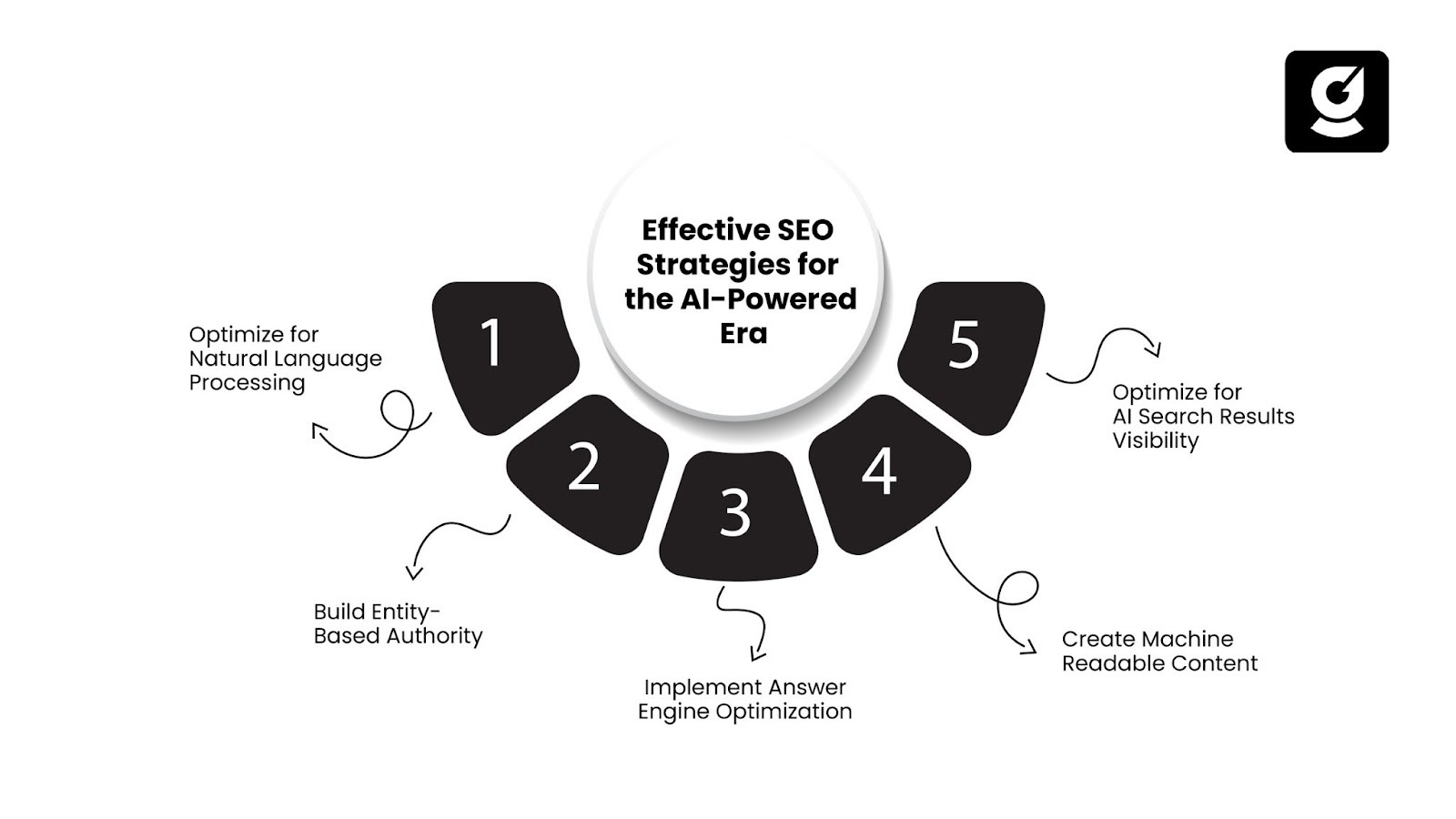
Modern SEO for B2B SaaS is no longer about ranking pages — it’s about becoming a trusted source for AI-generated answers. AI search systems evaluate meaning, authority, product clarity, and decision-stage alignment.
For SaaS companies selling to multiple stakeholders (CFOs, CTOs, Operations Heads), optimization must support complex buying journeys — not just keyword targeting.
Here’s how to build a strategy that strengthens AI Search Ranking and long-term visibility.
1. Optimize for Natural Language and Buyer Intent
B2B buyers now search in complete questions, problem statements, and workflow-based queries. AI systems interpret these conversational inputs and generate synthesized answers.
To align with this shift:
- Use decision-stage headings like: “How does enterprise invoicing software integrate with ERP systems?”
- Address comparison-driven searches such as “Best SaaS tool for multi-entity accounting.”
- Cover long-tail variations tied to role-specific intent (finance head vs. founder vs. IT lead).
- Define technical concepts clearly to improve contextual understanding.
Your content should reflect how real decision-makers articulate problems internally — not just how marketers structure keywords.
2. Build Entity-Based Authority in Your SaaS Category
AI search ranking increasingly relies on entity recognition. That means your brand must be consistently associated with your core solution category.
For B2B SaaS, this includes:
- Developing topic clusters around your primary product category (e.g., enterprise invoicing software, GST compliance automation, AI accounting tools).
- Publishing expert-led content that signals domain depth.
- Securing citations from credible industry sources.
- Maintaining consistent positioning across the website, case studies, and third-party platforms.
When AI systems repeatedly encounter your brand in specific problem domains, authority strengthens — and inclusion in AI-generated results improves.
3. Implement Answer Engine Optimization (AEO)
In AI-powered search environments, content often gets extracted rather than clicked. That makes Answer Engine Optimization essential.
For SaaS companies:
- Add structured FAQ sections targeting commercial and implementation queries.
- Provide concise summaries before long-form explanations.
- Include comparison tables for “X vs Y” searches.
- Apply relevant schema markup to improve machine readability.
Well-structured answers increase the probability of your content being quoted, summarized, or referenced inside AI search outputs.
4. Create Machine-Readable, Context-Rich Content
AI search systems rely on structure, clarity, and logical flow. Poor formatting reduces extraction accuracy.
To improve interpretation:
- Use clear heading hierarchies (H2, H3 aligned to search intent).
- Keep paragraphs concise and insight-driven.
- Support claims with data, case examples, or quantified results.
- Maintain logical content progression that mirrors a buyer’s evaluation journey.
In B2B SaaS, where buying cycles are long and research-intensive, structured clarity builds trust and improves AI Search Ranking signals simultaneously.
5. Optimize for AI Search Visibility — Not Just Rankings
Traditional SEO focused on blue-link positions. AI search environments reward presence across multiple surfaces.
Strategic focus areas include:
- Targeting featured snippets and answer boxes.
- Creating solution comparison pages for high-intent queries.
- Addressing pricing, integration, compliance, and implementation concerns directly.
- Monitoring zero-click search behavior and AI answer inclusions.
Visibility now means being cited, summarized, or referenced — even when traffic does not immediately follow. AI Search Ranking rewards brands that demonstrate expertise, clarity, and contextual authority across the entire buyer journey.
For SaaS companies competing in crowded markets, a structured AI SEO strategy ensures:
- Sustainable authority growth
- Higher inclusion in AI-generated answers
- Improved trust across multi-stakeholder buying committees
- Stronger long-term competitive positioning
In the AI era, optimization is no longer about pages — it’s about becoming the most reliable answer. Visibility must extend beyond traditional ranking metrics. A structuredAI SEO strategy for B2B SaaS ensures long-term authority and AI search ranking growth.
How growth.cx Helps SaaS and B2B Companies Improve AI Search Ranking
At growth.cx we help SaaS and B2B brands align their digital presence with evolving AI search ranking models. Partnering with an experienced SaaS SEO agency can accelerate structured authority building.
What growth.cx Delivers
At growth.cx, our approach to AI search ranking isn’t theoretical — it’s proven to generate measurable results for SaaS and B2B brands. We focus on visibility signals that matter in modern search environments, including entity authority, structured clarity, contextual relevance, and strategic content optimization.
Strategic Deliverables
- AI Search Ranking Diagnostics
We analyze how your content performs against modern ranking signals, including intent relevance, contextual authority, and structured data interpretation across AI search results.
- Zero-Click Visibility Analysis
We identify where your brand is being referenced or omitted within summarized search interactions and provide guidance to improve inclusion in answer blocks and AI-mediated responses.
- Entity Authority Mapping & Topic Clusters
We establish topic clusters and digital authority frameworks so machines and humans alike recognize your brand as a trusted source across vertical components.
- Content Frameworks & Schema Structures
We help teams create machine-readable content formats — schema, FAQ markup, and answer blocks — that align with conversational search patterns and improve extraction into results.
- Competitive Search Intelligence
We continuously monitor competitor performance, content gaps, and keyword intent shifts so your strategy evolves ahead of ranking trends rather than reacting to them.
Real Results from growth.cx
- Techmonk: Driving Qualified Leads Through Intent-Aligned Search Optimization
Growth.cx helped Techmonk refine its enterprise-SEO focus and build a targeted authority framework for high-intent SaaS queries. Through keyword prioritization, content re-architecture, and answer engine optimization, Techmonk saw sustained improvements in organic visibility and lead generation.
👉Read the full Techmonk case study
- HelloSend: Scaling SaaS Visibility with Structured Content and Context
HelloSend partnered with Growth.cx to strengthen its SaaS positioning and search presence. Growth.cx implemented a roadmap featuring topical clusters, schema enhancement, and natural language optimization tailored to buyer journeys. As a result, HelloSend achieved improved rankings, better zero-click visibility, and higher engagement across core categories of interest.
👉Explore the HelloSend case study
Rather than focusing solely on keyword placement, growth.cx evaluates how AI-powered search engines interpret brand authority, contextual depth, and structured clarity.
For companies navigating generative AI search environments, this approach ensures sustainable visibility. Early-stage companies must understandhow to market their B2B SaaS startup within evolving AI search environments.
Future of AI Search Ranking in SaaS
Search is moving toward systems that do far more than list links. Industry experts predict that search experiences in the coming years will increasingly:
- Enable agents that discover, decide, and transact on behalf of users, meaning visibility will depend on structured, machine-readable data that these systems can act on, rather than just traditional rankings.
- Integrate monetized placements inside conversational results, where inclusion and context become as valuable as position. Organic visibility now sets a foundation for paid opportunities in these experiences.
- Personalize responses uniquely for each user, so “rank one” no longer has a universal meaning; relevance and intent alignment will determine which responses a given user sees.
- See brand authority measured less by clicks and more by how frequently content is trusted, cited, and reused across AI search surfaces.
Brands that invest in semantic clarity and contextual authority will maintain a competitive advantage. A strongB2B SaaS SEO framework supports sustainable AI search ranking improvements across competitive markets.

Conclusion
Search behaviour has evolved into a layered, conversational process shaped by AI SEO. Buyers expect immediate clarity, structured comparisons, and contextual answers.
AI search ranking reflects this shift. Algorithms prioritize semantic depth, authority signals, and machine-readable structure. For SaaS and B2B organizations, adapting to this reality influences not only visibility but revenue growth and competitive positioning.
Leaders who integrate answer engine optimization, strengthen entity authority, and align content with natural language processing models will secure a sustained presence in AI search results.
Discover how AI can revolutionise your search ranking—book a call now and get future-proof AI-driven SEO strategies for SaaS and B2B companies.

FAQ
Search Impact Saas How Does Zero-Click Companies?
Zero-click search reduces the number of website clicks because answers appear directly in search results. For SaaS companies, visibility now depends on being featured in AI summaries, snippets, and answer boxes. To stay competitive, brands should focus on optimizing for search engines, creating structured content, and providing clear responses to buyer queries so their content appears in AI search results.
What is answer engine optimization?
Answer engine optimization structures content so AI-powered search engines can extract and summarize it accurately. It includes clear definitions, structured formatting, and semantic clustering.
How do large language models influence search visibility?
Large language models interpret relationships between topics, assess authority signals, and generate summarized AI search results. Content clarity and entity reinforcement improve the likelihood of inclusion.
What search engine optimization strategies work best for AI-driven search?
Effective strategies include natural language optimization, entity-based authority building, structured content formatting, and consistent brand reinforcement across platforms.