Recent statistics indicate that organic search traffic for most B2B SaaS businesses has stagnated or decreased, mainly due to AI-powered search results and changes in search engine behavior.
A 2025 study by Search Engine Journal indicates that more than 50% of search engine queries result in AI-powered answers. This means search engines are no longer just about displaying a list of links but are increasingly about answering search queries directly. This shift is causing a whole new set of problems for businesses that have traditionally relied on organic search traffic.
But how can you survive this paradigm shift? The key is to leverage future SEO trends, including AI search engine optimization, semantic search optimization, and authority signals.
Search engine optimization in 2026 is no longer just about using traditional search engine ranking factors. It’s about adjusting to AI-powered search engines, large language models, and the growing need for highly authoritative, structured content.
In this article, we will examine the most popular SEO trends that are currently affecting the B2B SaaS industry in 2026.
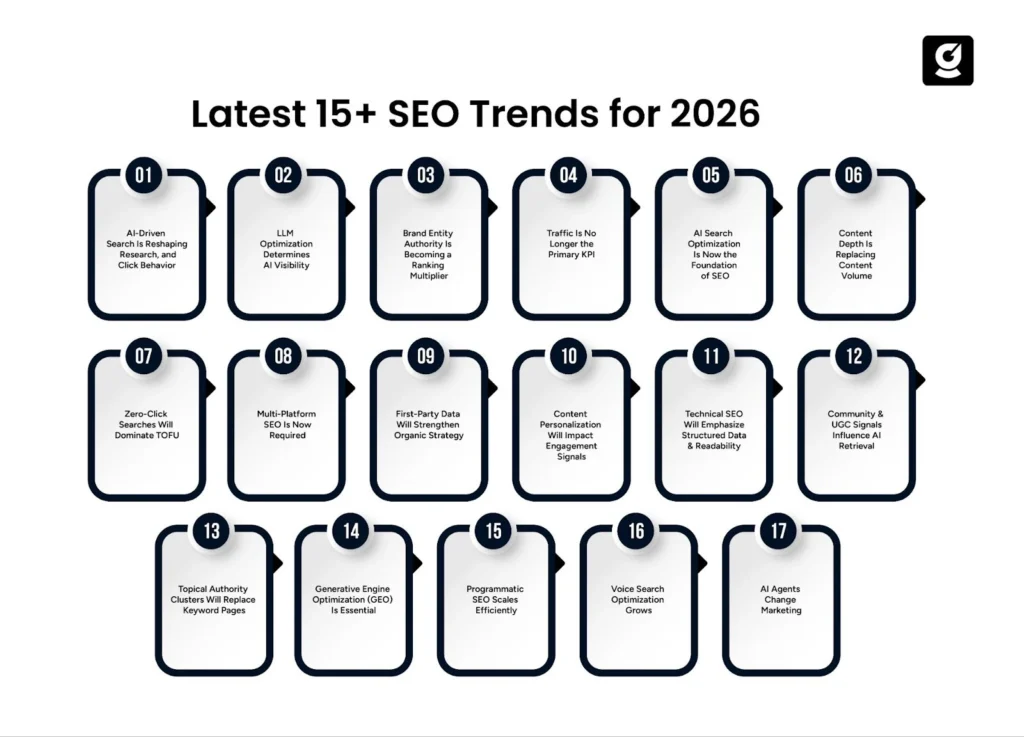
The 15+ Most Important SEO Trends for 2026
1. AI-Driven Search Is Reshaping Research, and Click Behavior
AI search engines are no longer new. They are now an essential part of how consumers interact with search engine results, especially in a complex decision-making space such as B2B SaaS.
AI search engines such as ChatGPT and Google’s Gemini offer users direct answers to their questions, reducing the need to click through to several pages.
The emergence of conversational AI is changing the way people interact with search engines. Instead of typing keyword-based searches, users are now using conversational searches.
Search engines and AI algorithms can now handle long-tail searches and deliver results tailored to specific user needs. This means that your content needs to be relevant to the contextual and scenario-based searches.
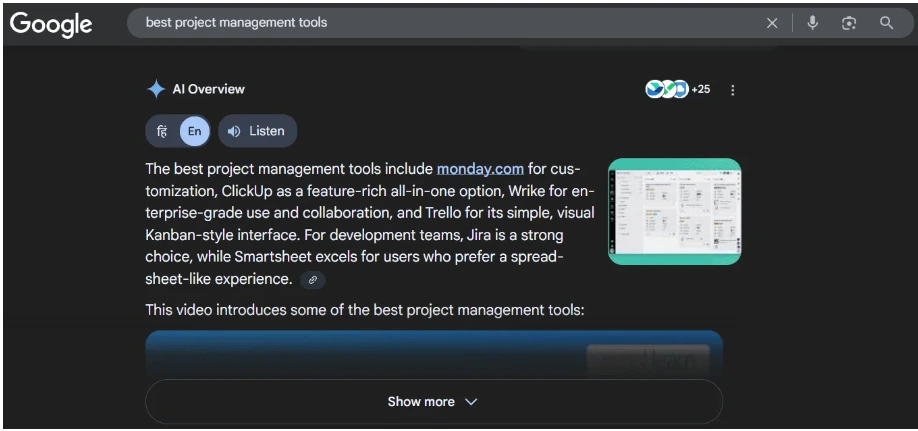
- Summaries offered by AI search engines reduce the need for traditional organic search results.
- Conversational search queries involving multiple steps are becoming the new standard, with users demanding additional information without leaving the search engine interface.
- Visibility is now dependent on AI citation share, which means your brand needs to be summarized and cited in AI search engines.
Also, Generative Engine Optimization (GEO) is increasingly involved in how buyers research and interact with content. In the past, B2B buyers would simply do a Google search and click through several pages to find the information they needed for their research.
Actionable Insight:
B2B SaaS content marketing tips can help businesses optimize their content for summary in AI search engines. This involves developing content that is highly structured, authoritative, and concise, as well as investing in data-driven content that performs well in AI search engine responses.
2. LLM Optimization Determines AI Visibility
Large language models (LLMs) such as GPT-4 and Gemini have transformed the way search engines index and rank content. LLMs rank content based on entity clarity, relevance, and authority. The capacity of AI to reference authoritative sources is essential in the current SEO environment.
- Entities that are frequently referenced in authoritative AI-generated content dominate.
- The structure of your content may affect its retrievability and citation by LLMs.
How Does This Impact Your B2B SaaS Strategy?
In 2026, visibility will depend on your content’s retrievability and citation by LLMs. Just being visible on Google is not enough. Your content must be indexed by LLMs to be visible.
Read our LLM SEO Guide for SaaS
Actionable Insight:
Prioritize topical authority and clarity. Make sure your content is organized, entity-heavy, and referenced in authoritative external sources.
3. Brand Entity Authority Is Becoming a Ranking Multiplier
As AI search engines develop, the role of brand authority is becoming increasingly important for content visibility. AI search engines not only rank content based on relevance to a search query but also on a brand’s online authority.
- Mentions of the brand on authoritative sites help in increasing visibility.
- The founder’s thought leadership helps the company establish itself as an authority, thereby increasing its visibility in AI search results.
- Digital PR activities such as backlinks, press releases, and media mentions play a very important role in helping AI search engines rank and cite your brand as an authority.
Actionable Insight:
B2B SaaS businesses need to focus on digital PR, content partnerships, and thought leadership to build their brand’s authority across platforms. It is no longer a matter of content quantity; it is a matter of genuine authority in your niche.
4. Traffic Is No Longer the Primary KPI
With the advent of AI-powered search, traffic-based KPIs are no longer a reliable indicator of SEO success.
- Click-through rates are lowered by AI because answers are frequently provided directly in search engines.
- Pipeline attribution (measuring SEO’s contribution to leads and conversions) is now at the forefront.
- Visibility within AI environments (such as ChatGPT, Google Gemini, and so on) is now the most important metric.
New Metrics to Embrace:
- AI citation frequency: The frequency with which your brand or content is cited within AI algorithms.
- Authority share: The relative visibility and authority of your brand compared to competitors within AI search results.
- Assisted MQL contribution: The contribution of content to Marketing Qualified Leads through AI-powered answers.
Actionable Insight:
Move your attention from traditional traffic metrics to AI citation and visibility metrics. Employ tools that measure the frequency with which your brand or content is cited within AI-powered answers.
5. AI Search Optimization Is Now the Foundation of SEO
With the advent of AI-powered search, traffic-based KPIs are no longer a reliable indicator of SEO success.
- Click-through rates are lowered by AI because answers are frequently provided directly in search engines.
- Pipeline attribution (measuring SEO’s contribution to leads and conversions) is now at the forefront.
- Visibility within AI environments (such as ChatGPT, Google Gemini, and so on) is now the most important metric.
New Metrics to Embrace:
- AI citation frequency: The frequency with which your brand or content is cited within AI algorithms.
- Authority share: The relative visibility and authority of your brand compared to competitors within AI search results.
- Assisted MQL contribution: The contribution of content to Marketing Qualified Leads through AI-powered answers.
Actionable Insight:
Move your attention from traditional traffic metrics to AI citation and visibility metrics. Employ tools that measure the frequency with which your brand or content is cited within AI-powered answers.
6. AI Search Optimization Is Now the Foundation of SEO
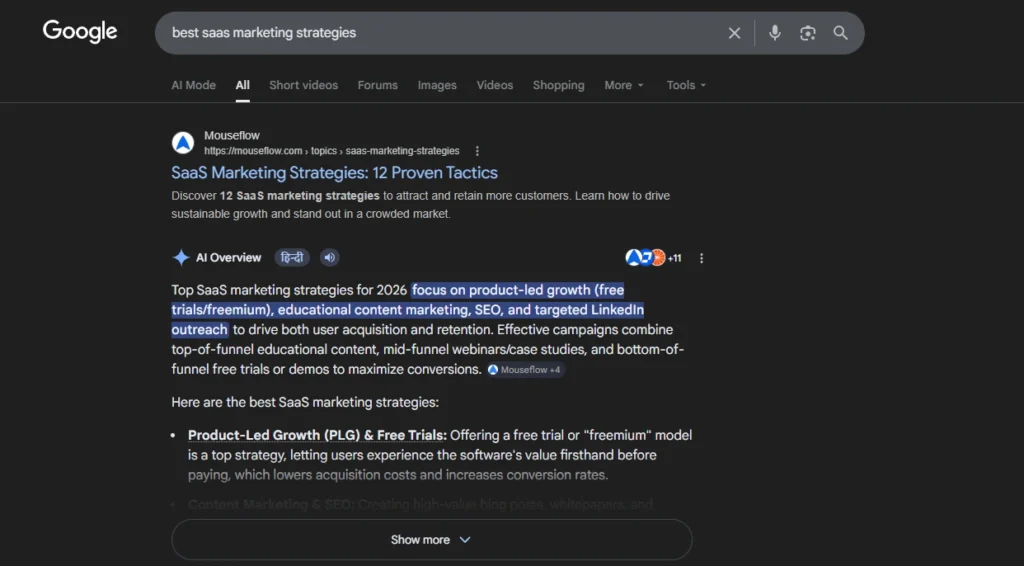
AI search optimization combines traditional SEO techniques with answer engine optimization, LLM optimization, and brand authority building.
Answer Engine Optimization (AEO) is about ensuring content is optimized for extraction by AI engines programmed to find the best, most straightforward answers. This is a crucial part of SEO content marketing as search engines continue to evolve.
- Structured, straightforward answers are becoming the new norm, preferred over long-form content.
- FAQ and definition content formatting is no longer optional; it’s a necessity.
- The content needs to be extractable, meaning it should be easily accessible to AI engines.
With AI answers becoming the new norm, content that provides answers quickly and straightforwardly is more likely to be included in AI-powered summaries. This means that the new SEO approach of ranking and page views is no longer sufficient.
AI search optimization is a hybrid SEO approach that blends:
- Traditional ranking signals
- LLM optimization
- Answer engine optimization (AEO)
- Brand authority building
Actionable Insight:
Incorporate AI search optimization into your core strategy, focusing on content quality, structured data, and authority-building activities to stay ahead in 2026.
7. Content Depth Is Replacing Content Volume
Content depth is becoming more important than simply producing high quantities of content. AI systems now prioritize comprehensive content that covers topics thoroughly over surface-level articles.
- Thin blog strategies (creating multiple short, shallow posts) are ineffective.
- Consolidation of content into in-depth, authoritative pieces improves your AI retrieval potential.
- Topic saturation (covering a subject comprehensively) is more valuable than publishing numerous low-quality blog posts.
Actionable Insight:
Instead of creating more content, invest in pillar content that covers topics comprehensively. This increases your chances of AI engines referencing your content.
8. Zero-Click Searches Will Dominate TOFU
Zero-click searches are on the rise, where search engines deliver answers directly on the results page, bypassing the need for users to click through to websites.
- Informational queries will be answered instantly in the search engine interface.
- Content must build authority and brand familiarity, even without direct clicks.
Actionable Insight:
Optimize your content to provide immediate answers. Use structured data, schema markup, and question-based headings to increase the chances of appearing in a zero-click search.
9. Multi-Platform SEO Is Now Required
Visibility in Google alone is no longer sufficient. AI systems aggregate content from a variety of sources, not just traditional search engines.
- AI systems pull content from multiple platforms, including:
- Blogs
- LinkedIn
- Industry publications
- Documentation
- Podcasts
- Blogs
Actionable Insight:
B2B SaaS companies need to build a multi-platform SEO presence. Ensure content distribution across LinkedIn, medium-sized publications, and even podcasts to increase brand mentions and AI-driven visibility.
10. First-Party Data Will Strengthen Organic Strategy
Utilizing first-party data (CRM insights, customer feedback, and web analytics) will play a key role in SEO moving forward. This data allows companies to better map out content that is aligned with customer needs.
- CRM insights can guide content mapping, ensuring you are addressing what matters most to your customers.
- Revenue-aligned keyword targeting increases SEO efficiency and drives higher conversion rates.
- SEO must align with sales conversations, ensuring content resonates at all stages of the buyer journey.
Actionable Insight:
Leverage your CRM data and sales conversations to guide SEO strategies. Align content with the real pain points, needs, and questions of your target audience.
11. Content Personalization Will Impact Engagement Signals
Content personalization is becoming a very important aspect of SEO, as AI and search engines are favoring content that is adaptive to user behavior.
- Adaptive content will enhance dwell time and engagement signals, which are becoming very important for search engines.
- Behavioral targeting will affect SEO rankings, as it will result in increased engagement due to personalized experiences.
- AI-powered user experience (UX) will have an indirect effect on the impact of SEO, as it will increase on-page factors.
Actionable Insight:
Personalized content strategies, such as dynamic content that is adaptive based on the user’s behavior, location, and interests, should be invested in.
12. Technical SEO Will Emphasize Structured Data & Readability
With the advancement of AI-powered search engines, structured data and readability are going to be crucial.
- Structured data and schema markup will play a vital role in AEO (Answer Engine Optimization).
- A content hierarchy should be clean and well-structured to ensure that it is properly interpreted and indexed by search engines and AI.
Actionable Insight:
Make sure that your website is schema-marked and has a clean content structure. Focus on content formatting that helps AI interpret it.
13. Community & UGC Signals Influence AI Retrieval
AI systems are increasingly looking at community discussions and user-generated content (UGC) to determine the authority and relevance of content.
- AI models ingest public discussions from forums, reviews, and social media.
- Community presence strengthens entity signals and boosts visibility.
- Brand mentions outside your website (e.g., in public discussions) matter more for SEO.
Actionable Insight:
Encourage user-generated content on forums, social media, and review sites. This helps strengthen your brand’s entity authority across the web.
14. Topical Authority Clusters Will Replace Keyword Pages
The traditional approach of creating keyword-centric pages is being replaced by building topical authority clusters. Search engines, particularly AI-driven ones, are now more focused on semantic search optimization. This approach prioritizes understanding the intent behind a query rather than matching individual keywords.
- Pillar-cluster architecture is the future of SEO, where content is grouped based on related topics rather than individual keywords.
- Intent mapping helps to map content to the buyer’s journey, making sure it resonates at each stage (TOFU, MOFU, BOFU).
- Contextual depth is more important than sheer volume of content.
Actionable Insight:
Reorganize your content into pillar pages and topic clusters that address user intent at every stage of the funnel, from awareness to consideration to decision.
15. Generative Engine Optimization (GEO) Is Essential
Generative engines, such as ChatGPT, need a unique approach to citation optimization.
- The generative engine uses high-quality wording, accurate statistics, and proper formatting to improve snippet optimization.
Actionable Insight:
The goal is to create authoritative and factual content that can be easily quoted by generative AI engines such as ChatGPT.
Understand GEO vs. AEO vs. SEO Strategy for B2B SaaS
16. Programmatic SEO Scales Efficiently
Programmatic SEO helps you scale efficiently without compromising the quality of your content. This is especially helpful for SaaS product features or feature-centric content.
- Templates and data-driven approaches enable the creation of mass pages without substantial loss of quality.
Actionable Insight:
Apply programmatic SEO to produce high volumes of optimized content for feature pages, service pages, and other content types with minimal resource investment.
17. Voice Search Optimization Grows
With the increasing adoption of voice assistants, voice search optimization is a must.
- Natural language matching is set to become highly important, as voice searches are likely to be longer and more conversational.
Actionable Insight:
Target natural language queries and optimize content to match the way people speak to their devices.
18. AI Agents Change Marketing
AI-powered marketing agents are increasingly handling research and transactions.
- Autonomous marketing agents demand optimized content workflows, which in turn require adjusting SEO approaches to suit their needs.
Actionable Insight:
Sync your SEO with AI agents by making your content easily consumable, flexible, and accessible to autonomous agents.
Explore Our AI SEO Agencies Services
Conclusion: The Future of SEO Is Hybrid, Authority-Driven, and AI-Integrated
It is about being noticed, referenced, and recommended by AI engines that are now influencing the buyer’s journey. Although traditional ranking factors remain important, they are no longer sufficient on their own. AI search optimization, LLM visibility, and answer engine optimization are now essential.
To succeed in this new world, B2B SaaS businesses must learn to navigate the new landscape of AI-powered search. At growth.cx, your trusted AI SEO Services, we understand what you are going through.
Launching a SaaS company is already a high-risk endeavor, and that is where we can help. Our team of experts, comprising growth hackers, digital marketers, content writers, developers, and designers, has assisted many SaaS startups in their journey to success.
We have assisted more than a dozencustomers in boosting the relevant website traffic, MQLs, SQLs, and monthly recurring revenue (MRR). Our aim is to lower the failure rate of startups by doing what we do best—marketing!
Get in touch with us today and let us collaborate to save time and money, so you can focus on what you do best—building amazing products and experiences for your customers. See how we can help scale your SaaS business with the right SEO approach.

FAQ
How do AI search engines affect B2B SaaS traffic?
AI search engines impact traffic by directly providing answers to users' queries, reducing the need to click multiple search results. B2B SaaS businesses need to optimize for citations in the AI-generated answer box rather than just the rankings.
What is LLM optimization?
LLM optimization is the optimization of content to be easily processed and cited by large language models such as GPT-4. It is the process of organizing content in a clear manner with rich entities and authority signals to increase visibility in the AI-generated answer box.
What is answer engine optimization (AEO)?
AEO is the process of making content easily extractable by AI, with a strong focus on providing direct answers to questions. This is crucial for being cited in the AI-driven search engine results.
Is traditional SEO still relevant?
Yes, traditional SEO is still relevant, but it must be integrated with AI-driven search optimization strategies. Ranking remains important, but visibility now relies on how well content is cited and referenced by AI engines.
How can B2B SaaS companies adapt to generative AI in search?
B2B SaaS companies can adapt by focusing on semantic search optimization, creating authoritative content, and ensuring their content is structured for easy extraction by AI engines. Additionally, building brand authority and maintaining an active digital presence are crucial.