Your Series B SaaS company has missed its pipeline target for the second consecutive quarter. During the board meeting, someone asks who owns marketing strategy, and the difficult answer is that nobody does. Since the VP of Marketing left five months ago, the CEO has been managing freelancers and external partners through Slack, keeping campaigns moving without a clear marketing leader driving the function.
The company decides it may be time to hire a fractional CMO. As you compare options, the question quickly becomes fractional CMO vs interim CMO: which leadership model actually fits your growth stage? You may also come across outsourced CMO services, with providers sometimes using these titles interchangeably.
The confusion is not just about terminology. These are three distinct engagement models with different levels of ownership, involvement, and expectations. Choosing the wrong one can mean bringing in external support when you need executive leadership, or temporary stability when your company needs a long-term growth strategy.
Why are these three titles so easy to confuse?
All three CMO types are confusing because no licensing body governs any of them; providers pick whichever label converts on their landing page, not the one that matches how they actually work.
A solo consultant, a boutique agency, and a staffing platform can all position the same arrangement as a fractional CMO. For companies looking to hire a fractional CMO, this creates a challenge: search results often show three different delivery models under one label, making it difficult to understand what type of leadership they actually need.
The confusion comes at a time when companies are actively rethinking how they build marketing leadership. Gartner’s 2025 CMO Spend Survey found that 39% of CMOs planned to reduce labor costs, pushing companies to look for more flexible leadership models instead of immediately adding traditional full-time executive roles.
For B2B SaaS founders, the real question is not the title. It is ownership: who owns the growth number when the board asks about results next quarter?
Fractional CMO vs Interim CMO vs Outsourced CMO: Key differences explained
| Differentiators | Fractional CMO | Outsourced CMO | Interim CMO |
| Where they sit | Inside your leadership team | Outside, delivered as a vendor service | Inside, temporarily, in the existing seat |
| Accountable for | Commercial outcomes (pipeline, CAC, ARR contribution) | Contracted scope of deliverables | Stability and continuity during the gap |
| Time horizon | Ongoing, no built-in end date | Contract term, renewed or not | Ends when the permanent hire starts |
| Time to start | 1–3 weeks | 1–3 weeks | 1–2 weeks |
| Best-fit trigger | No executive owns marketing strategy | You want the function managed externally without building internal leadership | The seat is vacant, and a permanent search is underway |
None of these models is automatically better than the others. A strong interim CMO can outperform a weak fractional engagement, and an outsourced team can be the right choice for a company that does not need internal ownership.
The right choice depends on the gap you need to solve, not the title attached to the person.
Fractional CMO vs Interim CMO: What Actually Separates These Leadership Models?
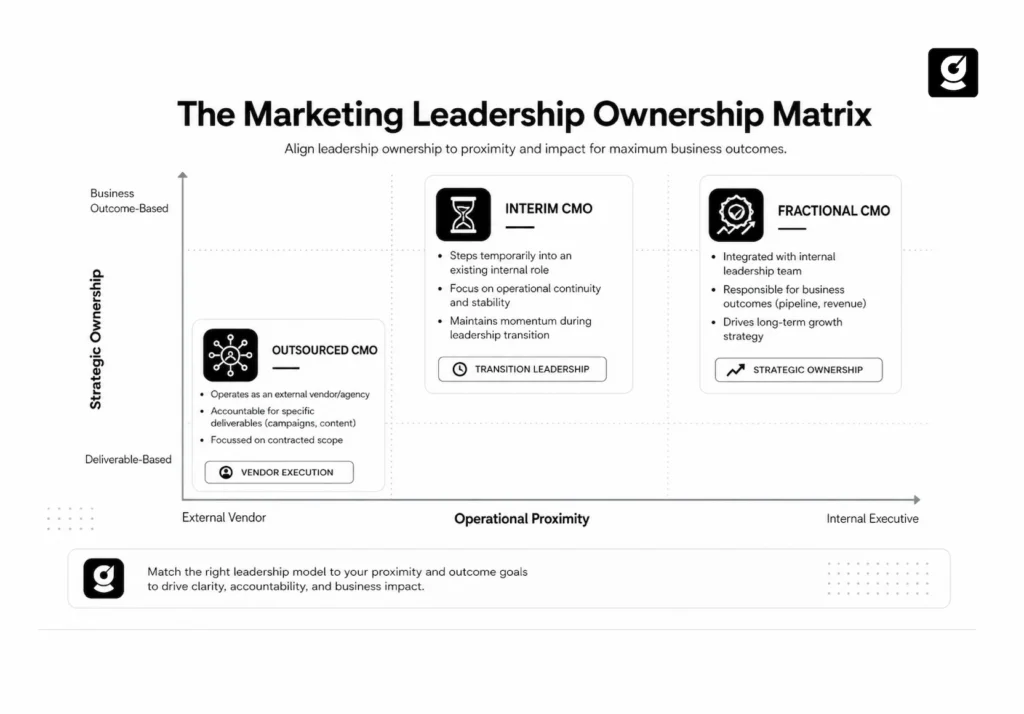
The real difference is not the number of hours they work. It is the level of ownership they carry, the decisions they influence, and whether they are accountable for business outcomes or specific deliverables.
What is the role of an Interim CMO?
When a CMO leaves unexpectedly, an interim CMO keeps marketing leadership moving while the company searches for a permanent replacement.
They step into the existing role, maintain operational continuity, and ensure critical decisions do not stall during the transition. Because the goal is to bridge a leadership gap, their focus is usually on maintaining momentum, stabilizing the team, and preparing the function for the next permanent leader.
How Is a Fractional CMO Different From an Interim CMO?
Understanding fractional CMO vs interim CMO starts with one key difference: ownership. A fractional chief marketing officer (fractional CMO) provides executive-level marketing leadership without the commitment of a full-time hire, taking ownership of strategy, team alignment, and growth outcomes. An interim CMO, on the other hand, typically steps in to maintain leadership continuity while a company searches for a permanent marketing leader.
What is the role of an Outsourced CMO?
An outsourced CMO gives companies access to marketing leadership without adding the role internally.
The engagement is structured as an external service, with responsibilities defined through a vendor relationship. This model works well when companies need strategic guidance or execution support without creating an internal executive position.
The challenge is proximity. Decisions around pricing, product direction, sales alignment, and revenue strategy often happen inside leadership conversations. An external provider may contribute valuable expertise but may not have the same day-to-day involvement in those decisions.
Which CMO model fits your current business situation?
Ownership and mandate explain what each model is. They don’t tell you which one to actually sign this quarter. These are the operational triggers, not a repeat of the definitions above.
When to hire a fractional CMO
- You’re heading into a fundraise and need a GTM narrative credible enough to survive investor diligence, but nobody internally would stake the pitch deck on it.
- Marketing spend is spread across four or five channels, and no one can say with confidence which two are actually worth keeping.
- The company has crossed roughly $3M to $5M ARR, the point where “the founder does marketing on the side” stops scaling and starts quietly costing pipeline.
- You need someone accountable for the strategy eighteen months from now, not just for the length of a single contract.

When to hire an outsourced CMO
- There’s no internal marketing team today and no near-term plan to build one, so you’d rather buy the whole function from a provider with its own bench than add headcount.
- Leadership wants a fixed, predictable line-item cost against a defined statement of work, budgeted the way you’d budget outsourced IT or accounting.
- You need breadth across execution channels immediately: ads, content, email, social, more than you need one person owning a single strategic thread.
- Marketing is currently treated internally as a cost center to run efficiently, not yet as a function leadership wants to sit inside and shape directly.
When to hire an interim CMO
- Your CMO or VP of Marketing left with no succession plan, and a formal search is already underway or about to start.
- You’re mid-acquisition or restructuring and need someone to stabilize the function through a leadership transition without making it their own.
- There’s a fixed-scope initiative with a hard start and end date, a pre-IPO rebrand, a major launch push, a repositioning tied to one funding event, and you need a specialist for that window and no longer.
- An existing CMO is on extended leave, and the team needs someone with real day-to-day authority to keep decisions moving until they’re back.
What each model actually does to your pipeline
Companies rarely ask this part before signing, and it’s the part that actually shows up on the board deck three months later.
| Fractional CMO | Outsourced CMO | Interim CMO | |
| Time to first strategic shift | 30–45 days; part-time hours mean assessment comes before redirection | 2–3 weeks to first campaign live, longer for a genuine strategic pivot to clear the account structure | Immediate authority over the existing plan, but aimed at continuity, not change |
| Typical revenue pattern | Often flat or slightly down in month one or two as weak channels get cut, then compounds over two to three quarters | A fast bump in activity-based metrics; pipeline lift depends on how tightly the scope was defined upfront | Usually holds revenue flat or prevents further decline; rarely a step-change, by design |
| Marketing activity pattern | Narrower and more concentrated, since the fractional CMO redirects the existing team rather than adding hands | Broader and higher-volume, since the vendor bench adds execution capacity the internal team doesn’t have to staff | Largely unchanged from before the transition, focused on not breaking what’s already running |
| Risk if the model is mismatched | Strategy churn without follow-through, since limited hours can’t force a big change through without a team executing behind it | Disconnected execution, campaigns and content produced without a coherent read on what’s actually moving pipeline | Stalled growth through a critical window, since the caretaker mandate can leave a real ownership gap unaddressed for months |
None of these patterns is better in the abstract. A company mid-search wants the interim pattern: flat and stable beats disrupted while a hire is still being found. A company with an ownership gap wants the fractional pattern: a slower first month in exchange for a strategy that compounds.
What actually hurts revenue is the mismatch: a caretaker mandate applied to a company that needed rebuilding, or a rebuild applied to a team that just needed stability for a quarter.
Looking to hire a fractional CMO? Build a growth function that owns revenue
Choosing between a fractional CMO, outsourced CMO, or interim CMO comes down to the problem your business needs to solve.
If you need temporary leadership coverage, an interim CMO can help maintain stability. If you need an external team to manage marketing execution, an outsourced model may fit better. But if your company needs strategic ownership, a clear go-to-market direction, and a marketing function built around revenue outcomes, you need more than campaign support.
growth.cx is a fractional CMO agency that helps B2B SaaS companies build revenue-focused marketing functions. Instead of only providing strategic advice, Growth.cx combines CMO-level leadership with hands-on execution across SEO, content, demand generation, paid acquisition, and growth programs.
The result is a marketing function that connects strategy to pipeline, improves visibility across channels, and builds a repeatable growth engine without the commitment of a full-time executive hire.
Final thoughts
The decision between a fractional CMO vs an interim CMO depends on whether your company needs long-term strategic ownership or short-term leadership stability. Whether you need temporary stability, external execution support, or long-term marketing ownership, the right structure should align with your growth goals.
For B2B SaaS companies that need CMO-level strategy without adding a full-time executive, growth.cx provides fractional marketing leadership backed by a team of growth specialists. From go-to-market strategy to demand generation and content-led growth, growth.cx helps companies build a marketing engine designed to drive measurable pipeline impact.
Talk to Growth.cx to explore how fractional marketing leadership can help your SaaS company build a scalable growth strategy.

FAQ’s
Which companies offer fractional CMO services compared to outsourced and interim CMO options?
Providers can include independent consultants, specialist agencies, boutique marketing firms, and executive staffing companies. For fractional CMO services, Growth.cx supports B2B SaaS companies with executive-level marketing leadership combined with execution across content, SEO, demand generation, paid acquisition, and growth programs.
When is a fractional CMO the best choice for a scaling startup?
A fractional CMO is a strong fit when a scaling startup needs senior marketing ownership but is not ready for a full-time CMO. This often happens when founders can no longer manage marketing themselves, pipeline growth has stalled, multiple channels lack clear direction, or the company needs stronger go-to-market leadership.
How do I choose between hiring a fractional CMO or an outsourced CMO for my startup?
Choose a fractional CMO when you need an executive who can work closely with leadership, own marketing strategy, and be accountable for growth outcomes. An outsourced CMO is generally better when you want an external provider to manage defined marketing activities or the entire function without building internal marketing leadership.
What are the typical responsibilities of an outsourced CMO agency?
An outsourced CMO agency typically provides marketing strategy, campaign planning, channel management, content, paid advertising, email, social media, reporting, and execution support. Its responsibilities are usually defined through a contract or statement of work rather than through an internal executive leadership role.