Most B2B SaaS companies do not struggle because they lack lead generation channels. They struggle because those channels are not creating a qualified pipeline.
- Traditional lead generation approaches often focus on increasing MQL volume instead of improving sales opportunities, resulting in wasted budgets and poor marketing-sales alignment.
- In 2026, 85% of B2B marketers reported difficulty connecting marketing performance with business outcomes, showing why companies are shifting from lead quantity to revenue impact.
Successful B2B lead generation tactics in 2027 will not be about running more campaigns. They will require a connected system combining demand generation, sales enablement, content, outbound, and conversion optimization.
For SaaS companies, effective B2B saas lead generation means attracting the right buyers, improving pipeline quality, reducing CAC, and creating predictable revenue growth. This guide breaks down 17 proven strategies and ranks them by their potential pipeline impact.
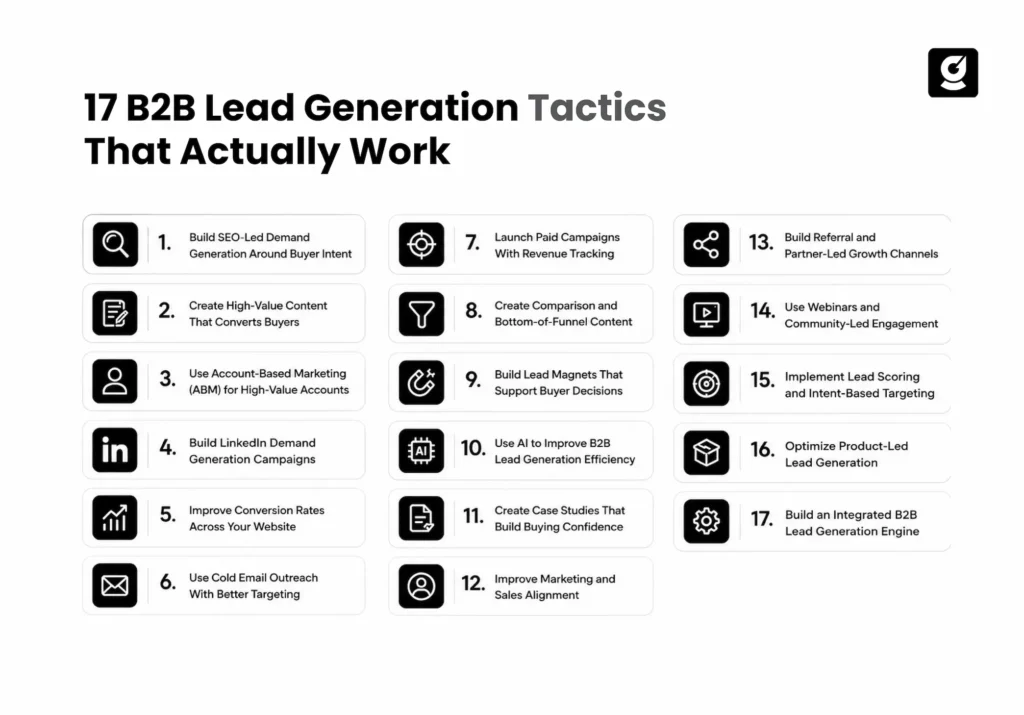
What Are the 17 B2B Lead Generation Tactics That Actually Work in 2027?
The 17 B2B lead generation tactics that actually work in 2027 are:
1. Build SEO-Led Demand Generation Around Buyer Intent
2. Create High-Value Content That Converts Buyers
3. Use Account-Based Marketing (ABM) for High-Value Accounts
4. Build LinkedIn Demand Generation Campaigns
5. Improve Conversion Rates Across Your Website
6. Use Cold Email Outreach With Better Targeting
7. Launch Paid Campaigns With Revenue Tracking
8. Create Comparison and Bottom-of-Funnel Content
9. Build Lead Magnets That Support Buyer Decisions
10. Use AI to Improve B2B Lead Generation Efficiency
11. Create Case Studies That Build Buying Confidence
12. Improve Marketing and Sales Alignment
13. Build Referral and Partner-Led Growth Channels
14. Use Webinars and Community-Led Engagement
15. Implement Lead Scoring and Intent-Based Targeting
16. Optimize Product-Led Lead Generation
17. Build an Integrated B2B Lead Generation Engine
B2B lead generation in 2027 is shifting from generating more leads to creating better-quality opportunities. SaaS companies need strategies that attract the right buyers, improve conversion rates, and contribute directly to revenue.
The most effective b2b lead generation tactics combine demand generation, content, outbound, sales alignment, and AI-driven insights to build a predictable pipeline.
1. Build SEO-Led Demand Generation Around Buyer Intent
SEO is no longer just a channel for increasing website traffic. For B2B SaaS companies, it has become a way to capture existing demand by helping potential buyers find answers when they are actively researching a problem.
Many companies still create content around high-volume keywords without understanding buyer intent. This often brings visitors who are not ready to purchase and creates a gap between traffic growth and pipeline growth.
A stronger SEO-led demand generation approach focuses on:
- Understanding what buyers search for before they know about your product.
- Creating content that addresses specific business challenges.
- Mapping content to different stages of the buying journey.
- Building authority around topics your ideal customers care about.
Also read: Saas SEO Best Practices
For example, a SaaS company selling sales software should not only target product-related keywords. It should also create content around challenges such as improving sales forecasting, increasing pipeline visibility, or reducing manual reporting.
A complete SEO-led B2B demand generation strategy should include:
- Problem-focused content: Helps prospects identify challenges and understand possible solutions.
- Solution-focused content: Educates buyers about approaches and frameworks.
- Commercial content: Supports prospects comparing vendors before purchase.
With AI search changing how buyers discover information, companies also need content that is easy for search engines and AI platforms to understand. Clear answers, structured content, expert insights, and real examples help brands improve visibility across both traditional and AI-powered search.
2. Create High-Value Content That Converts Buyers
Content remains one of the strongest B2B lead generation methods, but only when it supports the buyer’s decision-making process.
Publishing frequent blog posts alone does not create demand. Buyers engage with content that helps them solve problems, evaluate options, and reduce uncertainty before speaking with sales.
High-performing B2B SaaS content marketing should answer three important questions:
- What problem is the buyer trying to solve?
- What solutions or approaches should they consider?
- Why should they trust your company?
Instead of creating generic educational content, companies should invest in assets that influence buying decisions, such as:
- Industry research reports that build authority.
- Detailed guides that solve complex problems.
- Comparison pages that help buyers evaluate options.
- Case studies that demonstrate measurable outcomes.
- Playbooks and frameworks that provide immediate value.
The role of content marketing services changes throughout the funnel:
- Awareness stage: Content helps prospects understand problems they may not have clearly identified.
- Consideration stage: Content helps buyers compare solutions, strategies, and vendors.
- Decision stage: Content provides proof through case studies, testimonials, and ROI-focused resources.
For SaaS companies, content should not operate separately from sales. The best-performing teams use content as a sales enablement asset that helps prospects move faster through the buying journey.
3. Use Account-Based Marketing (ABM) for High-Value Accounts
Traditional lead generation focuses on attracting as many prospects as possible and filtering them later. Account-Based Marketing takes the opposite approach by identifying the companies most likely to become valuable customers and creating targeted campaigns around them.
ABM is especially effective for B2B SaaS companies selling complex products because buying decisions usually involve multiple stakeholders, longer evaluation cycles, and higher deal values.
A successful ABM program starts with:
- Defining a clear ideal customer profile.
- Identifying accounts that match your target criteria.
- Understanding account-level challenges and priorities.
- Creating personalized messaging for different stakeholders.
For example, a SaaS platform targeting enterprise companies may create different messaging for:
- A marketing leader focused on pipeline growth.
- A sales leader focused on efficiency.
- A CFO focused on cost and ROI.
ABM also improves marketing and sales alignment because both teams work toward the same account targets instead of measuring success only through lead volume.
The biggest advantage of ABM is quality. Instead of generating hundreds of unrelated leads, companies can create stronger engagement with accounts that have a higher chance of converting into revenue.
4. Build LinkedIn Demand Generation Campaigns
LinkedIn has become a key B2B demand generation channel because buyers often research companies and industry experts before they enter a sales conversation.
However, successful LinkedIn campaigns are not built around promotional posts alone. They require consistent education, expertise, and trust-building.
Effective LinkedIn demand generation includes:
- Sharing insights from founders and executives.
- Publishing content around customer challenges.
- Building authority through industry perspectives.
- Using paid campaigns to reach specific buyer segments.
Founder-led content is particularly effective for SaaS companies because buyers often trust insights from experienced operators more than traditional brand messaging.
For example, instead of posting “Our product helps companies increase efficiency,” a stronger approach is sharing:
- Common mistakes companies make in the category.
- Lessons from customer implementations.
- Industry trends affecting buyers.
- Frameworks for solving common problems.
LinkedIn lead generation works best when it supports the entire demand generation process:
Awareness → Engagement → Trust → Sales Conversation
The goal is not simply collecting leads. It is creating familiarity with decision-makers before they actively evaluate solutions.
5. Improve Conversion Rates Across Your Website
Driving more traffic does not automatically create more pipeline. Many B2B SaaS companies invest heavily in SEO, paid campaigns, and content but lose potential customers because their website does not clearly communicate value or guide visitors toward the next step.
Your website should work as a pipeline conversion engine, turning existing traffic into qualified opportunities.
A strong website conversion strategy focuses on:
- Clear positioning: Visitors should immediately understand who your product is for, what problem it solves, and why it is different.
- Intent-based landing pages: Create pages based on specific buyer needs instead of sending all traffic to generic pages.
- Optimized conversion paths: Reduce friction across demo requests, free trials, and signup experiences.
- Strong messaging alignment: Ensure website copy matches the problems and language your buyers actually use.
Please read: Conversion Rate Optimization in SaaS Platforms
For B2B SaaS companies, conversion rate optimization (CRO) is not only about increasing form submissions. It is about attracting better-fit prospects and helping them move faster through the buying journey.
Small improvements in messaging, page structure, CTAs, and user experience can significantly improve the return from existing marketing channels.
6. Use Cold Email Outreach With Better Targeting
Cold email remains an effective B2B lead generation technique, but the approach has changed. Sending large volumes of generic emails rarely produces meaningful results because buyers expect relevance and personalization.
Successful outbound campaigns start with understanding the target audience before writing the first email.
A modern cold email strategy includes:
- Building a focused prospect list: Target companies and decision-makers that match your ICP instead of reaching a broad audience.
- Personalized messaging: Connect your message to the prospect’s industry, challenges, recent activities, or business goals.
- Intent-based outreach: Reach prospects when they show signals that they may need your solution.
- Consistent follow-ups: Build a sequence that provides value instead of repeatedly asking for meetings.
The goal of outbound is not to generate maximum replies. It is to start relevant conversations with prospects who have a genuine business need.
For SaaS companies, combining cold email with content, LinkedIn engagement, and sales enablement creates a stronger outbound engine.
7. Launch Paid Campaigns With Revenue Tracking
Paid campaigns can generate fast results, but many companies fail because they optimize for clicks, impressions, or lead volume instead of business outcomes.
A successful B2B paid acquisition strategy connects campaigns directly to pipeline and revenue.
Effective paid campaigns focus on:
- High-intent search campaigns: Target buyers actively looking for solutions.
- LinkedIn advertising: Reach specific roles, industries, and company segments.
- Retargeting campaigns: Re-engage prospects who have already interacted with your brand.
- Conversion tracking: Measure which campaigns generate qualified opportunities.
For example, a campaign generating 500 leads may appear successful, but if only five leads become sales opportunities, the real impact is limited.
B2B companies should measure:
- Cost per qualified lead.
- Pipeline generated.
- Customer acquisition cost (CAC).
- Revenue influenced by campaigns.
Paid marketing works best when combined with strong landing pages, clear messaging, and effective follow-up processes.

8. Create Comparison and Bottom-of-Funnel Content
Not all website visitors have the same buying intent. Some are researching a problem, while others are actively comparing solutions and preparing to purchase.
Bottom-of-funnel content helps capture prospects who are closer to making a decision.
High-intent content formats include:
- Alternative pages: Help buyers comparing your competitors.
- Comparison pages: Explain differences between solutions.
- “Best tools for…” content: Capture category-level searches.
- Pricing and feature comparisons: Support evaluation decisions.
For example, a buyer searching for “best project management software for SaaS teams” is likely closer to a purchase decision than someone searching “what is project management.”
This type of content supports both SEO and sales because it answers common evaluation questions before prospects speak with a representative.
For B2B SaaS companies, bottom-of-funnel content can shorten sales cycles by helping buyers understand your value proposition earlier.
9. Build Lead Magnets That Support Buyer Decisions
Many companies use lead magnets only to collect email addresses. However, effective lead magnets should help prospects solve a problem while creating a reason to continue the conversation.
The best lead magnets are directly connected to buyer challenges.
Examples include:
- Industry-specific checklists.
- ROI calculators.
- Templates and frameworks.
- Assessment tools.
- Research reports.
- Implementation guides.
A strong lead magnet should answer:
- What problem does the buyer need help solving?
- What information would make their decision easier?
- How does this resource connect to your solution?
For example, a SaaS company selling marketing automation software could offer a “Marketing Automation Readiness Assessment” instead of a generic ebook.
The goal is not just collecting contacts. It is attracting prospects who match your ICP and showing expertise before a sales conversation begins.
10. Use AI to Improve B2B Lead Generation Efficiency
AI is changing how B2B companies identify prospects, personalize communication, and optimize campaigns. However, the biggest value comes from using AI to improve decision-making, not simply automate tasks.
AI can support different stages of the lead generation process:
- Prospect research: Identify relevant accounts and decision-makers faster.
- Personalization: Create more relevant outreach based on buyer context.
- Lead scoring: Prioritize prospects based on engagement and intent signals.
- Content optimization: Identify topics and formats that match buyer needs.
AI in B2B SaaS marketing helps marketing teams operate more efficiently while maintaining personalization.
11. Create Case Studies That Build Buying Confidence
B2B buyers rarely make decisions based only on product features. They want proof that your solution can solve problems similar to theirs.
Case studies help reduce purchase uncertainty by showing real customer outcomes.
A strong case study should include:
- Customer challenge: What problem the company faced.
- Solution approach: How the product or service helped.
- Implementation process: How the change was introduced.
- Business results: Measurable improvements achieved.
Effective case studies should focus on outcomes rather than just describing features.
For example:
- Weak approach: “The customer used our platform to manage workflows.”
- Stronger approach: “Customer reduced manual reporting time by 60% and improved sales visibility across teams.”
Case studies support both marketing and sales by giving buyers confidence that your solution works in real-world situations.
12. Improve Marketing and Sales Alignment
Generating leads is only valuable when marketing and sales teams agree on what makes a lead worth pursuing. Many B2B companies struggle because marketing focuses on lead volume while sales focuses on lead quality.
A strong lead generation process requires both teams to work toward the same revenue goals.
Key areas to align include:
- Shared ICP definition: Marketing and sales should agree on the industries, company sizes, buyer roles, and challenges they want to target.
- Lead qualification criteria: Define what makes a lead sales-ready based on business fit and buying intent.
- Common revenue metrics: Measure success through pipeline contribution, conversion rates, and revenue impact.
- Regular feedback loops: Sales insights should help marketing improve campaigns, messaging, and targeting.
For SaaS companies, better alignment reduces wasted sales efforts and improves conversion rates because sales teams receive leads that are more relevant and better prepared.
13. Build Referral and Partner-Led Growth Channels
Referral and partnership channels remain effective B2B customer acquisition strategies because buyers often trust recommendations from existing customers, industry peers, and trusted partners.
Unlike traditional acquisition channels, referrals bring built-in credibility because prospects already have a reason to trust your brand.
A strong referral and partner strategy includes:
- Customer referral programs: Encourage successful customers to recommend your solution within their network.
- Strategic partnerships: Collaborate with companies serving similar audiences but offering complementary solutions.
- Technology partnerships: Build integrations and partnerships within your ecosystem.
- Industry collaborations: Work with communities, experts, and organizations that influence your target buyers.
For example, a SaaS company selling CRM software could partner with sales consultants, implementation agencies, or complementary software providers to reach qualified audiences.
14. Use Webinars and Community-Led Engagement
B2B buyers increasingly prefer learning before engaging with sales. Webinars and communities help companies build trust by providing valuable insights before asking prospects to make a purchase decision.
Unlike traditional promotional campaigns, educational engagement positions your company as a knowledgeable resource.
Effective approaches include:
- Educational webinars: Address specific challenges faced by your target audience.
- Expert discussions: Bring industry leaders together to share practical insights.
- Customer sessions: Showcase real experiences and use cases.
- SaaS communities: Create spaces where prospects and customers can exchange knowledge.
For example, instead of hosting a webinar titled “Why Our Product Is Better,” a SaaS company could discuss “How Growing Teams Can Improve Sales Pipeline Visibility.”
15. Implement Lead Scoring and Intent-Based Targeting
Not every lead represents the same business opportunity. A person downloading an ebook and a company evaluating software for purchase should not receive the same sales priority.
Lead scoring helps marketing and sales teams identify prospects with the highest conversion potential.
A strong lead scoring model considers:
- Company fit: Industry, company size, location, and revenue potential.
- Buyer engagement: Website visits, content downloads, webinar attendance, and product interactions.
- Intent signals: Searches, comparison activity, pricing page visits, and repeated engagement.
- Buying stage: Whether the prospect is exploring a problem or actively evaluating solutions.
Intent-based targeting helps companies reach buyers at the right moment instead of relying only on demographic information.
16. Optimize Product-Led Lead Generation
For SaaS companies, the product itself can become one of the strongest lead generation channels. Instead of convincing prospects only through marketing messages, product-led growth allows users to experience value directly.
Product-led lead generation strategies include:
- Free trials: Allow prospects to explore the product before purchasing.
- Product demos: Help buyers understand how the solution fits their workflow.
- Interactive tools: Provide immediate value while capturing qualified interest.
- Self-service onboarding: Reduce friction and help users reach value faster.
A successful product-led approach focuses on helping users experience the product’s benefits quickly.
Further read: B2B SaaS Product Marketing Agencies
For example, a SaaS analytics platform could offer a free report generator that allows users to see the value of the product before starting a sales conversation.
17. Build an Integrated B2B Lead Generation Engine
Individual marketing tactics rarely create predictable growth when they operate separately. A successful B2B lead generation process requires multiple channels working together to attract, engage, and convert buyers.
A connected lead generation engine combines:
- SEO and content marketing: Capture existing demand and educate buyers.
- Paid campaigns: Reach targeted audiences and accelerate acquisition.
- Outbound campaigns: Create direct conversations with high-value prospects.
- ABM: Focus resources on strategic accounts.
- Sales enablement: Help sales teams convert opportunities faster.
- Conversion optimization: Improve the performance of every channel.
The biggest mistake companies make is treating each channel as an independent activity. More traffic, more leads, or more campaigns do not automatically create revenue.
The goal is to build a system where every activity supports the same growth path:
Demand Generation → Qualified Pipeline → Revenue Growth
For B2B SaaS companies in 2027, the winning approach will not be using one “perfect” tactic. It will be creating a connected growth engine that consistently attracts the right buyers and converts demand into measurable business outcomes.
How Can growth.cx Help Build a Predictable B2B Lead Generation Engine?
Generating leads is only one part of growth. The real challenge for B2B SaaS companies is building a system where marketing activities consistently create qualified pipelines and contribute to revenue.
growth.cx helps SaaS startups and scaleups move from disconnected marketing efforts to a connected Demand → Pipeline → Revenue growth engine. Instead of managing SEO, paid campaigns, content, or outbound as separate activities, growth.cx brings these channels together into one coordinated strategy.
With a full-stack SaaS marketing approach, growth.cx combines:
- SEO and AI SEO: Build visibility across search engines and AI platforms by targeting buyer-led searches and creating content that attracts high-intent prospects.
- Content marketing: Develop authority-building content that educates buyers and supports every stage of the sales journey.
- Demand generation: Create campaigns that turn market interest into measurable pipeline opportunities.
- Paid campaigns and ABM: Use targeted Google and LinkedIn campaigns to reach the right accounts instead of chasing low-quality leads.
- Cold email outreach: Build personalized outbound systems that create conversations with relevant decision-makers.
- Sales enablement: Equip sales teams with the messaging, assets, and insights needed to convert opportunities faster.
The difference is the execution model. growth.cx works like an extension of your internal team with a Fractional CMO and dedicated specialists who manage strategy, execution, and optimization together. This helps SaaS companies access senior marketing expertise without building a large in-house team.

Closing Thoughts
B2B SaaS growth does not come from adopting every available marketing channel. It comes from choosing the right strategies for your target market, sales cycle, and growth stage, then connecting them into a system that consistently creates opportunities.
The most effective companies focus beyond lead volume. They prioritize reaching the right buyers, creating meaningful engagement, improving conversion rates, and turning marketing efforts into measurable pipeline and revenue.
Whether you are building your first demand generation engine or scaling an existing one, the right combination of SEO, content, outbound, paid campaigns, ABM, and sales enablement can help create predictable growth.
Need help building a predictable B2B SaaS pipeline?
Partner with growth.cx to build a demand generation engine aligned with your business goals. With a full-stack SaaS marketing approach, growth.cx helps companies attract qualified buyers, improve pipeline performance, and become a trusted B2B lead generation platform for sustainable growth.
FAQs
Which B2B lead generation tactics generate the most qualified pipeline?
Tactics like ABM, bottom-of-funnel SEO content, personalized outbound, and referral programs often generate higher-quality pipeline. These approaches focus on reaching buyers with clear intent and stronger alignment with your ideal customer profile.
How is AI changing B2B lead generation?
AI is improving B2B lead generation by helping teams identify prospects, personalize campaigns, analyze buyer behaviour, improve lead scoring, and optimize outreach. It enables faster decision-making while helping marketers create more relevant buyer experiences.
How can intent data improve B2B lead generation?
Intent data helps companies identify prospects actively researching solutions. By tracking signals like content engagement, website activity, and comparison searches, teams can prioritize high-potential accounts and deliver more timely, relevant outreach.
Is outbound lead generation still effective for B2B companies?
Yes, outbound remains effective when it is targeted and personalized. Modern B2B outbound focuses on reaching the right accounts with relevant messaging, intent signals, and valuable conversations instead of sending mass, generic campaigns.
How should B2B companies measure the impact of lead generation tactics on pipeline?
Companies should measure lead generation through pipeline and revenue metrics, not just lead volume. Key metrics include qualified opportunities, conversion rates, CAC, pipeline contribution, revenue influenced, and the performance of individual acquisition channels.