You may be investing more in SEO, paid campaigns, and content, yet still seeing the same problems:
- Demo requests remain flat.
- Trial sign-ups are not growing with traffic.
- High-intent visitors leave without converting.
- More leads are coming in, but few become qualified opportunities.
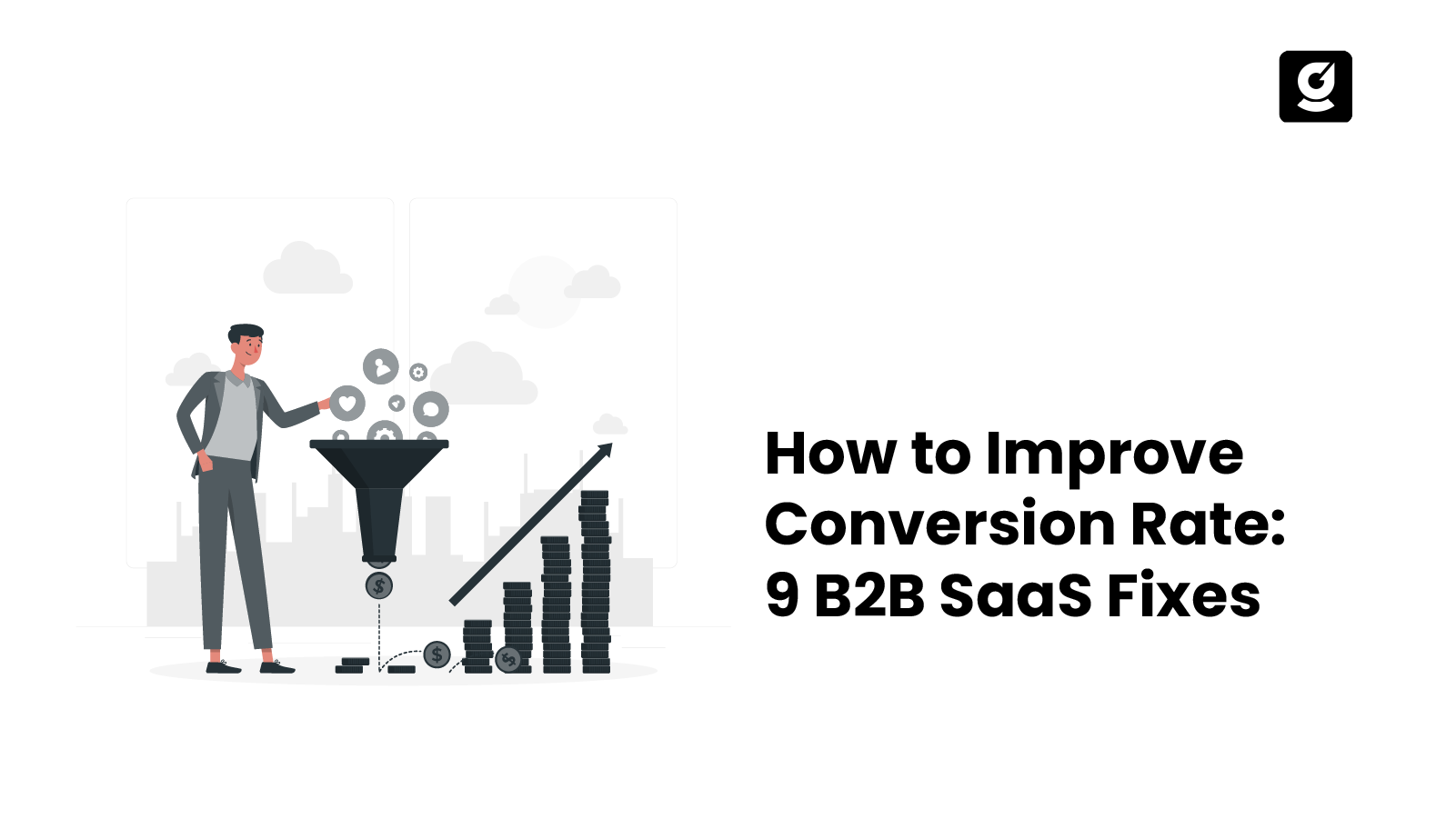
If you are trying to understand how to improve conversion rate, start by looking at what happens after visitors arrive. The real leak may sit between visit → intent → conversion → qualified pipeline, not at the traffic stage.
The nine fixes below show how B2B SaaS teams can improve conversion rate by removing friction, strengthening buyer intent signals, and turning more existing demand into demos, trials, and qualified pipeline.
Please read: Conversion Rate Optimisation Agencies
What Should You Measure Before Trying to Improve Conversion Rate?
Before changing headlines, CTAs, or forms, define what a valuable conversion actually means for your SaaS business. A newsletter signup and a demo request should not carry the same weight simply because both involve submitting a form.
Start by identifying your primary high-intent conversion. Depending on your sales model, that could be:
- Demo request for a sales-led SaaS product
- Free trial for a product-led motion
- Product signup for self-serve acquisition
- Contact sales for higher-ACV or enterprise deals
- Qualified consultation for complex solutions
Then measure what happens after that conversion. A stronger SaaS conversion funnel looks beyond the initial form fill:
Visitor → Conversion → Qualified Lead → Opportunity → Revenue
This matters because a higher B2B SaaS conversion rate is only useful if those additional conversions become a real pipeline.
For more accurate website conversion rate optimization, break performance down by:
- Landing page
- Acquisition channel
- ICP segment
- Conversion type
This helps you see whether the problem is low conversion volume, poor lead quality, or a specific page or channel attracting the wrong audience.
How to Improve Conversion Rate on a B2B SaaS Website: 9 Fixes
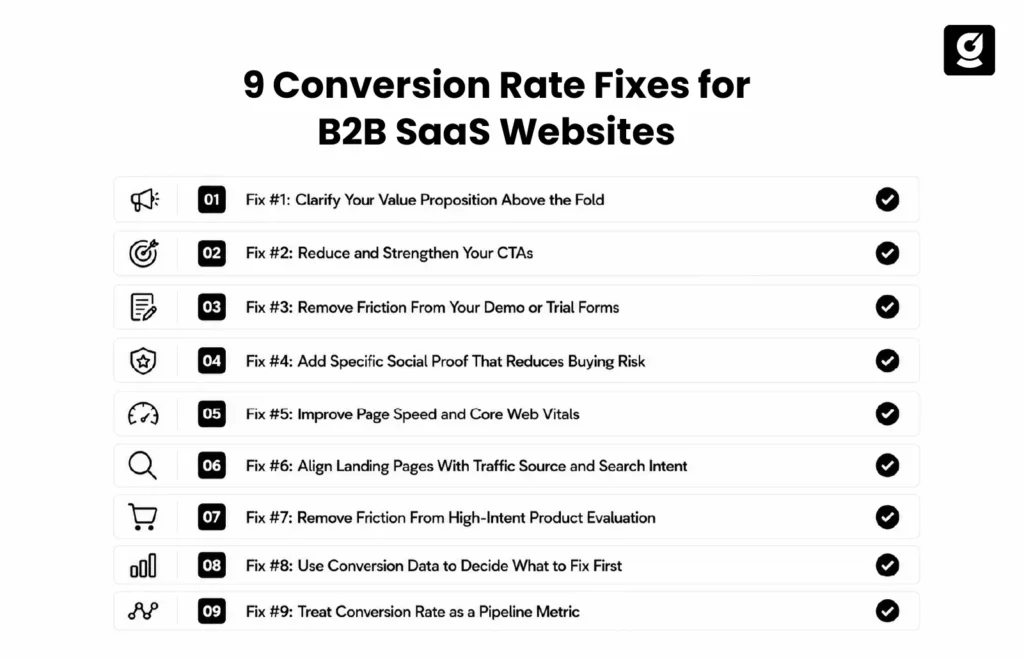
The 9 Fixes to Improve Conversion Rate on a B2B SaaS Website
- Fix #1: Clarify Your Value Proposition Above the Fold
- Fix #2: Reduce and Strengthen Your CTAs
- Fix #3: Remove Friction From Your Demo or Trial Forms
- Fix #4: Add Specific Social Proof That Reduces Buying Risk
- Fix #5: Improve Page Speed and Core Web Vitals
- Fix #6: Align Landing Pages With Traffic Source and Search Intent
- Fix #7: Remove Friction From High-Intent Product Evaluation
- Fix #8: Use Conversion Data to Decide What to Fix First
- Fix #9: Treat Conversion Rate as a Pipeline Metric
Improving conversion rate is rarely about changing one button or rewriting one headline. For B2B SaaS websites, the bigger question is whether the page helps the right visitor understand the product, trust the company, and move naturally toward the next buying step.
Here are nine areas worth fixing before putting more budget into acquisition.
Fix #1: Clarify Your Value Proposition Above the Fold
Your hero section should answer three questions before a visitor has to scroll:
- What does this product do?
- Who is it for?
- Why should I care?
A common SaaS mistake is leading with an internal product description such as “Help revenue teams spot stalled deals earlier and keep qualified opportunities moving through the pipeline.” while leaving the buyer to work out what that actually means for them. Lead with the problem or outcome first, then explain how the product delivers it.
A stronger above-the-fold section should communicate:
- The ICP or use case you serve
- The problem you remove
- The business outcome you create
- What makes your approach different
- A clear next action
Quick self-check: Show your homepage to someone unfamiliar with the product for five seconds. Can they explain what you sell, who should buy it, and why it matters? If not, the message needs work.
Fix #2: Reduce and Strengthen Your CTAs
When every section asks the visitor to do something different, the website creates decisions instead of guiding one.
A first-time visitor reading an educational article may respond better to “See How It Works” than “Book a Demo.” Someone viewing pricing, integrations, or a competitor comparison is showing stronger buying intent, so “Book a Demo” or “Talk to Sales” may be more appropriate.
Choose one primary CTA based on the page’s main conversion goal. Secondary CTAs can support visitors who are not ready for that commitment, but they should not compete visually with the main action.
For example:
- Sales-led SaaS: Book a Demo
- Product-led SaaS: Start Free Trial
- Enterprise product: Talk to Sales
- Evaluation-stage visitor: See How It Works or View Customer Stories
The CTA also needs to match the buyer’s stage. Someone reading an educational article may not be ready to talk to sales, while a visitor comparing pricing or integrations may be much closer to a decision.
The goal is not to put more CTAs on the page. It is to make the next logical action obvious.
Fix #3: Remove Friction From Your Demo or Trial Forms
Getting someone to click “Book a Demo” is only half the job. If the next screen asks for ten fields, creates scheduling friction, or does not indicate what happens next, high-intent prospects can still disappear.
Start by asking whether every field is necessary before the conversion.
For a product-led signup, keep the first step as lightweight as possible. You can collect company details, use cases, or additional profile information after users enter the product.
A sales-led SaaS company may need qualification fields such as company size, work email, or use case, especially when sales capacity is limited. The point is not to remove every field. It is to remove fields that do not help either the buyer or your qualification process.
Where more information is needed over time, progressive profiling can collect it later rather than demanding everything upfront.
Fix #4: Add Specific Social Proof That Reduces Buying Risk
A row of well-known logos shows that companies have used your product. It does not explain why they chose it or what changed after they did.
Give prospects proof that resembles the decision they are currently making.
Instead of:
“The platform has been great for our team.”
Use proof that includes:
Customer type + problem + outcome
For example, a cybersecurity SaaS company targeting enterprises will usually gain more from a case-study snippet showing how another enterprise shortened compliance workflows than from an unrelated startup testimonial.
Useful proof can include:
- Customer outcomes with measurable results
- Short case-study snippets
- Quotes tied to specific use cases
- Relevant customer logos
- G2 or Capterra ratings where applicable
- Proof specific to industry, company size, or buyer role
Place that proof next to the claim it validates. A security testimonial belongs near security messaging; conversion results belong near the related product benefit.
Fix #5: Improve Page Speed and Core Web Vitals
A strong offer cannot convert a visitor who gives up waiting for the page to become usable.
Start with Google’s current Core Web Vitals:
- Largest Contentful Paint (LCP) for loading performance
- Interaction to Next Paint (INP) for responsiveness
- Cumulative Layout Shift (CLS) for visual stability.
There is also a measurable business case for improving speed.
A Deloitte study published through published through Think with Google found that a 0.1-second improvement in mobile speed correlated with higher conversion rates in the retail and travel sites studied.
Those figures should not be used as B2B SaaS benchmarks, but they reinforce a simple point: performance problems can create conversion friction before a prospect has even evaluated the product.
For SaaS teams, start with high-intent pages:
- Compress oversized images and videos
- Lazy-load noncritical media
- Reduce unnecessary third-party scripts
- Remove render-blocking resources
- Test pricing, product, demo, and campaign pages on mobile

Fix #6: Align Landing Pages With Traffic Source and Search Intent
A visitor who clicked a LinkedIn ad, someone searching Google for a specific problem, and a prospect comparing vendors are not arriving with the same context. However, sending all three to the same generic homepage wastes that intent.
Build continuity between:
Traffic intent → Page message → Proof → CTA
For paid campaigns, the landing-page headline and offer should closely match the promise made in the ad. If an ad promotes a solution for SaaS finance teams, the landing page should not open with broad messaging aimed at every possible industry.
Organic visitors often need a different journey. Informational searches may require education before a product CTA, while high-intent searches such as alternatives, pricing, integrations, or vendor comparisons should get evaluation-focused information quickly.
Treat landing pages as part of the acquisition strategy, not merely as destinations for campaign traffic.
Fix #7: Remove Friction From High-Intent Product Evaluation
Getting a high-intent buyer to your website does not mean they are ready to book a demo immediately. Before making that commitment, they may need enough information to decide whether your product belongs on their shortlist.
This is where many SaaS websites create unnecessary friction.
Important information is often hidden behind sales conversations, spread across several pages, or explained using vague product language.
Make it easier for serious buyers to answer questions such as:
- Does the product support my use case?
- Does it integrate with my existing stack?
- What does the product actually look like?
- Is it suitable for a company of my size?
- What security or compliance requirements does it support?
- How difficult is implementation?
- What results have similar customers achieved?
- What should I expect to pay?
Depending on the product and buying process, useful evaluation content can include:
- Product screenshots and workflow examples
- Integration details
- Pricing or pricing context
- Security and compliance information
- Implementation expectations
- Customer stories tied to specific use cases
- Comparison and alternative pages
- Technical documentation
- FAQs addressing common sales objections
Fix #8: Use Conversion Data to Decide What to Fix First
A useful prioritisation rule is:
High-intent page + meaningful drop-off + enough traffic = investigate first.
For example, a small conversion problem on your pricing page may matter more than a larger percentage drop on a low-intent blog page because the pricing visitor is much closer to a buying decision.
Do not redesign the homepage because someone dislikes the hero copy. Find the point where the funnel is actually breaking.
Start with quantitative data:
- Page-level conversion rates
- CTA click-through rates
- Form starts vs. form completions
- Demo bookings
- Trial activations
- Conversion rates by traffic source
Then use behavioural tools such as heatmaps and session recordings to understand why visitors may be dropping out.
If 40% of visitors reach the demo form but few complete it, changing the homepage may not be the priority. If paid traffic converts well but organic product pages do not, investigate intent and messaging before changing the entire website.
Once you have a hypothesis, test one meaningful change at a time where traffic volume supports experimentation. CRO becomes much more useful when changes are driven by evidence rather than design preference.
Fix #9: Treat Conversion Rate as a Pipeline Metric, Not a Vanity Metric
A conversion-rate increase looks good in an analytics dashboard. But if those additional conversions never become qualified opportunities, you have improved the wrong number.
Track what happens after the website conversion:
Visitor → Conversion → MQL → SQL → Opportunity → Pipeline → Revenue
This allows you to ask better questions.
- Did the new landing page simply generate more form fills?
- Did it generate more sales-qualified conversations?
- Did lowering form friction increase trial volume while reducing account quality?
- Which pages and acquisition channels produce the highest-value opportunities?
Compare conversion performance by:
- Page
- Campaign
- Acquisition channel
- ICP segment
- Conversion type
This is where CRO stops being an isolated website exercise and becomes part of the wider revenue system.
The question is no longer simply, “Did our conversion rate increase?”
It becomes:
“Did this change help us generate more qualified pipeline from the demand we already had?”
That is the metric that matters.
Which Conversion Rate Fix Should Your SaaS Team Prioritize First?
Not every SaaS website has the same conversion problem. Start by identifying where the biggest meaningful drop-off occurs between traffic, conversion, qualified pipeline, and revenue.
Once you know where the funnel is breaking, prioritize the fixes connected to that problem instead of working through all nine in order.
1. If Traffic Is High but Conversions Are Low
Focus on:
- Value proposition
- Traffic-to-page intent match
- Product clarity
- CTA relevance
More traffic will not help if visitors do not understand the offer or next step.
2. If Visitors Click but Do Not Convert
Check:
- Form length
- Demo booking flow
- Trial/signup friction
- Page speed and usability
The issue is likely in the conversion path, not acquisition.
3. If Conversions Are High but Pipeline Is Weak
Review:
- ICP targeting
- Traffic quality
- Lead qualification
- Positioning
- Conversion offer
More leads are not useful if they do not become qualified opportunities.
4. If Pipeline Quality Is Good but Volume Is Low
Prioritize:
- High-intent SEO
- PPC
- Bottom-of-funnel content
- Additional conversion paths
The goal is to improve the full path:
Demand → Conversion → Qualified Pipeline → Revenue

Closing Thoughts
More traffic will not fix a SaaS website with a broken buying journey, and more form fills do not automatically mean better growth.
The real goal is to help the right buyers understand the product, see why it fits their needs, find enough evidence to trust the decision, and take the next step without unnecessary friction.
That is when CRO becomes meaningful: when improvements show up in qualified opportunities, pipeline, and revenue, not just as a higher percentage in an analytics dashboard.
growth.cx helps B2B SaaS companies improve the path from demand to revenue across positioning, websites, landing pages, SEO, paid acquisition, content, and lead generation.
Ready to turn more of your existing demand into qualified pipeline? Talk to growth.cx about building a stronger conversion path from first visit to revenue.
FAQs
How do you calculate a B2B SaaS conversion rate?
Divide the number of visitors who complete your desired action by the total number of visitors, then multiply by 100. For example, if 50 of 2,000 visitors request a demo, the conversion rate is 2.5%.
How can you improve conversion rate on a SaaS website?
Start by identifying where qualified visitors drop off. Then prioritize high-impact issues such as unclear positioning, weak CTAs, form friction, poor traffic-to-page message match, insufficient proof, and slow or confusing page experiences instead of making random design changes.
Why is my SaaS website getting traffic but not conversions?
Traffic alone does not guarantee buyer intent. If visitors arrive but do not take action, check whether your page matches their search intent, clearly communicates the product's value, gives them enough proof, and offers an appropriate next step.
Which conversion metrics should B2B SaaS companies track?
Do not stop at visitor-to-form conversion. Track how conversions progress through the funnel, including visitor → lead → MQL → SQL → opportunity → revenue, and compare results by channel, landing page, ICP, and conversion type.