Here is a number worth sitting with: B2B SaaS SEO delivers an average ROI of 702%, with a break-even period of roughly seven months. And yet, the majority of SaaS companies are not seeing it. They are publishing content consistently, checking boxes on a tool’s recommendation list, and watching their organic traffic plateau while competitors quietly capture demo requests month after month.
The gap between companies that generate pipeline from SEO and those that generate traffic reports is almost never a content volume problem. It is a strategy problem.
They are targeting the wrong keywords, high volume, low intent. They are producing content that ranks but does not convert. They have no system connecting organic search to revenue. And in 2026, they are also invisible in the AI answer engines, where 94% of their B2B buyers now research purchases before ever visiting a website.
This guide breaks down the exact SaaS SEO strategy we build for every B2B client at growth.cx, step by step. Not principles. The process.
What Is a SaaS SEO Strategy (And What It Is Not)
A SaaS SEO strategy is a structured system that maps organic search demand to your buyer journey and converts that traffic into qualified pipeline: demos, trials, and SQLs. It is not a content calendar. It is not a keyword spreadsheet. It is not a list of backlinks to acquire.
The reason most SEO for SaaS companies underperforms is that teams treat these tactical components as the strategy itself. They publish content without knowing whether that content targets the right buyer at the right decision stage. They build backlinks to pages that do not convert. They track rankings to pages nobody in their ICP is searching for.
A real SaaS SEO strategy starts with the buyer and works backward to the keyword, not the other way around.
Before we get into the steps, one clarification: B2B SaaS SEO is not the same as traditional SEO. B2B buying cycles span three to nine months and involve six to ten stakeholders. A single blog post rarely closes a deal, but a strategic content architecture can own the entire research journey, from the first awareness query to the final vendor comparison. That distinction changes everything about how you build the strategy.
Step 1: ICP-First SEO Audit: Know Before You Build
Every engagement we run at Growth.cx starts here, not in a keyword tool, but in a conversation about who the buyer is.
Most SaaS teams skip a proper audit and jump straight to content production. The result is a content library full of posts that rank for keywords nobody they care about searches for.
An ICP-first audit answers three questions:
- Which existing pages rank but attract zero ICP-matched visitors?
- Which pages rank and receive traffic but do not convert to a demo or trial?
- Which search behaviors actually describe your buyer’s problem before they know your product exists?
Tools we use: Google Search Console, Ahrefs or Semrush, and your CRM’s lead source data.
The deliverable is an ICP-to-keyword map, a document that connects each buyer persona to the search queries they use at each stage of the decision journey. Without this, every subsequent step is guesswork.
At growth.cx, our audit process cross-references search intent against CRM conversion data so we know, before writing a single word, which keyword categories have actually produced MQLs for comparable SaaS businesses.

Step 2: Intent-Layered Keyword Research
Once we have the ICP map, keyword research becomes targeting, not exploration.
The mistake most SaaS SEO strategy guides miss is treating keyword volume as the primary filter. Volume tells you how many people are searching. It tells you nothing about whether those people can buy what you sell.
We use four intent layers for every B2B SaaS keyword map:
- Problem-aware (TOFU): “how to reduce customer churn”, the buyer knows they have a problem, not a solution
- Solution-aware (MOFU): “customer success software”, they know the category exists and are evaluating options
- Comparison-aware (BOFU): “Gainsight vs ChurnZero”, they have a shortlist and are making a final decision
- Brand-aware (retention): “[Your Brand] pricing” or “[Your Brand] integrations”, existing users and late-stage evaluators
Each layer requires different content, different CTAs, and different success metrics. A TOFU post converts to an email subscriber or a retargeting pixel. A BOFU comparison page converts to a demo request.
We also run a competitor content gap analysis at this stage, identifying every keyword your direct competitors rank for on page one that you do not. These gaps represent demand that already exists for solutions like yours, currently captured by someone else.
Priority is assigned by pipeline impact score: intent weight × product relevance × competitive difficulty. Search volume is one input, not the output.
Step 3: Topical Authority Architecture
Google does not reward individual blog posts. It rewards domains that demonstrate comprehensive expertise across a topic.
Topical authority is built through clusters: one pillar page that covers a broad topic definitively, surrounded by a network of cluster posts that cover specific subtopics in depth. Every cluster post links to the pillar. The pillar links back to the most relevant cluster posts.
For a SaaS CRM product, the topical cluster around “sales pipeline management” might include:
- Pillar: What is sales pipeline management, and how does it work
- Cluster: Pipeline stages explained for B2B sales teams
- Cluster: How to forecast revenue from your sales pipeline
- Cluster: CRM vs spreadsheet for pipeline management
- Cluster: Best pipeline management software for mid-market SaaS
This architecture does three things: it signals domain authority to Google, it keeps buyers within your content ecosystem across multiple sessions, and it creates natural internal linking that distributes page authority across your highest-value conversion pages.
We typically identify two to three core topical clusters per client in the first six months, based on their product categories and ICP search behavior. Learn more about how we approach B2B SaaS content marketing strategy for topical depth.
Step 4: Product-Led Content Creation
The most common SaaS content mistake is writing educational articles that never mention the product. This produces traffic with no commercial signal; visitors leave informed but unconverted.
Product-led content educates the reader while positioning your product as the natural solution to the problem the article describes. The goal is not to write a product brochure. It is to embed product relevance at three specific points in every article:
- In the problem framing, when you describe the challenge, your product’s category is the implied solution
- In the solution walkthrough, your product appears as a concrete example of how the framework is implemented
- In the CTA, the offer at the end connects directly to the topic (an audit, a template, a demo relevant to what they just read)
Content formats that work at MOFU for B2B SaaS:
- Comparison posts (“Salesforce vs HubSpot for mid-market SaaS”).
- Best-of lists (“Best customer success software for Series B companies”).
- Use-case guides (“How fintech SaaS companies reduce time-to-onboard”).
- Tutorial content tied to specific product features.
For a detailed breakdown of this approach, see our guide on how to write SEO-focused content for your SaaS business.
Step 5: Technical SEO for SaaS Websites
SaaS websites face technical challenges that standard e-commerce or media SEO do not. Ignoring them limits every other step.
The issues we address most frequently with B2B SaaS clients:
- JavaScript rendering: many SaaS marketing sites are built on React or Next.js. If Google cannot render the JavaScript, it cannot index the content.
- Duplicate content from the free-trial subdomains (e.g., app.yourproduct.com) is bleeding into the marketing site.
- Crawl budget is wasted on pagination, filter parameters, or auto-generated tag pages.
- Core Web Vitals: particularly LCP (Largest Contentful Paint) and INP (Interaction to Next Paint) on marketing pages, which affect both rankings and conversion rates.
- Schema markup: SaaS companies should implement Article, FAQ, SoftwareApplication, and HowTo schemas depending on page type.
Site architecture matters here, too. The hub-and-spoke model should mirror your topical cluster structure, not be a historical accident of how your CMS categories were set up two years ago.
Step 6: Authority Building and Strategic Link Acquisition
Domain authority remains a ranking factor in 2026. The SaaS companies with the strongest organic presence have built a backlink profile from relevant, high-authority publications in their space.
What works for B2B SaaS link acquisition:
- Original research and data studies: publish a benchmark report. Journalists and bloggers cite original data. This is the highest-ROI link-building activity.
- Contributed articles to SaaS publications (SaaStr, G2 Learning Hub, industry-specific trade outlets).
- Podcast appearances: most podcast hosts link to guests from their episode pages.
- Partner integration pages: if your product integrates with Salesforce, Slack, or HubSpot, their app marketplaces and partner directories are high-authority links waiting to be claimed.
- HARO and Qwoted: responding to journalist queries builds both links and brand mentions in publications your buyers actually read.
What does not work: buying guest posts on DA-20 blogs with no audience, private blog networks, or link schemes that Google’s spam policies have been catching since 2023.
The metric to track here refers to domains from relevant SaaS and B2B publications, not raw domain count.
Step 7: Conversion Optimization Across Organic Touchpoints
Most SaaS SEO strategies stop at ranking. This step is where the pipeline is actually built.
Getting to page one is table stakes. What happens when a qualified buyer lands on your article determines whether that traffic becomes a demo request or a bounce.
CRO for organic SaaS content means:
- Above-the-fold CTAs on blog posts that match the intent of the article (not a generic newsletter signup).
- In-content contextual CTAs: It is placed after the most valuable section, not just in a sidebar widget nobody reads.
- Exit-intent overlays tied to the topic (a reader finishing a SaaS SEO article should see an offer for a free SEO audit, not a generic product tour).
- Lead magnets with topic alignment: A checklist, calculator, or template that matches what the reader came to learn.
The goal is to make the conversion offer feel like the natural next step after reading, not an interruption.
Step 8: AEO + GEO: Optimizing for AI Search in 2026
This is the step every competitor skips. It is also the step that is becoming the most consequential for the B2B pipeline.
94% of B2B buying groups now use large language models during their purchase journey (6sense Buyer Experience Report, 2025). They ask ChatGPT which CRM handles enterprise compliance. They ask Perplexity to compare project management tools. Your brand’s absence from those AI responses means you are losing pipeline before buyers ever arrive at Google.
AEO (Answer Engine Optimization) structures your content so AI models extract and cite your answers:
- Use FAQ schema and answer-first formatting, lead each section with a direct, one-paragraph answer before elaborating
- Ensure entity clarity, your brand name, product category, and core use cases must appear consistently and unambiguously across your site and third-party profiles
- Write extractable data points and statistics that AI models can pull as citations
GEO (Generative Engine Optimization) gets your brand recommended by name in AI-generated responses:
- Earn citations from authoritative SaaS publications that AI models draw from (G2, Capterra, TechCrunch, Product Hunt)
- Get listed on “best of” category pages, as AI models pull these when asked comparison questions
- Maintain consistent brand messaging and positioning across every third-party mention. AI models build entity understanding from the full web, not just your own domain
LLM Optimization specifically means structuring long-form content with clear H2/H3 hierarchies, summary blocks at the top of sections, and concise paragraphs that language models can extract without losing context.
The metric to track: Brand Recommendation Rate: how often your brand appears when you manually query AI models with the purchase-intent questions your buyers are asking.
This layer is what separates a 2026 SaaS SEO strategy from every guide written before AI search became a primary B2B research channel. For a broader view of how AI is reshaping search for SaaS, read our breakdown of SEO trends for B2B SaaS in 2025.
Pipeline Attribution: Connecting SEO to Revenue
Traffic is not a business outcome. Pipeline is.
The reason SEO loses budget conversations is that most teams report on the wrong metrics. Rankings and impressions do not appear in a CFO’s revenue model. Demo requests and closed-won attribution do.
Here is the metrics stack we use for every B2B SaaS client:
- Google Search Console: Impressions, clicks, and landing pages, filtered by ICP-relevant keyword clusters
- GA4 with conversion events: Demo requests, trial signups, and form fills tracked as goals, segmented by organic channel
- CRM UTM tracking: every organic visitor tagged at the session level, so the sales team can see when a closed-won deal first engaged via organic search three months before the demo
- Looker Studio pipeline dashboard: A monthly report that shows organic-sourced MQLs, SQL conversion rate from organic, and pipeline influenced by organic content touches
Realistic timelines for B2B SaaS SEO:
| Period | What to expect |
| Month 1–2 | Audit complete, strategy finalized, technical fixes shipped, content briefs in production |
| Month 3–4 | Content publishing starts, and early indexing and ranking signals appear for long-tail keywords |
| Month 4–6 | Page-one movement on lower-competition keywords, initial organic conversion data |
| Month 6–12 | Topical authority establishing, qualified traffic growing, organic starting to appear in pipeline reports |
| Month 9–18 | Organic becomes a measurable and compounding pipeline source |
Set these expectations with your leadership team before month one. The companies that abandon SEO at month four are the ones that expected month-two results.
Red Flags: Signs Your Current SaaS SEO Strategy Is Broken
Before any engagement, we ask new clients to self-assess. These eight signals indicate a strategy that needs rebuilding, not more content:
- You target keywords with 10,000+ monthly searches, but cannot trace a single demo request to them in your CRM
- Your homepage and feature pages do not rank on page one for your core product category keyword
- Your blog traffic does not appear in your lead source data at all
- Your content calendar is built around what is trending on Twitter, not keyword intent research
- You have 50+ published blog posts, but fewer than ten rank in the top ten results
- Your technical SEO has not been audited in over 12 months
- You have no comparison or alternative pages targeting your main competitors by name
- Your SEO team and your demand generation team plan campaigns independently, with no shared content strategy
If three or more of these describe your current state, the issue is not execution pace; it is the absence of a system. More content at the same pace will produce more of the same results.
A Real SaaS SEO Strategy Example
To make this concrete: a Series A project management SaaS came to us with 22 published blog posts, flat organic traffic for four months, and zero organic-sourced demos in their CRM.
Their existing keyword targets were dominated by enterprise-level competitors with domain ratings above 80. They had no comparison pages, no BOFU content, and no technical SEO audit had ever been run.
What we did in the first 90 days:
- ICP audit revealed their buyers searched for “resource planning for marketing agencies” and “project timeline software for remote teams”, not “project management software,” which was unwinnable for their domain
- An intent-layered keyword map produced 28 prioritized targets: 8 BOFU comparison keywords, 12 MOFU use-case keywords, and 8 TOFU problem-awareness keywords
- Two topical clusters built around “agency operations” and “marketing team workflows.”
- Technical audit resolved 11 indexing issues, including a canonicalization problem that had suppressed four existing posts
- Three comparison pages were published, targeting competitor alternatives
By month seven: 14 keywords on page one, organic demo requests visible in CRM for the first time, organic accounting for 19% of total MQL volume.Results like these come from building the right strategy first, then executing consistently against it. For more on what this looks like across different SaaS growth stages, explore our B2B SaaS SEO agency page.
A strategy documented in a slide deck does not move the pipeline. Execution does.
At growth.cx, we have run this framework across 150+ B2B SaaS and tech companies, from seed-stage startups identifying their first keyword clusters to Series B companies rebuilding content architectures that scaled in the wrong direction.
What makes our approach different from a standard SEO agency:
- Growth-led SEO framework: Marketing-led, product-led, and content-led SEO work together inside one execution model rather than operating as disconnected initiatives.
- Conversion Rate Optimization (CRO): It is built into every engagement, not offered as an add-on service.
- Pipeline as the north star: Reporting focuses on MQLs, SQLs, and organic-attributed revenue, not rankings alone.
- Free premium SuiteJar account: Every client receives access to an all-in-one SEO platform (worth $99/month) as part of the engagement.
Execution quality matters more than frameworks alone. That is why our work focuses on turning organic growth into measurable business outcomes.
Examples include:
SurveySensum : An AI-enabled B2B customer feedback platform that had tried in-house SEO and external consultants without seeing pipeline results. After rebuilding their content architecture around ICP-aligned keyword clusters, fixing structural URL and indexing issues, and layering in conversion rate optimization.
Organic traffic grew by 93.03%, monthly demos went from near zero to 30–50 per month, and the engagement generated $135K in organic ARR.
Cargoz : A UAE-based tech-driven warehouse marketplace with near-zero visibility for high-intent storage searches. We rebuilt their service and location pages, published targeted blog content in quick succession, resolved technical crawlability issues, and built consistent backlinks.
The result: 28% growth in organic search traffic from high-intent UAE keywords and a 100% increase in organic leads.
UrbanVault : A Bangalore-based Workspace-as-a-Service provider with 79 ranking keywords, no location pages, missing schema, and a pipeline dominated by unqualified inquiries. We built a full SEO roadmap, fixed 50+ technical issues, created location-specific landing pages across Bangalore’s key business hubs, published 20+ optimized blog posts, and earned 40–50 backlinks per month.
Within three months, top-ranking keywords grew from 79 to 234, Google Search impressions doubled, and the engagement rate reached 62%, driven by high-intent commercial traffic.
We are not building a content library.
We are building an organic revenue channel.
If your current strategy drives traffic but not pipeline, or if you are building SEO from scratch and want the right foundation from day one, we would like to see your numbers.

Conclusion
A SaaS SEO strategy that drives pipeline is not a content volume game. It is a precision system, one that starts with understanding exactly who your buyer is, maps every piece of content to a specific decision stage, and measures success against demos and revenue rather than monthly impressions.
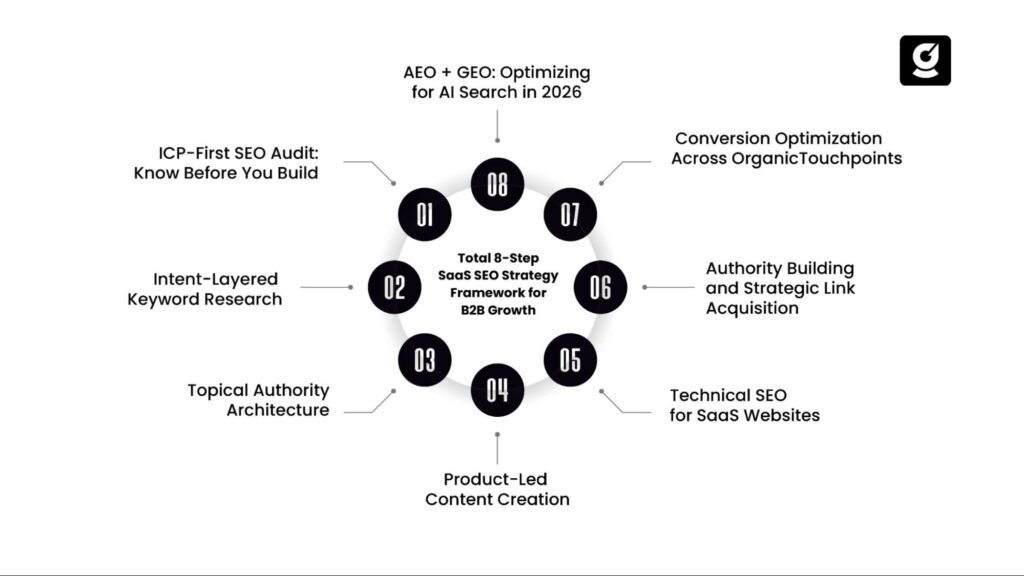
The eight steps we have covered here, ICP-first audit, intent-layered keyword research, topical authority architecture, product-led content creation, technical SEO, strategic link acquisition, conversion optimization, and AEO plus GEO for AI visibility, are not independent tactics. They are a connected framework where each step enables the next.
The SaaS companies generating a compounding organic pipeline in 2026 are the ones that treat SEO as a revenue system rather than a marketing activity. They set realistic timelines, measure the right things, and build for the long term, even when paid channels produce short-term results alongside them.
If you are still in the phase of publishing and hoping, this is the shift worth making.
Ready to build a SaaS SEO strategy that actually drives pipeline? Connect with the growth.cx team →
FAQs
Best tools for SaaS SEO strategy implementation
Popular SaaS SEO tools include Ahrefs and Semrush for keyword research, Google Search Console for performance tracking, GA4 for conversion analysis, Screaming Frog for technical audits, and SuiteJar for all-in-one SEO workflow management.
What are the core components of a successful SaaS SEO strategy?
A successful SaaS SEO strategy includes ICP-first keyword research, topical authority building, product-led content, technical SEO, strategic link acquisition, conversion optimization, and AI search visibility through AEO and GEO practices.
How to improve organic traffic for a SaaS product using SEO?
Increase SaaS organic traffic by publishing intent-driven content, improving site performance, targeting comparison and use-case keywords, and strengthening internal linking. Consistent SEO execution combined with CRO helps convert traffic into a qualified pipeline.
How much does SaaS SEO cost?
SaaS SEO costs vary based on company size, competition, and the scope of execution. Most B2B SaaS companies invest between $2,000 and $15,000+ per month for strategy, content, technical SEO, link building, and conversion optimization. Contact Growth.cx for a scope-specific estimate based on your current domain, growth stage, and pipeline targets