A SaaS VP of Marketing pulls up Search Console on a Tuesday morning. Organic traffic sits up 14% quarter-over-quarter, and rankings for the category’s primary head-term keyword have held position one for six months straight. By every dashboard that used to matter, the organic acquisition engine functions as built.
Then she opens ChatGPT and types the exact query a mid-market prospect uses during vendor shortlisting: “What is the best mid-market enterprise resource planning software for a 200-person firm?” Her product does not appear in the generated output. A direct competitor with a fraction of her domain authority sits at the top of the recommended list.
That gap is not a fluke. Forrester’s 2026 B2B Buyer Journey research shows 72% of software buyers use AI assistants during vendor evaluation, while companion data from Crackle PR reveals 51% of tech brands carry zero citations across AI engines.
Ranking well and being cited well are graded by two different systems. This guide breaks down exactly how to optimize for AI search when your traditional SEO strategy is already working.
Why is “My traffic looks fine” the wrong signal to trust right now?
Because search volume and buyer research have quietly decoupled. Aggregate traffic can look stable while the research phase of the buying journey moves somewhere your analytics can’t see. Let’s understand the problem in depth:
- Search traffic does not show the complete buyer journey: A buyer who creates a shortlist in ChatGPT and visits your website only to check pricing may appear as a direct or organic visitor in analytics. Your dashboard cannot show the AI interaction that influenced the decision.
- AI visibility is becoming a separate performance metric: Strong Google rankings do not automatically mean strong AI citation coverage. A company can rank well in search results while competitors are being recommended more frequently in AI-generated answers or AI search results.
- Buyer research is happening before vendor: Research shows that many business buyers use AI tools before contacting vendors. AI helps them compare strengths and weaknesses, research products, and create internal business cases before a sales conversation begins.
- Competitors can win discovery without outranking you on Google: A competitor does not need to beat your search rankings to influence buyers. If AI platforms consistently mention them during comparison or evaluation queries, they can enter the shortlist before your brand is considered.
- Traditional analytics miss AI-driven influence: Google Analytics can measure website visits, but it cannot fully capture brand mentions, citations, or recommendations happening inside AI assistants. This creates a visibility gap between what teams measure and how buyers actually discover solutions

What does AI content optimization look like on a well-ranking page?
An AI-optimized content strategy will look like structuring content for chunk-level extraction, building a recognizable entity presence beyond your website, and ensuring AI crawlers can access and understand your content. The goal is to improve AI visibility while building on the SEO foundation that already drives organic traffic.
The reason ranking and citation diverge comes down to retrieval. When an AI engine looks something up, it decomposes the buyer’s question into sub-queries and pulls whichever chunks of content score highest against each one, an entirely different filter than backlinks or domain authority.
A page can rank first on Google and still lose the citation if it doesn’t cleanly answer the specific sub-query the model generated.
| Traditional SEO signal | AI-powered search citation signal |
| Backlinks and domain authority | Consistency of brand facts across third-party platforms |
| On-page keyword optimization | Chunk-level, answer-first content structure |
| Meta description and click-through rate | Freshness and crawlability for AI-specific bots |
| Long-form page depth and word count | Front-loaded, self-contained, extractable answers |
Where most AI-powered search advice gets this wrong
Most advice about AI-powered search optimization falls into two extremes, and both create the wrong expectations:
1. Panic content that says “Traditional Search is Dying!”
This type of content treats AI- poweredsearch as a complete replacement for Google and suggests that SEO will quickly lose its value. It often relies on predictions like Gartner’s February 2024 forecast that traditional search volume would decline by 25% by 2026, without considering the broader picture.
The reality is different. Google still holds a large share of global search activity, and many B2B SaaS companies continue to see stable or growing organic traffic. The shift is not that search is disappearing. It is that buyers are using more channels, including AI tools, to research solutions before making decisions.
2. Checklist content that reduces AI content optimization to simple tasks
The other extreme treats AI-powered search optimization as a quick technical checklist: add FAQ schema, publish an llms.txt file, update a few pages, and expect AI platforms to start citing your brand.
But AI visibility depends on deeper factors. AI systems need to understand your brand, identify relevant information, access your content, and determine when your content is trustworthy enough to reference. A well-written FAQ page will not guarantee AI citations if crawlers cannot access the content, your entity signals are weak, or the system does not find your information relevant for a specific query.
The Right Way to Think About AI-powered Search Optimization
AI search optimization is not about replacing SEO or following a fixed checklist. It is a separate optimization layer focused on helping AI systems understand your brand, retrieve your content, and confidently reference your information in generated answers.
How to optimize for AI search without abandoning what already works
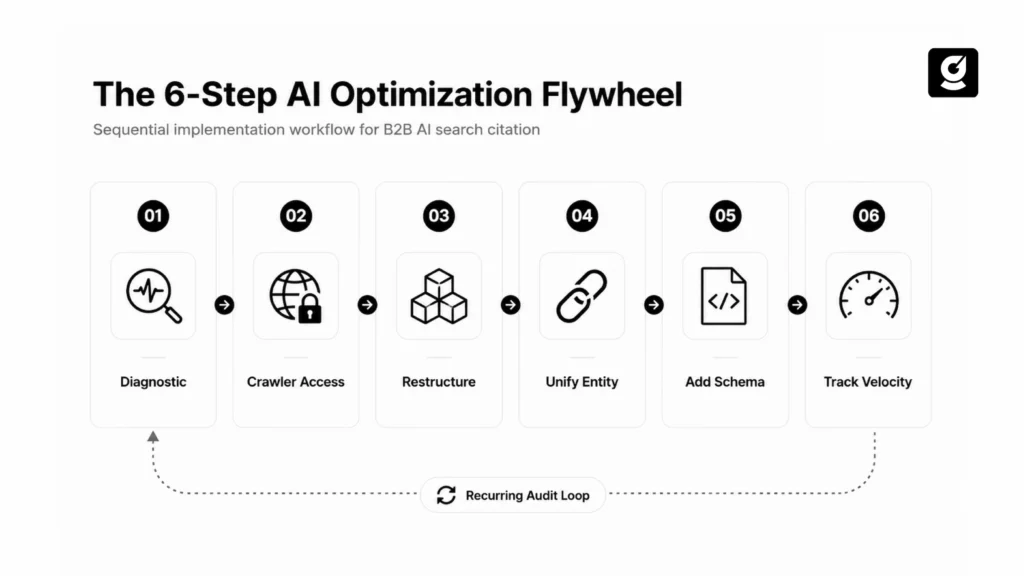
This sequence matters. Crawler access gates everything downstream, so fixing it first prevents wasted effort on content changes an AI engine can’t even reach yet. Work through these in order, then treat steps one and six as a recurring loop, not a one-time audit.
- Run the diagnostic baseline: Send 10 to 15 buyer-intent prompts through ChatGPT, Perplexity, and Gemini. Focus strictly on evaluation questions mid-market buyers submit during vendor comparisons. If your brand is absent, teams often partner with specialized execution partners like growth.cx to run full entity and citation audit passes.
- Audit crawler accessibility: Inspect robots.txt for GPTBot, OAI-SearchBot, PerplexityBot, and Google-Extended. Ensure core comparison pages deliver content via server-side rendering. Teams using growth.cx’s technical audit framework typically flags client-side rendering blocks before touching on-page text.
- Restructure high-intent pages: Rebuild comparison and pricing pages into self-contained, answer-first units. Keep each section under 150 words with the primary conclusion positioned in sentence one.
- Unify the external entity footprint: Standardize category listings, pricing details, and company facts across G2, Capterra, Trustpilot, and Reddit. Inconsistent platform data remains a primary driver of citation drop-off.
- Implement structural schema: Deploy accurate Organization, Product, and FAQ schema built on verifiable facts rather than marketing claims.
- Track citation velocity: Re-run buyer prompts every four weeks to track platform coverage. Growth teams leveraging growth.cx’s citation monitoring workflows analyze performance across individual LLM engines rather than relying solely on traditional search rank trackers.
None of this replaces the SEO program already driving traffic. It runs alongside it, on a different set of signals, and the only way to know it’s working is to keep measuring the number your current dashboard was never built to show.
Maintain your SEO foundation while building AI visibility
Optimizing for AI search requires balancing two visibility systems: the search rankings that already drive traffic and the AI platforms influencing how buyers discover and evaluate solutions.
A specialized B2B SaaS SEO & GEO partner can help maintain both by protecting existing organic performance while building the technical, content, and entity foundations needed for AI visibility.
Some agencies helping brands navigate this shift include:
1. growth.cx
A B2B SaaS-focused SEO and GEO agency that helps companies improve organic search performance while building AI search visibility through content engineering, technical optimization, entity optimization, and citation tracking.
2. Omniscient Digital
A content-focused SEO agency that works with B2B SaaS companies on organic growth strategies, including content systems, topical authority, and search visibility.
3. TripleDart
A B2B SaaS marketing agency that supports companies with SEO, content marketing, and growth strategies designed to improve demand generation.
Choosing the right partner depends on your growth stage, existing SEO foundation, and whether your priority is improving rankings, increasing AI citations, or building a broader search visibility strategy.
6 AI- powered search optimization mistakes that reduce your visibility
Most of these SEO optimization mistakes aren’t content problems. They are structural or organizational habits that quietly cancel out otherwise solid work.
- Blocking AI crawlers at the network layer without realizing it. Cloudflare and most CDNs or WAF tools sit in front of robots.txt and can block AI crawlers even when robots.txt explicitly allows them. Per Cloudflare’s own documentation, bots it classifies as Training or Agent will be blocked by default on ad-monetized pages starting September 15, 2026, and plenty of existing zones already block PerplexityBot and similar crawlers through older bot-protection settings that were never audited for AI traffic. Check your CDN’s bot-management dashboard directly, not just robots.txt.
- Gating pricing and product specs behind “Contact Sales.” A form is invisible to a model looking for a concrete fact to cite. Every competitor who publishes real pricing ranges becomes more citable by default, not because their product is better, but because their page has something to extract.
- Optimizing only for ChatGPT and ignoring Perplexity, Gemini, and Copilot. Each platform sources differently: Perplexity leans heavily on live web retrieval, Gemini draws from Google’s index, Copilot from Bing’s. A page structured well for one doesn’t automatically perform the same way on the others, and B2B buying committees split their research across all of them.
- Publishing generic, interchangeable content. Content that could run on any competitor’s blog with the logo swapped is exactly the content a model has the least reason to cite over an equivalent alternative. Original data, named specifics, and first-hand detail make a source hard to substitute, which is the actual bar for citation, not word count or keyword density.
- Leaving G2 and Capterra profiles to sales or customer success. These platforms feed the entity signals AI engines use to confirm a brand is real and current, which makes them a marketing-owned visibility lever, not a review-collection afterthought owned by whoever remembers to ask.
- Treating this as a one-time project instead of a recurring measurement loop. A single round of schema fixes and crawler-access checks earns a temporary snapshot, not permanent coverage. Citation rates shift as models update, as competitors make the same fixes, and as a brand’s own entity signals age. The teams that hold their position are the ones still re-running the diagnostic months later.
AI-powered search optimization is the next layer of search visibility
AI search optimization is not about abandoning the SEO strategies that already drive results. It is about ensuring your brand remains discoverable as buyers move between traditional search engines and AI platforms throughout their research journey.
The difference between brands that gain AI visibility and those that get overlooked comes down to more than content updates. It requires improving crawler accessibility, strengthening entity signals, creating content structures that AI systems can extract, and continuously measuring where your brand appears in AI-generated answers.
If your B2B SaaS brand is ranking well but struggling to appear in AI recommendations, connect with growth.cx. Its AI search optimization approach combines content engineering, entity optimization, technical accessibility, and citation tracking to help brands improve visibility across the platforms where modern buyers research solutions.

FAQ’s
How do you optimize content for AI search?
AI search content optimization focuses on creating clear, self-contained answers that AI models can easily extract. Structure content around specific buyer questions, place key answers early, support claims with verifiable information, and create original insights that make your content more valuable than generic alternatives.
How do you optimize a website for AI search?
Website optimization for AI search starts with ensuring AI crawlers can access your important pages. Audit robots.txt and technical barriers, improve server-side rendering, optimize high-intent pages like pricing and comparison pages, implement accurate schema markup, and maintain consistent brand information across external platforms.
How do you optimize for AI search engines?
To optimize for AI search engines, focus on the signals AI platforms use to select sources: accessibility, content clarity, brand authority, and reliable external information. Since platforms like ChatGPT, Perplexity, Gemini, and Copilot retrieve information differently, brands should optimize for broader AI visibility instead of relying on a single platform.
How do you optimize SEO for AI search?
AI search optimization does not replace SEO; it adds another visibility layer alongside traditional search. Continue building strong SEO foundations while improving content structure, entity signals, technical accessibility, and citation coverage across AI-generated answers.
How can you improve your visibility in AI search results?
You can improve AI search visibility by making your content easier for AI systems to retrieve and trust. Focus on publishing original, detailed content, keeping company information consistent across review platforms, removing crawl barriers, and regularly measuring how often your brand appears in AI responses.
How do you rank in GPT search?
Ranking in GPT search requires more than traditional Google rankings. Brands need accessible content, strong entity recognition, clear answers to buyer questions, and trustworthy signals from their website and third-party sources so AI systems can confidently reference their information.