Our search trend is changing fast today. It’s no longer necessary to wait for search engines to return a list of blue links, and businesses and brands are improving their content to rank higher.
AI-powered search has entirely changed the game. When you ask ChatGPT something, it provides the final version of the direct answer based on its backend search and detailed analysis of the topic.
Google’s AI Overviews provide users with instant responses drawn from multiple sources. This shift has made Google AI Overviews SEO a key part of any B2B SaaS content strategy.
Well, if your content doesn’t appear in these summaries, it loses visibility even if it ranks well.
This blog explains how to fix that by creating clear, structured, intent-focused content that AI can trust, summarize, and cite.
Stats to Know About Google AI Overviews SEO in 2026
AI has been around in digital marketing for a long time, but over time, people have come to understand how to use it to produce faster, more accurate results.
The AI engine tells us to make our content easier to understand so it can help users who have no knowledge of the topic they are searching for.
Google AI Overviews are an important part of contemporary AI search engines, with over 2 billion users worldwide.
AI Overviews can reduce the CTR on top-ranking pages by up to 58%. At the same time, how people use the internet is changing. People are clicking on fewer traditional links because AI-powered search results give them direct answers.
One thing is clear from this: AI search visibility matters more than just rankings.
What Are Google AI Overviews and Why Do They Matter for SEO?
Google AI Overviews are short, AI-generated summaries shown on search results that pull and synthesize web content from different sources and present a combined answer.
This feature has a big effect on SEO.
Instead of ranking pages, AI search algorithms now decide:
- Which content to trust
- Which content to summarize
- Which sources to cite
For SaaS companies, SEO for AI search is no longer just about getting a high ranking; it’s also about being included in answers.
Why AI Search Is Reducing Your Traffic?
Take a query like “best CRM tools for small business.”
Instead of clicking through multiple results, users now get a direct answer from AI, reducing the need to visit individual pages.
- A CRM software list (HubSpot, Salesforce, etc.)
- What CRM means (definition and use cases)
- CRM pricing comparison
- CRM tools for small businesses
- CRM implementation guides
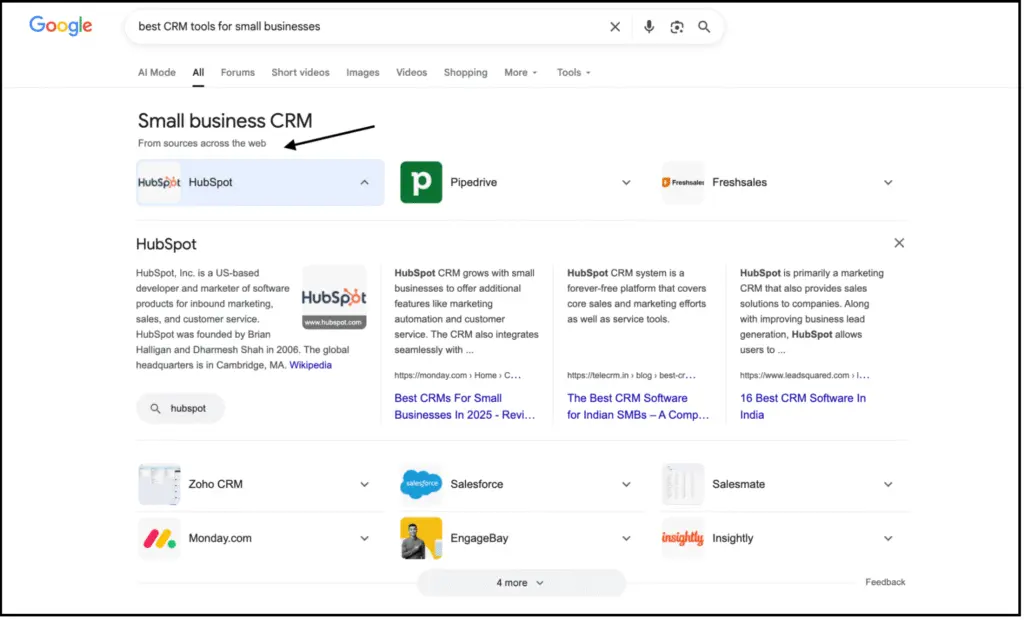
Google doesn’t know a user’s intent when they search for something. Are they trying to buy a CRM, learn how to use it, or compare different tools?
AI helps search engines better understand what the user actually wants behind short, ambiguous queries like “CRM.” So that search engines can show more relevant results, whether the user is in a learning stage, comparison stage, or buying stage.
Traditional SEO was all about keywords and backlinks. Now, AI search engine optimization depends on:
- Context and meaning
- Topic depth
- Clear structure
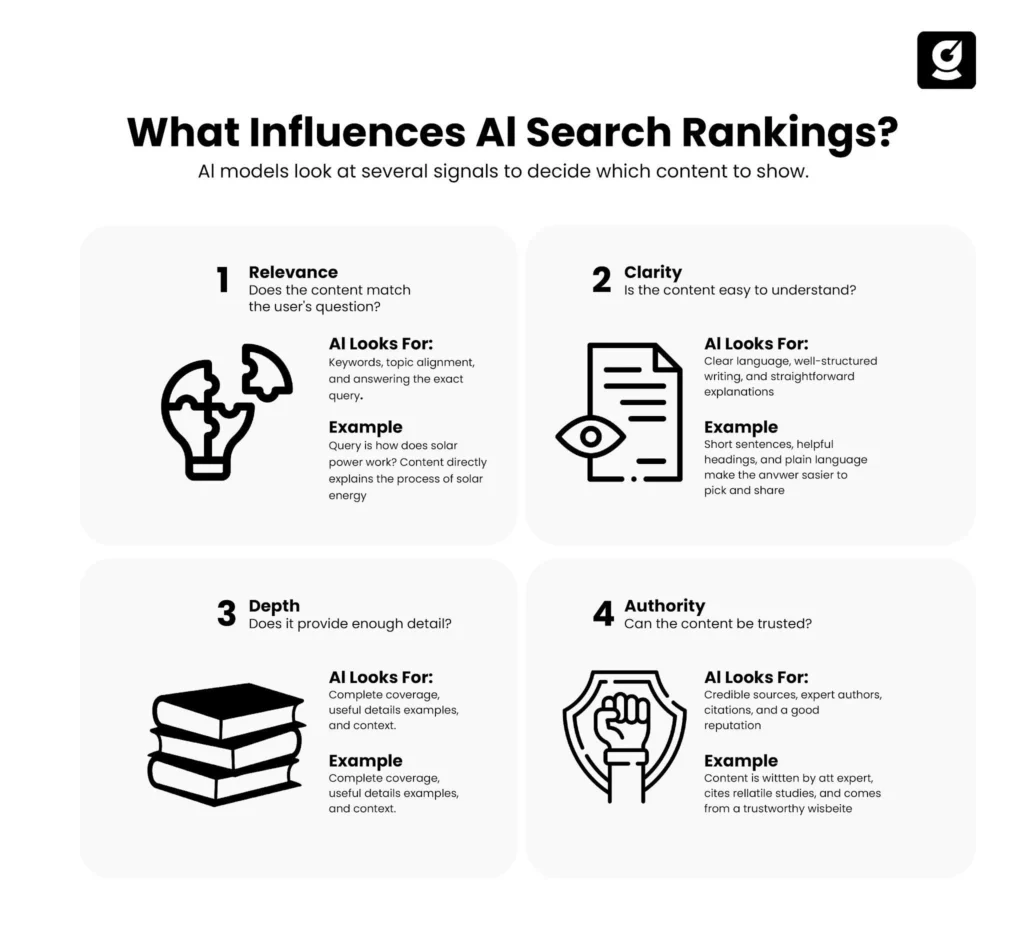
AI search ranking factors include:
- How it relates to the question
- Clarity of explanation
- Content completeness
- Trust and power
This is why generative AI SEO is more about what people want than about how many times a keyword appears.
How to Get Your Content Cited in Google AI Overviews?
Using the right keywords might not help you get a good ranking in Google AI Overviews. It’s about giving people the answers they are really looking for right away. Use simple words, keep your sentences short, and make your writing easy to read by using headings and short paragraphs.
Always keep your mind on what the user wants: Are they trying to understand something, compare options, or make a decision? If your content clearly answers that question and provides real, useful insights, Google is more likely to show it in AI Overviews.
How to Get the Most Out of AI Search Engines?
Here are the best ways to do SEO for AI search engines:
- Use headings that ask questions.
- Keep paragraphs concise and clear.
- Add schema to structured data.
- Use the same words all the time.
- Build internal links across related topics.
These practices enhance AI search visibility and increase the likelihood that AI-driven search results will select your content.
How to Optimize Content for AI Search Optimization?
AI search optimization is very different from SEO, and many of us are still treating it like the old game. Let me show you the real picture. Write to give a clear idea about answers, not keywords. AI models learn from and find information that directly answers questions.
| Don’t write fluff like “10 best tips for X.” Write “Here’s exactly how X works and when to use it.” Be the person who makes the AI look smart by quoting you. |
Instead of writing about big ideas, answer questions like these:
- How to optimize content for Google AI Overviews?
- How to rank SaaS SEO content in AI-powered search results?
- How to get featured in Google AI search results?
- How to optimize for generative AI search results?
- How to optimize content for AI search optimization?
Also:
- Add well-labeled sections and short explanations.
- Include comparisons
- Include bullet points and FAQ.
- Provide real insights
This makes it easier for AI search engines to find your content.
What Does Google AI Actually Look for Before Citing Your Content?
Google Search doesn’t just show you a list of links; instead, it summarizes and selects the best answer, placing it at the top by pulling from trusted web pages. That’s precisely the overview of generative AI. You don’t even need to click anymore.
So, if Google’s AI doesn’t choose your content to summarize, you’re not visible.
The good news is that the process isn’t a black-box mystery. Google’s AI gets its information from sources that are clear, reliable, and actually answer the question well.
Therefore, the key to optimization is to create content that is so exceptional and clear that an AI would feel ashamed not to reference it.
Now let’s talk about how to optimize for generative AI search results.
Focus on:
- Relevance → Stay tightly aligned to the query.
- Content that shows real expertise, fresh data, and clear structure
- Clarity → Simple language works best.
- Structure → Easy-to-scan formatting
Avoid:
- Fluff
- Keyword stuffing
- Overwriting
- Repetition
This is how Google’s generative search selects content for summaries.
SEO for AI Search: Leveraging Generative AI to Boost Rankings
People are fed up with googling. They’re moving toward zero-click search in B2B SaaS, seeking answers from ChatGPT, Perplexity, and Gemini instead. These tools give one answer, not ten blue links. If you’re not in the answer, you effectively don’t exist for that question.
Smart SaaS teams use generative AI SEO to:
- Identify trending topics instead of surface-level content.
- Structure content for neural networks instead of crawlers
- Scale content volume without scaling headcount
But ranking requires more than AI-generated content. To improve SEO for generative AI search engines, combine:
- AI tools for scale
Use AI to find groups of related topics, point out missing content, mark outdated statistics, create structural drafts, automatically deploy schema markup across hundreds of pages, and keep an eye on how much of your brand’s voice is heard on ChatGPT, Perplexity, and Gemini.
- Human insights for depth
Human → AI → Human
A human expert identifies the insight or angle. AI drafts at scale using that seed. A human editor adds depth, specificity, and a layer of credibility before publishing. AI surfaces the gap and the structure.
Humans fill it with lived experience, original data, and sharp opinion. The future of SEO belongs to teams who can pair human judgment with AI-powered intelligence.
Ranking Content in AI-Powered Search Results: Challenges and Solutions
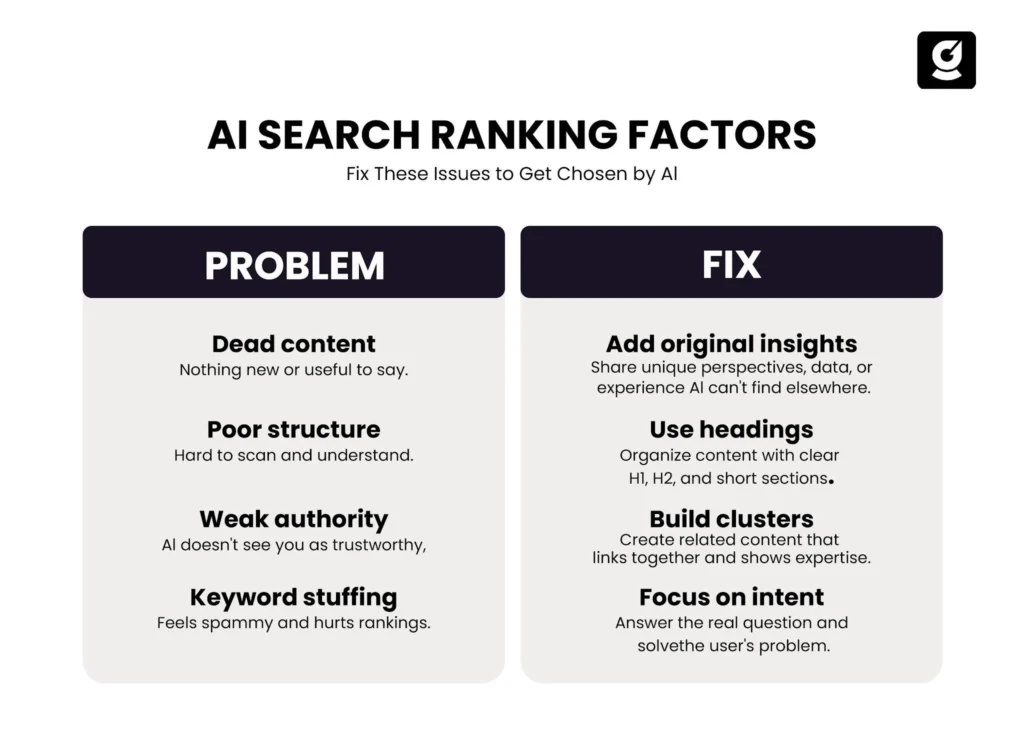
What Are The Common challenges in AI search optimization?
1. Dead content
Nobody wants generic content. To stand out, business strategists need to bring in original thinking or insights drawn from real experience.
2. Poor structure
Content lacking clear headings, logical sections, and an easy-to-follow flow doesn’t make any sense. Use clear sections and headings.
3. Weak topical authority
If your site covers topics on its own without adding related content, it becomes harder to demonstrate depth and expertise. Group your content.
4. Keyword-stuff writing
Focusing on what users genuinely want and utilizing keywords organically in helpful, well-structured content is a better approach. These changes will directly impact AI search ranking factors.
The Future of SEO: How Generative AI Is Changing SEO in 2026
The year is 2026, and we can’t deny the use of generative AI in content marketing. Search is becoming more conversational, with users asking fuller, more natural questions and expecting direct, context-aware answers.
We are getting personalized results from AI systems that modify what they show based on intent, behavior, and relevance. Furthermore, AI is reducing clicks on low-value pages by surfacing quick answers directly within the search experience.
This shift indicates that thin, keyword-led pages do not always drive traffic. Winning in AI search engines will depend on:
- Authority
- Clarity
- Depth
How to Optimize Content for Google AI Overviews?
Being the most trustworthy response to a genuine query is now the goal of content optimization for Google AI Overviews.
Instead of focusing on keyword-centric content, prioritize clarity, structure, and depth, as Google’s AI now scans, comprehends, and summarizes content.
AI-generated results are more likely to show your content if it is clear, directly answers what users want, and is backed up by reliable information.
To excel in Google AI search results, Focus on:
- Topic clusters instead of single blogs
- Multiple related questions on one page
- Answers that are clear and well-organized
This makes AI searches more visible and increases the likelihood of inclusion.
Measuring Success in Google AI Overviews SEO
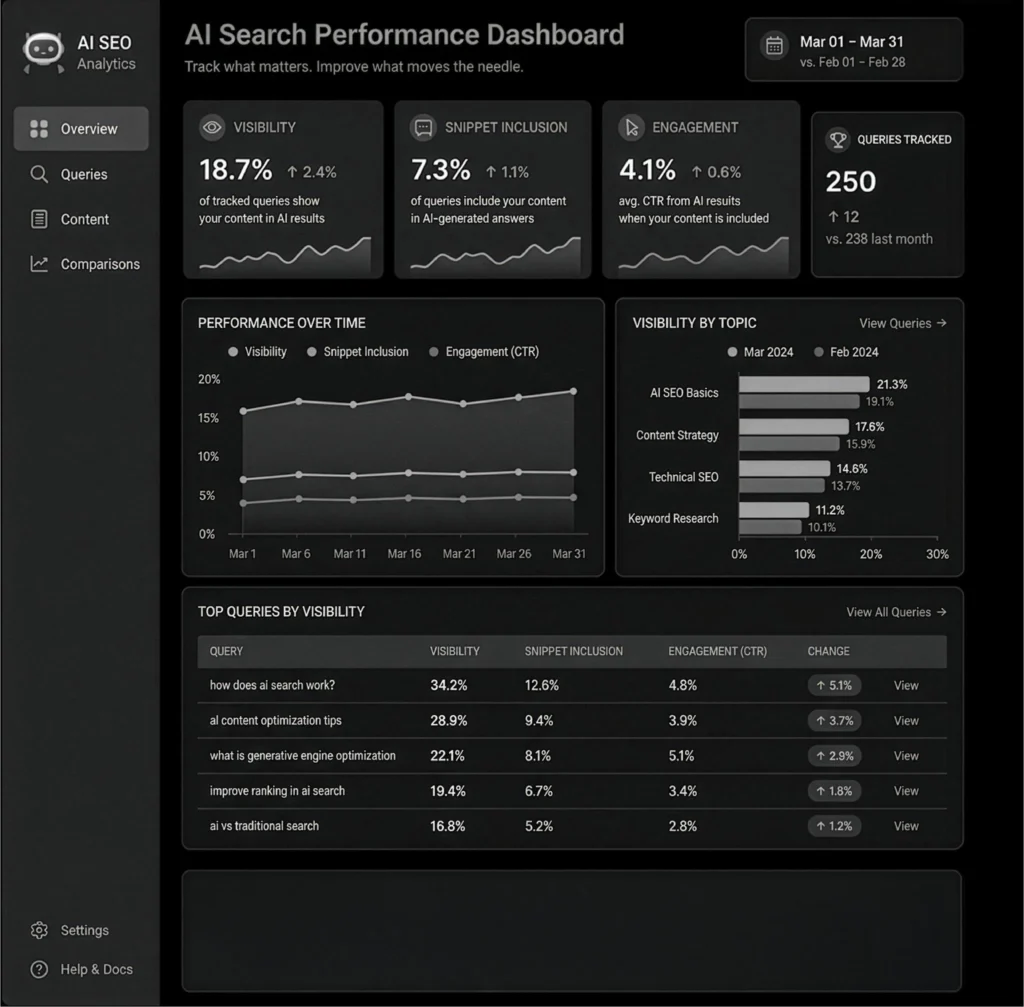
Monitoring AI Search Visibility and Performance
If you want to know whether your Google AI Overviews SEO efforts are working, you need to keep an eye on how well your content does on the following:
- Traditional search rankings
- AI snippet inclusions
- Click-through sites
- Engagement on social and community platforms
Refining Strategies Based on AI Search Insights
If your content is not showing up in AI search results, a few changes can make a real difference:
- Use informative headings to clarify and organize content.
- Give detailed explanations
- Put an FAQ section on each of your pages.
- Give examples, statistics, or expert opinions to back up your point.
Combining smart technology with a well-thought-out plan can make AI search more visible.
How to Choose the Right Tool for AI Search Optimization?
Not every SEO tool is built for AI search. When choosing one, look for features like:
- Content structuring support
- Search intent analysis
- AI SERP or AI overview tracking
- Topic clustering
Try to avoid tools that only focus on traditional SEO metrics. Those can still help, but they do not give the full picture when you are trying to improve visibility in AI-powered search.
Common Mistakes to Avoid
Many pieces of content fall short in AI search for similar reasons:
- Writing only for keywords instead of user intent
- Ignoring content structure
- Publishing thin or shallow content
- Making explanations harder than they need to be
- Letting content get outdated
These mistakes reduce the likelihood that AI-driven search results will surface your content.
Conclusion
Don’t think of AI search as just another SEO update. It changes how information is chosen and sent. Search engines are changing what “visibility” means, moving from showing links to giving direct answers.
In the future, the pages that come in first place won’t be the winners. AI systems will trust them enough to quote, summarize, and recommend them.
This means B2B SaaS companies can no longer rely solely on traditional SEO. You should think about how AI understands, organizes, and picks your content.
To stay ahead in generative AI search, you need to:
- Draft clear, well-structured content.
- Put yourself in the user’s shoes.
- Add depth, credibility, and real value
Brands that adapt early will build authority faster and remain visible across AI-driven platforms.
growth.cx helps SaaS companies build AI-first content strategies using Generative Engine Optimization (GEO), Answer Engine Optimization (AEO), and AI SEO services. Unlike traditional SaaS marketing agencies, this agency focuses on structured, intent-driven content that aligns with AI search algorithms and drives measurable growth.
Because the future of search is about being chosen.

FAQ
How can B2B SaaS companies get featured in Google AI Overviews?
Create clear, structured content that directly answers user questions. Use simple language, strong headings, real examples, and cover topics in depth so AI can easily extract and summarize your content.
Does traditional SEO still matter for ranking in AI search results?
Yes, but it’s not enough. Traditional SEO helps with visibility, but AI search prioritizes clarity, relevance, and content quality over keyword density and backlinks alone.
What type of content performs best in Google AI Overviews?
Content that gives direct answers, is easy to scan, and explains topics clearly performs best. Pages with structured sections, FAQs, examples, and comparisons are more likely to be selected.
How does generative AI search impact B2B SaaS SEO strategies?
It shifts focus from ranking pages to being included in answers. SaaS companies need to prioritize user intent, structured content, and topical depth rather than relying solely on keywords.
What role does topical authority play in AI search rankings?
Topical authority shows that your site consistently covers a subject in depth. AI is more likely to trust and reference content from sources that demonstrate strong expertise across related topics.
How should content be structured to improve chances of appearing in AI Overviews?
Use clear headings, short paragraphs, bullet points, and question-based sections. Start with direct answers, then add supporting details to make the content easy for AI to extract.
How important is E-E-A-T for AI search results?
E-E-A-T is critical. AI systems prefer content that shows real experience, expertise, authority, and trust, especially when backed by credible sources, data, or original insights.