

Many UK agencies say they do demand generation. In B2B Marketing’s 2026 UK agency benchmark, 74% of agencies said they offer it, but only 23 listed it among their top three specialisms. That gap is the problem when you compare demand generation agencies UK buyers find on page one. The same two words sit on every homepage, but the fees, contracts and outcomes behind them differ enormously
This guide compares seven demand generation agencies for B2B SaaS and tech companies: growth.cx, Digital Litmus, Gripped, Ledger Bennett, Rocket SaaS, ToJupiter and Velocity Partners. Each gets a fit and a limit, followed by the questions to ask before you sign.
How do the seven demand generation agencies UK teams shortlist compare?
| Agency | Location | Key consideration | Pricing | Contract terms |
| growth.cx | UK and international B2B SaaS | Dedicated revenue pod and one unified pipeline report | Custom pricing (ad spend paid separately) | 90-day minimum, then month-to-month |
| Digital Litmus | London | HubSpot implementation scope and current pricing | Custom pricing | Custom terms |
| Gripped | London | Entry-tier scope and notice period | £8,000–£12,000/month (typical) | Rolling contract; three months’ notice |
| Ledger Bennett | UK-founded; part of Havas | Day-to-day account team and reporting | Custom pricing | Custom terms |
| Rocket SaaS | London | Internal marketing ownership and daily collaboration | Custom pricing | Month-to-month |
| ToJupiter | London | Whether media spend is included | £7,500–£10,000/month | Custom terms |
| Velocity Partners | London; rebranding as Pretzl | Contracting entity and pipeline measurement | Custom pricing | Custom terms |
Where does each agency fit, and where does it stop?
1. growth.cx
growth.cx is a B2B SaaS demand generation agency that combines LinkedIn outbound, cold email, account-based ads, and retargeting into one pipeline engine. Its goal is a predictable pipeline: ads warm up your target accounts before outreach lands, and ad engagement feeds follow-up sequences.
What it offers:
- LinkedIn outbound: Puts your message in front of the right roles at named accounts, so sales talks to buyers who match your ICP
- Cold email outbound: 500 to 1,000 verified contacts a month with deliverability handled, so emails reach inboxes, not spam folders
- LinkedIn ABM ads: Sponsored Content and Lead Gen campaigns aimed at named accounts
- Google ABM ads: Search and Performance Max campaigns that capture buyers searching your category, competitors, and solutions
- Meta retargeting: Keeps openers, site visitors, and LinkedIn engagers in view, so warm accounts don’t go cold between touches.
How it connects demand generation channels:
- Coordinated ads and outbound: LinkedIn and Google campaigns build awareness among target accounts before email and LinkedIn outreach begins.
- Engagement-based follow-up: Accounts that engage with ads or visit the website can enter relevant follow-up sequences.
- Visitor intelligence: Company-level visitor data helps identify potential buying accounts and inform subsequent outreach.
- Shared campaign signals: Email engagement, ad interactions and website activity inform targeting and follow-up decisions.
- Unified ownership and reporting: A dedicated revenue pod coordinates the channels and reports performance through one pipeline view. Go-live is typically one to two weeks.
Proof (reported by growth.cx):
- LinkedERP: $775K in qualified pipeline in 90 days from email and LinkedIn outreach, including 31 sales-qualified leads from 19,000 prospects.
- HelloSend: Organic clicks up 314% and impressions up 4,130% in six months.
- SurveySensum: $135K in ARR with no paid spend, and 30–50 qualified demos a month from SEO and content.
Best fit: UK B2B SaaS teams that want outbound and paid acquisition to run as one connected engine by a dedicated team, with results judged on qualified pipeline.
Not the right fit if: You only need a single-channel specialist, you need PR or events support, or you want a verdict within one month. growth.cx asks for a 90-day minimum so campaigns can collect buyer signals before the engine starts compounding.
2. Gripped
Gripped is one of the London agencies that works only with SaaS, AI, and technology companies, and its offer is limited to marketing programs for that one sector. So non-tech B2B businesses get no relevant experience. Its campaigns and reporting are built around software buyers, so the scope stays tied to that single market.
It also says early-stage companies should establish product-market fit before hiring an agency, and that full-service demand generation typically costs £8K to £12K a month in agency fees, which puts it out of reach for startups and smaller budgets. So very early or very large enterprise buyers may fall outside its sweet spot.
It describes its work in terms of pipeline and opportunities rather than traffic or clicks.
Best suited to: SaaS and tech teams that want a structured demand program.
Not the right fit if: You are an early-stage team still settling positioning and product fit, which the agency itself advises, or you want strict month-to-month terms, because its notice period is three months.
3. ToJupiter
ToJupiter is an agency offering demand generation only to early-stage B2B SaaS companies. Its offer centres on paid media-led demand programs. Its own G2 profile lists no website design, branding, or PR services.
Delivery rests on a small founder-led team plus a small group of SaaS experts, with no large agency bench behind it. This model suits companies that want hands-on marketing capacity without hiring a full in-house team of their own.
Best suited to: Early-stage SaaS teams that want an embedded team.
Not the right fit if: You need global or enterprise-scale programs, or you want a deep base of independent reviews.
4. Rocket Saas
Rocket SaaS is another London-based marketing agency that works with B2B SaaS companies. It offers SaaS marketing for brands with limited in-house resources.
Its listed services stop at strategy, content, paid advertising, email nurturing, and web development. It works as a stand-in marketing department, so teams wanting a narrow, single-channel specialist are not its model.
Before signing, ask how much day-to-day collaboration the engagement requires, who owns marketing decisions, and whether the agency can support a long, enterprise sales cycle.
Best suited to: B2B SaaS teams that want help with demand generation, paid media, and content.
Not the right fit if: You need an agency to operate independently without regular input from your team.
5. Digital Litmus
Digital Litmus combines demand generation with HubSpot and revenue operations work. Its offer centres on CRM setup, migration, and the marketing-to-sales handoff, so teams on other CRMs, or wanting campaigns without a systems rebuild, are outside its stated focus.
Its site says it plans the HubSpot setup before building it, a strength for teams whose CRM is the bottleneck. Programs are scoped per client and pricing isn’t published, so ask for a written scope before comparing it with fixed-fee agencies
Best suited to: Teams on HubSpot that want CRM setup and demand work handled together.
Not the right fit if: You are not on HubSpot, because the offer is built around it, or you want monthly campaign work without a systems rebuild.
6. Ledger Bennett
Ledger Bennett is a demand generation agency that is no longer independent. Its site now promotes a full-service, 360º offer and a separate staffing arm, Fluid Talent, which makes it less of a narrow demand generation specialist.
The agency describes itself as a specialist, working internationally as well as in the UK. Companies weighing it against smaller or startup-focused agencies should ask who would work on their account day-to-day, how the team has been organised since the merger, and how reporting would tie to pipeline and revenue
Best suited to: Established B2B brands that want an agency inside a larger network.
Not the right fit if: You are Seed to Series B, want published pricing, or want a small embedded team. Its published work leans toward established brands inside a larger network, which a founder-led team may find heavy.
7. Velocity Partners
Velocity Partners is known for content-led marketing, and it serves only technology companies. Its offer is split across strategy, creative, and performance, so paid media and lead generation are one pillar of three rather than the core.
It works only with technology companies, which rules it out for other B2B sectors. Its site also announces that Velocity is becoming Pretzl, so buyers should check which entity they would contract with and whether the team and services will stay the same.
Teams should confirm which company signs the contract, what the content programs actually include, and how results are tied to pipeline and sales goals.
Best suited to: B2B tech brands that want content and brand-led work
Not the right fit if: You are Seed to Series B and need pipeline signals within weeks, or you want outbound and paid execution at the centre.
What should you ask a demand generation agency before signing?
Ask these seven questions:
- How do you define a qualified lead, and will that definition go in the contract?
- Can you report sales-qualified leads and pipeline, not only cost per lead and click rate?
- What is the notice period? (Among agencies that publish terms, notice periods range from month-to-month to three months’ notice.)
- Who runs our ad accounts day-to-day, and who owns the accounts, CRM setup, and data if we leave?
- Which SaaS companies have you worked with at our deal size and sales cycle, and can you name results?
- Which channels does your own team deliver, and which do you subcontract?
- How do you handle PECR and UK GDPR on cold email and LinkedIn outreach?
Why does demand generation activity so often fail to become pipeline?
Demand generation activity so often fails to become pipeline because the numbers an agency can report every week measure activity, and the channels that compound take longer than a reporting cycle.
Paid campaigns show results in days. Search and content take months. Gripped says meaningful pipeline impact takes three to six months. That is an honest timeline, and it means the first quarter of any retainer gets judged on early signals, not revenue.
That is where things go wrong.
Cost per lead can fall every month while the number of leads your sales team accepts stays flat, because the cheap leads come from a form that asks only for an email. Marketing reports a win, sales ignores the list, and nobody is lying. They are counting different things.
The third gap is the handoff.
If a lead waits a week for a reply, or the agency cannot see which leads became opportunities in your CRM, nobody can say whether the campaign worked. An agency that only sees form fills will optimize for form fills.
What does a wrong pick cost?
More than the monthly fee. A minimum term or a notice period means you pay for months of work before you can leave, and that cost sits before any ad spend. Some agencies also add a markup on advertising they buy for you.
Before you sign, work out your minimum commitment: the monthly fee multiplied by the minimum term or notice period, plus any setup fees, and ask for all of it in writing.
What does the first six months with an agency look like?
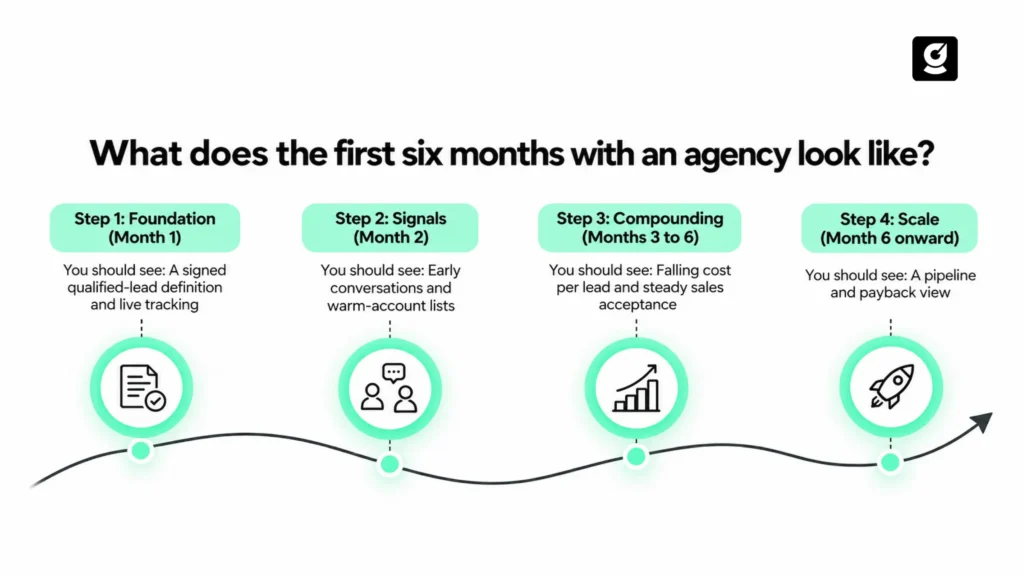
Ask the agency to define the deliverables, milestones and reporting metrics for each phase before the engagement begins. The timeline below shows the progress you should be able to evaluate at each stage.
| Phase | Timing | What gets built | What you should see |
| Foundation | Month 1 | ICP research, messaging, tracking, sending domains, ad creative | A signed qualified-lead definition and live tracking |
| Signals | Month 2 | Campaigns live, retargeting audiences growing | Early conversations and warm-account lists |
| Compounding | Months 3 to 6 | Channels sharing data, targeting refined | Falling cost per lead, steady sales acceptance |
| Scale | Month 6 onward | Budget moved to what produced opportunities | A pipeline and payback view |
Month 1: Foundation.
Before launch, the agency needs access to your website, ad accounts, CRM, brand assets, product messaging, and ICP. growth.cx says it can go live within one to two weeks once those are in place. In that time, the agency should:
- Research your ICP and agree on messaging with you.
- Set up dedicated sending domains and warm up inboxes so cold email doesn’t risk your main domain’s reputation.
- Build ad creative and tracking.
- Write one definition of a qualified lead that marketing and sales both sign off on.
Month 2: Signals.
Campaigns go live, and the first engagement signals begin to emerge. Review replies, qualified leads and early opportunities by channel, alongside retargeting audience growth.
At this stage, focus on whether the campaigns are reaching relevant accounts and generating meaningful conversations rather than expecting a mature pipeline.
Months 3 to 6: Compounding
As campaign data accumulates, targeting and channel allocation should become more precise. Track cost per lead alongside sales acceptance and qualified opportunities.
A falling cost per lead is not an improvement if sales accepts fewer leads or the quality of opportunities declines. growth.cx requires a 90-day minimum engagement to allow time for campaign data and buyer signals to develop.
Month 6 onward: Scale
Budget moves to the channels that produced qualified opportunities. You should see a pipeline and payback view instead of a traffic report, plus a clear answer on what to cut.
Want to know if your demand generation is producing pipeline?
Judge any demand generation agency on qualified pipeline, not clicks or lead counts. Before you sign, ask each agency on your shortlist to show how a target account moves from first touch to qualified opportunity, and who owns the CRM data along the way.
growth.cx is a B2B SaaS marketing agency that runs AI SEO, account-based ads, email and LinkedIn outreach, and performance marketing as one plan.
If you already invest in demand generation and cannot tie it to revenue, bring your shortlist to growth.cx for a short call. We will show where demand is dropping out.
Talk to growth.cx or see our SaaS marketing support for the full picture.