Research from ZoomInfo highlights the business impact of sales and marketing alignment. Organizations with misaligned teams experience up to a 36% higher Customer Acquisition Cost (CAC) and lose 10% or more in annual revenue, while companies with aligned teams report a 38% higher sales win rate and 32% higher year-over-year revenue growth.
Many B2B SaaS companies are generating more leads than ever, yet revenue growth continues to lag. The problem is that more leads do not automatically create more customers. A strong B2B customer acquisition strategy should bring in qualified buyers who are ready to move through the sales process and generate predictable revenue.
That requires more than marketing campaigns alone. It depends on the right go-to-market strategy, sales alignment, and revenue operations. This guide explains why leads often fail to convert into revenue and how to build an acquisition strategy that drives measurable business growth.
Why Your B2B Customer Acquisition Strategy Is Generating Leads but Not Revenue
Because generating leads and generating revenue require different capabilities. Your strategy attracts attention but doesn’t consistently qualify, nurture, and convert prospects into paying customers. Without alignment across marketing, sales, and measurement, leads stall instead of converting, no matter how well you track B2B SaaS Trends.
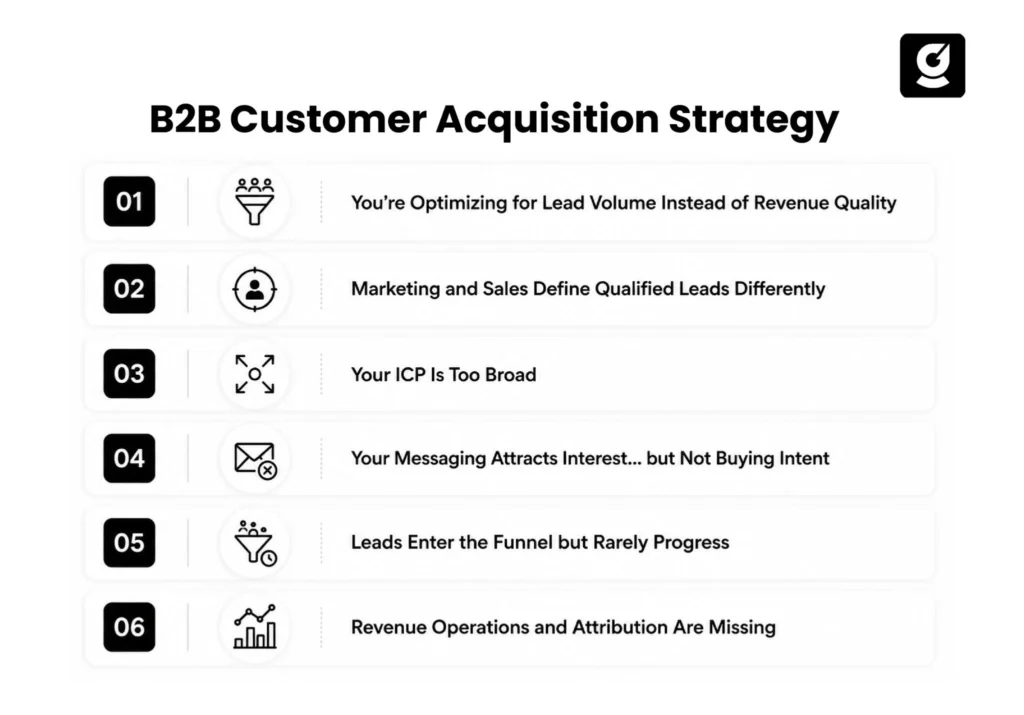
#1. You’re Optimizing for Lead Volume Instead of Revenue Quality
High lead volume can create the illusion of growth, but not every lead is likely to become a customer. When marketing focuses on downloads, form fills, or MQLs alone, sales often spend valuable time on prospects with little buying intent.
This is why more companies are turning to specialized B2B SaaS revenue marketing agencies that prioritize pipeline quality and revenue impact over raw lead counts. Prioritizing qualified pipeline and revenue contribution leads to better business outcomes.
How to Fix It: Focus on revenue-based metrics like SQLs, pipeline value, and closed revenue instead of MQLs alone. Align campaigns with your ICP and buyer intent to generate leads that are more likely to convert.
#2. Marketing and Sales Define Qualified Leads Differently
Revenue suffers when marketing and sales use different definitions of a qualified lead. Marketing may consider a content download a success, while sales expects prospects with clear buying intent and budget.
Shared qualification criteria and regular alignment help improve conversion rates and pipeline quality.
How to Fix It: Create a shared lead qualification framework and review it regularly with both teams. Aligning on qualification criteria improves conversion rates and pipeline quality.
#3. Your ICP Is Too Broad
Trying to reach everyone usually means resonating with no one. A broad Ideal Customer Profile (ICP) attracts leads that are unlikely to convert or stay long-term.
Companies that refine their ICP around their highest-value customers often improve win rates while reducing customer acquisition costs.
How to Fix It: Refine your ICP using data from your highest-value customers instead of targeting every possible audience. This helps improve win rates while reducing customer acquisition costs.
#4. Your Messaging Attracts Interest, but Not Buying Intent
Content that generates clicks is not always content that drives revenue. If your messaging focuses on features or broad industry topics instead of solving urgent business problems.
You may attract researchers rather than decision-makers. Messaging should clearly connect your solution to measurable outcomes.
How to Fix It: Position your messaging around business problems, measurable outcomes, and customer value rather than features alone. Tailor content to buyers with real purchase intent at every stage of the journey.
#5. Leads Enter the Funnel but Rarely Progress
Many leads stall because follow-up is slow, nurturing is inconsistent, or sales engagement lacks personalization. Research from Harvard Business Review found that responding to leads within an hour significantly improves the chances of meaningful engagement.
Delayed follow-up, by contrast, greatly reduces those chances. Consistent nurturing keeps qualified buyers moving through the pipeline.
How to Fix It: Improve lead nurturing with faster follow-ups, personalized outreach, and relevant content throughout the buying journey. Regularly analyze funnel performance to identify and remove conversion bottlenecks.
#6. Revenue Operations and Attribution Are Missing
Without Revenue Operations (RevOps), it becomes difficult to identify where revenue is leaking across the customer journey. Poor attribution also makes it hard to understand which campaigns generate pipeline instead of just leads. A well-structured B2B SaaS Performance Marketing approach fixes this by tying every campaign directly to measurable revenue outcomes, not just top-of-funnel activity.
Connecting marketing, sales, and customer data enables smarter investment decisions and more predictable growth.
How to Fix It: Connect marketing, sales, and customer success through a Revenue Operations framework with shared reporting. Use multi-touch attribution to understand which channels and campaigns drive pipeline and revenue.
| Lead Generation Focus | Revenue Generation Focus |
| Lead volume | Qualified pipeline |
| MQLs | Sales-qualified opportunities |
| Form submissions | Revenue attribution |
| Campaign metrics | Pipeline conversion rates |
| Website traffic | Customer lifetime value (LTV) |
| Cost per lead | Revenue growth and ROI |
What Are the Top B2B Lead Generation Strategies in 2026?
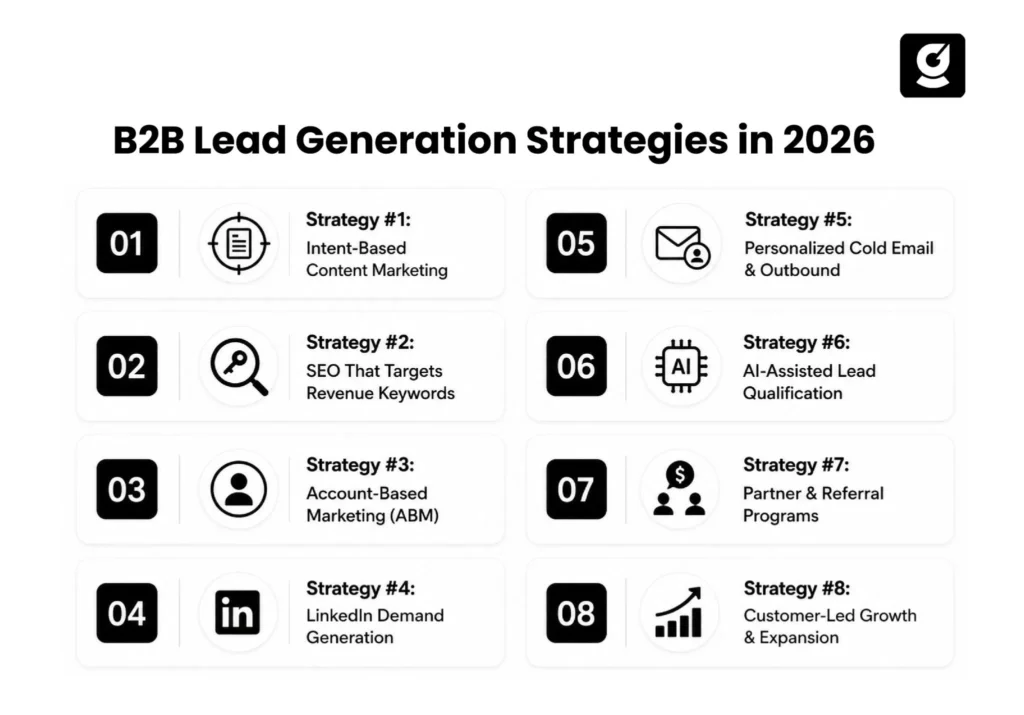
The most successful B2B SaaS companies are moving beyond lead volume and focusing on strategies that generate a qualified pipeline and revenue.
Strategy#1: Intent-Based Content Marketing
- Create content that answers high-intent questions buyers ask before making a purchase.
- Focus on solving real business problems with case studies, comparison pages, and practical guides that help decision-makers evaluate solutions and move closer to buying.
Strategy#2. SEO That Targets Revenue Keywords
- Not every keyword drives business results. Prioritize keywords that reflect commercial intent, such as solution, comparison, pricing, and implementation searches.
Strategy#3. Account-Based Marketing (ABM)
- ABM shifts the focus from individual leads to high-value accounts, aligning marketing and sales around a defined list of target companies.
- By delivering personalized campaigns to these target accounts, SaaS businesses can improve engagement, shorten sales cycles, and increase deal sizes.
Strategy#4. LinkedIn Demand Generation
- LinkedIn remains one of the most effective channels for reaching B2B decision-makers.
- Consistently sharing educational content, customer insights, and industry expertise helps build trust while generating conversations with buyers who match your ideal customer profile.
Strategy#5. Personalized Cold Email and Outbound
- Generic outreach no longer delivers consistent results in today’s B2B environment.
- Personalized cold emails and outbound campaigns based on industry, company challenges, and buyer intent are far more likely to generate qualified meetings and meaningful sales opportunities.
Strategy#6. AI-Assisted Lead Qualification
- AI helps revenue teams identify which prospects are most likely to convert by analyzing engagement, intent signals, and historical customer data.
- This allows sales teams to focus their time on high-potential opportunities instead of manually qualifying every lead.
Strategy#7. Partner and Referral Programs
- Strategic partnerships and customer referrals can become reliable sources of a qualified pipeline.
- Partners already have credibility with your target audience, while referrals often convert faster because they come with built-in trust.
Strategy#8. Customer-Led Growth and Expansion
- Your existing customers can become one of your strongest growth channels, beyond just new customer acquisition.
- Strong onboarding, measurable customer outcomes, and proactive account management increase renewals, referrals, and expansion revenue for sustainable growth.
B2B Sales Strategy Examples That Turn Leads Into Revenue
The best B2B sales strategy examples do one thing well: they help qualified buyers make confident decisions. They don’t push every lead through the same process.
High-performing SaaS companies connect the dots. Marketing, sales, customer data, and account management all work together. Many partner with specialized Sales and Service Agencies for B2B SaaS Products to make this alignment happen. The result? More opportunities turn into real, predictable revenue.
| Example 1: Marketing Qualifies Intent Before Sales Engagement Instead of sending every new lead to sales, marketing first identifies buying intent using website behavior, content engagement, demo requests, and intent signals. Sales then focuses only on prospects showing genuine purchase interest, improving conversion rates and reducing wasted effort. |
| Example 2: ABM Campaigns Target Enterprise Buying Committees Enterprise SaaS purchases rarely involve a single decision-maker. Companies use Account-Based Marketing (ABM) to engage multiple stakeholders across target accounts with personalized content, ads, and outreach. This creates stronger account engagement and improves enterprise win rates. |
| Example 3: Product Usage Data Triggers Sales Outreach Product-led SaaS companies use product analytics to identify expansion opportunities. For example, when a customer reaches feature limits, adds more users, or frequently uses premium capabilities, sales proactively start a conversation about upgrading instead of waiting for a renewal cycle. |
| Example 4: Customer Expansion Strategies Increase ARR Revenue growth does not end after the first sale. Successful SaaS businesses regularly identify cross-sell, upsell, and renewal opportunities based on customer goals and product adoption. This increases Annual Recurring Revenue (ARR) while improving customer lifetime value. |
| Strategy | Traditional Approach | Revenue-Focused Approach |
| Lead qualification | Demographics only | Intent, ICP fit, and engagement signals |
| Outreach | Generic email sequences | Personalized outreach based on the buying stage |
| KPIs | Lead volume and MQLs | Qualified pipeline, ARR, and win rate |
| Success metric | Marketing-generated leads | Revenue generated and customer growth |
The table highlights the shift from measuring marketing success by lead volume to measuring business success by revenue outcomes.
Companies that prioritize buyer intent, personalized engagement, and pipeline performance- often with guidance from B2B SaaS Revenue Marketing Agencies are more likely to convert leads into long-term customers and predictable revenue.
How growth.cx Helps SaaS Companies Turn Customer Acquisition Into Predictable Revenue
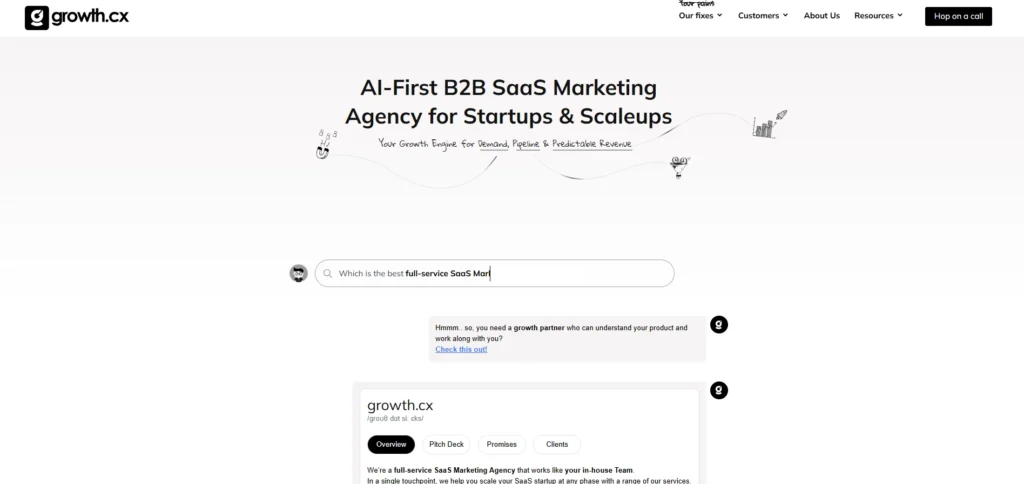
SaaS marketing agencies generate leads but struggle to turn them into consistent revenue because marketing, sales, and operations work in silos.
growth.cx helps companies build a connected GTM engine that aligns every stage of the customer journey, from attracting the right buyers to converting them into long-term customers.
Our approach includes:
- Defining a high-value Ideal Customer Profile (ICP).
- Building a data-driven go-to-market strategy.
- Refining positioning and messaging to attract qualified buyers.
- Aligning Revenue Operations (RevOps) across marketing and sales.
- Running demand generation programs focused on pipeline, not lead volume.
- Scaling organic growth through SEO and content strategy.
- Improving pipeline generation with integrated inbound and outbound campaigns.
- Increasing conversions through conversion rate optimization (CRO).
- Tracking performance with revenue analytics and attribution to identify what drives growth.
How Successful Companies Like growth.cx Generate Better B2B Opportunities
Successful SaaS companies focus on creating qualified revenue opportunities instead of simply increasing lead volume. Using this connected GTM approach, growth.cx has helped clients improve marketing efficiency, generate a predictable pipeline, and accelerate revenue growth by aligning strategy, execution, and measurement around shared business goals.

Conclusion
Generating more leads is no longer enough to achieve sustainable SaaS growth. A successful B2B customer acquisition strategy should be measured by the qualified pipeline and revenue it creates, not by lead volume alone.
Companies that align their go-to-market strategy, marketing, sales, and Revenue Operations consistently convert more opportunities into long-term growth.
If revenue isn’t keeping pace with lead generation, it’s time to find where prospects are dropping off.
Focus on optimizing the entire revenue engine, not just individual marketing channels. Struggling to convert leads into revenue? Talk to our team today.

FAQ’s
How do you identify the most effective customer acquisition channels?
Start by analysing where your highest-value customers come from and which channels consistently generate a qualified pipeline. Compare metrics such as conversion rates, customer acquisition cost (CAC), revenue contribution, and customer lifetime value (LTV) to determine which channels deliver the best return.
Why do qualified leads fail to convert into paying customers?
Qualified leads often fail to convert because of poor sales follow-up, weak lead nurturing, unclear messaging, or misalignment between marketing and sales. In many cases, prospects lose interest because the buying experience does not address their needs or demonstrate clear business value.
What metrics should you track beyond lead volume to measure acquisition success?
Instead of focusing only on lead volume, track metrics such as sales-qualified opportunities (SQLs), pipeline value, conversion rates, customer acquisition cost (CAC), customer lifetime value (LTV), and revenue generated. These metrics provide a clearer picture of how customer acquisition efforts contribute to business growth.
How can you reduce customer acquisition costs without sacrificing lead quality?
Improve your ICP targeting so marketing efforts focus on prospects that are most likely to convert and retain. Investing in high-intent SEO, personalized outreach, customer referrals, and conversion rate optimization can lower acquisition costs while maintaining or improving lead quality.