Implementing a bulk AI SEO audit focuses on strategic business growth and identifying ways to drive revenue. According to a recent study, 67% of B2B buyers rely on a business’s content to inform their buying decisions (Gartner). Still, the majority of SaaS businesses renew their SEO agency contracts without any review. Most simply look at the traffic graph, give a nod, and sign.
That is the mistake. Traffic can be easy to obtain. Intent to convert is not. With most agencies using AI tools to do their workflows, the distance between a report and its impact on a business has never been greater.
This guide on an AI SEO Audit is for businesses looking to know what to look for, what to ask, and what to be aware of, before committing to an annual contract.
What Is an AI SEO Audit and Why Does It Matter Before Renewal?
An AI SEO audit examines how an agency implements AI tools in its SEO workflows (content, keyword research, tech SEO, reporting) and assesses the tools beyond simple rankings and site metrics.
Normal SEO Audit vs. AI SEO Audit
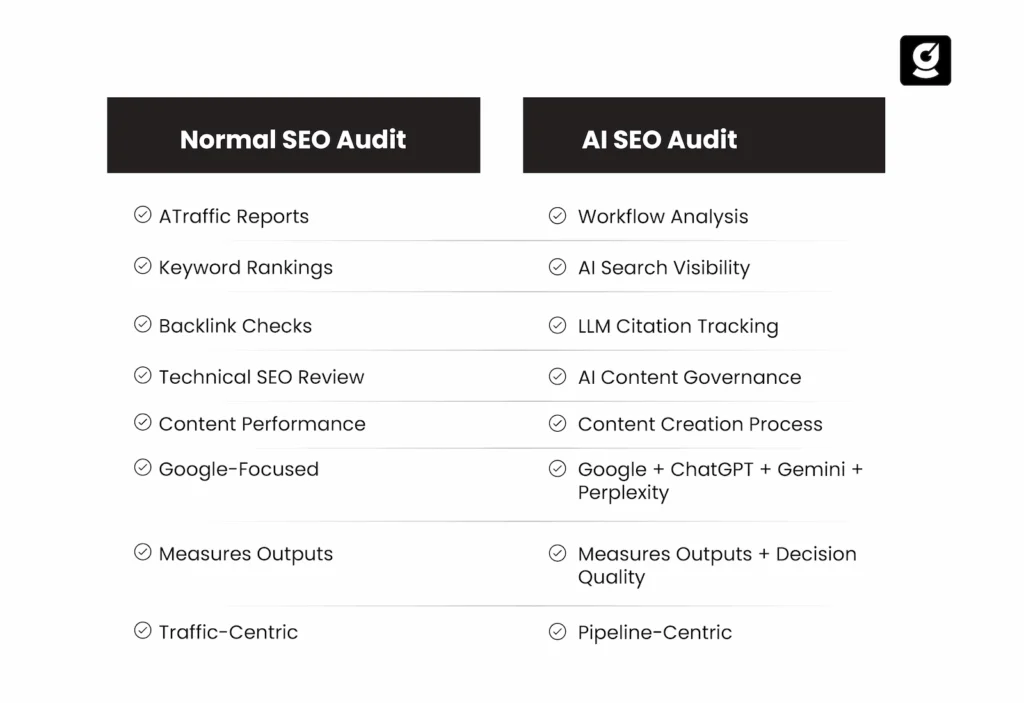
A Normal SEO Audit simply finds the answer to “How is the website performing?”
But an AI SEO Audit asks: “How is the website performing, and are the agency’s AI-powered workflows actually driving business growth?”
Keep in mind, Traffic Reports Tell You What Happened. AI SEO Audits Reveal Why It Happened.
Almost all agencies today use AI for briefs and drafts, as well as for internal linking, schema, and outreach.
Very few clients are asking what is being reviewed manually and what is being done by the machine.
The focus of your renewal discussion should be on what is being put into the pipeline rather than what is being produced.
Find out how AI SEO services for B2B SaaS differ from traditional SEO and what to expect from a modern agency.
Are You Reviewing the Right Metrics or Just Vanity Numbers?
Increased site traffic does not equate to an effective SEO program; it shows that your site has been indexed and is now receiving clicks. For B2B SaaS companies, those clicks must come from potential buyers, not passive content consumers who will never convert.
Capturing low-intent clicks will become increasingly more difficult for many informational queries. Google AI Overviews, ChatGPT, and Perplexity now answer basic questions for users. Your agency may start creating more and more content, chasing impressions, but that content will be erased by AI systems before users ever see your site.
Here is what you should measure instead:
- SQL contribution by topic cluster: Which content assets are tied to sales-qualified leads?
- Demo intent per page: Are your high-traffic pages converting to demo requests or free trials?
- Branded demand growth: Is direct search for your company name increasing alongside organic traffic?
- AI Overview inclusion rate: Is your content being cited inside Google’s AI-generated answers?
- LLM citation frequency: Is your brand being referenced in ChatGPT, Perplexity, or Gemini responses?
If your agency cannot answer these questions with data, remember that it is your first red flag.
What an AI SEO Audit Should Actually Cover in 2026
Most SEO audits still follow a checklist built for a different era. In 2026, search is no longer just a keyword game. AI systems are reshaping how content gets discovered, evaluated, and surfaced. A credible audit has to keep pace.
Here is what a rigorous AI SEO audit should actually examine:
Strategy Review
- Evaluate whether the content targets how buyers actually search today, not three years ago
- Assess topic authority coverage, competitive positioning, and content cluster structure
- Surface misalignment between intended intent and actual search behavior is driving traffic
Content Workflows
- Examine how content gets created, reviewed, and updated, not just what gets published
- Check whether briefs prevent thin content and whether a human editorial layer exists before publication
- Confirm that refresh cycles are triggered by performance data, not arbitrary schedules
Technical SEO
- Audit Core Web Vitals, crawl efficiency, structured data, and mobile rendering as standard requirements.
- Evaluate how well the site communicates its content to AI-powered systems, not just traditional crawlers
- Review schema markup, entity clarity, internal linking, and page authority distribution
AI Search Visibility
- Assess whether content is positioned to appear in AI Overviews, zero-click answers, and LLM-cited responses
- Evaluate structured answers, entity associations, and authoritative sourcing signals
- Check for the kind of direct, well-framed prose that AI systems favor for summarization
Reporting
- Establish what gets measured, how frequently, and what thresholds trigger action
- Track rankings, traffic, AI citation appearance, featured snippet ownership, and content decay rates
- Turn audit findings into a continuous improvement loop, not a quarterly retrospective
For SaaS companies managing hundreds or thousands of indexed pages, a bulk AI SEO audit becomes essential, not optional. Automated audit pipelines can flag underperforming pages, detect duplicate intent, and surface crawl anomalies across an entire site in the time it would take a team to manually review a single content cluster.
Why a Bulk AI SEO Audit Matters for Growing SaaS Websites
Growth creates SEO debt. SaaS companies publish quickly and at scale, and the content library can compound into a liability without systematic oversight.
Content Decay
- Pages that once ranked quietly fall off page one as competitors publish fresher content and search intent shifts
- A bulk audit identifies pages where rankings, CTR, and traffic have dropped below viable thresholds before the revenue impact becomes visible
Cannibalization
- Multiple pages end up targeting the same keywords over time, fragmenting authority instead of concentrating it
- A bulk audit maps keyword-to-URL ownership across the full site and surfaces conflicts that would take weeks to find manually
AI-Generated Content Sprawl
- Rapid AI-assisted publishing often leaves large volumes of structurally similar, topically redundant, or editorially thin pages in the index
- A bulk audit highlights pages where distinctiveness is minimal, and interaction indicators are faint before gradually diminishing domain authority.
Large-Scale Audits Before Contract Renewal
- The period before a major agency renewal, platform migration, or annual SEO investment decision is the right moment for a comprehensive audit
- It establishes an honest performance baseline and gives leadership the data needed to make informed decisions about future spend
For a broader view on how AI is changing B2B SEO strategy, see this breakdown of the top ways AI is transforming B2B SEO.
What Does a Proper AI SEO Audit Checklist Cover?
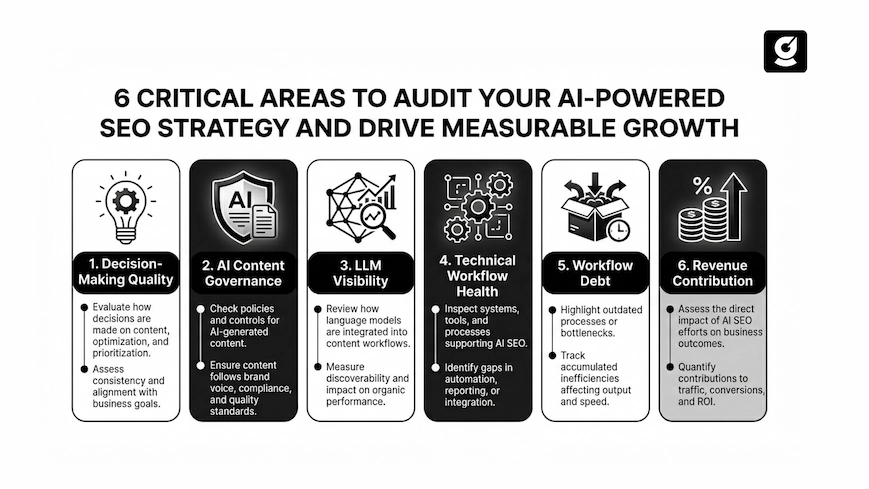
How Do You Know If Your Agency’s AI Workflows Are Actually Human-Verified?
Most agencies have quietly shifted to AI-first production. AI generates briefs and drafts. Internal links, schema markup, and outreach emails can be automated. The human is in the loop, but often just to approve, not to verify.
This creates a specific problem for technical SaaS companies. AI tools hallucinate. They get product details wrong. They misrepresent integrations, security posture, and pricing. Published at scale, this content erodes trust not just with Google, but with the buyers who find it.
Ask your agency these four questions before renewal:
- Who reads every draft before it is published?
- What is your process for validating technical claims against product documentation?
- How often do you mine support tickets and sales calls to inform content?
- What is your hallucination risk protocol for technical SaaS content?
If the answers are vague, the oversight is likely vague too. AI governance in SEO is not a nice-to-have for B2B SaaS. It is a trust signal and one that Google and AI search engines are actively evaluating.
What Are the Best AI SEO Audit Tools for Evaluating Agency Performance?
No single tool covers everything. The agencies worth working with use a layered stack: one tool for technical crawling, one for AI visibility, one for content intelligence, and one for reporting. What matters is whether the tools they use can actually surface the problems that affect your growth, not just generate a health score.
Here is what the credible stack looks like in 2026:
SEMRUSH: Best for Technical Audits and AI Search Health
- Categorizes site issues into errors, warnings, and notices with thematic reports covering crawlability, Core Web Vitals, HTTPS, and internal linking.
- Includes an AI Search Health score that evaluates whether the site is accessible to LLM crawlers, one of the few tools to surface this front and center in the audit dashboard.
- Best for agencies that need a broad platform covering keyword research, site audits, competitor data, and AI visibility under one subscription.
Ahrefs: Best for Backlink Analysis and Always-On Crawling
- Offers an always-on crawl that monitors site changes every minute, useful for agencies managing multiple accounts where issues need to be flagged continuously rather than only at scheduled intervals.
- Leads on backlink index size and competitor link research; the site audit takes a cleaner visual approach with prominent health scoring.
- Best for agencies where link authority and competitive benchmarking are core deliverables.
Screaming Frog: Best for Deep Technical Baseline Audits
- Crawls at the page level with granular control over user agents, JavaScript rendering, structured data validation, redirect chains, and custom extraction, with accuracy that cloud tools rarely match.
- Integrates with Google Analytics, Search Console, and PageSpeed Insights so crawl data overlays directly with real traffic and performance signals.
- Best used at the start of an engagement to establish a defensible technical baseline; pair it with a cloud platform for continuous monitoring between manual crawls.
Search Atlas: Best for AI Automation and LLM Visibility Tracking
- Combines site auditing, rank tracking, content optimization, and backlink analysis with OTTO SEO, an automation engine that deploys technical fixes directly on-site without manual implementation.
- Tracks LLM visibility across ChatGPT, Perplexity, and other AI surfaces, making it one of the more comprehensive options for agencies managing generative search presence.
- Best for agencies that want to close the gap between audit findings and executed fixes without adding engineering overhead.
SE Ranking: Best Value for Multi-Account Agency Management
- Covers rank tracking, keyword clustering, content optimization, and site audits in a single subscription at a price point well below Semrush and Ahrefs.
- Has repositioned as an AI SEO platform with AI search tracking layered on top of its core audit and monitoring features.
- Best for smaller or mid-sized agencies managing a high volume of client accounts, where per-seat and per-project costs compound quickly.
Rankability: Best for Reporting Across Traditional and AI Search
- Built around a proprietary Search Performance Index that combines Google rankings, local pack, AI answer citations, and video search into a single visibility signal.
- Designed for agencies whose client reports need to explain total search presence, not just keyword movement across both traditional and AI-powered surfaces.
- Best when the primary deliverable is a narrative that connects SEO performance to business outcomes, not a raw data export.
How to Use AI Automation to Generate a Full SEO Audit in Just 3 Minutes
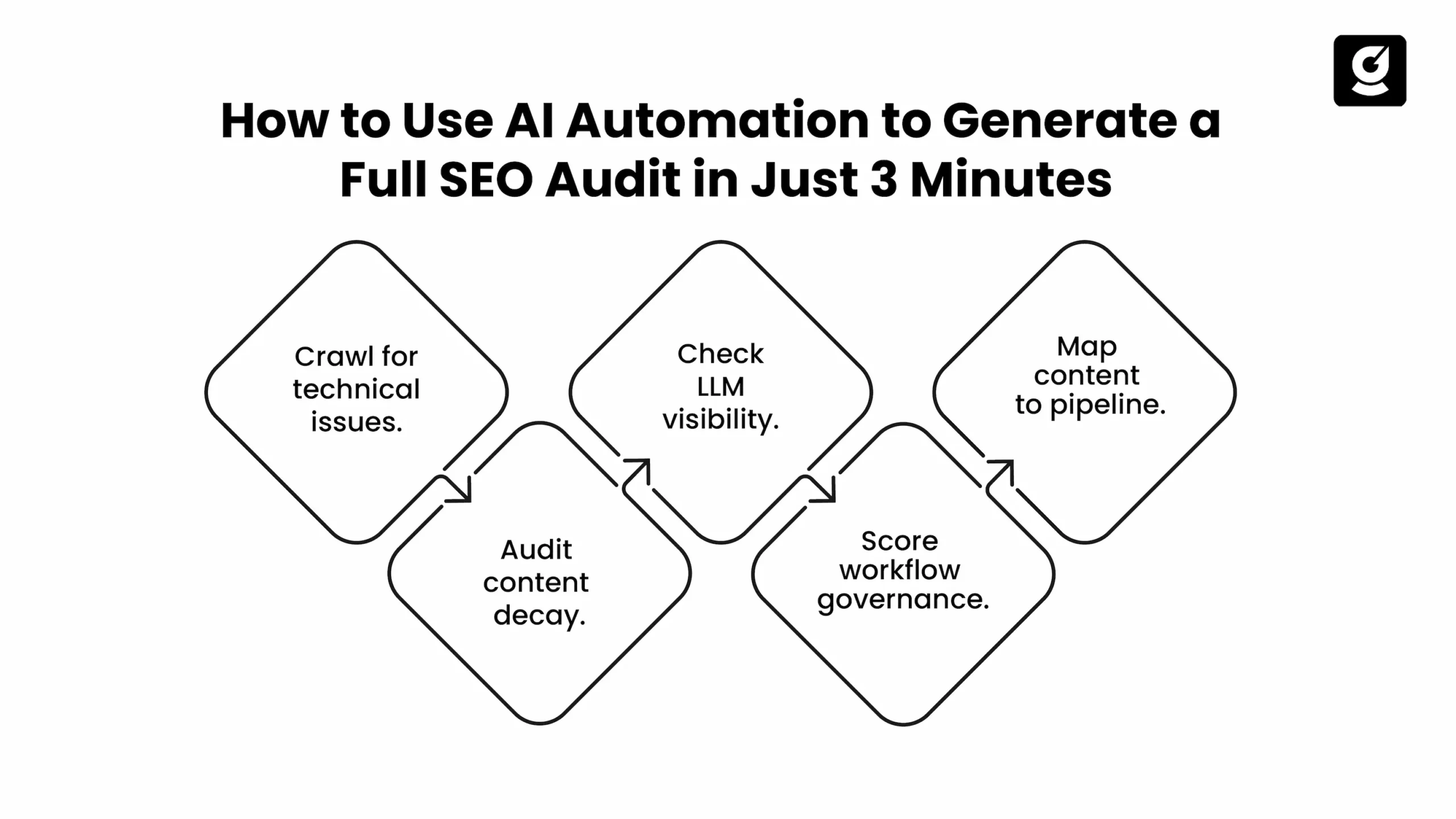
How to Review Your Agency’s Technical and Content Workflows?
Most agencies deliver recommendations. Fewer can show the workflow behind them. Before trusting any audit output, it is worth understanding how your agency actually operates, what triggers a technical review, how content decisions get made, and whether there is a repeatable process or just reactive fixes.
Here is what to examine:
Technical Workflow
- Check whether the agency runs crawls on a fixed schedule or only when something visibly breaks.
- Confirm that technical findings are being tracked over time, not just flagged once and forgotten.
- Ask how they handle post-publish QA: are new pages checked for indexability, structured data, and canonical setup before or after they go live?
- Verify that site changes: migrations, redesigns, and URL restructuring trigger a fresh technical audit, not a standard monthly report.
Content Workflow
- Find out whether content briefs are built from keyword and intent data or from topic ideas alone.
- Check if there is an editorial review step between AI-assisted drafting and publication.
- Ask how underperforming content gets identified: Is it surfaced by a tool, reported manually, or only noticed when traffic drops?
- Confirm that content updates are prioritized based on performance data, not on how old the page is.
What Good Looks Like
- Technical and content workflows run on parallel tracks, not in silos.
- Every published page has a clear owner, a target keyword, and a review date.
- Recommendations are tied to data, not delivered as standalone opinions.
- The agency can show you a changelog: what was changed, when, and what moved as a result.
Is Your B2B SaaS Agency Building Your Capability or Just Their Retainer?
This is the question most SaaS founders never ask. A good SaaS SEO agency should make your internal team smarter over time through documented workflows, transferable systems, and clear reporting that anyone on your team can read and act on.
A bad agency creates dependency. Every insight lives inside their tools. Every process is locked in their systems. When the contract ends, you start from zero.
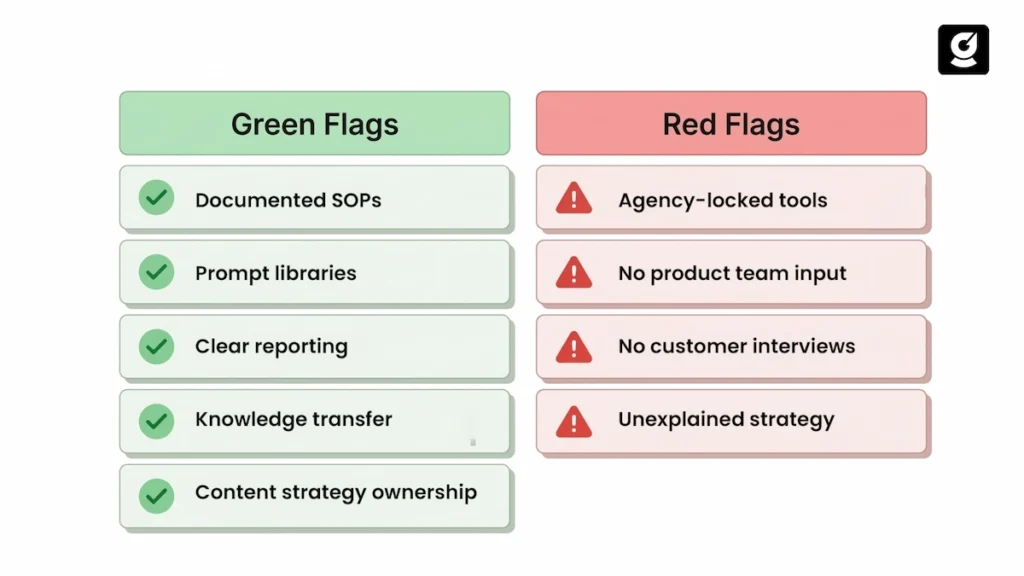
Before renewal, check for these green flags:
- Documented SOPs your team can access and use independently
- Prompt libraries and content frameworks that belong to you
- Reporting dashboards with clear definitions, not just numbers
- Regular knowledge transfer sessions with your internal team
- Clear ownership of content strategy versus execution
And watch for these red flags:
- All reporting lives in agency-owned tools with no export option
- Strategy decisions are made without input from your product or sales team
- The agency has never interviewed a customer or listened to a sales call
- Your team cannot explain what the agency is doing or why
For more on what to expect from a modern B2B SaaS marketing partner, read how AI marketing agencies work for B2B SaaS.
How to Measure Whether Your Agency Is Ready for AI Search
Rankings are no longer the full picture. A page can hold its position in Google search results and still be invisible in AI Overviews, ChatGPT responses, and Perplexity citations. If your agency is not measuring both surfaces, they are reporting on half the search landscape and calling it done.
Here is what AI search readiness actually looks like in practice:
They Track More Than Keyword Positions
- An AI-ready agency monitors brand and content mentions across LLM platforms, not just Google rankings.
- They distinguish between traditional organic traffic and traffic influenced by AI-assisted discovery.
- They can tell you whether your content is being cited, summarized, or ignored by generative search systems.
Their Content Is Structured for AI Consumption
- Pages are written with direct, well-framed answers that AI systems can extract and summarize cleanly.
- Schema markup, entity clarity, and structured data are treated as AI visibility levers, not just technical checkboxes.
- Content avoids vague framing and buries no key answers deep in long paragraphs.
They Understand Prompt-Level Search Behavior
- They can map which of your pages are likely to surface for conversational, multi-step queries, not just head keywords
- They research how your target buyers phrase questions to AI assistants, not just what they type into Google.
- Topic authority and depth are prioritized over individual keyword density.
They Have Adapted Their Reporting
- Monthly reports contain AI citation data, featured snippet ownership, and zero-click visibility in addition to standard traffic and ranking metrics.
- They flag when AI crawlers are blocked or when content structure suppresses generative visibility.
- Their reporting reflects what is happening across the full search surface, not just the metrics that look good in a slide.
How to Conduct an AI SEO Website Analysis Beyond Rankings
An AI SEO website analysis that stops at rankings is a gap audit dressed up as a strategy review. The deeper analysis looks at how your site performs as a knowledge source for both human visitors and AI systems pulling content to answer queries.
Here is what that analysis should cover:
Entity and Topical Authority Mapping
- Identify whether your site is clearly associated with the topics and entities that matter most in your category. AI systems rely heavily on entity relationships to decide what to cite.
- Check whether internal linking reinforces topical clusters or scatters authority across disconnected pages.
- Look for gaps where competitors are cited by AI platforms on topics your site covers but has not claimed clearly enough.
Content Quality at the Page Level
- Evaluate whether pages answer the primary query directly and early. Buried answers rarely get extracted by AI summarization systems.
- Flag pages that are structurally thin: short word count, minimal unique insight, heavy reliance on generic statements.
- Identify pages that rank adequately on Google but carry zero AI citation presence; these are optimization targets, not wins.
Crawlability for AI Bots
- Confirm that AI crawlers like GPTBot, ClaudeBot, and PerplexityBot are not blocked in robots.txt either intentionally or by legacy rules.
- Verify that JavaScript-heavy pages render fully before any AI bot can parse them; rendering failures are invisible in standard rank reports.
- Check that canonical tags are clean and consistent so that AI systems do not index duplicate or near-duplicate versions of the same content.
Structured Data and Citation Signals
- Audit schema markup across key page types (FAQ, HowTo, Article, Product )and verify it is rendering correctly, not just present in the code.
- Check whether author entities, publication dates, and organizational markup are consistent across the site, and these are trust signals for AI citation decisions.
- Identify pages where structured data could be added or strengthened to improve the odds of appearing in AI-generated answers.
Is growth.cx the Right AI SEO Audit Partner for B2B SaaS Companies in India?
growth.cx is a full-service B2B SaaS AI SEO agency built for companies that need more than vague traffic reports. Their AI SEO audit service is structured around pipeline contribution rather than content volume. Their structured, AI-powered SEO audit covers all five areas and includes a clear 3-month roadmap. Not 40-page reports.
The problem with most Indian SEO agencies is that they sell AI-powered services that simply resell generic tools at a markup.
growth.cx works differently. They blend AI-driven audits with human strategists who grasp SaaS buying cycles, procurement hurdles, and product positioning.
What growth.cx AI SEO audit covers:
- Technical site analysis with actionable prioritization, not a raw crawl dump.
- LLM visibility tracking across ChatGPT, Gemini, and Perplexity.
- Content decay and workflow debt analysis.
- AI governance scoring what is automated versus human-verified.
- A 3-month roadmap structured around SERP features, AI snippets, and buyer-stage content.
They also track CTR, conversions, and AI-based SEO performance, not just keyword rankings.
Conclusion
The agencies that will deliver results in 2026 are not the ones with the longest client lists or the most polished decks. They are the ones who have updated their methodology to match how search actually works today across Google, AI platforms, and the full buyer journey.
An AI SEO audit is not a verdict on your SaaS marketing agency. This is a starting point for a sincere discussion. It tells you what is working, what has been missed, and whether the strategy you are paying for is built for the search landscape you are competing in right now.
If that conversation is overdue, now is the right time to have it.
Not sure where your current SEO program stands?

FAQs
Which LLM and AI tool gives the best SEO audits and recommendations?
No single tool does everything well. For technical audits, Screaming Frog paired with ChatGPT or Claude for analysis works well. For content gap and intent analysis, Surfer SEO and Clearscope are solid. For LLM visibility tracking, tools like Profound and Brandwatch are emerging as the most reliable options in 2025.
How do you avoid hallucinations during an SEO audit with AI?
Never let AI validate its own output. Always cross-check AI-generated recommendations against Google Search Console data, your actual CMS, and product documentation. For technical SaaS content specifically, have a subject-matter expert review any claims about integrations, security, or pricing before publication. Treat AI output as a first draft, not a final answer.
What are the best AI tools for performing a comprehensive SEO audit?
| Tool | Best For |
| Screaming Frog | Technical crawl and site health |
| Surfer SEO | Content optimization and NLP analysis |
| Ahrefs / Semrush | Backlink and keyword gap analysis |
| Clearscope | Content brief quality and topic coverage |
| Profound | LLM visibility and AI citation tracking |
| ChatGPT or Claude | Interpreting crawl data and prioritizing fixes |
Use these in combination. No single tool covers technical health, content quality, and LLM visibility simultaneously.
How can AI improve a website's SEO audit process?
AI cuts audit time from weeks to hours by automating crawl analysis, content decay detection, and keyword clustering. More importantly, it surfaces patterns humans miss, such as topic cannibalization across 200 pages or a drop in AI Overview inclusion in your core product category. The improvement is not just speed. It is the depth of insight at scale.
Where can small businesses find affordable AI SEO audit software?
Start with free tiers. Google Search Console and Google Analytics cover the basics at no cost. Screaming Frog's free version crawls up to 500 URLs. For AI-assisted analysis, ChatGPT Plus at $20 per month can interpret crawl data if you know how to prompt it. Paid tools like Ubersuggest and SE Ranking offer small business pricing under $50 per month and include audit features. Avoid enterprise tools until your site exceeds 1,000 pages or your team needs multi-user access.