FREE GUIDE
LinkedIn Ads Guide: Why 90% of B2B SaaS Ad Spend Gets Wasted
Stop blaming the platform. This LinkedIn Ads guide explains why LinkedIn costs more than other B2B channels, what's actually leaking budget, and the four pillars that turn spend into predictable pipeline.
Summary
Most B2B SaaS teams don't have a LinkedIn problem. They have a translation problem: the platform is built to reach a buying committee, but the account is run like it's supposed to capture demand the way Google does.
While up to 90% of ad spend can easily be wasted when accounts are misconfigured, this primary leak happens because the platform is built to reach a complex buying committee, yet it is often run like a Google Ads campaign meant to capture immediate demand.
LinkedIn ends up carrying the blame for a mismatch it didn't create. Fix the targeting, the creative, and what gets measured, and the same budget behaves like a different channel.
32%
Average LinkedIn ad spend wasted on non-buying audiences across 56 B2B SaaS accounts. Top-quartile accounts waste 13.5%; bottom-quartile accounts waste 52.4%.
121%
LinkedIn's average return on ad spend for B2B marketers, ahead of Google Search (67%) and Meta (51%).
In this LinkedIn advertising guide, you'll learn:
- What LinkedIn Ads for B2B actually sell, and how that's different from Google or Meta
- Why the gap between a 13.5%-waste account and a 52.4%-waste account is strategy, not budget
- The four pillars that separate top-quartile LinkedIn accounts from the rest
- A six-step framework for building a leak-proof account
- How to tell whether the fix is targeting, creative, or the offer
What Are LinkedIn Ads?
LinkedIn Ads are a paid advertising solution that helps B2B companies reach targeted professional audiences on LinkedIn. Advertisers can build audiences using attributes such as job title, seniority, company, industry, skills, and location. This makes LinkedIn particularly useful for reaching specific decision-makers and buying committees..
Unlike search ads, LinkedIn Ads don't rely primarily on people actively searching for a solution. You are paying to reach a defined professional audience, which is one reason LinkedIn clicks can cost more than on other platforms. Reaching CTOs, VPs, and other senior decision-makers in competitive categories comes at a premium.
LinkedIn offers formats such as Sponsored Content, Message and Conversation Ads, Document Ads, and LinkedIn Thought Leader Ads, along with objectives such as awareness, engagement, and conversions. But choosing the right format or objective alone won't make a campaign perform.
Four things have a much bigger impact: audience, message, offer, and measurement. The format and objective are campaign settings. These four determine whether the campaign actually works.
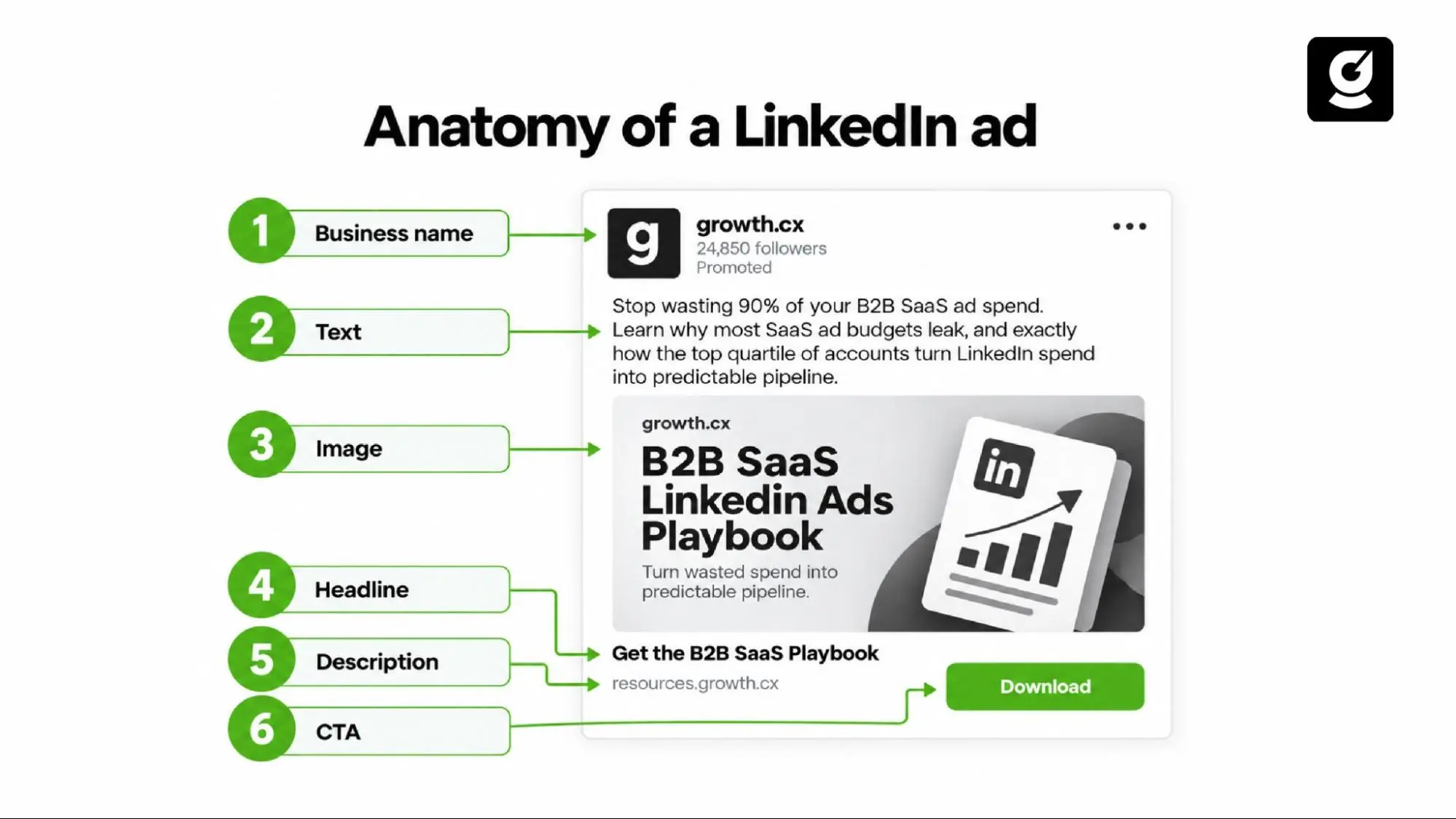
How Do LinkedIn Ads Work?
LinkedIn Ads work by putting your message in front of a specific professional audience rather than waiting for that audience to search for a solution. You define who you want to reach, choose a campaign objective, create the ad, and LinkedIn decides when and where to show it based on your campaign settings and the ad auction.
Effective LinkedIn Ads targeting starts with your ICP. Instead of targeting broad professional audiences, you can narrow your audience using attributes such as company, industry, job function, seniority, and location.
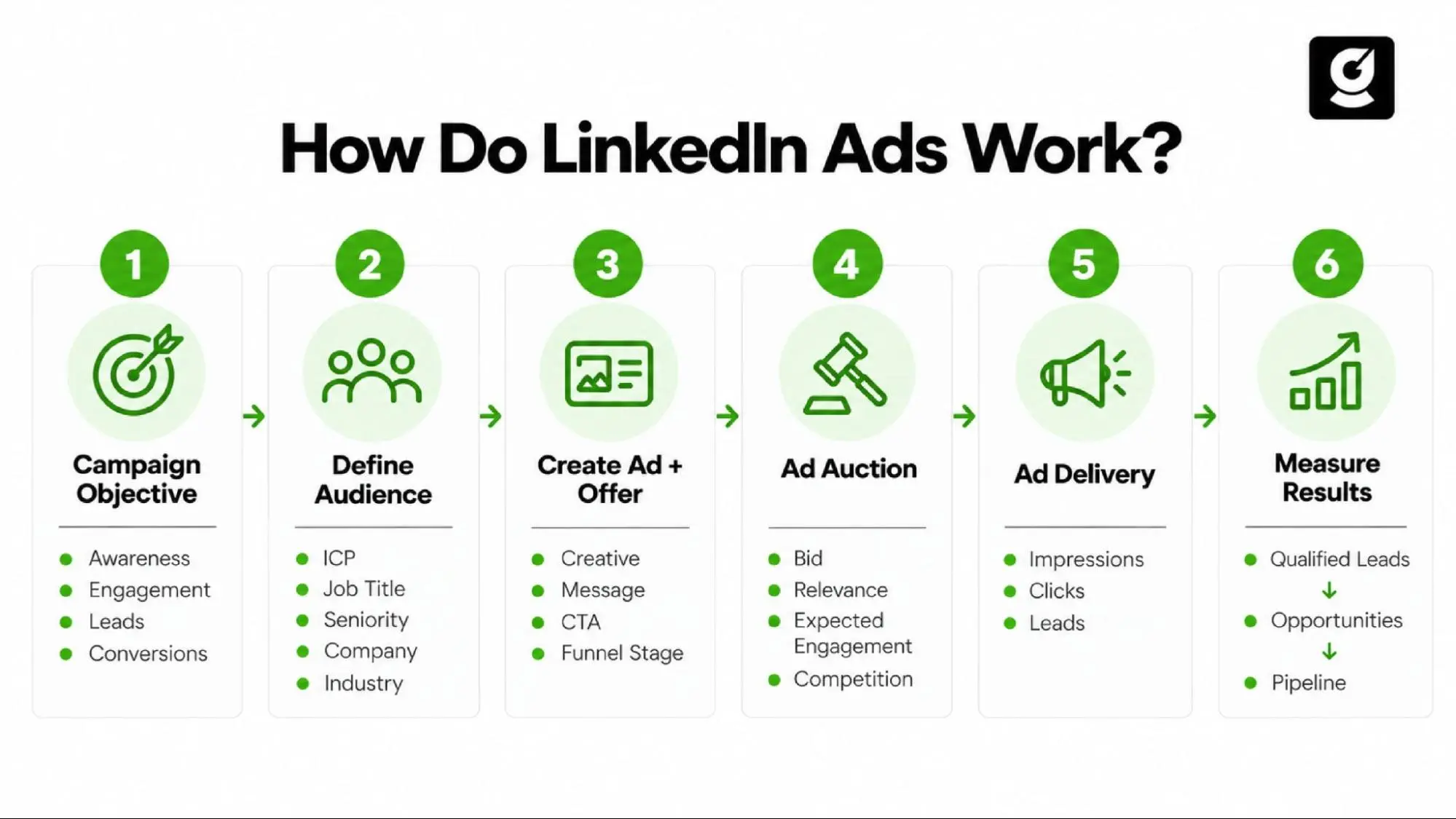
The process looks like this:
- Choose a campaign objective
Start by deciding what the campaign needs to achieve, such as awareness, engagement, website visits, lead generation, or conversions. The objective influences how LinkedIn optimizes delivery.
- Define your audience
Build the audience around your ICP using professional attributes such as company, industry, job function, seniority, and location. For B2B SaaS, this lets you target specific personas, buying committees, or target-account segments.
- Create the ad and offer
Match the creative, message, offer, and CTA to the audience and funnel stage. A cold prospect may need educational content or a problem-led message, while someone who has already engaged with your brand may be ready for a case study or demo.
- Enter the LinkedIn ad auction
When an eligible member is likely to see an ad, LinkedIn runs an auction among competing ads. The winner isn't necessarily the advertiser with the highest bid. Factors such as your bid, expected engagement, ad relevance, and competition for that audience all influence delivery. - Pay for the resulting delivery or action
Your costs depend on factors such as the audience you're targeting, competition, campaign settings, bidding strategy, and ad performance. This is one reason LinkedIn can cost more when you're targeting a highly specific B2B audience. - Measure what happens after the click
Clicks and leads are only the beginning for B2B SaaS. Connect campaign data to your CRM to see whether those leads become qualified opportunities and pipeline.
Why Increasing Your Bid Isn't Always the Answer
A higher bid can help you compete for more delivery, but it won't fix an audience that's too broad or an ad that doesn't resonate. If the right people aren't engaging, increasing your bid can simply mean paying more to reach the same problem.
Treat bidding as a lever for delivery, not a substitute for better targeting, creative, or offers.
Why Are LinkedIn Ads Important for B2B SaaS?
LinkedIn is useful for B2B SaaS because you can reach people based on the professional context that actually matters to a buying decision. You can narrow an audience by company, industry, job function, seniority, and other professional attributes instead of relying only on what someone happens to search for.
That matters when you're selling software to a specific type of company or buying committee.
A SaaS product might need to reach a VP of Marketing at a 200–500 employee company, a RevOps leader at a growing SaaS business, or several decision-makers within the same target account. Google can capture people who are already searching for a solution. LinkedIn gives you more control over who you want to put the message in front of before they start searching.
That makes this platform particularly useful in LinkedIn B2B marketing for:
- Demand generation: Introduce a problem or solution before someone is actively looking for it.
- Account-based marketing: Reach decision-makers within specific target accounts and coordinate LinkedIn Ads with LinkedIn outreach.
- Buying committee targeting: Build campaigns around multiple people involved in a B2B purchase.
- Thought leadership: Put useful insights, research, and expert content in front of a relevant professional audience.
- Retargeting: Stay visible to people who have already interacted with your ads, content, or website.
The trade-off is that LinkedIn can be expensive. You're paying to reach a specific professional audience, so poor targeting or weak messaging can make every click more costly.
The platform isn't necessarily the problem.
The real question is whether you're using its targeting and professional context well enough to reach the right people with the right message.
What Are the Best LinkedIn Ad Formats for B2B SaaS?
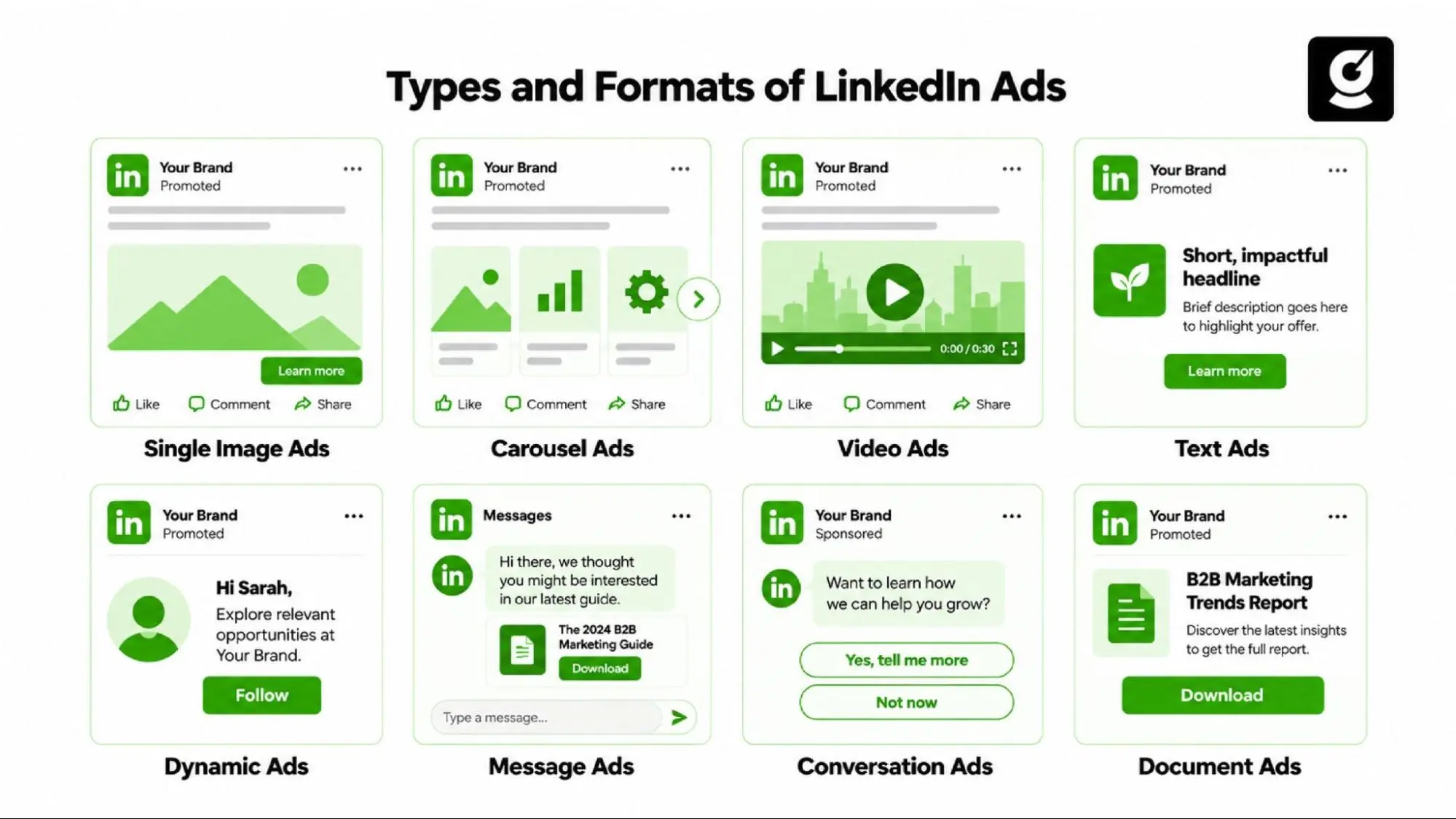
No single LinkedIn ad format works for every B2B SaaS campaign.
The right format depends on what you're trying to communicate, who you're targeting, and how close that audience is to a buying decision.
A product launch, a research report, and a demo request don't need to look or feel the same. The format should support the job the ad needs to do.
| Ad Format | Best For | Typical Use |
| Thought Leader Ads | Building credibility and reach | Promote useful insights or posts from industry experts |
| Single Image Ads | Clear, focused messaging | Demand generation, lead generation, and problem-led campaigns |
| Document Ads | Sharing substantial content | Reports, guides, checklists, and research |
| Video Ads | Explaining or demonstrating ideas | Product education, customer stories, and awareness |
| Message Ads | Direct communication | Targeted offers and high-intent outreach |
| Conversation Ads | Interactive journeys | Guiding prospects toward different content, offers, or actions |
Match the Format to the Job
For cold audiences, simple formats such as Single Image, Video, or Thought Leader Ads can introduce the problem without asking for too much too soon.
Following LinkedIn single image ad best practices means keeping the message focused, making the value clear, and giving the audience one obvious next step.
When the audience needs more information, Document Ads can give them something useful to explore. This works particularly well for reports, research, checklists, and other content that helps a buyer understand a problem.
For warmer audiences, Message and Conversation Ads can support more direct interactions. They can work well when you already have a clear reason to reach out, and the next step is relevant to the prospect.
The mistake is choosing a format because it is popular or because it worked for another campaign.
Thus, start with the audience and the offer, then choose the format that makes the message easiest to act on.
LinkedIn Ads vs. Other B2B Channels
| Channel | Primary Strength | Intent | Targeting | Best For |
| LinkedIn Ads | Professional audience targeting | Low–Medium | High | Demand gen, ABM |
| Google Ads | Capturing existing demand | High | Keyword-
based |
High-intent acquisition |
| SEO | Organic discovery | Medium– High |
Search-based | Long-term demand |
| Direct engagement | Medium– High |
First-party | Nurturing | |
| Meta Ads | Broad reach | Low– Medium |
Interest/
behavior |
Awareness |
The flow that actually separates a working LinkedIn account from a wasteful one:
ICP definition → Audience & Auction Fit → Creative Matched to Intent → Offer Matched to Funnel Stage → Pipeline Measurement
Note: LinkedIn isn't Google Ads with a professional skin. Asking it to capture people who are already searching is asking it to do a job it was never priced to do.
Why Do B2B SaaS Companies Waste Money on LinkedIn Ads?
Waste on LinkedIn looks like efficiency at first glance. Cost per lead can look fine for months while pipeline quietly fails to show up, because the leak isn't in the number marketing is watching.
Here's what that gap looks like inside an account nobody's caught yet:
- The audience is built on job titles alone, so an intern with "marketing" in their title costs the same click as a VP.
- Every person sees the same ad copy, so the message that lands for a technical buyer also gets shown to a budget-holder who needs a different argument entirely.
- A cold audience gets asked to book a demo on the first impression, so the offer dies before the relationship exists.
- Five personas run inside one campaign, so the report shows an average that hides which persona is actually converting.
- Warm prospects who are already engaged get shown the same cold-audience ad again, so the account pays full price for interest it already earned once.
- Leadership sees cost-per-lead getting cheaper while nobody checks whether those leads ever become pipeline.
| Cause | What It Looks Like | Fix |
| Poor targeting | Audience too broad, built on job titles alone | Tighten ICP, add exclusions |
| Weak messaging | Generic, product-led ad copy | Lead with the audience's problem |
| Wrong offer | Cold audience asked to book a demo | Match offer to funnel stage |
| Poor campaign structure | Multiple personas mixed into one campaign | Segment by audience |
| No retargeting | Warm prospects treated like cold traffic | Build retargeting layers |
| Lead-focused measurement | Optimizing for CPL alone | Track qualified pipeline |
That gap is measurable: the best-managed accounts waste roughly a third less budget than the worst-managed ones, and the difference is almost entirely strategic, not platform-driven.
What Are the Core Pillars of a Leak-Proof LinkedIn Account?
A LinkedIn account stops wasting budget when four elements work together.
Fixing one in isolation can help, but the biggest gains come when all four work together.
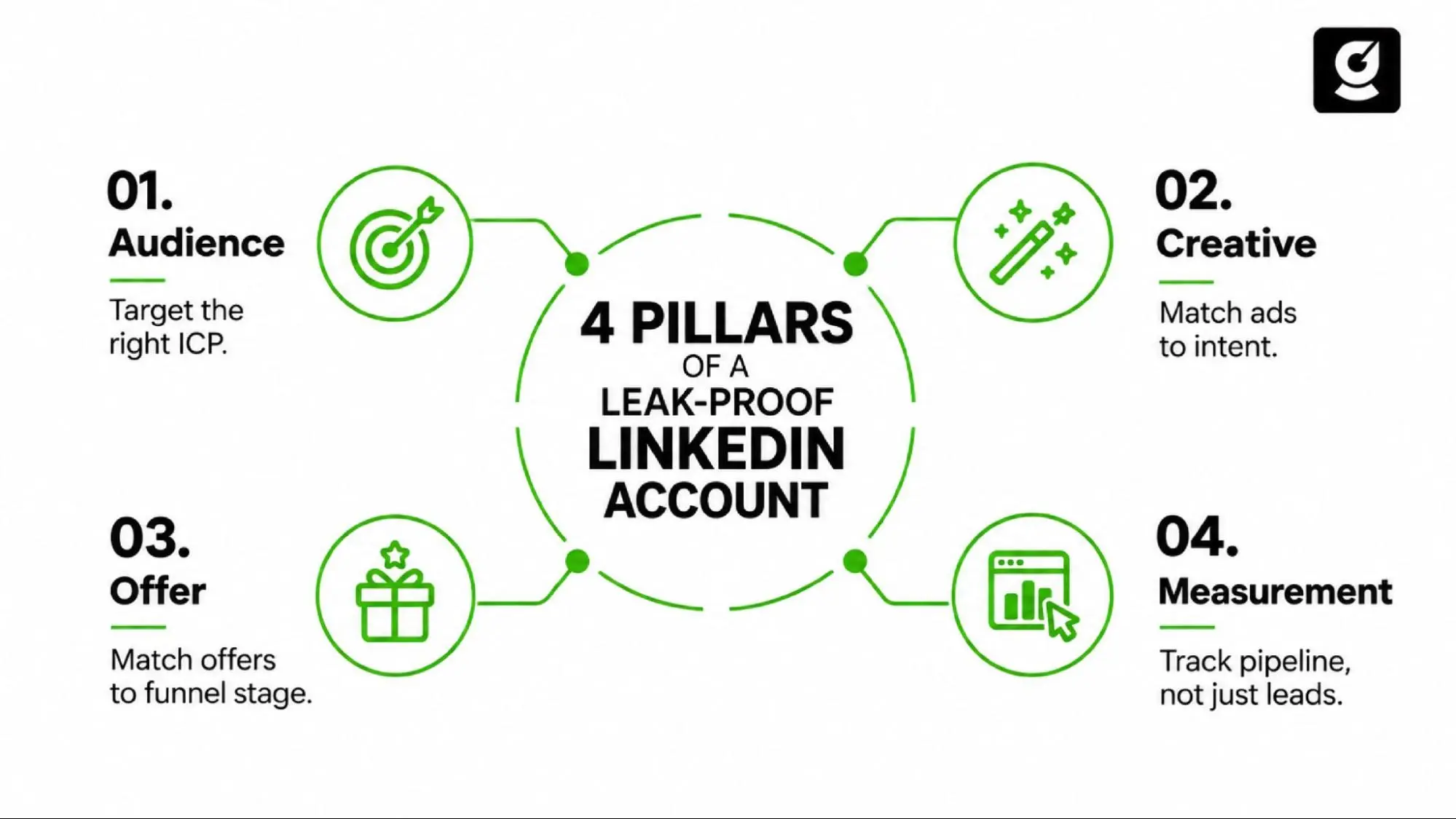
1. Audience & Campaign Structure
- Define ICP by firmographics (company size, industry, geography) before opening Campaign Manager
- Map the full buying committee, not one job title
- Add exclusions for job seekers, students, and irrelevant seniority
- Split campaigns so each one isolates a single persona or account tier, not five personas averaged together
- Keep audience overlap low enough that segment-level results are actually readable
2. Creative Matched to Intent
- Write a different hook for cold audiences (problem-led) than warm ones (proof-led)
- Test at least two creative angles per persona before scaling spend
- Monitor frequency alongside CTR, not spend alone; the same ad shown too often to the same person stops working and starts costing more for the same result
- Retire creative once engagement drops; don't wait for it to hit zero
3. Offer Matched to Funnel Stage
- TOFU: educational content, no form friction
- MOFU: guides, reports, or case studies behind a short form
- BOFU: demo or consultation, positioned as the logical next step, not the opening ask
- Reduce form fields to the minimum needed to qualify
4. Retargeting & Pipeline Measurement
- Build separate retargeting audiences for website visitors, ad/content engagers, and named target accounts
- Sequence messaging: never show a cold-audience ad to someone who already engaged
- Connect LinkedIn campaigns to CRM stage data and track cost per qualified lead, not cost per lead
- Report pipeline influenced, not MQL volume, to leadership
How Do You Build a Leak-Proof LinkedIn Account?
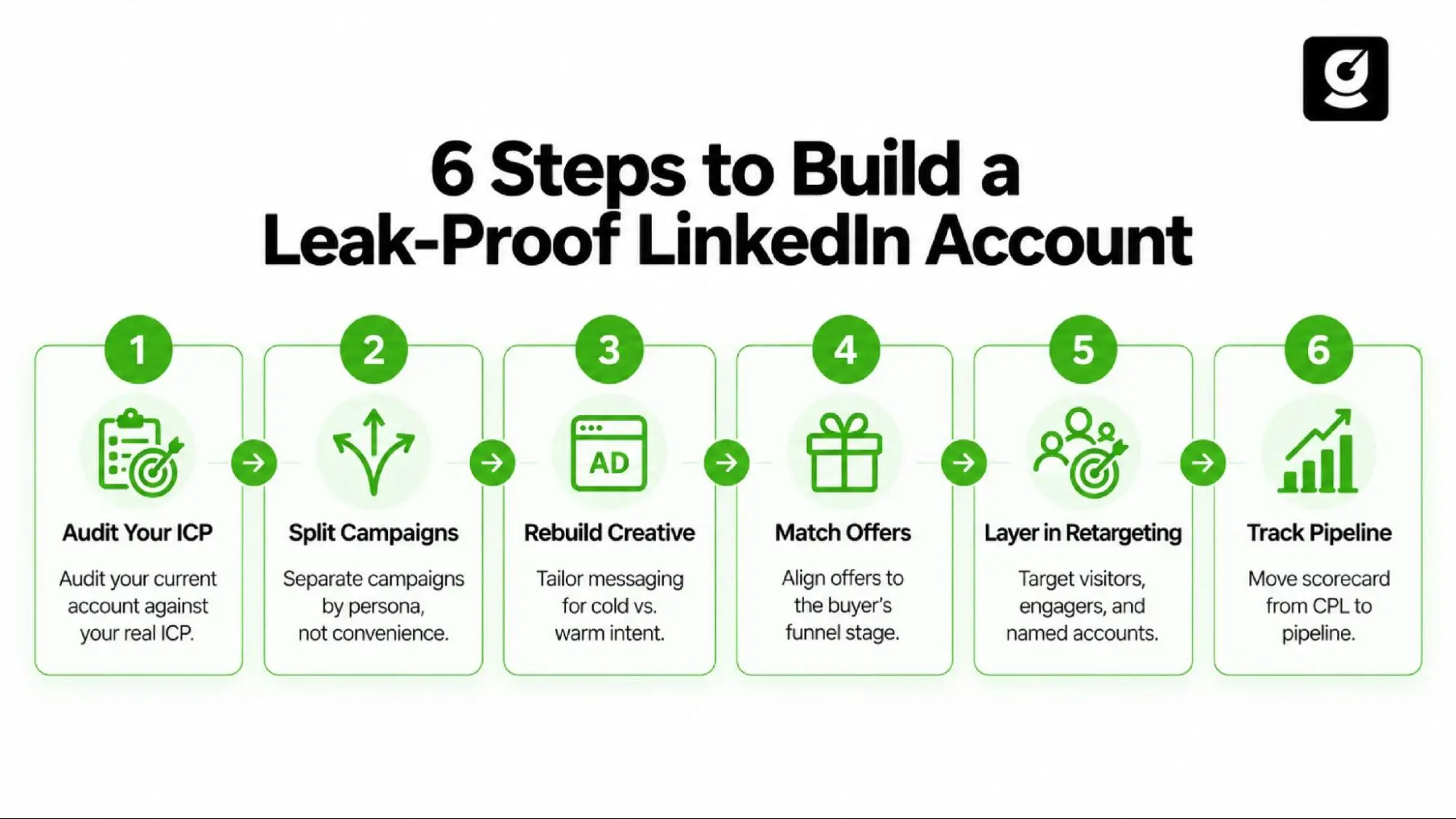
Once you've identified the four areas that need attention, the next step in this LinkedIn Ads guide is turning them into an account structure you can actually manage.
Step 1: Audit Your Current Account Against Your Real ICP
Start by comparing your current LinkedIn audience with the companies and people you actually want to reach.
Check:
- Company size and industry
- Geography
- Job function and seniority
- Buying committee roles
- Exclusions such as students, job seekers, or irrelevant industries
If a large share of your spend is reaching people outside your ICP, fix the audience before increasing the budget.
Step 2: Split Campaigns by Persona, Not Convenience
Avoid putting multiple personas into one campaign simply because they share a similar job title.
Separate campaigns where the audience, pain point, or buying role is meaningfully different. This gives you cleaner performance data and lets you tailor the message to each group.
For example, a campaign targeting VPs of Marketing may need a different message from one targeting Demand Generation Managers, even if both influence the same purchase.
Step 3: Rebuild Creative Around Cold vs. Warm Intent
Your audience's level of awareness should influence what you show them.
For cold audiences, lead with the problem they recognize and give them a useful reason to engage. For warm audiences, use proof, specific outcomes, customer examples, or stronger product context.
Don't rely on one creative angle across the entire funnel. Test different hooks and formats against each audience segment, then retire ads when engagement starts to decline.
Step 4: Match the Offer to the Funnel Stage
The offer should make sense for where the prospect is in the buying journey.
- TOFU: Educational guides, checklists, research, or practical resources
- MOFU: Case studies, reports, webinars, or deeper comparison content
- BOFU: Demo requests, consultations, audits, or other high-intent offers
A cold prospect who has never heard of your company may not be ready to book a demo. Asking for that commitment too early can turn an otherwise relevant audience into a poor-converting campaign.
Match the offer to the amount of trust and intent you've already built.
Step 5: Layer in Retargeting Before Increasing Budget
Once your initial campaigns are reaching the right people, create separate LinkedIn retargeting ads for people who have already shown interest.
This can include:
- Website visitors
- Ad and content engagers
- Video viewers
- Named target accounts
Use different messaging for these audiences instead of showing them the same cold-audience ad again. The goal is to move people from awareness to consideration and, eventually, conversion.
Step 6: Move Your Scorecard From CPL to Pipeline
CPL can tell you what you're paying for a lead. It can't tell you whether those leads are turning into revenue opportunities.
Track metrics such as:
- Cost per qualified lead
- Lead-to-opportunity rate
- Cost per opportunity
- Pipeline influenced by campaign
- Conversion rate by audience and offer
Connect LinkedIn campaign data with your CRM wherever possible. This helps you identify which audiences, creatives, and offers are producing qualified pipeline rather than simply generating cheap leads.
A leak-proof LinkedIn account isn't built by changing one setting. It's built by connecting audience, campaign structure, creative, offer, retargeting, and measurement into one system.
Targeting vs. Creative: Which Should You Fix First?
Fix targeting first if you're reaching the wrong people. Fix the creative first if the right people aren't engaging. Most accounts need both, but the diagnostic below points to the bigger lever.
| If You See... | Likely Problem | Prioritize |
| High impressions, poor engagement | Creative/message | Creative |
| Good CTR, poor lead quality | Targeting | Targeting |
| Good engagement, poor conversion | Offer/landing page | Offer |
| Strong leads, weak opportunities | Audience/qualification | Targeting |
| High frequency, declining CTR | Creative fatigue | Creative |
| Strong leads but low pipeline | Lead quality/offer | Targeting + offer |
LinkedIn Ads Metrics Every B2B SaaS Team Should Track
| Category | Metrics |
| Targeting | Audience size vs. ICP fit, cost per click by seniority tier, exclusion list coverage |
| Creative | CTR by angle, frequency, engagement decay rate |
| Offer | Form completion rate, cost per qualified lead |
| Pipeline | Lead-to-opportunity rate by campaign, cost per opportunity, pipeline influenced |
Do You Need a LinkedIn Ads Agency?
As campaigns get more complex (more personas, more ABM tiers, more channels to coordinate), you usually need full-time LinkedIn-specific expertise. Whether that's worth outsourcing depends on complexity and bandwidth, not company size alone.
Consider an agency when campaigns span multiple ICPs or ABM tiers, when nobody in-house has the bandwidth to test and iterate weekly, or when paid activity isn't connecting to pipeline data anyone trusts.
A good LinkedIn ad agency delivers ICP and audience strategy, campaign architecture built for testing rather than one large campaign, creative iteration, retargeting layers, landing page optimization, and reporting tied to pipeline rather than platform metrics. Look for proven B2B SaaS experience specifically, an understanding of long sales cycles, and the ability to connect paid activity to LinkedIn Outreach, SEO, and other GTM channels.
Conclusion
LinkedIn Ads aren't a bad investment for B2B SaaS. Cost per click runs higher because the audience is more specific, and specific audiences cost more to reach on any platform.
What separates a 13.5%-waste account from a 52.4%-waste account isn't budget. It's the four pillars: audience and campaign structure, creative matched to intent, offer matched to funnel stage, and retargeting tied to pipeline measurement. Fix those, and the same spend behaves like a different channel, without needing more of it.
That's the gap growth.cx works inside. As a B2B SaaS marketing agency, growth.cx doesn't run LinkedIn Ads as an isolated line item; it sits inside the same revenue engine as ABM, outbound, AI SEO, content, and website conversion, so audience and messaging data from one channel improves the others instead of staying siloed
Ready to Turn LinkedIn Ad Spend Into Pipeline?
Build a LinkedIn Ads strategy that reaches the right B2B SaaS buyers, reduces wasted spend, and connects campaigns to qualified pipeline.