GTM agency for B2B SaaS teams that need pipeline, not another plan

Trusted by 150+ B2B SaaS & Tech Companies








THE PIPELINE PROBLEM
Why does your GTM stall after the plan gets approved?
The strategy lives in a deck. The execution lives with four vendors.
One firm wrote the positioning. Another runs ads, a third sends outbound, a fourth handles SEO, and nobody owns the number. When pipeline misses, every vendor points at a different metric.
Your ICP was set once. The market kept moving.
Targeting still runs on assumptions from your last funding round. Messaging speaks to buyers you had 18 months ago, not the accounts showing intent today.
Every channel runs alone, so none of them learn.
SEO intent never reaches your ABM list. Outbound replies never shape ad copy. Each channel pays to learn what another channel already knows.
Buyers shortlist inside ChatGPT before they fill out a form.
B2B buyers now ask ChatGPT, Perplexity, and Google's AI Overviews which vendors to consider. If your GTM plan ignores AI search, you lose the first touch before sales ever sees the account.
The result is familiar: more spend, more activity, and a pipeline that stays flat quarter after quarter.
Mission triggers
When do SaaS teams bring in a GTM partner?
Teams rarely hire a go-to-market agency when things are calm. They call us when the plan has to change, and the pipeline can't wait for a new hire to ramp.
You're launching a new product or category
You need an ICP, positioning, and a first motion that proves demand fast, without burning runway on channels that won't convert yet.
You're entering a new market or moving upmarket
US expansion, a new vertical, or a shift from SMB to mid-market. Your current playbook was built for a different buyer, and it shows in win rates.
You're switching motions
PLG to sales-assisted. Inbound-only to outbound plus ABM. The motion changes, and the channels, messaging, and handoffs have to change with it.
Your pipeline stalls while the targets keep rising
The board raised the number after your last round. Adding spend to the same channels isn't moving pipeline anymore.
Not a fit: We're not the right partner for pre-product-market-fit companies or teams without a sales motion to hand pipeline to
Sound familiar? Book a GTM strategy call →Launch stack
Go-to-market consulting that ships straight into execution
Most GTM consulting ends with a document. Ours ends with live channels, tracked pipeline, and a team that keeps improving both.
Go-to-market strategy services built around pipeline math
We start with the decisions every other channel depends on. Your SaaS go-to-market strategy is built backwards from the pipeline and ARR you need, not from the channels you already run.
ICP and TAM definition – Which accounts, which roles, and which buying triggers matter most
Positioning and messaging – Why you, why now, in words your buyers already use
Motion selection – Inbound, outbound, ABM, product-led sales, or the right mix for your stage
Channel mix and pipeline targets – Where budget goes, what each channel owes the pipeline, and by when
We deploy this when: You're launching, relaunching, or changing motion.
Map my GTM strategy →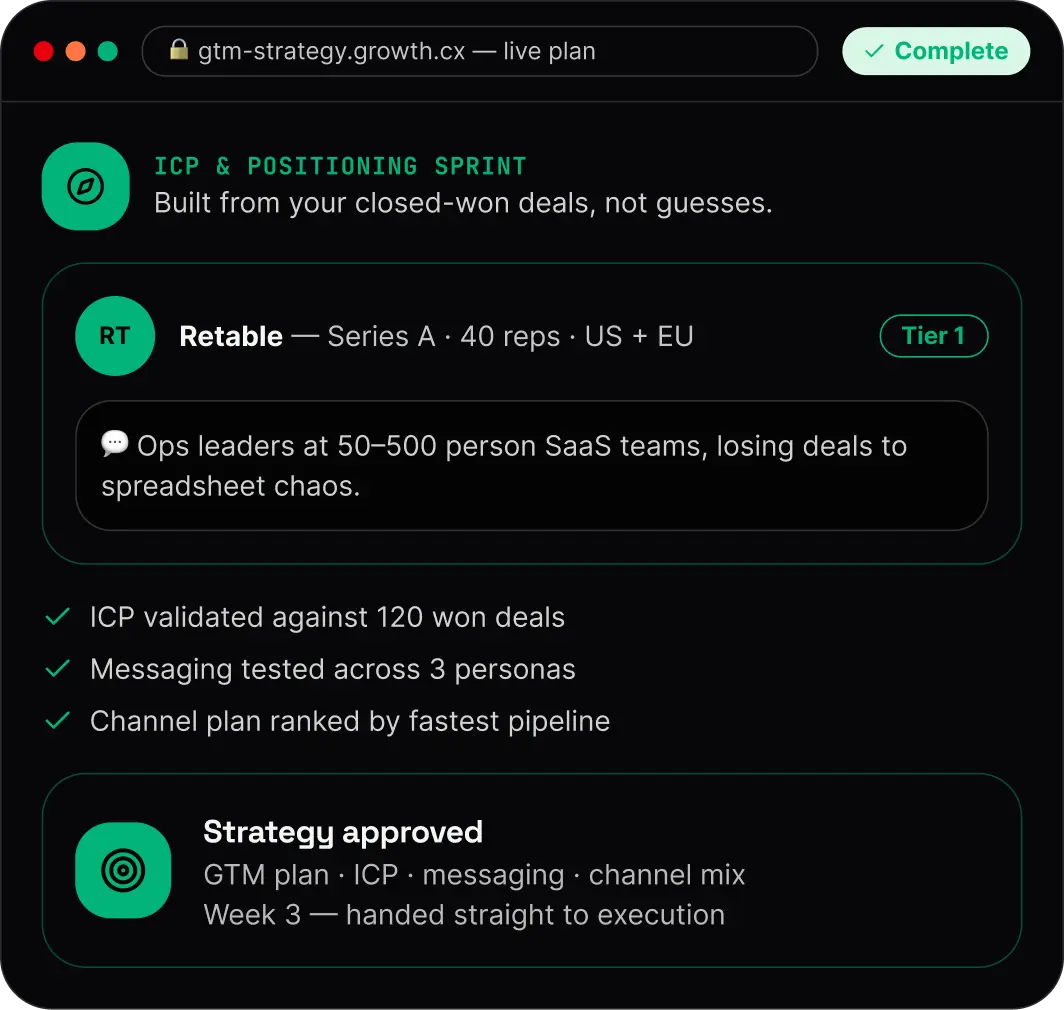
Mission control
What separates a GTM partner from a GTM vendor?
Every go-to-market agency claims strategy and execution. Here's where the usual options break, and what changes when one team owns both.
| The alternative | Where it breaks | The growth.cx way |
|---|---|---|
| Strategy consultancy | You get the plan, then you hunt for someone to run it | The team that writes the plan runs the channels and owns the number |
| Outbound or GTM engineering shop | One channel, tool-first, strategy assumed | Motion chosen first, then the right engines, outbound included |
| Traditional growth marketing agency | Siloed deliverables tied to traffic and clicks | Every engine reports against SQLs, pipeline, and ARR |
| Point-solution revenue marketing agency | Paid or SEO runs alone and learns alone | Signals move between channels so each one gets cheaper |
| In-house hire | 3 to 6 months to ramp, one skill set, high fixed burn | A senior GTM team from week one |
Senior attention, by design
Each growth.cx expert works with only 1 to 2 clients. You get the person in the pitch, not a junior after the contract is signed.
AI search is part of the GTM plan
Most GTM agencies stop at ads and outbound. We plan for how buyers now shortlist vendors in ChatGPT and Perplexity, then build the visibility to match.
KPIs you can check every week
Deliverables come with realistic KPIs tied to pipeline, so you always know what we're moving and by how much.
Trajectory
How a growth.cx GTM engagement runs, from diagnosis to scale
Four phases, one team, and a clear metric at every stage. Most clients see qualified pipeline from the new motion within the first 3 months.

Foundation
We audit your funnel, CRM data, channels, and win-loss patterns to find what is actually holding pipeline back. Then we lock the B2B SaaS GTM strategy: ICP, positioning, motion, and pipeline targets.
You get: A GTM plan with channel mix, budget split, and targets by month
We measure: Baseline pipeline, CAC, and conversion by stage
Activation
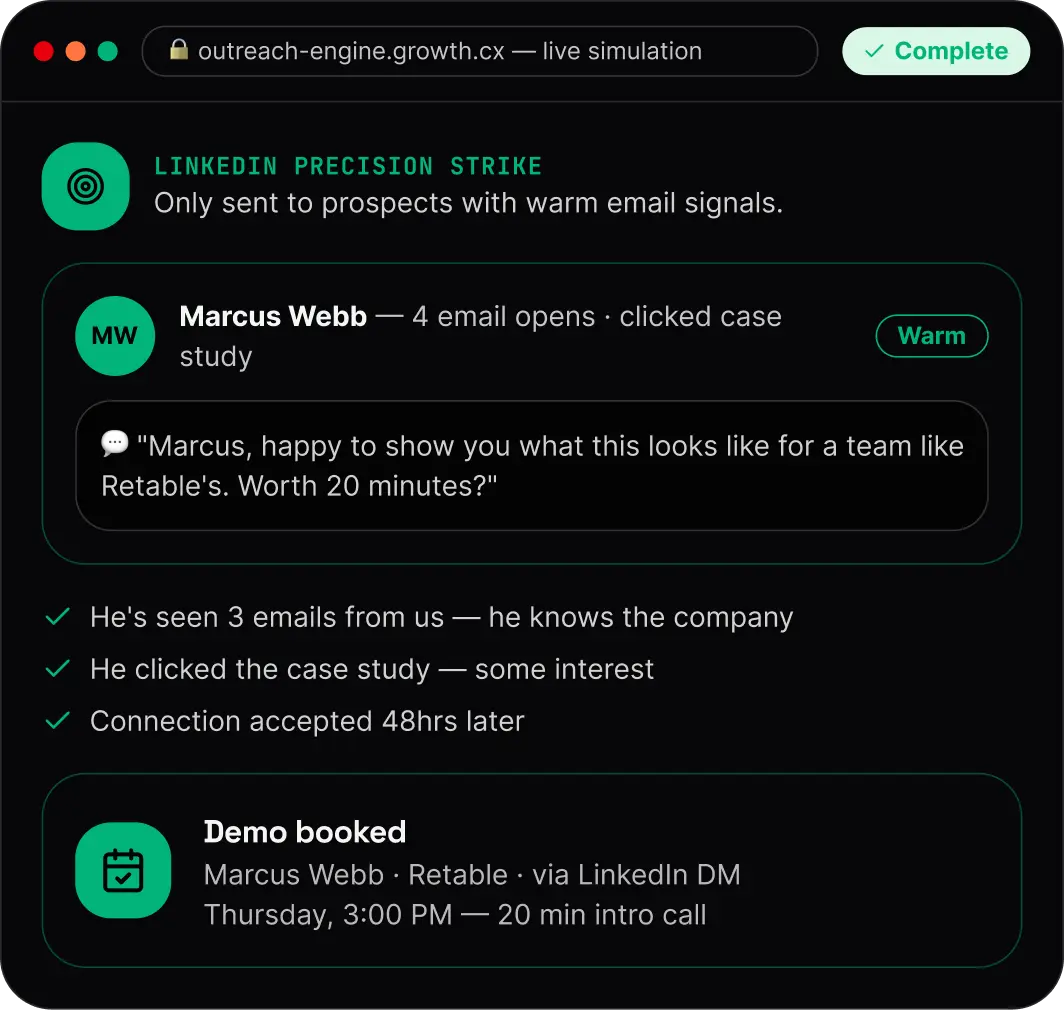
The first Revenue Engines go live in the order the plan set. Messaging gets tested across channels at once, so we learn in weeks, not quarters.
You get: Live campaigns, sequences, and content tied to your ICP
We measure: Qualified meetings, SQLs, and cost per SQL
Compounding
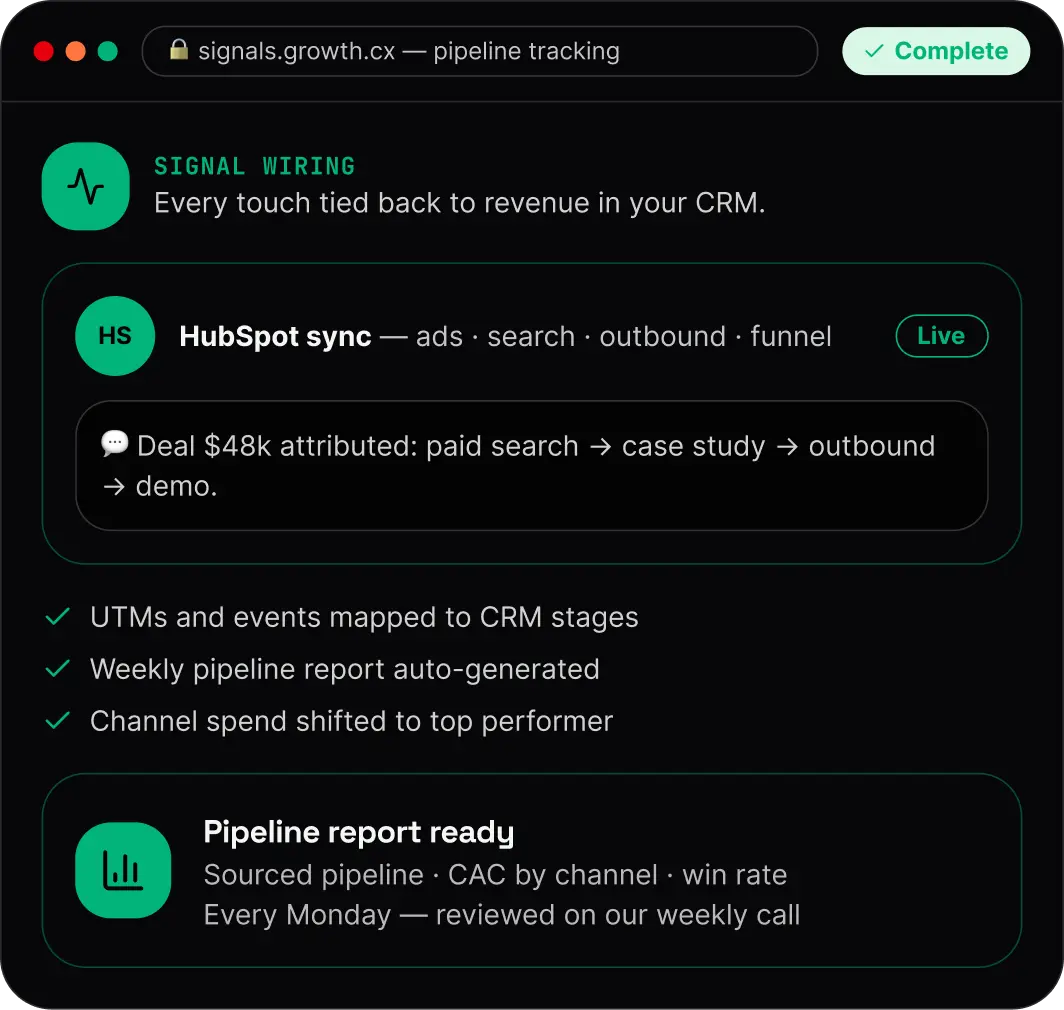
Signals start moving between channels. What converts gets more budget, and what doesn't gets cut.
You get: Cross-channel signal feeding and weekly optimization
We measure: Pipeline velocity and win rate by source
Scale
We add engines, segments, or markets once the core motion is repeatable. The goal is pipeline that grows without growing headcount at the same rate.
You get: An expansion roadmap and quarterly strategy reviews
We measure: Pipeline and ARR against target
What working with our GTM agency looks like, week to week and quarter to quarter
300+ Founders. Real Words.
Don't take our word for it.

"growth.cx developed a customized growth strategy that included targeted social media campaigns, email marketing, and SEO. They understood our needs and created content that resonated with our ICP. As a result, we saw a 25% increase in sales within just 3 months. The ROI from our investment has been more than worth it."

"growth.cx has been incredibly thorough in their approach, providing clear and consistent communication every step of the way. They’ve developed a solid, well-structured plan to successfully launch my SaaS, giving me confidence in our marketing strategy."

"growth.cx has been instrumental in building our organic and paid marketing efforts from scratch - right from messaging to consistently generating qualified leads. Their team is incredibly flexible, adapting to our evolving needs, and has become our go-to marketing partner for all strategy execution and growth initiatives."

"growth.cx did a fantastic job developing our Webflow website, delivering a fast, intuitive, and high-performing design. Their expertise and attention to detail made the entire process smooth and efficient. They also significantly reduced our spam score from 13 to 2 - truly impressive work!"

"Working with growth.cx has been like having an extended growth team that helps you execute at a super fast speed. They've been our partner on graphic design & video support as well as some marketing ops. The team is reliable, dependable & very agile. It's been a good experience partnering with them."
Ground station
GTM agency questions, answered
A GTM agency plans and runs how a company brings its product to market. That covers the ICP, positioning, motion, and channels that create pipeline. At growth.cx, the same team that builds the strategy also runs the channels and reports against pipeline.
GTM consulting decides what to run. Demand gen agencies run it. Most teams hire one of each and lose time in the gap between them. We do both, and demand generation runs as one engine inside your GTM plan.
We execute. Strategy is the first phase. Then our teams run ads, outbound, AI search, and demand programs against the targets we set together.
Your B2B SaaS GTM strategy starts from deal size, sales cycle, and where your buyers already look. We choose the motion from that data, then test it in live channels before scaling spend.
First channels usually go live within 4 weeks, with early qualified meetings in the Activation phase. Compounding gains take 3 to 4 months as signals start moving between channels.
Pricing depends on how many Revenue Engines your plan needs and how fast you want to scale.
Ready for launch
Find out what's capping your pipeline before you plan next quarter
Book a GTM strategy call with a senior growth.cx lead. Bring your numbers, and we'll show you where your motion is leaking and which Revenue Engine to start with.
Book a GTM strategy call →No pitch deck. Just a working session with a GTM agency that runs what it recommends.