Your next SaaS customer may not discover you through a Google search. They may discover you through a conversation with ChatGPT.
- B2B software research is shifting from searching for links to asking AI for recommendations. According to reports, in 2026, 51% of B2B software buyers reported starting their research with AI chatbots more often than Google, while 71% use AI chatbots somewhere in their software evaluation journey.
For SaaS brands, this creates a new visibility challenge. Traditional SEO helps you compete for search rankings, but ChatGPT SEO and LLM SEO focus on earning a place inside AI-generated answers where buyers discover, compare, and shortlist solutions.
Ranking in ChatGPT is not about reaching a fixed position. It is about becoming a trusted source that AI systems understand, mention, cite, and recommend through strong AI brand visibility, relevant content, and credible signals.
The brands that adapt to this shift early will have a stronger advantage in the AI-driven buying journey.
In light of this, let us understand what ranking in ChatGPT means for B2B SaaS brands.
What Does “Ranking in ChatGPT” Actually Mean for B2B SaaS Brands?
Ranking in ChatGPT does not mean achieving a fixed position like Google search results. It means becoming a trusted source that ChatGPT selects, mentions, or cites when users ask questions related to your category, product, or solution.
For B2B SaaS brands, visibility depends on relevance, authority, content quality, and how well AI systems understand your brand.
Also read: AI Search Ranking Blueprint
Being Mentioned vs. Being Cited in ChatGPT: What Is the Difference?
A SaaS brand can appear in ChatGPT responses in different ways, but not every appearance carries the same value.
- A Mention Means ChatGPT Recognizes Your Brand
A mention happens when ChatGPT includes your company name in an answer.
Example:
“Some popular AI SEO platforms include Growth.cx, Semrush, and Ahrefs.”
Here, ChatGPT recognizes your brand as relevant to the topic, but it may not provide additional context or evidence behind the recommendation.
Brand mentions help improve awareness, but they do not always indicate strong authority.
- A Citation Means ChatGPT Uses Your Content as a Source
A citation happens when ChatGPT references your website, article, research, or other content as supporting information.
Example:
A user asks:
“What are the best AI SEO strategies for SaaS companies?”
ChatGPT may provide an answer and reference a specific guide, research report, or article from your website.
Citations are valuable because they show that AI systems consider your content a reliable source of information.
Strong citation signals usually come from:
- Original research and data.
- Detailed industry guides.
- Expert-driven content.
- Case studies.
- Well-structured educational resources.
For B2B SaaS brands, earning citations can influence how often your company appears in AI-generated answers during buyer research.
For SaaS companies, ChatGPT visibility can directly impact:
- Brand discovery: Getting introduced to buyers who may not know your company yet.
- Qualified traffic: Attracting users with stronger purchase intent.
- Pipeline generation: Creating more opportunities from AI-assisted research journeys.
How Does ChatGPT Ranking Decide Which Brands to Recommend?
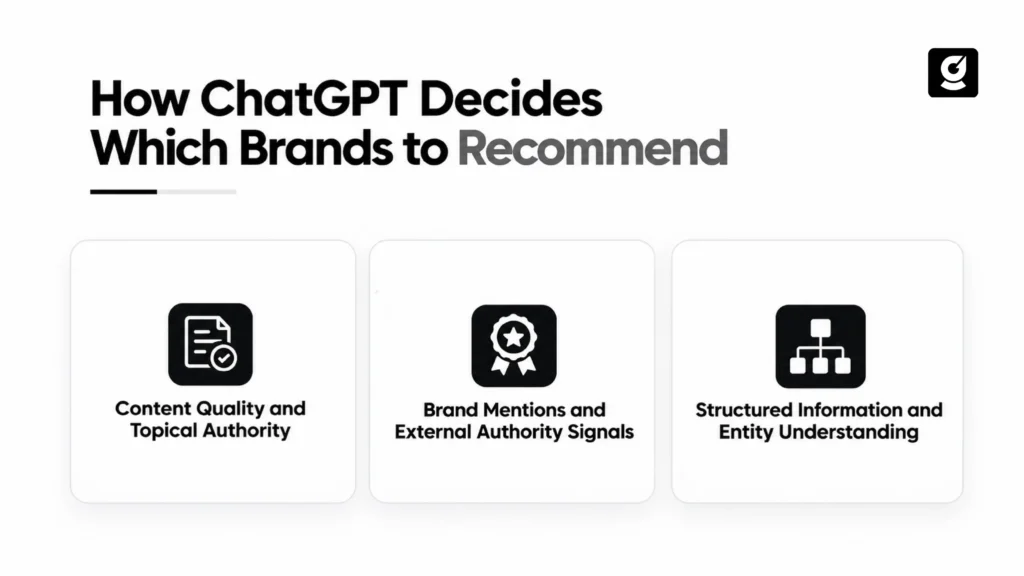
The following are ways ChatGPT decides which brands to recommend:
1. Content Quality and Topical Authority
2. Brand Mentions and External Authority Signals
3. Structured Information and Entity Understanding
ChatGPT does not recommend SaaS brands randomly. When users ask AI tools for software recommendations, comparisons, or solutions, the system relies on multiple signals to determine which brands appear relevant and trustworthy.
For B2B SaaS companies, improving ChatGPT rankings requires more than publishing product pages. AI systems need enough context to understand your expertise, category relevance, and credibility.
The major signals that influence AI recommendations include:
1. Content Quality and Topical Authority: Become the Most Useful Source in Your Category
ChatGPT is more likely to recommend brands that demonstrate expertise around a specific topic rather than websites with limited information.
For SaaS companies, this means moving beyond product pages and creating content that answers the questions buyers ask before making a decision.
Build topical authority through:
- Comprehensive industry guides.
- Product comparison pages.
- Use-case content.
- Implementation resources.
- Customer success stories.
- Expert-led insights.
For example, a customer support software company should not only publish “Customer Support Software Features.” It should also cover:
- Best customer support tools for SaaS companies.
- How to improve support response time.
- Customer support automation strategies.
- Zendesk alternatives and comparisons.
This helps AI systems understand:
- The category you operate in.
- The problems you solve.
- The customers you serve.
A connected library of helpful content creates stronger relevance signals than a website development focused only on product pages.
2. Brand Mentions and External Authority Signals: AI Looks Beyond Your Website
Your website explains what your brand offers, but external sources help AI systems understand whether your brand is trusted.
This is why AI brand mentions play an important role in ChatGPT visibility.
AI systems consider signals from:
- SaaS review platforms.
- Industry publications.
- Software directories.
- Partner websites.
- Customer testimonials.
- Third-party articles.
For example, a SaaS brand consistently mentioned as a solution for a specific problem across trusted platforms provides stronger evidence for AI systems to recommend it.
Compare:
Company A:
- Only has product pages.
- Limited external mentions.
- Few customer reviews.
Company B:
- Has customer case studies.
- Appears in industry comparisons.
- Has reviews on trusted platforms.
- Receives third-party mentions.
Company B provides stronger authority signals because its expertise is validated beyond its own website.
To improve ChatGPT visibility, SaaS brands need a digital presence that extends beyond their own content.
3. Structured Information and Entity Understanding: Help ChatGPT Understand Your Brand
Before ChatGPT can recommend your company, it needs to clearly understand your identity, category, and expertise.
Many SaaS brands struggle with AI visibility because their information is inconsistent across different platforms.
AI systems need clarity around:
- Who you are.
- What category you belong to.
- What problems you solve.
- Who you serve.
- How you differ from alternatives.
Strengthen your entity signals through:
- Consistent brand descriptions.
- Clear product and service pages.
- Detailed about pages.
- Author profiles.
- Schema markup.
- Updated company information.
For example:
Weak positioning:
“We help companies grow better.”
Stronger positioning:
“An AI-first B2B SaaS marketing agency helping startups and scaleups build demand generation, pipeline, and predictable revenue.”
The clearer your brand identity is across the web, the easier it becomes for AI systems to connect your company with relevant user queries and recommendations.

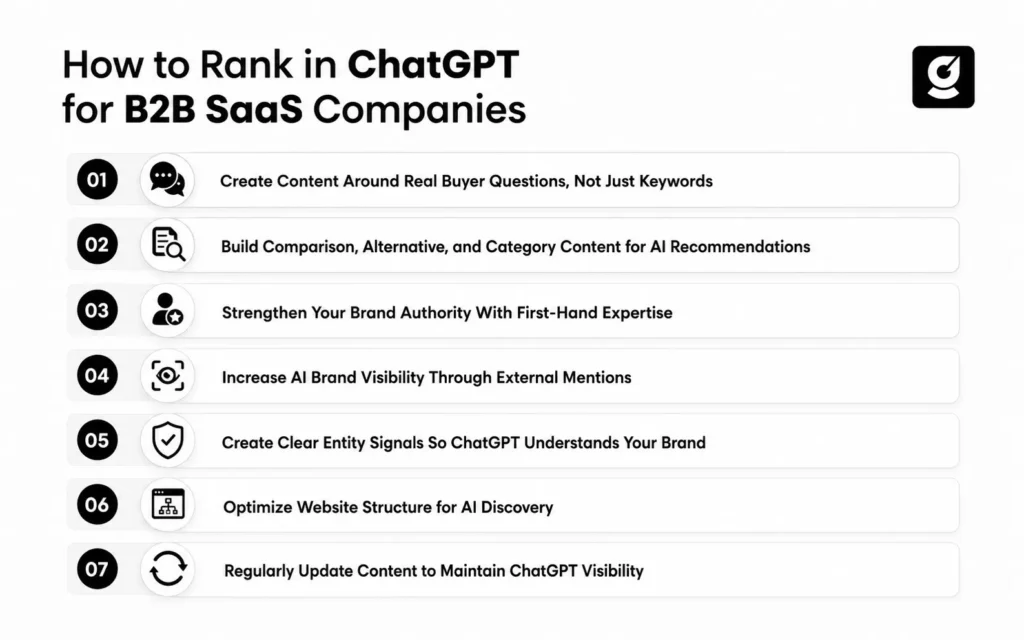
How to Rank in ChatGPT for B2B SaaS Companies?
The step-by-step process on how to rank in ChatGPT is given below:
1. Create Content Around Real Buyer Questions, Not Just Keywords
2. Build Comparison, Alternative, and Category Content for AI Recommendations
3. Strengthen Your Brand Authority With First-Hand Expertise
4. Increase AI Brand Visibility Through External Mentions
5. Create Clear Entity Signals So ChatGPT Understands Your Brand
6. Optimize Website Structure for AI Discovery
7. Regularly Update Content to Maintain ChatGPT Visibility
Getting your brand mentioned in ChatGPT responses requires more than publishing content or targeting keywords. Unlike traditional search engines, ChatGPT does not rank pages based on a single factor. It evaluates whether a brand appears relevant, trustworthy, and useful for a specific user query.
For B2B SaaS companies, improving ChatGPT rankings requires building strong content signals, authority, and brand recognition across multiple sources.
Here are the key factors that influence whether your SaaS brand gets discovered and recommended in ChatGPT:
1. Create Content Around Buyer Decisions, Not Just Search Keywords
ChatGPT users rarely search with short keywords. They ask questions based on their problems, goals, and purchase decisions.
A SaaS buyer may ask:
- “What is the best CRM for a growing SaaS startup?”
- “Which project management tool works best for remote teams?”
- “What are the best alternatives to Salesforce for small businesses?”
To appear in these conversations, your B2B SaaS content marketing needs to answer the questions buyers ask before choosing a solution.
Focus on creating:
- Buyer-focused guides.
- Industry-specific resources.
- Use-case pages.
- Implementation content.
- Problem-solving articles.
For example:
Instead of creating:
“CRM Features and Benefits”
Create:
“How SaaS Startups Can Choose the Right CRM for Scaling Sales Teams”
The second approach gives AI systems more context about your target audience, use case, and expertise, making it easier to associate your brand with relevant queries.
2. Create Comparison and Alternative Pages for AI Recommendation Queries
Many ChatGPT searches are recommendation-driven. Users often ask AI tools to compare software, find alternatives, or shortlist solutions.
Common queries include:
- “What are the best tools for X?”
- “What are the alternatives to X?”
- “Compare X vs Y.”
For SaaS brands, this makes comparison content an important part of ChatGPT optimization.
Create:
- Comparison Pages
Help buyers evaluate different solutions.
Examples:
- Product A vs. Product B.
- Your product vs. competitor solutions.
- Alternative Pages
Capture buyers already evaluating another tool.
Example:
- “Best [Competitor] Alternatives for SaaS Teams.”
- Category Pages
Help AI systems understand your position within a software category.
Example:
- “Best AI SEO Tools for B2B SaaS Companies.”
- Use-Case Pages
Show where your product fits.
Example:
- “Marketing Automation Software for SaaS Growth Teams.”
These pages provide AI systems with stronger context around your category, competitors, and ideal customer profile.
3. Build First-Hand Expertise That AI Systems Can Trust
AI systems have access to thousands of articles covering the same topics. Generic content rarely gives them a reason to recommend one brand over another.
SaaS companies need content that demonstrates real experience through:
- Customer case studies.
- Original research.
- Industry benchmarks.
- Expert opinions.
- Product insights.
- Real implementation examples.
For example:
A generic article:
“How to Improve SaaS Marketing”
shares general advice.
A stronger resource:
“How We Helped a SaaS Company Increase Qualified Pipeline Through AI SEO”
shows experience, process, and measurable outcomes.
First-hand content creates stronger trust signals and improves the chances of earning ChatGPT citations.
4. Strengthen AI Brand Visibility Through External Mentions
Your website explains your brand, but external sources help validate your credibility.
ChatGPT can use information from across the web when generating recommendations. This makes AI brand mentions an important part of LLM SEO.
Build authority through:
- SaaS review platforms.
- Industry publications.
- Software directories.
- Partner websites.
- Customer testimonials.
- Expert interviews.
- Community discussions.
For example, if multiple trusted sources describe your company as a “B2B SaaS SEO agency for startups,” AI systems receive stronger signals about your category and expertise.
A strong digital presence beyond your website improves your chances of being included in AI-generated recommendations.
5. Build Clear Entity Signals So ChatGPT Understands Your Brand
Before ChatGPT recommends your company, it needs to understand exactly what your brand represents.
Many SaaS companies struggle with AI visibility because their positioning changes across platforms.
Your brand information should clearly communicate:
- Who do you serve?
- What category do you belong to?
- What problem do you solve?
- How your solution differs.
Strengthen entity signals through:
- Consistent company descriptions.
- Clear product positioning.
- Dedicated solution pages.
- Author profiles.
- Structured data.
- Customer case studies.
For example:
Weak positioning:
“We help businesses grow.”
Strong positioning:
“AI-first B2B SaaS marketing agency helping startups and scaleups build demand generation, pipeline, and predictable revenue.”
Clear positioning helps AI systems connect your brand with the right user questions.
6. Improve Website Structure So AI Can Understand Content Relationships
Creating valuable content is only one part of AI visibility. AI systems also need to understand how different pages, topics, and resources connect.
Improve discoverability through:
Internal Linking
Connect related content:
AI SEO guide → AI SEO service page → SaaS SEO case study
Topic Clusters
Build connected resources instead of isolated blogs.
Example:
A SaaS marketing website can connect:
- AI SEO.
- SaaS SEO.
- Content marketing.
- Demand generation.
- Customer success stories.
Technical Accessibility
Maintain:
- Crawlable pages.
- Proper indexing.
- Structured data.
- Clear headings.
- Updated content.
These signals help AI systems interpret your expertise and understand relationships between topics.
Please read: Best SaaS Website Design Agencies
7. Keep Content Updated to Maintain AI Search Visibility
AI-generated answers depend on information being accurate and current. Outdated content can reduce your chances of appearing in recommendations, especially for fast-changing SaaS categories.
Regularly refresh:
- Software comparison pages.
- Pricing comparisons.
- Industry statistics.
- Tool recommendation pages.
- Alternative pages.
For example:
A “Top SaaS Marketing Tools” article published in 2023 may not reflect current tools, pricing, or market changes.
Regular updates help maintain relevance and improve your chances of appearing in future ChatGPT responses.
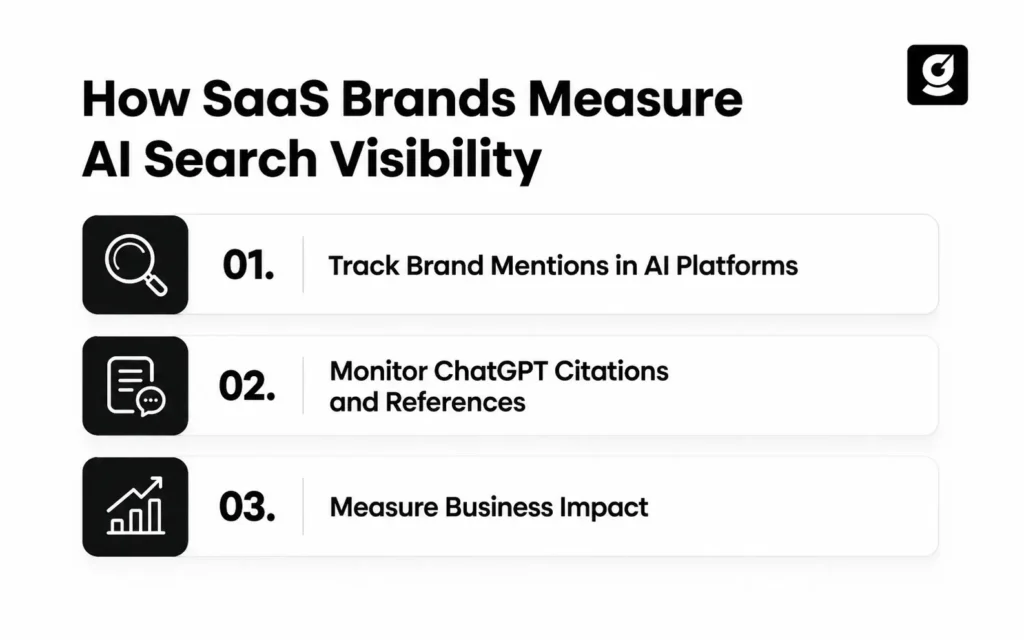
How Can SaaS Brands Measure AI Search Visibility?
SaaS brands can measure AI search visibility through the following:
1. Track Brand Mentions in AI Platforms
2. Monitor ChatGPT Citations and References
3. Measure Business Impact
Measuring AI search visibility requires a different approach from traditional SEO tracking. Search rankings, clicks, and organic traffic alone cannot show whether your brand is appearing in AI-generated answers.
For B2B SaaS companies, the goal is to understand:
- How often AI platforms mention your brand.
- Which queries trigger your appearance.
- Whether ChatGPT algorithm references your content.
- Whether AI visibility contributes to pipeline growth.
Tracking these signals helps SaaS teams understand whether their LLM SEO and ChatGPT optimization efforts are improving brand discovery.
1. Track Brand Mentions Across AI Platforms
The first step is understanding how often your brand appears in AI-generated responses.
Monitor:
- How frequently ChatGPT mentions your brand for relevant queries.
- Which buyer questions lead to your brand appearing.
- Whether competitors appear more frequently in similar searches.
- How your positioning changes across different prompts.
For example, a SaaS company can track queries such as:
- “Best AI SEO tools for SaaS companies.”
- “Top SaaS marketing agencies for startups.”
- “Alternatives to [competitor name].”
This helps identify:
- Where your brand already has AI visibility.
- Which topics need stronger content coverage.
- Where competitors have stronger authority signals.
Unlike traditional keyword rankings, AI visibility depends on whether your brand becomes part of the answer, not just whether a page ranks for a query.
2. Monitor ChatGPT Citations and Content References
Brand mentions show awareness, but ChatGPT citations provide deeper insight into whether AI systems consider your content a reliable source.
Track:
- Which pages ChatGPT references.
- Which content formats receive citations.
- What topics generate the most AI visibility.
- Whether your resources are being used as supporting information.
For example, if ChatGPT frequently references:
- Your industry research.
- Comparison pages.
- Detailed guides.
- Customer case studies.
It indicates that these assets are building stronger authority signals.
Analyzing citation patterns helps SaaS teams understand which content types contribute most to AI discovery and where future content investments should focus.
3. Measure the Business Impact of AI Visibility
AI visibility is valuable only when it contributes to business growth.
Connect AI search performance with revenue-related metrics such as:
- Organic traffic from AI platforms.
- Demo requests influenced by AI discovery.
- Branded search growth.
- Qualified leads from AI-assisted journeys.
- Pipeline contribution.
For example, a prospect may discover your company through ChatGPT, later search your brand name, visit your website, and request a demo. Traditional attribution may not always capture this complete journey.
SaaS companies should evaluate AI visibility as part of a broader demand-generation strategy rather than treating it as a standalone SEO metric.
How growth.cx Helps B2B SaaS Brands Improve AI Search Visibility
Getting mentioned in ChatGPT is not the final objective. For B2B SaaS companies, AI visibility only creates business value when it brings the right buyers into the pipeline.
This requires more than optimizing a few blogs for AI search. SaaS brands need a connected strategy that combines AI SEO, SaaS content, authority building, demand generation, and conversion-focused assets.
growth.cx helps B2B SaaS companies build this foundation by connecting:
AI Visibility → Qualified Demand → Sales Pipeline → Revenue Growth
1. Build an AI SEO Strategy Around How SaaS Buyers Search and Evaluate Solutions
Most SaaS companies optimize content around keywords, but AI search requires understanding the entire buyer journey.
A buyer asking ChatGPT for a software recommendation is usually not searching randomly. They are trying to solve a business problem, compare solutions, or validate a purchase decision.
growth.cx helps SaaS companies identify these AI search opportunities by:
- Mapping buyer questions across awareness, consideration, and decision stages.
- Finding topics where potential customers use AI assistants for research.
- Building content clusters around SaaS categories, problems, and use cases.
- Optimizing content so AI systems can clearly understand the brand, expertise, and relevance.
For example, instead of creating only a general article about “marketing automation,” a SaaS company can build a connected content ecosystem around:
- Best marketing automation tools for SaaS companies.
- Marketing automation alternatives.
- How SaaS teams improve pipeline with automation.
- Marketing automation implementation guides.
- Customer success stories.
This approach helps AI systems associate the brand with specific buyer needs rather than isolated keywords.
Further read: From Search Engines to AI Search
2. Create Content Assets That Build AI Authority, Not Just Organic Traffic
Many SaaS companies create content to increase rankings and traffic but overlook whether that content builds trust with AI systems and potential buyers.
ChatGPT recommendations depend heavily on whether a brand appears credible, relevant, and consistently referenced.
growth.cx creates SaaS-focused content designed to strengthen these authority signals through:
- Expert-Led SaaS Content
Instead of generic educational content, growth.cx focuses on insights that reflect SaaS buying challenges, market trends, and customer problems.
This includes:
- In-depth guides.
- Strategic frameworks.
- Industry analysis.
- Founder and expert perspectives.
- Comparison and Alternative Pages
AI assistants frequently answer software recommendation queries.
growth.cx helps SaaS brands create decision-stage assets such as:
- Competitor comparison pages.
- Alternative pages.
- “Best tools” category pages.
- Product evaluation content.
These pages help brands become visible when buyers are actively comparing solutions.
- Bottom-Funnel Content and Case Studies
AI visibility becomes valuable when it supports revenue conversations.
growth.cx develops assets that help move buyers from research to action:
- Customer case studies.
- Solution pages.
- Use-case pages.
- Conversion-focused landing pages.
These assets provide stronger signals about what the company offers and who benefits from it.
3. Connect AI Search Visibility With Demand Generation and Revenue Growth
A common mistake SaaS companies make is to treat AI visibility as the end goal.
Being mentioned in ChatGPT is valuable, but the real business impact comes when that visibility attracts qualified buyers.
growth.cx focuses on connecting AI search efforts with measurable growth outcomes:
Demand → Pipeline → Revenue
This means AI SEO is integrated with:
- Lead generation.
- SaaS SEO strategy.
- Performance marketing.
- Content marketing.
- Account-based marketing.
- Sales enablement.
For example, improving visibility for a high-intent query like “best AI SEO agency for SaaS startups” is not only about earning a mention. It is about attracting companies actively looking for a solution and converting that demand into pipeline opportunities.
growth.cx works as an extension of SaaS marketing teams by combining strategic leadership with execution. Instead of managing disconnected marketing activities, the focus is on building a predictable growth engine where AI visibility, content authority, and demand generation work together.

Closing Thoughts
AI search is changing how B2B SaaS buyers discover, compare, and choose solutions. The brands that build visibility early will have a stronger opportunity to influence buyer decisions before competitors enter the conversation.
However, appearing in ChatGPT requires more than publishing blogs. It requires a connected approach that combines AI SEO, authoritative content, brand signals, technical optimization, and strategic distribution to help AI systems understand why your brand deserves to be recommended.
At Growth.cx, we help B2B SaaS companies build AI-first growth engines that connect visibility with demand, pipeline, and revenue. From improving AI search presence to creating content that attracts and converts the right buyers, we help SaaS brands turn emerging AI opportunities into measurable growth.
Ready to make your SaaS brand discoverable in the AI search era? Partner with growth.cx to build an AI-powered growth strategy that turns visibility into pipeline.
FAQs
What are the best practices for optimizing AI responses for specific user intent?
Create content around real buyer queries, match different search intents, provide direct answers, use structured formats like FAQs and comparisons, and include context that helps AI systems connect your content with specific user needs.
What are the best tools to improve ranking in AI chat platforms?
AI visibility tools like Profound, Peec AI, Otterly.AI, and Semrush AI Visibility Toolkit help track brand mentions, citations, competitor presence, and performance across AI search platforms.
Which services offer SEO solutions tailored for AI chat ranking?
AI SEO services focus on improving LLM visibility through content optimization, entity building, technical SEO, digital PR, citation tracking, and authority development to increase the chances of appearing in AI-generated recommendations.
How does ChatGPT decide which websites to recommend?
ChatGPT considers multiple signals, including content relevance, brand authority, third-party mentions, website information consistency, expert content, and trusted sources that help validate a company's expertise and category positioning.
Does Google ranking affect how often a website appears in ChatGPT?
Google rankings can influence visibility indirectly because strong SEO often reflects quality, authority, and accessibility. However, ChatGPT recommendations also depend on entity signals, citations, external mentions, and content relevance.
Do backlinks help a website rank in ChatGPT?
Backlinks can support ChatGPT visibility indirectly by strengthening authority and trust signals. However, AI platforms also evaluate content quality, brand mentions, relevance, and information consistency across multiple sources.
How important are third-party reviews and mentions for ChatGPT visibility?
Third-party reviews and mentions are important because they validate your brand beyond your own website. Trusted references from review platforms, publications, and industry sources can improve AI systems' confidence in recommending your company.