A demand gen lead at a Series B RevOps platform runs two searches back to back. The first, “predictive lead scoring vs rule based scoring,” returns a full AI Overview citing four sources. The second, “hubspot pricing,” returns the traditional ten blue links, no AI answer in sight. Same searcher, same day, same intent to buy software. Different result format entirely.
This is the part most AI Overview optimization advice skips. It treats AI search visibility as one lever: write better content, structure it well, and Google will reward you with an AI Overview. The data says something more specific.
Whether an AI Overview appears at all is decided almost entirely by query classification, not content quality. What you can influence is whether you get cited once an Overview does appear, and that is a completely different mechanism.
The stakes are real either way. Ahrefs measured a 34.5% CTR drop for position-one rankings once an AI Overview appears on that query, across 300,000 keywords. But pages cited inside the Overview recover roughly 62% of that lost click volume; pages that rank but aren’t cited recover only 28%. Getting cited, not just ranking, is the actual game now.
What actually triggers an AI overview in Google search?
Google doesn’t spin up Gemini for every search. Running generative models at global search scale is computationally expensive, and inserting an AI summary onto a page heavy with paid ads risks diluting ad revenue.
To protect both server costs and monetization, Google relies on an internal classification layer that evaluates three specific signals before triggering an AI Overview:
- Syntactic complexity: Long-tail queries with conversational markers (“how,” “why,” or multi-part comparisons) flag the search as a complex synthesis task rather than a simple lookup.
- Monetization priority: If a query carries immediate buying intent, Google prioritizes paid ad units, product shopping grids, and classic blue links over AI-generated answers.
- Information friction: When answering a question requires aggregating fragments from four or five distinct websites, the algorithm triggers an AI Overview to streamline the search generative experience.
If a query hits those specific criteria, the AI Overview gate opens. If it doesn’t, standard search engine results take over.
Evaluating your keyword list for AI overview optimization
Before spending resources optimizing a page for generative citations, run your target keywords through this evaluation matrix to determine whether you are playing for a traditional ranking or an AI Overview citation:
| Search query type | Example query | Primary trigger signals | AI Overview probability | Strategic focus |
| Comparative / synthesis | “predictive lead scoring vs rule based” | 7+ words, explicit comparison, multi-source breakdown needed | High (80%+) | Gate 2 (Citations): Use clear comparison tables and concise summary blocks. |
| Broad informational | “How does lead scoring work” | Explanatory intent, step-by-step process | Medium to high (60–80%) | Provide immediate answer blocks under H2s and back claims with original data. |
| High-intent commercial | “hubspot pricing” | Commercial keywords (“pricing”, “buy”, “software”) | Low (<15%) | Traditional SEO: Target classic position 1–3 rankings and ad placements. |
| Navigational / Brand | “hubspot login” | Single brand name, exact destination lookup | Near Zero (0–5%) | Technical SEO & Direct Brand Management. |
Real-World proof: Comparison of AI triggers vs. traditional results
To see query valuation in action, consider how Google handles two back-to-back searches from a B2B buyer evaluating revenue operations software:
Scenario A: Complex synthesis query
- Search query: “predictive lead scoring vs rule based scoring”
- SERP layout: AI overview featured (occupying top-of-page real estate, citing sources).
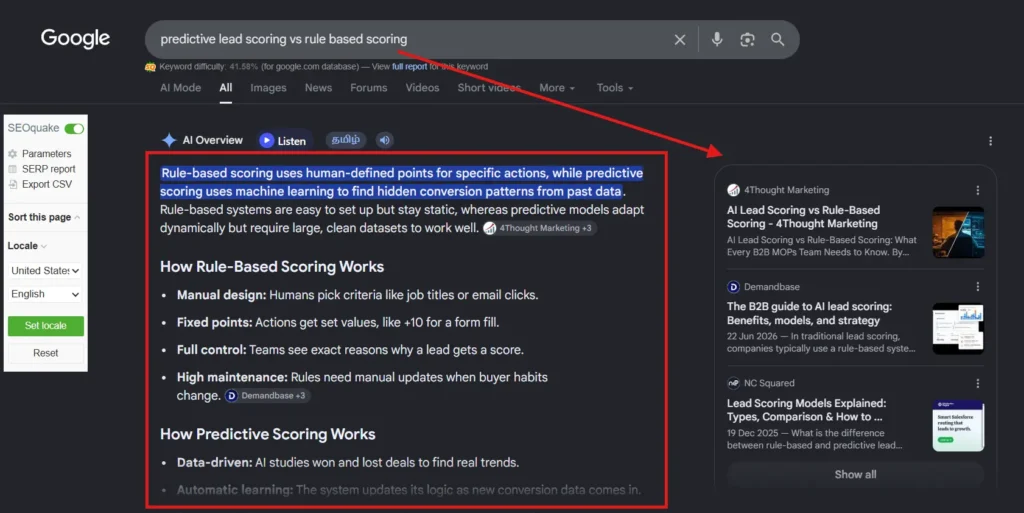
Why the AI overview triggered:
- Multi-dimensional comparison: The searcher is asking for a comparison of two distinct frameworks, which requires synthesizing information across multiple articles.
- High information friction: A single organic link rarely answers both sides of a “vs” query thoroughly without bias, so Google generates a synthesized middle ground.
- Low ad competition: Keywords focused on broad methodologies yield lower commercial ad revenue than software purchase terms.
Scenario B: High-intent commercial query
- Search query: “hubspot pricing”
- SERP layout: Traditional Blue Links & Ads (Zero AI Overview generated).
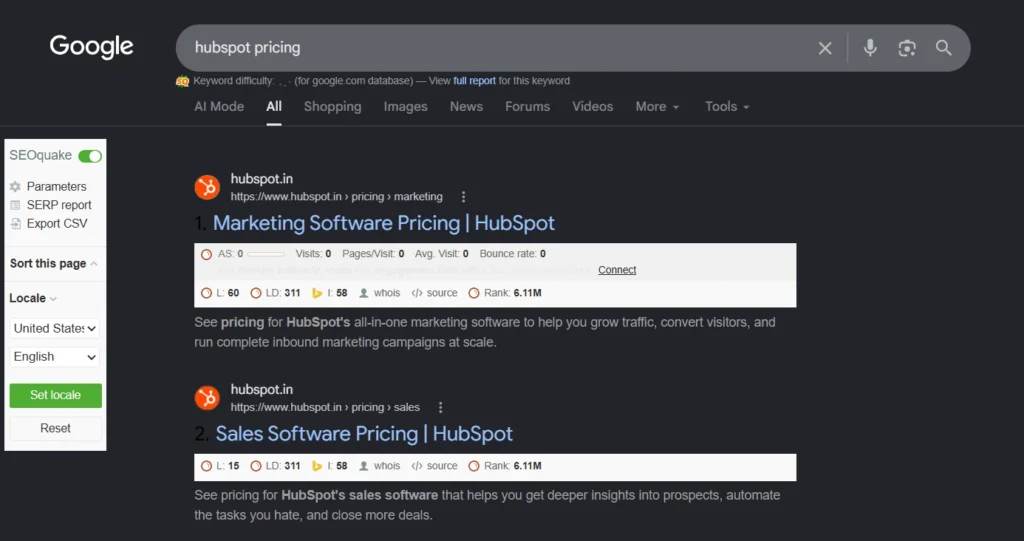
Why the AI overview was suppressed:
- Clear transactional destination: The user is looking for a direct cost page or buying portal.
- Ad monetization boundary: Inserting an AI summary above paid ads degrades ad click-through rates, directly impacting Google’s core revenue model.
- Low synthesis value: Pricing tables are factual and rigid. They do not require generative text to explain a concept.
Key takeaway for content strategy
- If your target term looks like Scenario B, your job is traditional organic SEO, competing for positions 1–3 and ad space.
- If your target term mirrors Scenario A, standard ranking tactics are only half the battle. Your primary goal is Gate 2 optimization: structuring your page to ensure that when Google generates that AI summary, your brand is one of the four sources cited in the box.
Why do certain queries still default to traditional results?
The “HubSpot pricing” case study isn’t an isolated anomaly. It represents a macro pattern across millions of searches. Broad search industry data reveals that the suppression of AI Overviews is just as predictable, and just as heavily governed by intent, as their activation.
Across major industry benchmarks, commercial and transactional searches register low single-digit trigger rates. A nearly 7x gap compared to complex informational queries. Vertical-specific tracking highlights this stark divide:
- E-commerce & Retail queries: Trigger an AI Overview only 3–14% of the time, as search engines prioritize product grids and shopping ads.
- B2B Tech & software queries: Trigger an AI Overview up to 82% of the time, given the high demand for synthesis and comparisons.
- Pure local queries: Searches like “plumber near me” trigger AI summaries only ~15% of the time because Google relies on Map Packs. However, local queries with an informational layer (“how much does an eye exam cost near me”) jump to 92% because the user wants an answer, not just a destination.
- Real-Time data queries: Terms covering weather, stock prices, or breaking news bypass AI Overviews entirely. As outlined in Google Search Central’s official documentation on AI features, Google’s systems route fresh, fast-moving topics to live data modules rather than the generative synthesis pipeline.
How to optimize for AI Overviews?
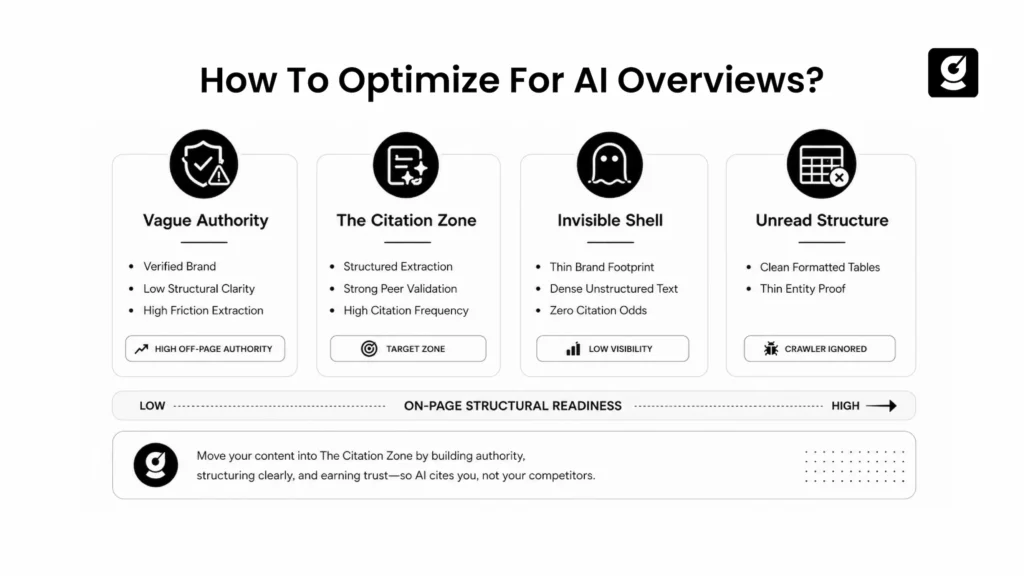
AI Overview optimization requires structuring high-ranking content for extraction rather than trying to force AI summaries to appear on ineligible queries.
This is where Generative Engine Optimization (GEO) actually happens, and it is a much tighter, more specific job than most bloated checklists suggest. You aren’t optimizing to force an AI trigger. You are optimizing for citation inclusion inside query types that already trigger reliably.
For a marketing or content team with focused bandwidth, winning these citations comes down to four core realities:
1. Entity clarity beats keyword density
AI models conclude source credibility from your brand’s overall footprint across the web, not just a single blog post.
Unbranded citation surfaces, such as G2 reviews or LinkedIn thought leadership from named executives, function as verified peer evidence that AI systems weight far more heavily than self-published marketing copy. A company with a thin web footprint has a small citation surface, regardless of how well an individual page is optimized.
2. Structural formatting rules citation rates
Content architecture directly impacts citation frequency. Industry audits across generative engines show a massive gap in citation rates driven purely by formatting mechanics:
- Question-format headers: Question-phrased H2s earn significantly more AI citations than statement-style headers.
- Inverted-pyramid answers: Placing a direct, 1-to-2-sentence summary immediately beneath the H2 gives LLMs a clean extraction block.
- Comparison tables: Structuring multi-variable data in clear HTML tables allows crawlers to parse tabular data instantly.
3. Schema is overhyped; Rendering gaps are real
Schema markup (JSON-LD) is not the silver bullet many guides claim. Generative crawlers largely read rendered visible content rather than metadata. Where schema does correlate with citation gains (like FAQPage markup), it is simply because it mirrors clean, visible text structure.
However, JavaScript rendering issues will silently kill your citation odds. If your pricing tables, feature comparisons, or key claims load client-side via JavaScript after initial page load, AI crawlers may only see an empty shell. If the crawler can’t render the text instantly, your content is excluded from the citation pipeline.
A Practical 5-step GEO execution blueprint for AI overview optimization
If you have limited bandwidth, prioritize your GEO efforts in this exact sequence:
- Filter your keyword list: Run your target keywords through an AI SEO audit to evaluate existing content against query trigger rates. Stop attempting to force AI Overview visibility on transactional or pure-local pages where the trigger rates do not support it.
- Rebuild high-value asset pages: Update your top 5–10 comparison and category-definition pages. Convert H2s into questions, place a summary answer in the first two sentences, and convert list-based data into HTML tables.
- Audit rendering execution: Inspect your top informational pages to ensure key claims, stats, and pricing data render in the initial server-response HTML without requiring client-side JavaScript execution.
- Expand external citation surfaces: Refresh review profiles (G2, Capterra) and publish executive thought leadership on LinkedIn to give LLMs verified third-party signals about your entity.
- Track citations as a unique metric: Log monthly priority queries to track whether your domain is cited in the AI Overview box, not just where you sit in classic organic rank position.

How do you measure AI Overview visibility?
Standard rank tracking misses most of what is happening in search today. Traditional rankings and AI Overview citations are now two entirely different outcomes, meaning a team tracking rank alone is missing the metric that actually drives traffic.
To track your true reach, monitor these three key metrics on a monthly cadence:
- Citation rate: Check whether your domain is explicitly cited inside the AI Overview box for your priority informational and comparison queries.
- Search console CTR divergence: Track pages where impressions stay steady while clicks drop, which signals that an AI summary is satisfying user intent directly on the SERP.
- Unlinked brand mentions: Track how often your product or company is recommended inside AI-generated answers, even when a direct hyperlink isn’t provided.
Organic rankings tell you if you would win a click on a traditional results page. Citation tracking tells you whether you are part of the answer on queries where traditional links are pushed down.
If managing this complex tracking in-house drains your team’s bandwidth, partnering with a specialized GEO agency can accelerate your progress and handle the technical execution for you.
Exploring GEO partners to support your strategy
If auditing entity graphs, resolving JavaScript rendering issues, and tracking LLM citation share exceeds your internal bandwidth, working alongside a GEO partner can help streamline the process.
- growth.cx: An AI-first marketing agency, specializing in B2B SaaS and tech scaleups, focusing on entity mapping, answer-first content restructuring, and tracking citation share across AI Overviews, ChatGPT, and Perplexity. They operate as an embedded growth team, helping brands align their existing content strategy with generative engine mechanics to capture high-intent buyer queries.
- Siege Media: Focuses on enterprise-level content creation and digital PR, building the off-page authority and strong E-E-A-T signals that generative engines use to verify sources. Their team specializes in crafting high-end, linkable assets that earn unbranded citations across authoritative industry publications.
- TripleDart: Tailored for B2B software brands competing in crowded categories, specializing in optimizing off-page review surfaces like G2, Capterra, and TrustRadius. They structure on-page content and off-page footprint data to ensure LLMs consistently recognize and recommend your product inside generative comparisons.
Future-proofing your search strategy for AI Overviews
As search engines shift from returning lists of links to synthesizing AI-generated answers, traditional SEO tactics alone are no longer enough to win buyer attention. Capturing high-intent software queries now requires optimizing for complete entity visibility across conversational platforms like ChatGPT, Perplexity, Gemini, and Google AI Overviews.
Understanding where your brand currently stands inside these answer engines is the first step toward securing your market share. Book a discovery call with growth.cx to receive a custom AI SEO audit, measure your current citation share against key competitors, and build a scalable framework designed to capture high-intent pipeline.

FAQ’s
How to prepare website content for generative AI summaries?
Structure content so AI systems can easily extract key information. Use question-format H2s, answer the question within the first one or two sentences, organize comparisons in HTML tables, support important claims with credible evidence, and ensure essential content appears in server-rendered HTML rather than relying heavily on JavaScript.
How can you increase your chances of being cited in Google AI Overviews?
Focus on informational, comparative, and synthesis-driven queries that commonly trigger AI Overviews. Create clear answer blocks, improve entity and brand authority across trusted external sources, make important information crawlable, and track AI citations separately from traditional keyword rankings.
What are the strategies to improve visibility in AI-powered search results?
Start by identifying queries that are likely to trigger AI-generated answers. Then restructure important pages around questions and direct answers, improve technical crawlability, build credible third-party brand mentions, strengthen comparison and data content, and regularly monitor whether your website appears as a cited source in AI-generated results.
Are there any recommended tools for analyzing content relevance for AI Overviews?
Use AI SEO audit tools to evaluate content structure and target queries, Google Search Console to monitor impressions and CTR changes, and AI citation-tracking platforms to check whether your pages appear in AI-generated answers. The goal is to measure citation visibility alongside traditional organic rankings rather than relying on rank tracking alone.