In February 2024, Gartner predicted traditional search volume would drop 25% by 2026 as AI chatbots replaced blue-link queries. That deadline landed this year. Google still handles somewhere close to 90% of search volume, and the 25% collapse never happened at that scale (Market Mosaic).
An entire Generative Engine Optimization services industry quickly capitalized on that fear, selling retainers for “AI visibility” before buyers even knew how to measure success. Now, a year into those contracts, founders and CMOs are struggling to prove value to their boards, holding slides full of citation screenshots instead of a real pipeline.
The prediction missed the mark, but the underlying habit shift didn’t. Buyers are researching LLMs before opening Google, making GEO as relevant as ever. The real issue is, most companies bought into the hype long before they figured out how to measure it.
Why do SaaS buying journeys demand new metrics?
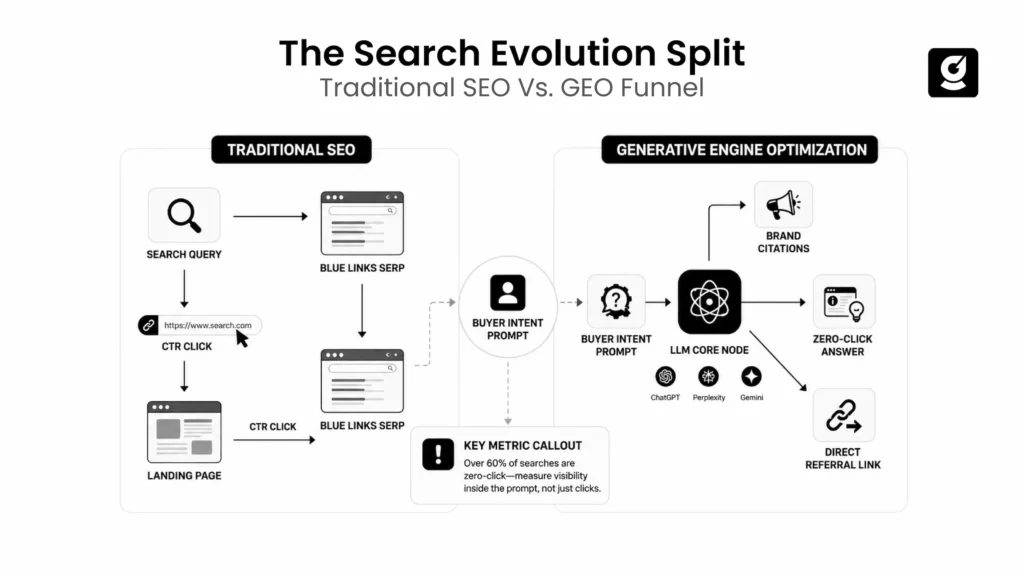
Software buyers no longer rely on standard web searches. Instead, they turn to ChatGPT and Perplexity to generate shortlists, summarize reviews, and compare features instantly. Traditional SEO measures traffic and rankings, but Generative Engine Optimization (GEO) happens inside conversational, zero-click answers.
Measuring GEO success requires tracking how often LLMs cite and recommend your brand during active buying prompts, rather than counting clicks to your homepage.
Why is measuring generative engine optimization services so hard?
Because there’s no equivalent of Google Search Console for AI platforms, and the underlying data reshapes itself monthly. Let’s understand why measuring GEO services is harder than it looks in depth:
- No standard analytics: Unlike Search Console, which gives exact impressions, positions, and clicks per keyword. ChatGPT, Perplexity, and Gemini give nothing comparable. No dashboard, no query-level report, no API that answers “how often was my brand mentioned this month.”
- Poor GEO metric measurement: Every GEO measurement gets built from scratch, off manual prompt panels or third-party sampling tools. Two vendors auditing the same company in the same month can report different numbers, and neither is technically wrong. They just sampled different prompts.
- Constant citation drift: Research from Maximus Labs shows that nearly half of the sources AI tools cite shift every single month. If ChatGPT recommends your product in June, it might recommend your competitor in August for the same prompt. This isn’t because you did anything wrong or changed your website. It’s simply because the AI itself got updated behind the scenes.
- Citation accuracy: Studies found that a large share of LLM citations, in some samples 50 to 90%, point to a source that doesn’t fully support the claim being made. Models attribute answers to the nearest matching page, not necessarily the page that actually said it. “We got you mentioned in ChatGPT” is an anecdote, not a report.
A real GEO strategy needs a fixed measurement structure before it needs a bigger content calendar.

What AI visibility metrics should your GEO strategy report on?
| GEO Metrics | What does it measure? | Benchmark (B2B SaaS) |
| AI Overview Citation Rate | Inclusion frequency in Google AI Overviews. | 20%–35% of target queries |
| Share of Model Voice | Brand mentions vs. competitors in LLMs. | Top 3 cited in category |
| Cross-Platform Reach | Citation presence across ChatGPT, Perplexity & Gemini. | Active on 3+ platforms |
| Zero-Click Exposure | Brand impressions within generated answers. | MoM impression growth |
| Citation Decay Rate | Lost AI citations over time from model updates. | <15% loss per quarter |
| E-E-A-T Signal Health | Off-page sentiment & reviews (G2, Reddit, Quora). | Positive quarterly trend |
| AI Referral Pipeline | Qualified traffic & leads coming from LLM links. | 5%–10% of total pipeline |
GEO shifts focus away from traditional metrics like rank position (#1 blue link) and organic click-through rates (CTR). Because over 60% of searches are zero-click, a GEO strategy must report on GEO metrics that measure how often, where, and how accurately your brand is cited across LLM platforms.
Here are the key AI visibility & GEO metrics your GEO strategy should track and report:
- AI overview citation rate: The percentage of your target category queries that trigger an AI-generated answer in which your brand, website, or content is explicitly cited as a source. Tracking this metric shows whether your GEO efforts are helping search engines select your content as supporting evidence for relevant buyer questions.
- Share of model voice (brand exposure): Measures how often your brand is mentioned, recommended, or cited in AI-generated responses compared with key competitors across AI platforms. A growing share of model voice indicates that AI systems increasingly associate your brand with important topics, solutions, and category-level queries.
- Cross-Platform citation reach: Tracks how consistently your brand or content appears across multiple AI engines rather than measuring visibility on only one platform. This helps identify where your GEO strategy performs well and where additional content optimization or authority-building may be required to improve visibility.
- Zero-Click brand impressions: Tracks search queries that generate strong impressions but relatively few clicks, helping identify cases where users may be receiving information directly within search features such as AI Overviews. While Search Console cannot directly confirm that every zero-click impression came from an AI answer, trends in impressions, CTR, and AI-triggering queries can help estimate how search behavior is changing.
- Citation freshness & decay rate: Measures how long your pages continue appearing as cited sources and how citation visibility changes after content updates, competitor changes, or search platform updates. Monitoring citation decay helps you identify pages that need refreshing and determine whether updating facts, examples, statistics, or supporting evidence restores AI visibility.
- E-E-A-T signal health (Off-Page brand mentions): Tracks third-party signals such as brand mentions, reviews, expert references, sentiment, and discussions across sources including Reddit, Quora, G2, Capterra, industry publications, and authoritative websites. These signals help show whether your brand has enough external credibility and topic authority to support stronger visibility in both traditional search and AI-generated answers.
- Referral traffic from AI engines: Measures website visits coming directly from AI platforms and AI-powered discovery tools. Beyond traffic volume, track engagement, conversions, demo requests, and pipeline from these referrals to understand whether AI visibility is attracting qualified buyers rather than simply generating additional visits.
Where generative engine optimization services fall short?
Most GEO agencies can present a convincing list of GEO metrics. The bigger issue is whether those metrics are tracked consistently, tied to business outcomes, and integrated with the broader GTM funnel.
- Metrics often stop at visibility: Agencies may report citation rate, brand mentions, share of voice, sentiment, or AI visibility scores without showing how those gains influence leads, opportunities, or revenue.
- Reporting lacks a fixed measurement framework: A metric mentioned in a sales deck is not the same as tracking the same prompt set, competitors, platforms, and benchmarks every month. Without consistency, it is difficult to tell whether GEO performance is actually improving.
- CRM attribution is often missing: Many GEO programs are managed by SEO or content teams that do not have direct access to CRM, RevOps, paid media, or outbound data. That makes it harder to connect AI visibility with pipeline and closed revenue.
- GEO is treated as a standalone service: When GEO operates as an isolated retainer, reporting naturally focuses on AI search performance rather than its contribution to the full customer acquisition funnel.
- Traffic gets measured more often than conversion quality: AI referral sessions can show that users are arriving from platforms such as ChatGPT or Perplexity, but agencies do not always track whether those visitors become qualified leads, demos, opportunities, or customers.
- Cross-functional ownership is unclear: GEO touches content, SEO, brand, demand generation, RevOps, and sales. When one agency or team owns only the content layer, important downstream data often falls outside the reporting scope.
- Pipeline reporting is easier to promise than to operationalize: Agencies such as TripleDart and RevvGrowth publicly position GEO around visibility and pipeline metrics, but the real differentiator is whether that connection is implemented consistently in recurring client reporting.
Important questions to ask GEO service providers
Everything above is what you should expect to see in a report. But these are the questions to ask before you’re sitting around waiting for Month One. Bring them to the sales call, not the kickoff call.
- Can I see your fixed prompt panel, not a sample, the actual list?
A GEO agency should be able to provide the actual prompt set it plans to track, ideally 20 to 50 buyer-intent queries based on your ICP that remain consistent across reporting cycles. A red flag is an agency that talks about “proprietary AI monitoring technology” but never shows the queries being measured.
- Which platforms do you track, and do you report them separately or blended?
You should expect a GEO agency to specify the platforms it monitors, such as ChatGPT, Perplexity, and Google AI Overviews, and report performance separately for each. A single blended “AI visibility score” can hide where your brand is gaining or losing visibility.
- How do you distinguish a mention from a citation in your reporting?
A GEO agency should clearly define brand mentions and citations and report them as separate metrics. This matters because being mentioned in an AI answer is different from having your content cited as a supporting source. A red flag is using “visibility” as a catch-all metric without explaining what it actually includes.
- Can you tie AI-referred sessions to the CRM stage and closed revenue?
You should expect the agency to explain exactly how AI-referred traffic will be connected to pipeline, whether through referral-source tracking, analytics attribution, CRM integration, or regular CRM reconciliation. A red flag is reporting only directional AI traffic without a process for connecting it to leads, opportunities, and revenue.
- Do you re-baseline the prompt panel, or keep it fixed over time?
You should expect the core prompt panel to remain stable so performance can be compared meaningfully over time. Prompts may need to change when your ICP, positioning, or market changes, but they should not be replaced every reporting cycle simply to test new angles. Constantly changing prompts can make trend data difficult to interpret.
- Can I see an anonymized report from a past client at a similar stage?
A GEO agency should be willing to show an anonymized or redacted example of its reporting format, including the metrics tracked, platform breakdown, and business outcomes measured. A red flag is showing only client logos or headline case-study results without demonstrating what the actual reporting looks like.
- How do you handle citation drops after an AI model update?
You should expect the agency to explain how it separates platform-wide or model-driven changes from declines caused by your own content or authority signals. Strong reporting should add context around major AI platform changes rather than treating every visibility drop as a problem with your GEO strategy. A red flag is reporting the decline without investigating what caused it.
What should you do before signing a GEO services contract?
Run this checklist before signing a GEO services contract, whether you hire an agency or manage the program internally.
- Build a fixed buyer-intent prompt panel: Start with 20–30 real questions your buyers ask, using sales calls, customer conversations, support tickets, and search data rather than guessed keywords.
- Establish your visibility baseline: Measure your current Share of Model Voice, citation rate, and brand mentions against the same prompt panel across LLMs and other platforms relevant to your buyers.
- Define the reporting cadence in the contract: Specify how often the agency will monitor prompts, report monthly trends, and review pipeline impact. Avoid vague commitments such as “regular updates.”
- Separate AI referral traffic in your analytics: Set up reporting for traffic coming from AI platforms before the engagement starts so you can measure changes from a clear baseline.
- Agree on pipeline attribution: Require the agency to show how AI visibility and referral traffic will be connected to leads, opportunities, and CRM stages in quarterly reporting. If pipeline attribution is outside its scope, you should know that before signing.
GEO service providers for B2B SaaS companies
Choosing a GEO agency depends on your goals, whether you need AI visibility tracking, content optimization, brand authority building, or a stronger connection between AI search visibility and pipeline. The following agencies are worth evaluating based on their GEO approach and focus areas.
1. growth.cx
growth.cx positions GEO as part of a broader AI-driven search and revenue strategy rather than a standalone content initiative. The GEO agency focuses on improving how B2B SaaS brands appear across AI search platforms by combining AI visibility optimization, content strategy, technical SEO, and authority-building efforts.
For SaaS teams, this approach can be useful when the goal is not only to increase AI citations but also to connect AI search visibility with broader demand generation and pipeline outcomes.
Best suited for: B2B SaaS companies looking for GEO combined with SEO, content, and revenue-focused growth strategies.

2. RevvGrowth
RevvGrowth focuses on GEO and AI search optimization with an emphasis on improving brand visibility across AI platforms. Its framework includes tracking visibility signals such as AI mentions, retrieval success, citations, and AI-driven referral traffic.
For B2B SaaS companies exploring GEO, RevvGrowth can be a consideration when the priority is building a structured AI visibility measurement process and improving discoverability across conversational search platforms.
Best suited for: SaaS teams that want a dedicated GEO framework focused on AI visibility and search presence.
3. Kalungi
Kalungi is a B2B SaaS growth agency known for its focus on SaaS marketing strategy, content, demand generation, and scalable growth systems. While GEO may be part of a wider AI search strategy, its broader expertise lies in helping SaaS companies build repeatable marketing processes across the funnel.
For teams that want GEO efforts to fit into a larger SaaS marketing engine, Kalungi can be worth evaluating alongside more specialized GEO providers.
Best suited for: Early-stage and growing SaaS companies looking for broader marketing strategy support alongside AI search optimization.
Generative engine optimization services go beyond AI visibility
GEO services are still evolving, and the difference between providers comes down to how well they connect AI visibility metrics with measurable business outcomes.
Before choosing a GEO provider, evaluate how they track prompts, monitor AI platforms, and link citations to pipeline impact. The right GEO service depends on your growth stage, whether you need stronger visibility, authority building, or integration with your broader marketing engine.
If you want to understand your current AI search visibility and where your B2B SaaS brand can improve, connect with growth.cx. Its GEO approach combines AI-focused content engineering, entity optimization, authority signals, and citation tracking to help brands get discovered when buyers evaluate solutions

FAQ’s
Which KPIs are most important for measuring GEO performance?
The most important GEO KPIs include AI visibility rate, brand citation frequency, AI search share of voice, sentiment of AI-generated mentions, referral traffic from AI platforms, and conversions influenced by AI discovery. SaaS companies should also track keyword-level performance to understand which topics and prompts generate the most visibility.
How should SaaS companies measure visibility in AI-generated answers?
SaaS companies can measure AI visibility by regularly testing relevant prompts across platforms like ChatGPT, Perplexity, Gemini, and Claude. They should track whether their brand appears in responses, where it appears, how it is described, whether competitors are mentioned instead, and whether the answer includes a citation or link to their website.
How can companies track whether their brand is being cited by AI platforms?
Companies can monitor AI citations by running consistent prompt-based tests and tracking mentions across major generative search platforms. GEO tools, AI visibility tracking platforms, and manual audits can help identify when a brand is referenced, which pages are cited, what topics trigger mentions, and how citation frequency changes over time.
Can GEO performance be connected to website traffic, leads, and revenue?
Yes. GEO performance can be connected to business outcomes by tracking AI-driven referral traffic, assisted conversions, demo requests, sign-ups, and pipeline influenced by AI discovery. While AI visibility is an upper-funnel metric, connecting it with analytics and CRM data helps SaaS companies understand its contribution to revenue growth.
What should a GEO performance report include?
A GEO performance report should include AI visibility trends, tracked prompts, brand mentions, citation sources, competitor comparisons, AI platform performance, and changes in search presence over time. It should also include business metrics such as AI referral traffic, lead quality, conversions, and recommendations for improving future GEO efforts.