A fractional CMO posts in a fifty-person Slack group: “Anyone worked with a good AEO company?” Forty replies come in within the hour. Eleven of them are the same three agencies that were pitching “AI-powered content strategy” eight months ago, now wearing a new label on the same deck.
That’s the actual state of the market right now, and it’s not a minor branding problem. Forrester’s 2026 Buyers’ Journey Survey, based on nearly 18,000 global business buyers, found that 94% of B2B buyers used AI tools during their most recent purchase process, with 55% comparing vendors directly inside AI tools before any vendor contact happened.
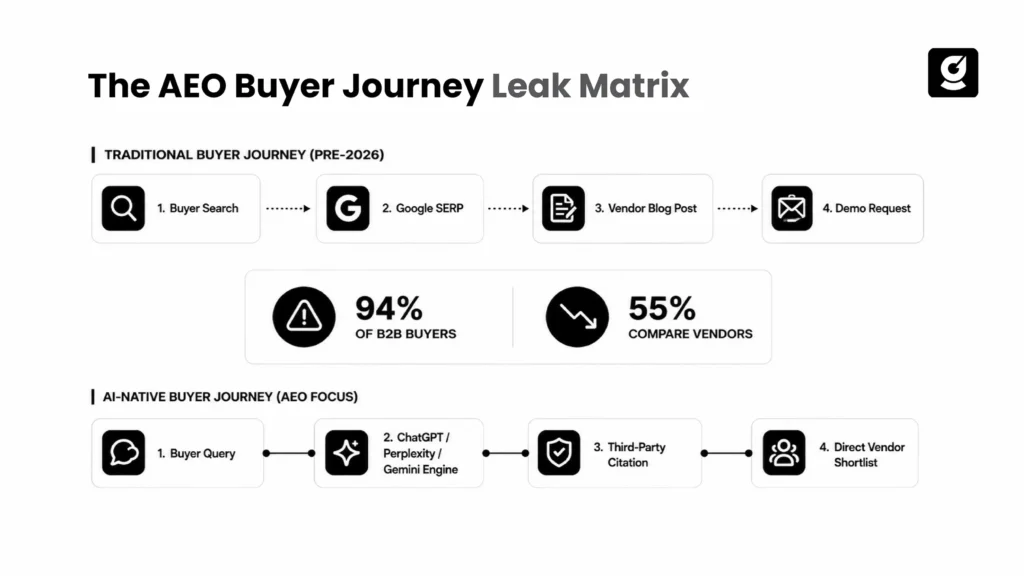
AI answer engines have overtaken vendor websites, sales reps, and product experts as the single most-used research source in B2B buying. Some companies are already reporting organic traffic declines of 10 to 40% as that research activity moves off their site entirely.
That’s the pressure a CMO is responding to when they go looking for an AEO company. The problem is the vendor pool answering that search is largely unvetted. Anyone with an existing inbound marketing scope can add “AEO” to a service list in an afternoon. Nothing stops them, because there’s no certification body, no shared measurement standard, and no track record requirement to call yourself one.
Why is “AEO company” suddenly the most-searched term in B2B marketing?
Budget is shifting rapidly, outpacing the maturity of the vendor category.
When a channel that used to bring 40% of pipeline research starts leaking to ChatGPT and AI Overviews, a CMO doesn’t get six months to evaluate carefully. They get a board question about why organic is down and a mandate to fix it now.
Let’s take a look at this CMO scenario:
Take the fractional CMO from the Slack thread. She pulled proposals from four of the agencies recommended in that reply chain over the following week. Three of the four decks were nearly identical to the SEO proposals she’d been sent by two of those same agencies a year earlier. They had the same content release schedule, the same backlink targets, the same deliverables list, with “AEO” swapped onto the cover page and one new slide referencing ChatGPT that named no actual tracking method.
But the fourth deck was different. It opened with a live audit of what ChatGPT and Perplexity currently said about her category, named the specific claims her competitors were getting cited for, and proposed a monthly re-audit cadence tied to that data.
Pitch deck breakdown: 3 Recycled retainers vs. 1 Real diagnostic
| Proposal element | The 3 “AEO in name only” Decks | The 1 True AEO deck |
| Cover page | Relabeled “SEO Proposal” to “AEO Strategy.” | Custom category AI search diagnostic. |
| Deliverables | Standard content calendar & backlink outreach. | Category audit across ChatGPT and Perplexity. |
| Tracking method | One slide referencing ChatGPT with no metrics. | Ongoing re-audit cadence tied to citation share. |
What’s the difference between rebranded SEO & a real AEO company?
To evaluate whether a vendor offers genuine Answer Engine Optimization or merely a rebranded SEO retainer, compare their execution across the core GEO vs AEO vs SEO strategy frameworks across five fundamental dimensions:
- Unit of Content Built
- Surfaces Measured
- Data Structure
- Definition of a “Monthly Win”
- Multi-Platform Strategy
Rebranded SEO agency vs dedicated AEO partner:
| Dimension | SEO Agency (with an AEO rebranding) | Dedicated AEO Partner |
| Unit of Content Built | Long-form blog post, keyword-clustered | Atomic, independently citable claims and structured Q&A |
| Surfaces Measured | Google rankings, backlinks, organic sessions | Citation frequency across ChatGPT, Perplexity, Gemini, AI Overviews |
| Data Structure | Basic schema markup, if any | Entity-level structured data mapped to how LLMs parse authority |
| Definition of a “Monthly Win” | Position improved from #8 to #4 | Brand named as the answer for a defined set of buyer questions, with source attribution |
| Multi-Platform Strategy | Google’s crawl-and-rank cycle | Multi-engine retrieval cycle, re-audited monthly as models update |
Why the gap matters: The real-world scenario
Consider a typical B2B SaaS scenario: A Series B RevOps platform with a lean marketing team spends a year publishing two 1,500-word blog posts per month. Their Google rankings look healthy, yet organic pipeline flattens for two consecutive quarters.
When pressed for an AEO strategy, their legacy SEO agency simply adds an FAQ block to existing posts. That is the tell.
A real AEO company approaches the problem differently by starting with a diagnostic audit:
- LLM query audit: What do ChatGPT and Perplexity currently output when buyers ask for RevOps platform recommendations in that specific category?
- Source mapping: Which third-party sources and review sites are AI models pulling from to generate those recommendations?
- Citation deficit analysis: Why does the SaaS company’s website fail to appear as a citable source despite ranking on page one of Google?
Google ranks pages based on URLs and backlinks. LLMs synthesize specific, extractable claims pulled from across the web. Solving for AI visibility requires a dedicated LLM SEO strategy built on structured entity data, panel-wide citation tracking, and modular content designed to answer buyer intent directly.
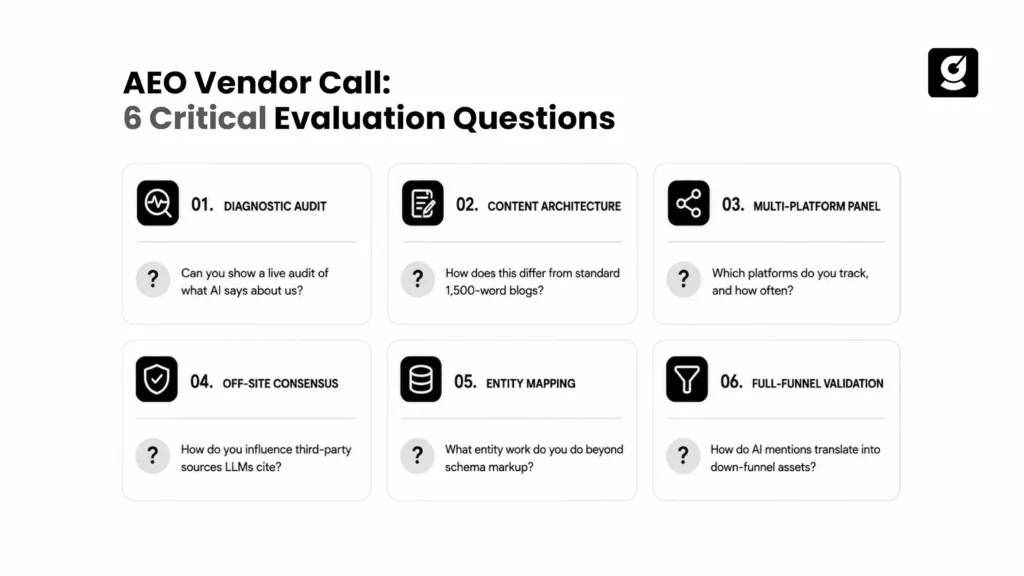
6 Critical questions to prepare before your call with an AEO company
Signing an Answer Engine Optimization (AEO) retainer based on a polished sales pitch and a rebranded SEO deck is one of the quickest ways to waste marketing budget. So here are some questions that you should consider:
| Focus area | Critical questions |
| Diagnostic audit | “Can you show a live audit of what ChatGPT/Perplexity says about our category?” |
| Content architecture | “How does your content framework differ from standard blog posts?” |
| Multi-Platform panel | “Which specific AI platforms do you track, and how often do you scan?” |
| Off-Site consensus | “How do you influence third-party sources that LLMs cite?” |
| Entity mapping | “What entity and structured data work do you do that isn’t schema markup on a blog post?” |
| Full-Funnel validation | “How do you ensure AI search mentions translate into down-funnel validation?” |
Before committing to a monthly retainer, CMOs and procurement leaders must force prospective agencies to prove they possess real diagnostic infrastructure, custom tracking capabilities, and an execution model built for LLM extraction.
- Can you show us a live audit of what ChatGPT and Perplexity currently output for our core category prompts?
A real answer is a live screen-share or exported report run against your actual category terms, not a recycled case study from another client.
Red flag: they need a week to “put something together,” which means this isn’t a built process yet. It’s a one-off favor.
- How does your content creation framework differ from standard SEO blog posts?
Good answer describes atomic, independently citable answer blocks structured around specific buyer questions, not a longer or more keyword-dense version of the same blog format.
Red flag: “we add an FAQ section at the bottom,” which is a cosmetic change to the same content unit, not a different one.
- Which specific AI platforms do you track, and how often do you scan for citation changes?
Good answer names ChatGPT, Perplexity, Gemini, and AI Overviews specifically, with a defined re-scan frequency, usually monthly, since model updates shift citations without warning.
Red flag: “we check periodically,” or a list that stops at ChatGPT alone.
- What is your operational process for influencing third-party sources that LLMs cite?
Good answer names specific tactics, earned placements on comparison sites, review platforms, and industry publications the models already trust, not just work confined to your own domain.
Red flag: they can’t name a single third-party site they’ve placed a client on, because everything they do lives on your blog.
- What entity and structured data work do you do that isn’t schema markup on a blog post?
Good answer references how they map your product, category, and claims as machine-readable entities across your whole site, not just individual posts.
Red flag: they equate “structured data” with adding an FAQ section.
- How do you ensure AI search mentions translate into down-funnel human validation assets?
Good answer connects citation wins to something a rep-validating buyer can actually find, a named case study, a specific stat, a comparison page, since most buyers still confirm what an AI told them with a human.
Red flag: the plan stops at getting cited, with no follow-through into content a sales team can point to.
None of these questions require you to already be technical. They require the vendor to be specific. Specificity is the entire filter, because vague answers scale infinitely and specific ones don’t.
What types of AEO companies will you actually run into?
The category has split into five rough types, and each one is honest about roughly 60% of the problem while quietly skipping the rest.
- SEO agencies adding AEO services: Their strength is content strategy, technical SEO, topic clusters, and authority building. That foundation still matters because AEO does not replace SEO. The gap is often AI-specific work such as citation tracking, prompt visibility, and structuring content so answer engines can easily retrieve and quote it.
- PR and digital authority firms: These companies focus on getting your brand mentioned on trusted third-party websites. That can improve the chances of being referenced in AI-generated answers. But they may do little to improve your own website’s content, technical structure, or conversion paths.
- AEO software and tooling companies: They provide citation trackers, AI visibility dashboards, schema tools, and entity monitoring. These tools are useful for teams that already know what to do with the data. What they usually do not provide is the strategy, content creation, or execution behind it.
- Audit-focused AEO specialists: These firms assess where your brand appears, where competitors are being cited, and what needs improvement. A good audit can reveal useful gaps, but someone still has to implement the recommendations afterward.
- Full-service AEO agencies: These providers connect AEO with SEO, content, digital PR, demand generation, and sometimes RevOps. The broader approach can work well for companies looking for more than AI visibility alone. But it may be unnecessary if you only need a focused audit or a specific AEO service.
The key is to understand what the AEO company actually delivers before comparing pricing or promises. The same “AEO” label can describe very different services.
AEO companies that B2B SaaS teams can consider
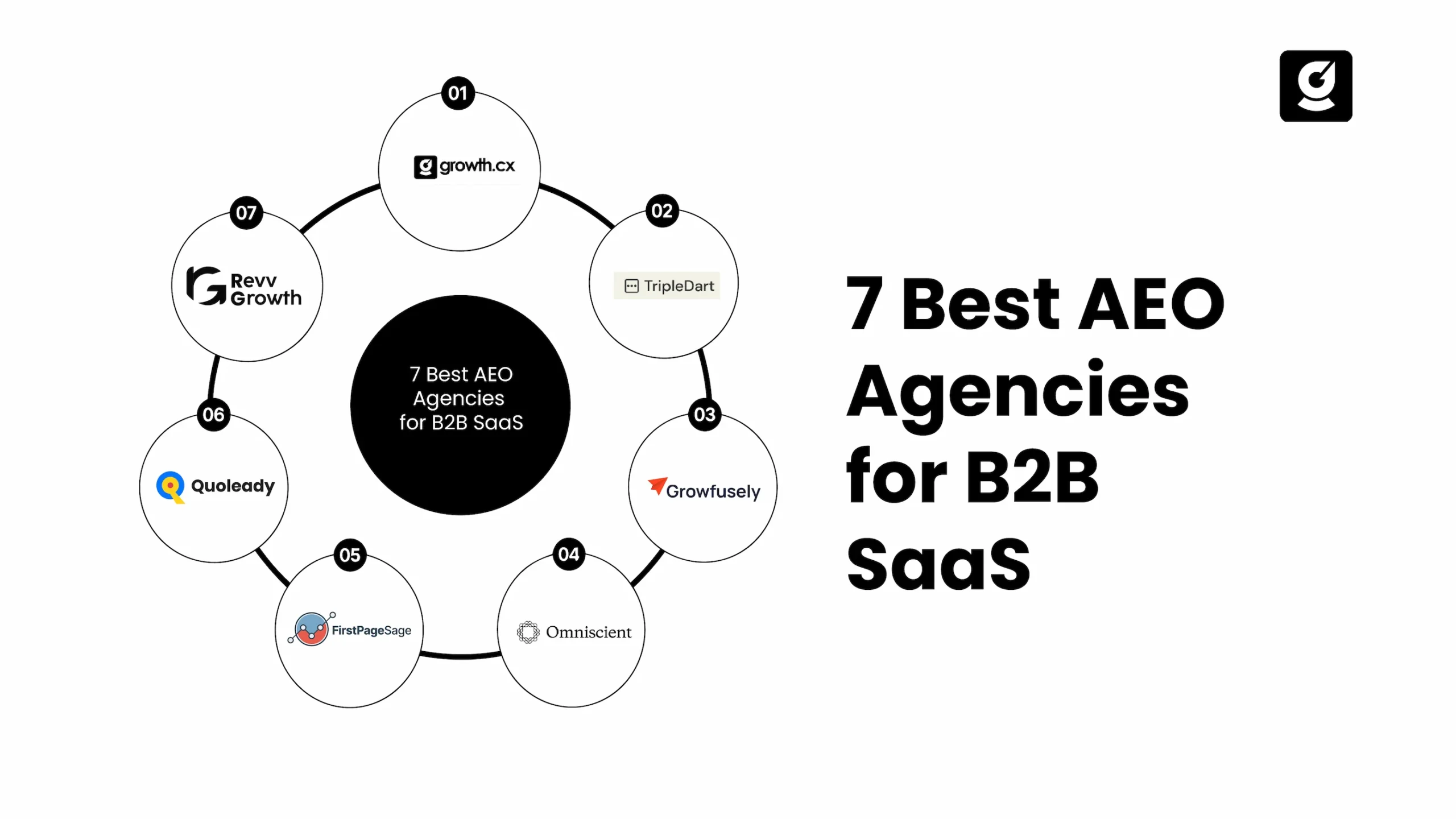
Once you know what type of AEO company you need, the next step is narrowing the field. There is no single agency that fits every B2B SaaS company, but these three take noticeably different approaches to AI search.
1. growth.cx
growth.cx is a B2B SaaS growth agency that combines AI SEO, AEO, content, and broader demand-generation work rather than treating AI visibility as a separate channel. Its AI SEO offering focuses on improving visibility across traditional and AI-driven search while connecting that work to qualified traffic and pipeline.
Best fit for: B2B SaaS companies that want AEO to work alongside SEO, content, and their wider growth strategy rather than running it as an isolated program.
2. TripleDart
TripleDart has a dedicated AEO offering for SaaS brands. Its approach includes AI visibility audits, structured content, schema, and optimization for platforms such as ChatGPT, Google AI Overviews, Perplexity, Meta AI, and Copilot.
Best fit for: SaaS teams looking for a more specialized AEO engagement with a strong focus on AI-search visibility and content structure.
3. Minuttia
Minuttia approaches AEO through a broader Google and AI Search Strategy that combines content creation, Digital PR, and AI-search analytics and reporting. It also has dedicated AEO services for B2B SaaS brands and publicly documents its work on AI-search visibility.
Best fit for: Established B2B SaaS and technology companies that want content, authority building, and AI-search measurement handled as part of the same program.
The important part is not choosing the AEO company with the longest service list. Compare how each provider approaches strategy, content, authority, AI visibility tracking, and measurement against what your team can already handle internally.
Take the Next Step Toward AI Search Dominance
Traditional search strategies are no longer sufficient to capture buyers who conduct software research inside AI platforms. To win in this evolving landscape, your SaaS brand needs a dedicated partner capable of engineering AI visibility across ChatGPT, Perplexity, Gemini, and Google AI Overviews.
Ready to discover how your SaaS brand currently performs inside conversational answer engines? Book a discovery call with Growth.cx to get a custom AI SEO audit, evaluate your brand’s citation share against key competitors, and build an AEO engine designed to capture high-intent pipeline.

FAQs
What AEO deliverables should a B2B SaaS company expect from a partner?
A B2B SaaS company should expect deliverables such as AI search visibility audits, prompt research, content optimization recommendations, entity and brand authority improvements, structured content updates, competitor analysis, and regular performance reports. A strong AEO partner should also provide insights on how these improvements support pipeline generation and customer acquisition.
How should CMOs evaluate an AEO company's experience with B2B SaaS?
CMOs should evaluate whether the AEO company understands SaaS buying journeys, complex products, technical audiences, and long sales cycles. They should review previous SaaS projects, the types of keywords and prompts they have optimized for, their approach to building topical authority, and their ability to position a brand as a trusted source in AI-generated responses.
What questions should CMOs ask an AEO company before signing a contract?
CMOs should ask about the agency’s AEO strategy, measurement framework, expected timelines, reporting process, previous SaaS results, and how they track AI visibility. They should also ask which AI platforms they optimize for, how they handle content updates, what resources are required from the internal team, and how success will be measured beyond rankings.
What AEO performance indicators should CMOs expect to see in monthly reports?
Monthly AEO reports should include metrics such as AI visibility growth, brand mentions, citation frequency, share of voice against competitors, tracked prompt performance, content improvements, and AI platform coverage. Reports should also connect these metrics with website traffic, qualified leads, conversions, and other business outcomes where possible.
What are the warning signs that an AEO company may not be the right partner?
Warning signs include guarantees of instant AI rankings, unclear measurement methods, a focus only on content volume, lack of SaaS experience, and reports that only show vanity metrics. A reliable AEO partner should explain its strategy clearly, set realistic expectations, and connect AI visibility improvements with meaningful business goals.