Forrester’s 2026 Buyers’ Journey Survey found that generative AI usage somewhere in the purchase process rose from 89% in 2025 to 94% in 2026 among nearly 18,000 global business buyers.
For SaaS companies, that creates a new growth question: who should own the work required to stay visible in these experiences?
The answer is not necessarily another full-time hire or an AI SEO agency.
Your existing team may already own the most important pieces: product knowledge, customer insight, positioning, and content expertise. What they may lack is specialist capability around AI-search analysis, GEO, technical optimization, or measurement.
That is where an AI SEO consultant can add value.
The real decision is not whether to outsource AI SEO. It is which capabilities to keep in-house, which to outsource, and which to build together.
What Capabilities Actually Make Up AI SEO?
“AI SEO” is not one job.
It is a combination of capabilities, and each one can have a different ownership model.
| Capability | What it involves |
| Business intelligence | ICP, positioning, customer problems, commercial priorities |
| SEO expertise | Technical SEO, content, authority, search demand |
| AI-search expertise | AI visibility, citations, mentions, query analysis |
| Content | Creation, optimization, first-hand expertise |
| Measurement | Visibility tracking, experimentation, reporting |
| Execution | Implementing recommendations across the site |
This distinction matters because most established SaaS companies are not starting from zero.
A scaling company may already have an SEO manager, content marketers, product marketing, developers, and analytics support. Hiring another generalist doesn’t fix anything. What’s actually missing is AI-search measurement and strategic expertise, specifically. That makes capability assessment the first step, before deciding whether to hire or outsource.
The missing layer may instead be AI-search benchmarking, platform-specific analysis, GEO strategy, or a better measurement system.
That is a capability gap, not necessarily a hiring gap.
What Should Never Leave the Internal Team?
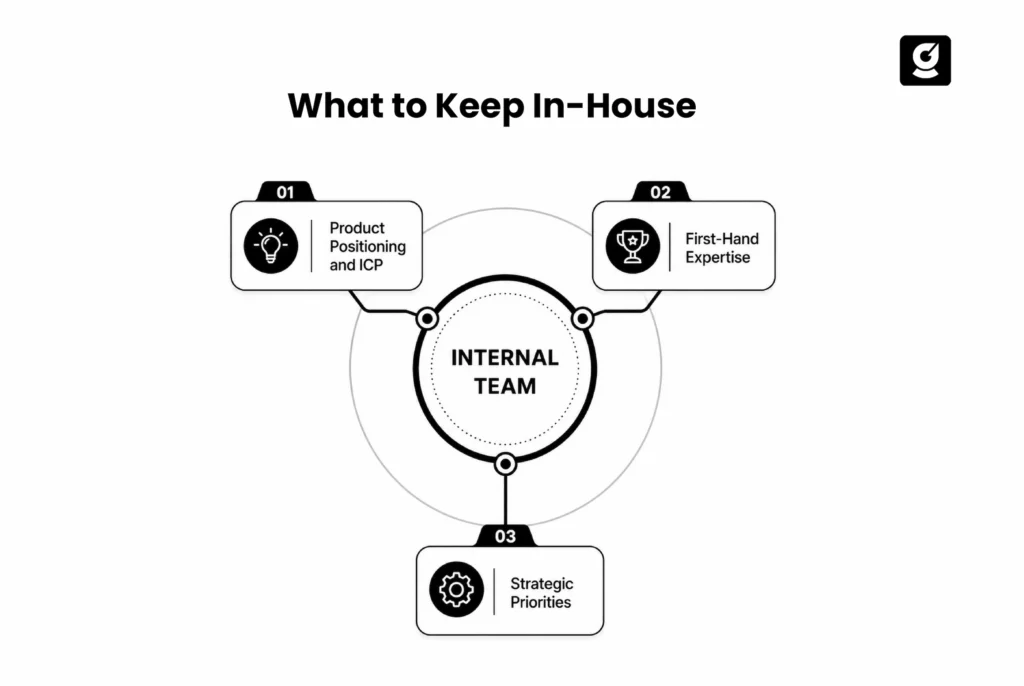
Some parts of the SEO and AI-search strategy are too closely tied to the business to hand over completely.
1. Product Positioning and ICP
For a product marketing team, AI SEO should not determine positioning on its own.
The team knows which use cases drive revenue and which product differentiators matter to buyers, while an AI SEO specialist can identify how those use cases appear in search and AI-generated answers.
Those two lists are not always the same. The two inputs together can reveal which positioning opportunities are both commercially important and discoverable.
For example, a project-management SaaS company might discover hundreds of opportunities around broad terms such as “project management software.” But its highest-value commercial segment may actually be enterprise portfolio management.
Optimizing for the larger search opportunity could increase visibility without creating the pipeline the business actually wants.
The external partner can surface the opportunity. The internal team decides whether it deserves investment.
2. First-Hand Expertise
Keep the source material close to the business:
- Customer interviews
- Product insights
- Original research
- Expert opinions
- Proprietary data
- Customer stories
- Case studies
- Sales objections
- Product roadmap insights
An external AI SEO expert can turn this knowledge into stronger search assets. They should not be expected to manufacture expertise that the company does not provide.
That distinction becomes even more important as AI systems increasingly influence how buyers discover and evaluate vendors. Forrester found that buyers increasingly turn to peers, product experts, and industry analysts to validate information generated or surfaced by AI during the buying process.
3. Strategic Priorities
The internal team should retain final ownership of:
- Which products need growth
- Which markets and segments matter
- Which competitors the company wants to displace
- Which business outcomes SEO should influence
- How much investment the channel deserves
An external partner can inform these decisions through search and competitive analysis, but commercial priorities should remain with the people accountable for the business.
What Should Get Outsourced When You Don’t Have the Expertise or Scale?
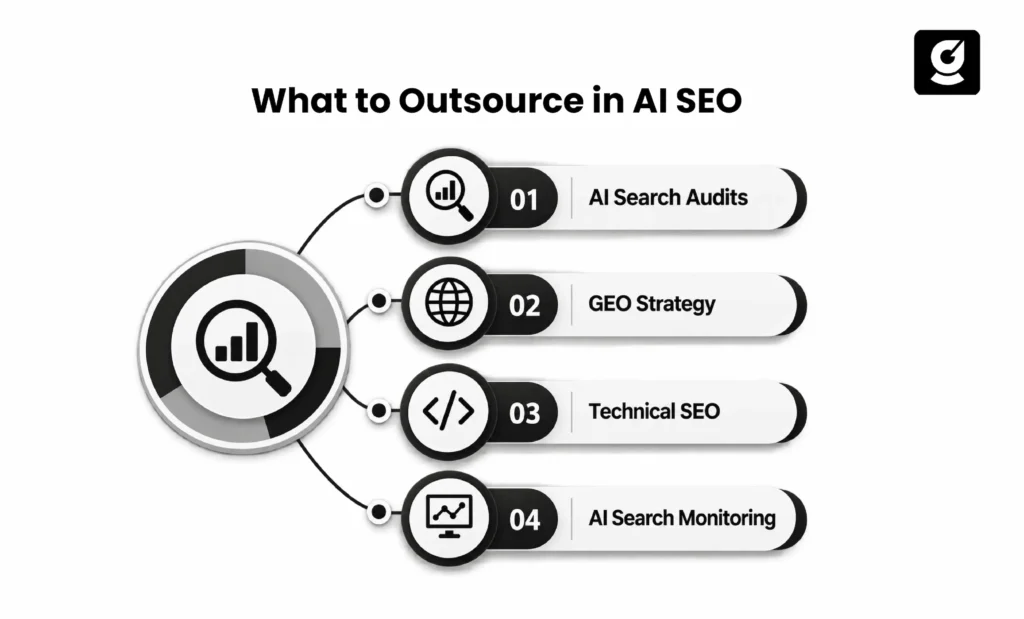
The strongest outsourcing candidates are usually specialist activities that are difficult to build internally or don’t justify a permanent role yet.
1. AI Search Visibility Audits
For an SEO manager at a B2B SaaS company, the problem may not be SEO knowledge at all. They may already have strong organic reporting but lack a reliable way to benchmark how the brand appears across AI search platforms.
An AI search consultant can establish the baseline, identify which competitors are being cited instead, and show where visibility gaps could affect high-value commercial queries.
Outsource an AI visibility audit when:
- Nobody internally can benchmark AI visibility
- You need an independent assessment
- The team lacks the required monitoring tools
- You need a baseline before allocating budget
- You want to understand how competitors appear across AI platforms
AI search also creates a measurement problem that traditional SEO reports do not fully address.
Different answer engines can surface very different sources for similar questions. Checking your visibility in one AI platform does not tell you how your brand appears across the wider AI-search landscape.
A proper audit should examine:
- Which commercial prompts mention your brand
- Which competitors appear instead
- Which sources AI platforms cite
- Where your brand is missing
- Which third-party sources influence recommendations
- Which gaps are commercially meaningful
The external specialist identifies the gap. Your internal team decides what the gap is worth fixing.
2. GEO Strategy
A GEO consultant brings AI-search query patterns, citation opportunities, entity visibility, competitor analysis, and measurement methodology built for platforms that don’t share a source list.
That’s knowledge you’re buying, not a finished strategy.
What an outsourced GEO consultant hands you is the raw expertise:
- which citation patterns matter,
- which entity signals AI platforms’ weight
- where the competitive gaps actually sit
But the GEO strategy still needs to connect back to the business:
ICP → commercial priorities → search demand → AI visibility → pipeline
That connection is where specialist expertise becomes strategic rather than simply tactical.
3. Technical SEO
Technical SEO should not automatically be outsourced because AI appears in the brief.
Outsource it when:
- The internal team lacks technical depth
- Engineering bandwidth is limited
- There is a migration or architecture problem
- The site has complex technical issues
- You need an independent technical audit
If your existing technical SEO team is strong, an AI SEO specialist may add little here.
The question is not, “Can someone else do this?”
It is, “Does someone else have expertise we currently lack?”
4. AI Search Monitoring
Monitoring becomes a strong outsourcing candidate when it is:
- Too time-consuming
- Too tool-intensive
- Difficult to interpret
- Too immature to justify a dedicated role
The value is not simply collecting brand mentions. It is understanding:
- What changed?
- Why did it change?
- Does it matter?
- What should we do next?
What Work Should Be Shared Instead of Fully Handed Over?
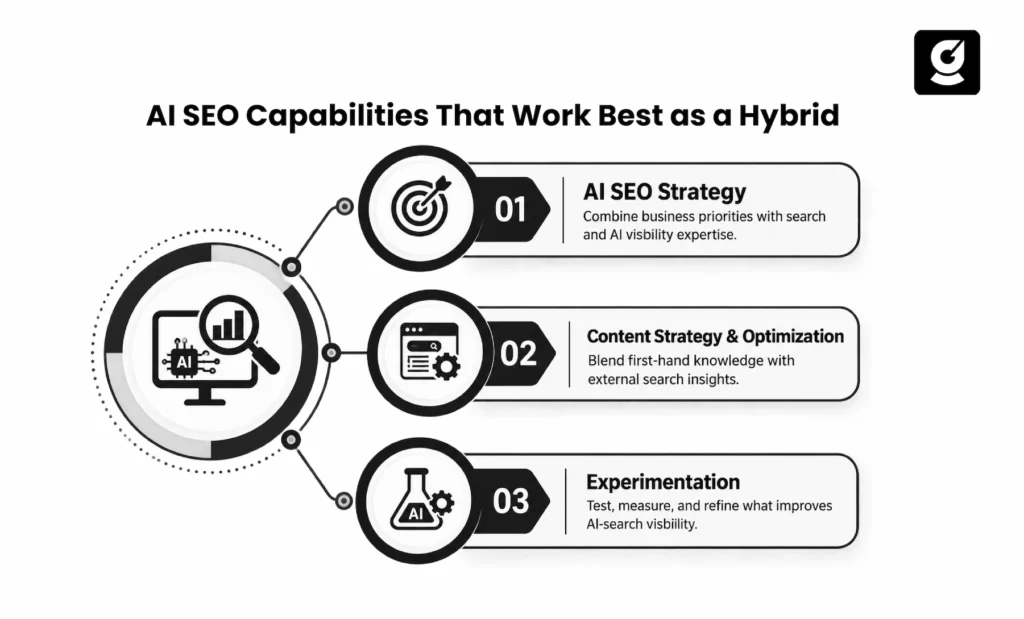
Some activities benefit most from a collaborative model, combining the internal team’s business context with an external partner’s specialist expertise.
1. AI SEO Strategy
The internal team contributes:
- Business objectives
- Revenue priorities
- ICP
- Product roadmap
- Existing SEO performance
- Customer intelligence
The external partner contributes:
- Search analysis
- AI visibility analysis
- Competitive intelligence
- Market research
- Opportunity sizing
- Measurement frameworks
The result should be a shared strategy, not a document that gets emailed over and forgotten.
2. Content Strategy & Optimization
For a content lead at a B2B SaaS company, the problem may be a large publishing pipeline that produces traffic but little visibility in AI answers. A strong content strategy connects what the business knows about its audience with the topics and search experiences that matter to buyers.
The in-house team brings expertise, customer insight, product knowledge, and original evidence.
An AI SEO expert can identify which topics, comparison queries, and evidence gaps are limiting visibility, giving the team a clearer basis for prioritization and content optimization.
A strong workflow looks like this:
Internal expertise → external research → shared prioritization → internal validation → execution
This gives the content enough search relevance without stripping away the knowledge that makes the brand credible.
3. Experimentation
AI search is still changing. Today’s best practices are not permanent rules.
Teams should test:
- Content structures
- Evidence formats
- Topic clusters
- Internal linking
- Expert contributions
- Comparison content
- First-hand research
- Different ways of demonstrating expertise
Then measure the results and feed those learnings back into the broader SEO strategy.
Case Study: Where Specialist AI SEO Expertise Adds Value
Visitly
Visitly is a good example of why AI SEO works best as a shared capability rather than a completely outsourced function. The company faced low visibility for high-intent searches, strong competition, and weak positioning around security and compliance.
This is how growth.cx’s AI SEO work helped:
- Increased their organic traffic by 120.36%
- The brand was cited more than 113 times in AI answers
- Engagement rate rose from 6.34% to 40.55%
The important point isn’t simply the traffic increase. Visitly’s results show why AI SEO should be measured beyond traditional organic performance, with AI citations and engagement providing additional signals of visibility and impact.
How Does growth.cx’s Rocket Anatomy Framework Fit This Decision?
Rocket Anatomy gives companies a way to think about capability ownership according to their stage of growth.
At Ignition, the company is still establishing market presence. There may not be enough internal capacity to justify building a complete AI-search capability. External expertise can provide the strategy, benchmarking, and execution needed without adding permanent headcount too early.
At Boosters, the company has enough internal marketing capability to own commercial direction while bringing in specialists for AI-search measurement, GEO, technical work, or competitive analysis.
At Orbit, the company is more established and may have the internal resources to own most of the capability. External support becomes more targeted, focusing on defined high-impact problems, independent analysis, market expansion, or specialist expertise.
The point is not that every company eventually needs less external help.
It is that the role of external expertise should change as the company changes.
That’s the principle behind growth.cx’s AI SEO practice: identify the capability the business is missing rather than forcing every company into the same service model.
When Should You Hire an AI Search Consultant Instead of an Employee?
An AI SEO consultant makes more sense when you have a capability gap or defined project.
For a CMO at a growing SaaS company, the question may be whether AI search justifies another permanent hire. If the company has not yet established whether AI visibility contributes meaningfully to its buying journey, hiring first may be premature.
An AI SEO consultant can establish the baseline, test the channel, and help the CMO determine whether the business needs ongoing internal capability.
Hire an AI search consultant when:
- When There’s a capability gap – The team understands SEO but not AI-search measurement, GEO, or LLM visibility.
- You need an AI-search audit or baseline
- You need a GEO strategy
- You need competitive visibility analysis
- You need independent analysis
- You want to test the channel before building a team
- Speed matters more than building permanent capability immediately
Consider hiring internally when:
- AI search is now a continuous growth channel
- The work requires daily collaboration with product, content, sales, and engineering
- The workload justifies a dedicated role
- You already have the management structure to support it
- You need persistent institutional knowledge around the function
The economics should also be evaluated at the capability level, not simply by comparing a consultant’s fee with an employee’s salary.
Consider:
- Salary
- Hiring time
- Benefits
- Tools
- Training
- Management
- Opportunity cost
- Time required to reach productivity
The cheaper option on paper is not necessarily the cheaper way to build the capability.
AI SEO Specialist, Consultant, or Agency: How Do You Choose?
Match the partner to the problem.
| Your situation | Best fit |
| You need an audit or strategic direction | AI SEO consultant |
| You need ongoing specialist execution | AI SEO specialist |
| You need SEO, content, and technical capabilities together | AI SEO services agency |
| You need SaaS-specific organic growth expertise | SEO consultant for SaaS |
| You want to test AI SEO before building a team | Consultant or specialist |
| You need ongoing multi-channel execution | Specialist team or agency |
The distinction is simple:
An AI SEO consultant is strongest when the question is, “What should we do?”
An AI SEO specialist is strongest when the question is, “Who can execute this specific capability?”
An agency or specialist team makes more sense when the question is, “How do we make several capabilities work together?”
The choice should follow the problem, not the vendor category.
How Do You Score a Task as Keep, Outsource, or Hybrid?
Before assigning ownership, run each activity through five questions.
| Question | If yes |
| Does it require proprietary business knowledge? | Keep closer to internal |
| Does it require specialist expertise? | Consider outsourcing |
| Is it recurring? | Consider building the capability |
| Is it project-based? | A consultant may be more efficient |
| Does it directly influence business strategy? | Keep strategic ownership internal |
This creates a practical division.
Keep in-house:
- Product knowledge
- ICP
- Positioning
- Customer insight
- Strategic priorities
- Final business decisions
Outsource:
- Specialist audits
- Technical projects
- AI-search benchmarking
- GEO expertise
- Independent analysis
- Specialized monitoring
Share:
- AI SEO strategy
- Content strategy
- Content optimization
- Experimentation
- Measurement
growth.cx principle here is to own what makes your company unique. Access externally what is expensive or unnecessary to build and maintain yourself.
What Should You Actually Expect From an External AI SEO Partner?
A good partner should answer five questions every cycle.
Not just, “Here are this month’s rankings.”
| 1. | What changed? | What happened to organic and AI-search visibility? |
| 2. | Why did it change? | Was the change driven by competitors, content, technical issues, search behavior, AI platform changes, or something else? |
| 3. | Does it matter commercially? | Is the change connected to the audiences, products, markets, and buying journeys that matter to the business? |
| 4. | What should we do next? | What should be prioritized?Just as importantly, what should not be prioritized? |
| 5. | What should we learn? | What does the data tell you about the next iteration of the strategy? |
That last question is often overlooked.
A strategic partner should leave the internal team smarter after every cycle, not more dependent on the partner.
This also applies to the working relationship itself. Before signing, establish:
- Who actually does the work
- Who attends strategy calls
- How often you’ll meet
- What overlap hours look like
- How decisions get made
- What information the partner needs from your team
- How recommendations are documented
- How success will be measured
The best external relationship feels less like handing off marketing and more like extending the team.
The Bottom Line on Building an AI SEO Team
AI search does not automatically justify a new hire, a new agency, or a new department.
First, identify the capability your team is missing. Then decide whether that gap is recurring enough to build internally, specialized enough to outsource, or requires both sides to work together.
The right AI SEO consultant should make the internal team faster, better informed, and more capable. They should not make the business dependent on a black box it cannot understand.
If you cannot yet answer which of the six capabilities your company is missing, that is not a reason to hire immediately. It is the reason to diagnose the gap first.
At growth.cx, we treat AI visibility as an extension of the broader organic growth system. As a B2B SaaS SEO agency, our approach is to identify where specialist expertise can strengthen your existing capabilities, while keeping your product knowledge, customer insight, positioning, and commercial priorities close to the business.
The objective is not simply to make a brand appear in AI answers. It is to build the signals that help the right buyers find, understand, trust, and consider the brand.
Ready to identify what your team should own, outsource, or share?
Explore growth.cx’s AI SEO approach and identify the capability gaps before committing to another hire, another tool, or another generic SEO retainer.

FAQ’s
Which AI SEO tasks should B2B SaaS companies outsource?
B2B SaaS companies should outsource AI SEO tasks that require specialist expertise or are difficult to justify as permanent internal roles. These may include AI search audits, GEO strategy, competitive visibility analysis, technical SEO projects, and AI search monitoring. The goal is to close a specific capability gap, not hand over the entire SEO function.
Which SEO and AI search activities are better handled in-house?
Activities that depend on proprietary business knowledge and commercial judgment are usually better kept in-house. Product positioning, ICP definition, customer insights, strategic priorities, product knowledge, and final business decisions require context that an external partner cannot fully replicate. Specialists can support these decisions with search, AI visibility, and competitive insights without owning the business strategy.
When should a B2B SaaS company hire an AI SEO consultant?
A B2B SaaS company should hire an AI SEO consultant when it has a clear capability gap, defined project, or need for specialist AI-search expertise. A consultant can establish an AI visibility baseline, develop a GEO strategy, analyze competitors, or test the channel before the company commits to a permanent hire. If AI search becomes a continuous growth function requiring daily collaboration, building internal capability may make more sense.
How can an AI SEO consultant work alongside an existing SEO team?
An AI SEO consultant can extend an existing SEO team's capabilities without replacing its ownership of organic growth. The internal team provides business objectives, product knowledge, customer insight, and existing SEO context, while the consultant contributes AI-search analysis, competitive research, GEO expertise, and measurement. Both sides can then prioritize opportunities, validate recommendations, and test improvements together.