A B2B software buyer researching your category in 2026 opens ChatGPT, types a question containing “best” and “for,” and reads back a shortlist of four vendors. Wynter’s survey of B2B SaaS marketing leaders found 84% of buyers now use AI for vendor discovery, 68% starting there.
If your brand is missing from that answer, you have not lost a ranking. You have been excluded from the shortlist before anyone clicks anything.
And that’s why GEO agencies exist. GEO was never meant to replace traditional search strategies. Let’s clear this myth right here. While these search models overlap, understanding GEO vs SEO makes one thing clear: ranking and visibility are not the same.
Ranking third for a keyword and being named inside an AI answer are separate outcomes with separate mechanics, which is why the agency that grew your organic traffic may not be the one that gets you cited.
Below are five GEO agencies we rate as the strongest options for B2B SaaS in 2026, with real pricing, verified results, and the honest limitations of each.
Why B2B SaaS companies need a GEO Marketing Agency in 2026
Traditional SEO builds your digital foundation, ensuring your website is indexed, fast, and visible on traditional search pages. Generative Engine Optimization (GEO) expands on that foundation to win zero-click, AI-driven discovery. Scaling in 2026 requires running both strategies in tandem for complete market coverage:
- Capture Zero-Click Buyers: AI tools synthesize a final shortlist directly inside the prompt, delivering answers without requiring zero clicks from the user to learn about your solution. A GEO agency formats your brand data for immediate extraction and recommendation during initial buyer discovery.
- Optimize for RAG & AI Parsers: Large Language Models process data through Retrieval-Augmented Generation (RAG). GEO agencies structure your technical content, entity schemas, and high-information passages for seamless parsing by AI engines.
- Defend Your “Share of Model” (SoM): Losing visibility on ChatGPT or Perplexity continuously drains your sales pipeline. GEO agencies actively track and expand your presence across high-intent category prompts.
- Manage External Entity Consensus: LLMs build brand trust by scanning third-party hubs like Reddit, review platforms, and industry media. A GEO agency optimizes your complete digital footprint across every web source AI engines rely on for authority.
Quick comparison: Best GEO agencies for B2B SaaS in 2026
| # | Agency | Stage fit | Differentiator |
| 1 | growth.cx | Bootstrapped to Series A | GEO run inside a full-funnel program by an embedded fractional team |
| 2 | RevvGrowth | Series A–C, $1M–$20M ARR | Prompt-level citation tracking across five engines, high content throughput |
| 3 | TripleDart | $5M–$50M ARR, Series B+ | Slate platform automating content freshness across hundreds of pages |
| 4 | Siege Media | $10M+ ARR, Series B+ | Original research and digital PR that makes the brand a primary source |
| 5 | First Page Sage | Enterprise, long sales cycles | Six-element GEO framework published in 2023; expert-authored authority content |
Top 5 GEO Agencies for B2B SaaS Brands Capture AI-Generated Pipeline
1. growth.cx: Best for AI-first intent mapping and generative search visibility
growth.cx is a high-intent AI Seo agency built for B2B SaaS and tech companies. Where traditional SEO gets relabeled, our framework engineers content so large language models parse, trust, and quote a client’s brand as the primary answer. We work as an embedded fractional team running 90-day sprints, which is what makes the model viable for companies that cannot yet carry heavy in-house marketing overhead.
- Machine-First Content Engineering: Content is structured specifically for direct LLM ingestion through first-fold summary blocks, concise TL;DR answers, and front-loaded Q&A modules. By omitting filler and emphasizing high-density formatting (such as tables, bulleted technical specifications, and explicit metrics), AI engines can extract precise data points and quote the brand directly.
- Conversational Intent Mapping: Rather than focusing solely on isolated keywords, search architecture is mapped around complex, bottom-of-funnel queries buyers submit to AI engines (for example, “what is the top compliance software for remote-first SaaS?”). Pages are organized into intentional clusters that directly address the specific evaluation criteria AI systems use to generate vendor shortlists.
- Entity and Knowledge Graph Integration: Deep JSON-LD structured data (including Product, Service, FAQ, and HowTo schemas) is deployed to establish clear entity relationships across external databases. This ensures AI models can accurately index the company’s offerings and categorize the brand as a verified entity.
- Multi-Platform Consensus Seeding: Because LLMs aggregate consensus from third-party sources, content is distributed across major review platforms, industry forums, and user-generated networks, including Reddit, Quora, and Medium, which search-enabled AI tools routinely index during live web retrieval.
- AI Visibility and Pipeline Attribution Tracking: Brand visibility is monitored by auditing recommendation frequency across answer engines like ChatGPT, Gemini, and Perplexity. AI-driven referral traffic is integrated with CRM pipeline tracking to assess impact on demo requests and pipeline generation, while content is refreshed periodically based on share-of-voice shifts within LLM outputs.
Best for: Early to growth-stage B2B and PLG SaaS startups, bootstrapped through Series A, that want an embedded team launching fast rather than a heavy in-house function, and brands chasing buyers who bypass Google entirely for LLMs and AI Overviews.
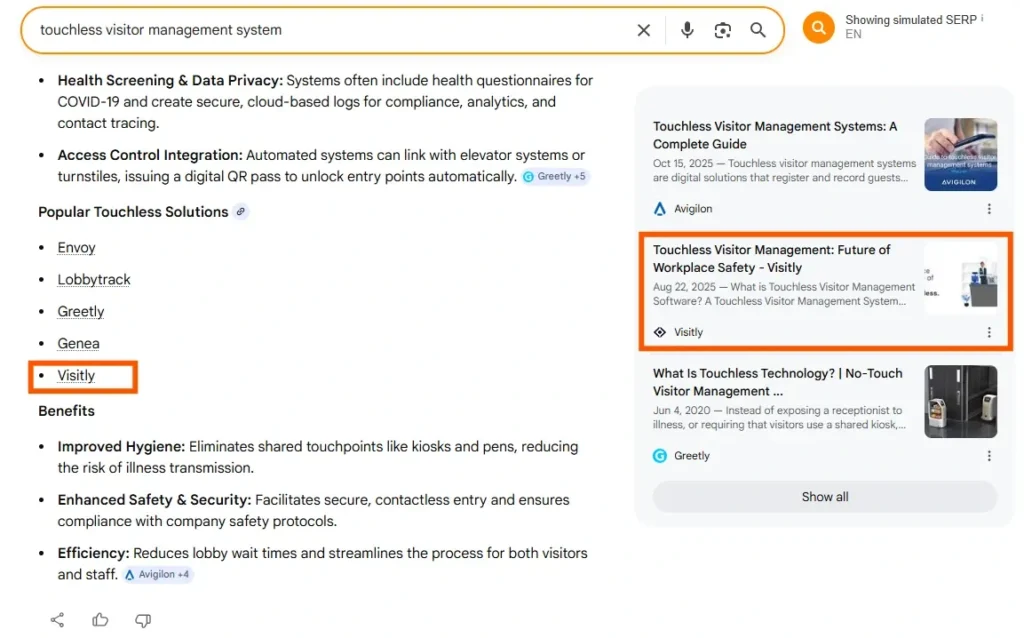
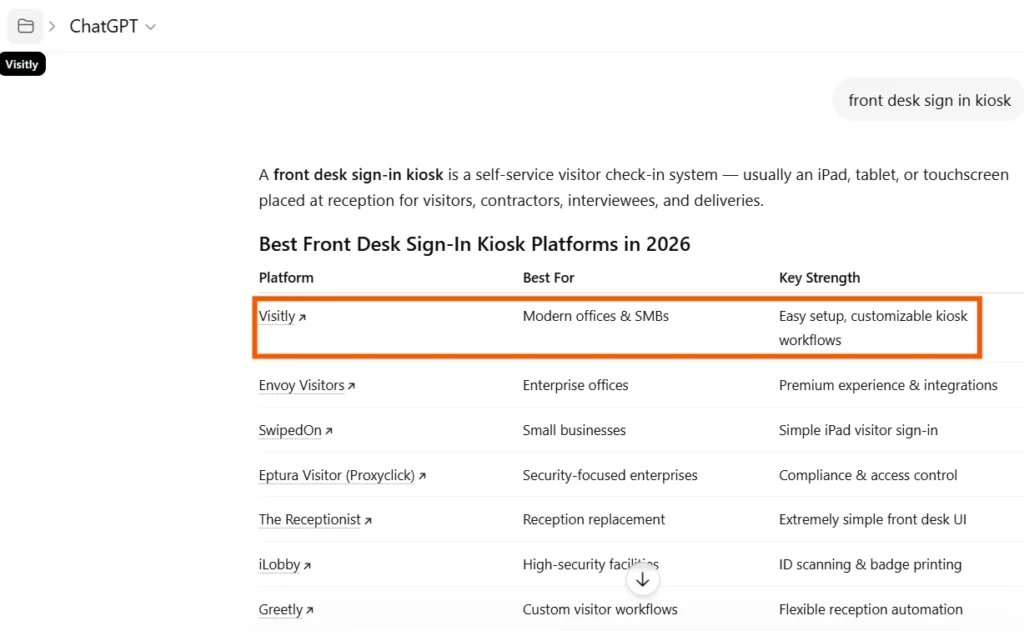
growth.cx B2B SaaS Case Study: Visitly, 400+ AI citations, 120% traffic lift
A visitor management platform outranked on every high-intent keyword by older, higher-authority competitors. We took the untapped bottom-funnel and comparison queries instead.
| Metric | Result |
| AI answer citations | 400+ across 212 cited pages |
| Share of voice on target prompts | 22% |
| Organic traffic | +120.36% (13,518 users) |
| Search impressions | +1.6 million |
| Engagement rate | 6.34% → 40.55% |
| Domain authority | 15 → 18 |
What didn’t work: broad informational topics drew traffic with no conversion intent. We cut them and moved the budget to comparison pages.
Read the full Visitly case study →

2. RevvGrowth: Best for AI-first answer engine optimization and hybrid scaling
RevvGrowth is a Chennai-based, AI-first agency founded in 2019 that works exclusively with B2B SaaS. It runs SEO, AEO, and GEO as a single engagement, not three workstreams, combining proprietary AI tooling with human editorial review.
The distinguishing detail is measurement granularity. RevvGrowth tracks LLM citations at the prompt level across five engines- ChatGPT, Perplexity, Gemini, Claude, and DeepSeek- instead of reporting one aggregate “AI visibility” number, and validates the methodology on its own brand before selling it. Production runs at a roughly 55/45 AI-to-human ratio, with editors reviewing every piece.
Best for: Series A–C B2B SaaS between $1M and $20M ARR that need high content throughput with citation tracking attached
Key features:
- 29-point AEO citation scorer applied pre-publication
- AI shortlist builder for comparison and alternative assets
- Prompt-level citation tracking across five engines
- Hybrid AI-plus-editor production, 40 to 130+ pages monthly
- Custom client-side AI agents for in-house AEO workflows
3. TripleDart: Best for software-assisted GEO and automated content refreshes
TripleDart runs GEO as a continuous system powered by Slate, its proprietary enterprise platform, not as a manual project or a one-off schema update. The premise is that AI visibility should not require a company to scale content headcount proportionally.
Slate tracks citation share across ChatGPT, Gemini, Perplexity and AI Overviews and triggers fix workflows automatically, scoring URLs on citation depth, freshness, schema and entity coverage. Automated refreshes push 50 to 100+ updates monthly to hold pages inside a 90-day freshness window, the signal AI engines weight when deciding what to cite. Human strategists handle narrative and attribution alongside AI agents running schema generation and citation tracking.
Best for: Engineering-first SaaS teams at $5M–$50M ARR with 100+ indexed pages who prefer closed-loop software to high-touch consulting
Key features:
- Slate platform for citation share tracking and automated fixes
- Page-level AEO scorecard prioritising high-value URLs
- Automated freshness within a strict 90-day window
- Operators-plus-AI-agents delivery model
- Answer-ready formatting with summary boxes and comparison tables
4. Siege Media: Best for content-led GEO and proprietary research
Siege Media approaches GEO through an authoritative, data-first framework. By building original research studies, digital PR assets, and interactive tools, it positions client brands as primary sources, not secondary commentary, which matters because the Princeton and Georgia Tech research identified original statistics as the highest-performing citation lever available.
DataFlywheel keeps published content fresh for AI crawlers through systematic quarterly refreshes, while BlueprintIQ analyses target markets using relevancy-adjusted keyword metrics and freshness scoring. The combination is aimed at mature libraries where decay, not absence, is the problem.
Best for: Established B2B and PLG SaaS scale-ups at $10M+ ARR or Series B+ with proprietary data to turn into citation assets, and mature brands sitting on hundreds of aging posts
Key features:
- Data journalism and original research production
- DataFlywheel automated quarterly content refreshes
- BlueprintIQ market analysis with freshness scoring
- Bottom-of-funnel assets built for AI engine preference
- Interactive calculators and tools serving generative intent
- Digital PR and link acquisition at scale
5. First Page Sage: Best for thought leadership and entity authority building
First Page Sage, founded in 2009 by Evan Bailyn and headquartered in Berkeley, has a stronger claim than most to having defined this category: it published a six-element GEO framework in 2023, covering authority content architecture, thought leadership, list placement, traditional SEO, PR and verifiability.
The model builds the entity trust LLMs lean on when generating vendor recommendations, using expert in-house writers, original research and active reputation management. The distinctive element is deliberate list placement, optimising presence across the ranked roundups and industry databases that disproportionately shape AI vendor shortlists, a direct read of how models assemble recommendations.
Best for: Established mid-market and enterprise B2B SaaS with complex products, high ACV and multi-stakeholder buying committees
Key features:
- Six-element GEO framework published in 2023
- Expert-led, product-accurate content built for primary-source citation
- List placement and third-party database outreach
- Online reputation and sentiment monitoring
- Original research and citation engineering
- Unified SEO and GEO strategy
How to compare GEO agencies for B2B SaaS?
Most comparison advice says to check case studies and reviews. That does not separate agencies in this category, because nearly all of them have both. These six dimensions do separate them, and every agency on this page sits differently on at least three.
| Dimension | What to ask | Why it discriminates |
| Stage fit | Which ARR band do most of your clients sit in? | Playbooks get built around an agency’s median client. Outside that band, you receive an adapted program, not a proven one. |
| Where GEO sits | Is GEO a standalone service, a layer inside a broader program, or a platform product? | Decides whether citation work connects to pipeline or gets reported beside it. |
| Measurement granularity | Is AI visibility reported per prompt per engine, or as one blended score? | A single number cannot be audited, argued with, or acted on. |
| Content model | How much output is AI-assisted, and who reviews it? | Ranges from hybrid production at high volume to expert-authored editorial. Both work, for different categories. |
| Freshness maintenance | What happens to a page 90 days after it publishes? | Citations decay. Some agencies automate refresh; others hand it back to you. |
| Commitment | What is the minimum term, and can we pilot? | Ranges from no lock-in to 24 months across the five agencies here. |
The right GEO agency depends on your stage, not your shortlist
Choosing between GEO agencies is less about finding the strongest team than finding one whose model matches your ARR, your existing content library, and what you can commit to. Each of these five is right at a particular size and wrong at another, which is why the list runs by stage, not quality.
Before signing with any geo company, ask for evidence: how they find citation gaps, which engines they track and at what granularity, and whether they can show a citation log naming the client, the platform, the prompt, and the date. Then ask what didn’t work on their last engagement. That answer tells you more than the case study does.
And if you want to know where your B2B SaaS brand stands in AI search today, hop on a call with growth.cx. Our GEO work brings together machine-first content engineering, entity architecture, consensus seeding, and prompt-level citation tracking, so your brand surfaces when buyers are comparing tools

FAQ’s
How do GEO agencies help SaaS brands appear in AI-generated search results?
GEO agencies improve the content, authority signals, technical structure, and brand visibility that AI search engines use when generating answers. This can include optimizing key pages, publishing citation-worthy content, strengthening topical authority, and improving mentions across trusted third-party sources.
What services do leading GEO agencies typically offer?
Most leading GEO agencies offer AI-search audits, content optimization, topical authority building, technical SEO, digital PR, entity optimization, content strategy, and AI visibility tracking. Some also combine GEO with traditional SEO to improve visibility across both search engines and AI platforms.
How is GEO different from traditional SEO for B2B SaaS companies?
Traditional SEO primarily focuses on ranking web pages in search results. GEO goes further by helping a SaaS brand become a source that AI platforms can understand, trust, reference, or recommend when answering buyer questions.
How can companies evaluate the results of a GEO marketing strategy?
Track more than organic traffic. Measure brand mentions and citations in AI-generated answers, visibility for high-value buyer queries, referral traffic from AI platforms, branded search growth, qualified leads, and whether AI visibility contributes to pipeline.
Should a B2B SaaS company hire a GEO agency or build GEO capabilities in-house?
Building in-house can work if you already have strong SEO, content, technical, and digital PR expertise. Hiring a GEO agency may make more sense when your team lacks specialized AI-search knowledge, needs faster execution, or wants outside expertise before investing in a dedicated internal function.