

Video is now a standard part of modern marketing. According to Wyzowl, 91% of businesses use video as a marketing tool, and Wistia reports that 76% of companies produce at least one marketing video every month. Interestingly, more than half of those teams spend more time creating those videos than actually promoting them. This is simply because video has become one of the most widely adopted content formats in B2B SaaS marketing.
As video is now a major part of many B2B video marketing strategy projects, views, watch time, engagement rates, and completion percentages continue to be the main discussion topics about video performance. If you ever come across any video marketing guide, you will get a detailed explanation of engagement metrics but very little about pipeline contribution.
SaaS companies operate in a very different business environment than they did a few years ago. Efficient growth, profitability, and measurable revenue outcomes are given more emphasis than just growth at any cost.
Instead of advancing real sales conversations, the majority of B2B video marketing is looking for attention. And thus, the real question is why so many video marketing guides continue to focus on visibility metrics when leadership teams increasingly care about pipeline, revenue influence, and commercial impact.
The response uncovers a broader issue beyond just video marketing.
It emphasizes the slower evolution of marketing measurement compared to business expectations and explains why numerous organizations continue to face challenges in linking marketing efforts to revenue results.
In this article, we explore the gap between how video marketing is measured and how SaaS companies evaluate business impact.
Why Most Video Marketing Guides Still Focus on Views
The way video marketing has evolved explains why views became the default measure of success, even though they do not always reflect pipeline impact.
1. The Influence of YouTube and Social-First Measurement Models
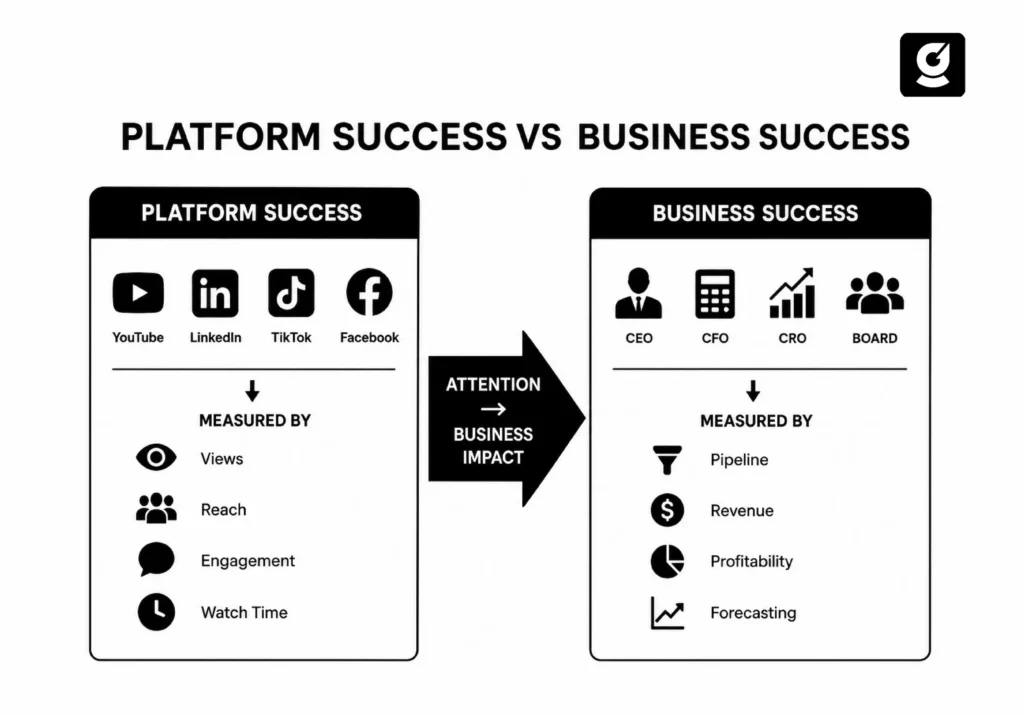
Social media sites like YouTube, Facebook, LinkedIn, Instagram, and TikTok laid the foundations of modern video marketing.
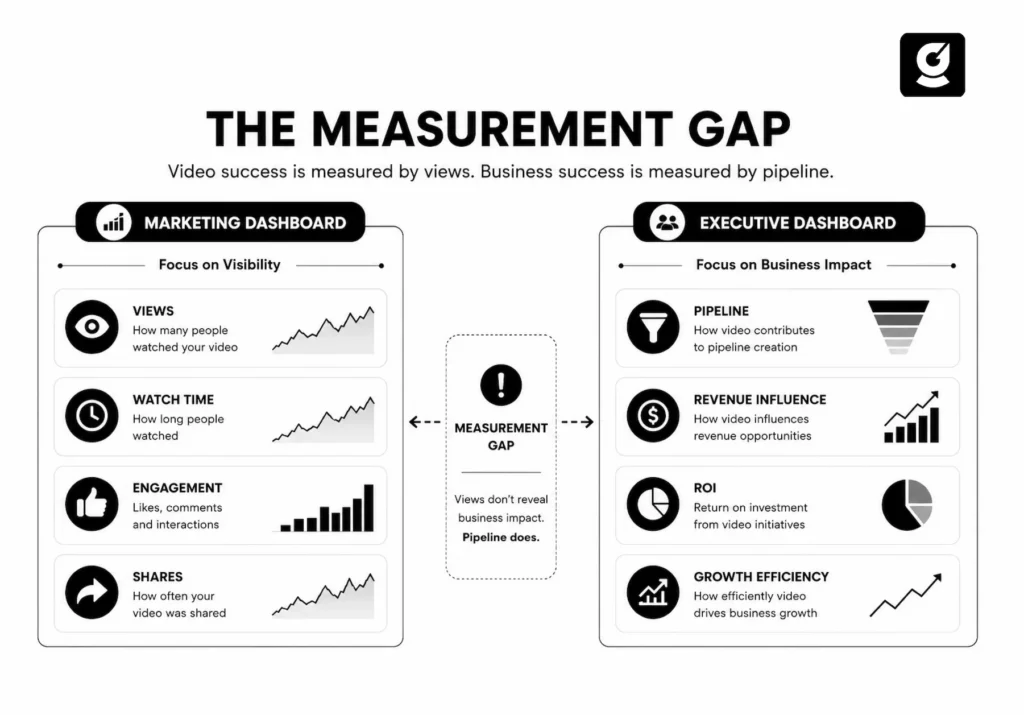
These platforms were built around audience engagement. Their dashboards were designed to answer questions such as:
- How many people watched?
- How long did they watch?
- How many people engaged?
- How often was the content shared?
As a result, marketers got used to using engagement-based metrics to assess performance. As video consumption increased, these metrics gained acceptance as standard norms in the industry.
Over time, views became the universal language of video performance. A view count could be understood instantly by anyone, including marketers, executives, agencies, and clients alike.
Pipeline, however, was a different story. Unlike views, pipeline data was not publicly visible, immediately available, or consistently measured across organizations. This naturally pushed the industry toward much easier engagement metrics.
2. Platform Algorithms Shaped What Marketers Consider Success
Almost all digital platforms reward visibility. Algorithms prioritize content that generates:
- Views
- Engagement
- Watch time
- Shares
- Audience retention
As platforms optimize for engagement, marketers often optimize for engagement as well.
This created a feedback loop where platforms promoted content that generated views. Marketers learned to pursue views, and industry benchmarks focused on views.
Eventually, many video marketing discussions became centered around maximizing visibility rather than understanding commercial impact.
The issue was never that views were irrelevant. The issue was that views became the default definition of success.
3. Views Are Easy to Benchmark
Another reason views dominate video marketing strategy discussions is practicality. Views solve several practical problems by offering:
- Immediate feedback
- Simple reporting
- Easy comparisons
- Cross-platform consistency
For example, a marketing team that launches a campaign can evaluate its view performance within hours. Whereas pipeline cannot be measured that way.
Analyzing the pipeline is naturally more complex since revenue results usually take several weeks or even months to materialize. Opportunities progress through extended sales processes that involve various stakeholders and decision-makers.
Determining the direct impact of video on the pipeline is made more difficult by the fact that numerous interactions contribute to conversions. As a result, organizations often turn towards metrics that provide instant visibility.
4. Most Video Marketing Guides Are Written for Campaign Execution
Many video marketing guides are written for people responsible for executing campaigns.
These guides often focus on questions such as:
- How do you improve video engagement?
- How do you increase watch time?
- How do you generate more reach?
- How do you improve audience retention?
These are valuable questions. However, they are operational questions rather than business questions.
A marketing manager launching a campaign needs engagement data to optimize performance. A CFO evaluating a marketing budget needs evidence of business impact. A CRO assessing growth opportunities needs visibility into pipeline creation.
These stakeholders operate at different levels of the organization and therefore prioritize different metrics.
This helps explain why many video marketing guides stop at engagement metrics while executive discussions continue toward pipeline and revenue.
| Visibility Metrics | Revenue Metrics |
| Views | Pipeline Created |
| Watch Time | Opportunity Influence |
| Engagement Rate | Revenue Influence |
| Shares | Sales Velocity Impact |
| Audience Retention | Commercial Outcomes |
| Reach | Forecasted Revenue Potential |
The Business Landscape Changed Faster Than Marketing Measurement
There is a visible shift in SaaS growth trends and the way SaaS companies evaluate growth today from how they evaluated growth five or ten years ago.
1. Marketing measurement didn’t evolve at the same pace.
Business expectations have changed over time, and marketing measurement has not always evolved at the same pace. Many organizations still report views, clicks, engagement, and reach, while expecting the marketing teams to demonstrate revenue impact.
This creates a measurement gap. The metrics available in marketing dashboards do not always align with the metrics leadership teams use to evaluate business performance.
Video marketing simply exposes this gap more clearly than many other channels. Because views are highly visible and pipeline is difficult to attribute, the contrast becomes impossible to ignore.
2. SaaS Companies Moved From Growth-at-All-Costs to Efficient Growth
Customer acquisition was the top priority for SaaS companies for a long time. As a result, marketing teams were inspired to promote top-of-funnel efforts, generate leads, and raise awareness. The fundamental idea was simple: greater visibility would eventually result in revenue growth.
The environment of today is completely different. Growth is still significant, but it is being assessed along with profitability, return on investment, and revenue efficiency.
This has increased the importance of metrics that link marketing initiatives to business results. These days, leadership teams want to know how marketing affects pipeline and future revenue, not just how much attention it generates.
3. Marketing Budgets Came Under Greater Scrutiny
As acquisition costs increased across digital channels, executive teams began asking more difficult questions. Instead of asking: How many people saw our content?, leaders increasingly asked: What business value did our marketing create?
This subtle shift had major implications. Metrics that were once considered sufficient became less persuasive. High engagement no longer guaranteed executive confidence.
Organizations wanted stronger evidence that marketing investments were contributing to revenue generation. However, views remained useful. But they no longer answered the most important business questions about video performance.
Leadership teams wanted to understand whether video content was influencing buying decisions, supporting opportunity creation, and contributing to pipeline growth.
Why Pipeline Became the Metric Revenue Teams Care About
As business expectations changed, organizations needed metrics that could connect marketing activity to commercial outcomes. This is where pipeline gained importance.
1. SaaS Companies Are Operating Under Greater Revenue Accountability
Marketing leaders today face a different level of scrutiny than they did a decade ago.
Budget discussions increasingly revolve around questions such as:
- Which activities generate opportunities?
- Which channels influence revenue?
- Which investments support growth objectives?
- Which programs should receive additional resources?
These questions are difficult to answer using engagement metrics alone.
A video may generate thousands of views, but if leadership cannot understand its relationship to revenue, its business value becomes harder to assess.
This shift has elevated the importance of pipeline as a performance indicator. Unlike engagement metrics, pipeline provides visibility into whether marketing efforts are contributing to revenue-generating opportunities.
2. Pipeline Connects Marketing Activity to Business Outcomes
One reason pipeline has become so important is that it serves as a bridge between marketing and revenue.
Pipeline helps organizations evaluate:
- Opportunity creation
- Revenue influence
- Sales engagement
- Commercial potential
Unlike views, pipeline provides insight into whether marketing activities are helping move prospects closer to a purchasing decision. This does not mean every marketing initiative should be judged exclusively by pipeline.
However, pipeline provides a stronger indication of business impact than engagement metrics alone. For leadership teams making investment decisions, that distinction matters.
3. Pipeline Creates Alignment Across Revenue Teams
Modern SaaS growth depends on collaboration between multiple functions.
Marketing generates awareness. Sales converts opportunities. Revenue operations provides visibility and reporting. Customer success supports retention and expansion.
Pipeline creates a shared measurement framework across these teams.
Instead of each department focusing on separate metrics, pipeline establishes a common objective. This alignment is one reason pipeline has become a strategic metric rather than simply a marketing metric.
4. Pipeline Supports Better Business Decisions
Leadership teams cannot allocate budgets or forecast growth based solely on engagement data. Business decisions require stronger signals.
Pipeline supports budget allocation, revenue forecasting, and making marketing investment decisions.
Organizations can better understand which investments contribute to revenue opportunities and can estimate future revenue potential in accordance with new trends in growth marketing strategies. Leaders gain greater visibility into which initiatives deserve continued investment.
Moreover, pipeline provides a more meaningful framework for evaluating commercial performance.
Why Pipeline Is Harder to Measure Than Views
If pipeline provides valuable business insight, why do many organizations still focus on views? The answer is simple. Views are easy to measure, while pipeline is much harder to track and attribute. But it is not all.
1. Video Rarely Receives Last-Touch Credit
One of the major reasons is that video rarely receives last-touch credit. Most B2B SaaS purchases involve multiple interactions. Buyers may read blog posts, attend webinars, analyse case studies, watch product videos, and then engage with sales teams before making a decision.
2. Multiple Stakeholders Make Attribution More Complex
Another reason is that B2B purchases rarely involve a single decision-maker. Buying committees often include executives, department leaders, technical evaluators, end users, and procurement teams. Each stakeholder consumes different content and interacts with the buying process differently.
3. Limited Measurement Capabilities
Next comes the measurement capabilities. Organizations with limited reporting systems often struggle to connect content engagement with opportunity progression, multi-touch interactions, and revenue attribution.
4. Video Influences More Than It Converts
Finally, video frequently contributes to pipeline without serving as the final conversion trigger. It helps buyers understand products, evaluate solutions, build confidence, and reduce perceived risk.
What This Debate Reveals About Modern B2B Video Marketing Strategy
The discussion around views versus pipeline reflects a broader transformation occurring across B2B marketing. The real issue is not video, but the measurement.
1. Marketing Measurement Is Shifting From Activity Metrics to Business Metrics
Historically, marketing teams focused heavily on activity-based indicators like traffic, impressions, clicks, views, and engagement.
These metrics remain useful. However, they are increasingly being supplemented by business-oriented metrics such as pipeline influence, opportunity creation, revenue contribution, and customer acquisition efficiency. These metrics help leadership teams understand whether marketing activities are creating commercial value.
2. Every Marketing Channel Is Being Held to Revenue Standards
Marketing accountability is no longer limited to video. Organisations are under greater pressure to show financial impact rather than just engagement in SEO, content marketing, paid advertising, events, and brand promotion.
These channels are being actively assessed by organisations based on pipeline, revenue, client acquisition efficiency, and overall business growth. The common theme is accountability. Leadership teams seek more visibility into how marketing efforts contribute to company performance and commercial outcomes, regardless of the channel.
3. Marketing Measurement Is Becoming a Business Discipline
Views are not yet outdated or irrelevant. It serves an important purpose of helping organizations understand whether content is attracting attention and reaching the intended audience.
The problem arises when those metrics become the only indicators of success.
Pipeline serves a different purpose by helping organizations evaluate opportunity creation, revenue influence, and commercial impact.
Different metrics answer different business questions. This is why the discussion has become increasingly strategic.
The challenge is not choosing between views and pipeline. The challenge is understanding when each metric should be used and how they contribute to a broader measurement framework.
As a result, measurement is becoming a critical component of growth decision-making rather than simply a reporting exercise.
How growth.cx Helps SaaS Companies Measure Marketing Beyond Views
Many SaaS companies can produce detailed marketing reports. Far fewer can confidently explain how marketing activities contribute to pipeline growth. This is where growth.cx, as a b2b saas explainer video marketing agency, helps.
1. Aligning Growth Strategy With Revenue Goals
Growth initiatives are most effective when they support clear business objectives. That’s why growth.cx helps SaaS companies evaluate:
- Growth priorities
- Revenue constraints
- Market opportunities
- Strategic trade-offs
This creates stronger alignment between marketing activities and commercial outcomes.
2. Building Revenue Measurement Frameworks
Marketing performance becomes more valuable when it can be connected to business impact. Keeping that in mind, growth.cx helps organizations strengthen visibility across:
- Demand generation programs
- Content initiatives
- Buyer journeys
- Revenue-focused marketing activities
The goal is to understand which activities contribute most effectively to growth.
3. Creating Better Visibility Between Marketing and Revenue Performance
Many organizations struggle because marketing and revenue reporting exist in separate systems. This creates gaps in visibility.
growth.cx helps SaaS companies improve alignment between:
- Marketing teams
- Sales teams
- Revenue operations
- Executive leadership
This allows decision-makers to evaluate marketing performance through a business lens rather than relying exclusively on engagement metrics.
The Question Is No Longer How Many People Watched
As video becomes a greater part of the B2B buying journey, measuring success requires looking beyond views. While visibility measures are still useful for tracking awareness and engagement, pipelines provide a more detailed knowledge of how video drives purchasing decisions and company growth.
The true shift is not from views to pipelines, but from assessing marketing effort to analyzing business effect. From a growth.cx perspective, organizations that relate video performance to buyer journeys, pipelines, and revenue have a better knowledge of what generates long-term success.
If your organization is evaluating video performance primarily through engagement metrics, it may be time to assess whether your measurement framework reflects the business outcomes you are trying to achieve.
As a SaaS marketing agency, growth.cx helps B2B SaaS companies build marketing strategies that connect content performance with pipeline and revenue outcomes.
Let’s connect to build a revenue-focused growth strategy that connects your marketing activity to measurable business impact.

FAQ’s
Which video formats generate the most qualified B2B leads?
The most effective video formats depend on where prospects are in the buying journey. However, product demos, case studies, webinars, and testimonials seem to generate the most qualified B2B leads by educating buyers, addressing buyer questions, building trust, and supporting purchase decisions.
How do you measure the ROI of B2B video marketing?
Measuring ROI requires connecting video performance with business outcomes. You can do so using pipeline, revenue influence, and opportunity creation, not just evaluating views and engagement.
How can you attribute pipeline and revenue to video marketing campaigns?
Pipeline attribution requires tracking how video content influences the buyer journey rather than relying only on last-touch attribution. Connect video marketing campaigns with CRM and multi-touch attribution to measure pipeline attribution and revenue influence.
Where should B2B SaaS companies distribute marketing videos for maximum impact?
To maximize visibility and pipeline impact, distribute B2B SaaS marketing videos across websites, LinkedIn, email, webinars, and sales enablement. However, choosing distribution channels based on the target audience and buyer journey helps you to maximize the overall impact.