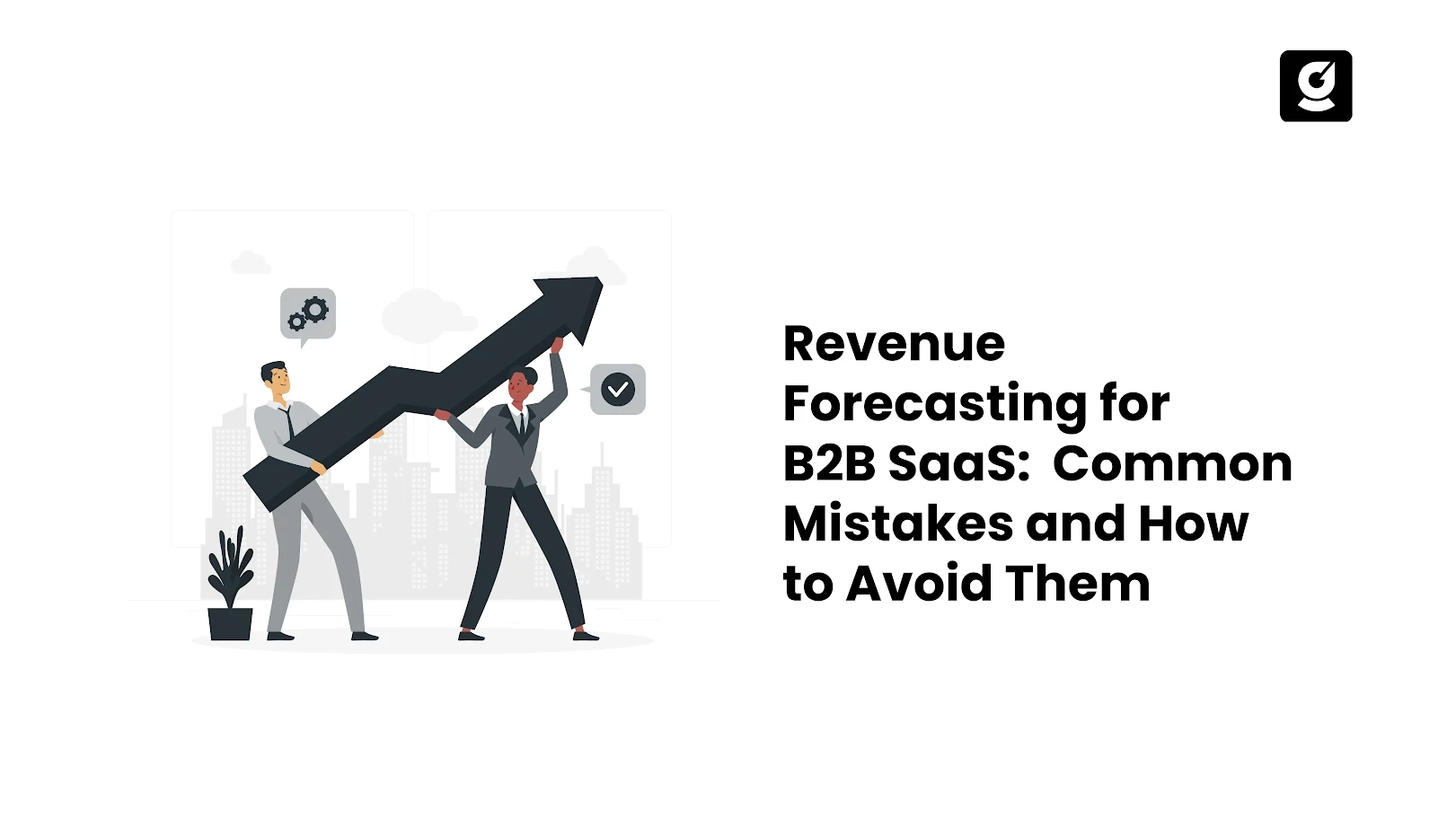
Most B2B SaaS companies already have enough pipeline data. The problem is that the pipeline data is often outdated or based on assumptions.
A sales rep may mark a deal as “verbal commit” after a promising call, but if the buyer later leaves the company and no one updates the CRM, the forecast still assumes the deal will close. Over time, these outdated assumptions make revenue forecasts inaccurate.
That gap between what’s in the CRM and what’s happening in the sales pipeline is where revenue forecasts become unreliable. Only 20% of sales organizations hit forecasts within 5% accuracy, and 43% miss by 10% or more, according to Xactly’s 2024 Sales Forecasting Benchmark Report.
For a board planning hiring, cash runway, and next quarter’s targets off that number, a 10% miss is not a rounding error. It is a real problem.
Revenue forecasting is the process of predicting future revenue using pipeline data, historical conversion rates, and sales stage probabilities.
If done right, it helps finance plan with confidence. Done wrong, it leads to missed targets, poor planning, and difficult decisions later in the quarter.
This blog post covers why forecasts break, the specific mistakes SaaS teams repeat every quarter, and what an accurate revenue forecasting model actually needs.
Common Revenue Forecasting Mistakes SaaS Companies Make
Revenue forecasts rarely fail because companies lack data. They fail because teams rely on inaccurate pipeline signals, outdated assumptions, and inconsistent forecasting processes.
Here are the top 5 Revenue Forecasting Mistakes:
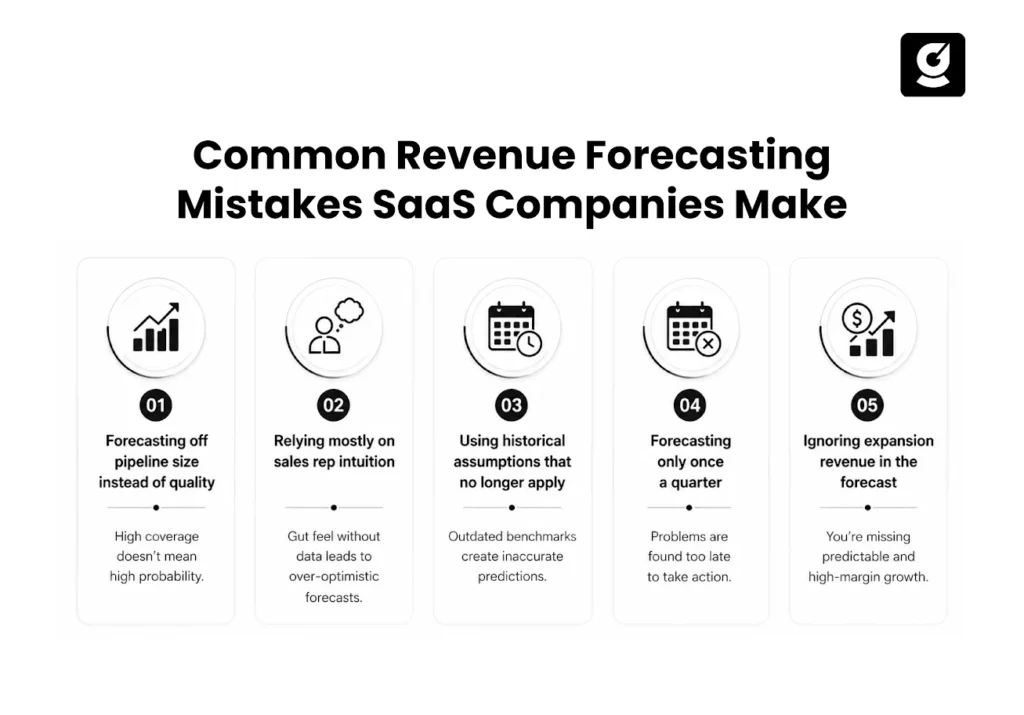
1. Forecasting Off Pipeline Size Instead of Quality
A large pipeline can create a false sense of confidence. Many SaaS teams assume that having enough pipeline coverage automatically means they are on track to hit revenue targets.
For example, a company may have a 3x pipeline coverage ratio and believe it has enough opportunities to achieve its quarterly goal. But if many of those deals are stalled, poorly qualified, or unlikely to close, the forecast is built on inflated expectations.
Why this happens
Pipeline volume is easier to measure than pipeline quality. Teams often focus on:
- Total pipeline value
- Number of opportunities created
- Deal count
But these metrics do not reveal whether buyers have real purchase intent.
A $500,000 pipeline does not mean much if:
- Decision-makers are not involved
- The buyer has not confirmed budget
- The sales cycle keeps extending
- Opportunities have stopped progressing
How it impacts forecast accuracy
When pipeline quality is ignored, SaaS companies overestimate future revenue. This creates inaccurate forecasts that affect:
- Hiring decisions
- Marketing investments
- Revenue planning
- Board expectations
Teams may continue spending based on revenue they expect to close but never actually generate.
How SaaS teams can fix it
Instead of measuring only pipeline coverage, evaluate pipeline health using signals such as:
- Deal stage movement
- Buyer engagement
- Decision-maker involvement
- Historical win rates
- Average sales cycle length
- Opportunity aging
A reliable forecast measures the probability of revenue, not just the amount of pipeline created.
2. Relying Mostly on Sales Rep Intuition
Sales reps often have the closest relationship with prospects. They understand customer conversations, objections, and buying signals better than anyone else.
However, relying only on rep confidence can introduce forecasting bias.
A rep may believe a deal is highly likely because:
- The prospect had positive conversations
- The demo went well
- The buyer showed interest
- The relationship feels strong
But important factors may remain hidden:
- Budget approval has not happened
- A competitor is being evaluated
- The executive sponsor is not involved
- Procurement may delay the purchase
Positive conversations do not always translate into buying decisions.
Why this happens
Sales teams naturally want to believe opportunities will close. Reps are also measured on pipeline generation and revenue targets, which can create unconscious optimism.
Forecasting can become a reflection of confidence rather than probability.
For example:
A rep may mark a deal as “90% likely to close” because the buyer said they liked the product.
But a data-driven forecast would ask:
- Has the buying committee approved the purchase?
- Is there a confirmed timeline?
- Has procurement started?
- Has the contract process begun?
How it impacts forecast accuracy
When every rep slightly overestimates their opportunities, the errors compound across the entire sales team.
A forecast can look healthy at the team level while hiding significant risks underneath.
This results in:
- Missed revenue targets
- Unexpected pipeline gaps
- Poor resource planning
- Last-minute attempts to recover revenue
How SaaS teams can fix it
Rep input should remain part of forecasting, but it should be combined with objective buying signals.
Use a combination of:
- Rep judgment
- Historical conversion data
- Deal stage criteria
- Customer engagement signals
- Sales cycle benchmarks
The goal is not to remove human judgment. It is to balance intuition with evidence.
3. Using Historical Assumptions That No Longer Apply
Historical data is valuable for forecasting, but past performance does not always predict future outcomes.
Many SaaS teams continue using conversion rates, sales cycle averages, or pipeline assumptions from previous periods without checking whether market conditions have changed.
A forecasting model built on outdated assumptions can create inaccurate predictions even when the calculations are correct.
Why this happens
Forecasting models often become outdated because teams:
- Do not regularly review assumptions
- Reuse previous quarter models
- Assume customer behavior remains consistent
- Ignore changes in sales cycles or buying patterns
However, SaaS markets change quickly.
Factors such as:
- Longer buying cycles
- Larger buying committees
- Pricing changes
- New competitors
- Economic conditions
can significantly impact conversion rates.
How it impacts forecast accuracy
Using outdated assumptions creates a gap between expected and actual performance.
For example:
A company may assume opportunities convert at 25% because that was historically accurate. But if enterprise buying cycles have increased and conversion has dropped to 15%, the forecast will consistently overestimate revenue.
How SaaS teams can fix it
Review forecasting assumptions regularly.
Teams should analyze:
- Current win rates
- Sales cycle changes
- Stage conversion rates
- Deal velocity
- Segment performance
A good revenue forecasting model evolves as the business changes.
4. Forecasting Only Once a Quarter
Many SaaS companies treat forecasting as a quarterly reporting exercise instead of an ongoing operating process.
Teams review forecasts before quarter-end, identify problems too late, and then try to recover missed revenue.
By that point, the available options are limited.
Why this happens
Quarterly forecasting often exists because teams associate forecasts with reporting rather than decision-making.
The focus becomes:
“What number will we report?”
instead of:
“What risks can we identify early enough to change the outcome?”
How it impacts forecast accuracy
When forecasting happens only once a quarter:
- Stalled deals remain unnoticed
- Pipeline risks appear too late
- Revenue gaps become difficult to recover
- Teams react instead of planning
A deal that starts slipping in week two may only become visible during the final weeks of the quarter.
How SaaS teams can fix it
Create a continuous forecasting process with:
- Weekly or biweekly pipeline reviews
- Regular opportunity health checks
- Updated close-date accuracy
- Forecast variance analysis
Continuous forecasting allows teams to identify problems while there is still time to act.
5. Ignoring Expansion Revenue in the Forecast
Many SaaS companies focus heavily on new customer acquisition while underestimating existing customer revenue opportunities.
However, expansion revenue from:
- Upsells
- Cross-sells
- Additional users
- Plan upgrades
can become a significant growth driver, especially for mature SaaS companies.
Why this happens
New business is easier to track because it has a visible sales pipeline.
Expansion opportunities often sit across customer success, account management, and product teams, making them harder to include in traditional sales forecasts.
How it impacts forecast accuracy
Ignoring expansion revenue creates an incomplete revenue picture.
Companies may underestimate predictable revenue streams while over-relying on new customer acquisition.
This can lead to:
- Poor growth planning
- Inaccurate ARR predictions
- Missed expansion opportunities
How SaaS teams can fix it
Include expansion and retention signals in revenue forecasts.
Track:
- Renewal probability
- Customer health scores
- Product adoption
- Expansion opportunities
- Net Revenue Retention (NRR)
A complete SaaS revenue forecast should account for both new revenue and existing customer growth.
SaaS Success Blueprint: Developing a Winning Revenue Forecast Strategy
A reliable revenue forecast does not start with a final revenue number. It starts with understanding how opportunities move through the pipeline and how likely they are to convert into actual revenue.
Many SaaS companies make the mistake of treating their entire pipeline as future revenue. A $6 million pipeline does not mean the company will generate $6 million in revenue. Some deals are still early-stage, some may not have a confirmed buyer, and others may slip beyond the expected closing period.
A stronger forecasting approach assigns probability based on each opportunity’s stage, historical conversion rates, and buying signals.
For example, consider a mid-market B2B SaaS company with:
- $8 million ARR
- $6 million active pipeline for the quarter
Instead of forecasting the full pipeline value, the company evaluates each opportunity based on its likelihood of closing:
- Early discovery opportunities may contribute only a small percentage because the buyer is still evaluating options.
- Completed demos have higher confidence because the prospect has invested more time.
- Proposal and contract-stage opportunities carry higher probability because commercial discussions have already started.
- Verbal commitments still require validation because procurement, budget approvals, and internal stakeholders can delay or stop deals.
Using this approach, the company may discover that its realistic expected revenue is closer to $2.1 million, rather than the full $6 million pipeline value.
This difference is why pipeline coverage alone can create false confidence. A company showing 3x pipeline coverage may still miss its revenue target if the pipeline is filled with low-quality or stalled opportunities.
A strong SaaS revenue forecasting strategy focuses on three things:
- Pipeline quality: Are these opportunities real, active, and aligned with the ideal customer profile?
- Conversion probability: How often do similar opportunities move from each stage to closed revenue?
- Forecast discipline: Are teams regularly updating deal health, timelines, and customer signals?
The goal of revenue forecasting is not to predict every deal perfectly. It is to create a realistic view of future revenue so leadership can make better decisions around hiring, marketing investment, and growth planning.
Know how growth.cx’ winning strategy helps B2B SaaS Companies Build Predictable Revenue Growth
Forecasting accuracy is a data and process problem, but the underlying issue is often upstream: a pipeline that never had a clear, trackable source in the first place. This is where growth.cx’s revenue-focused winning strategy changes the math.
growth.cx works as an in-house team for B2B SaaS and tech companies, not a bolt-on vendor, which is what separates it from a typical revenue marketing agency. That distinction matters directly for forecasting, because every channel growth.cx runs are built to feed clean, attributable data back into your pipeline.
- GTM strategy and fractional CMO leadership that connects marketing spend directly to pipeline stages sales can actually forecast against.
- Demand generation and B2B lead generation built around qualification criteria, not raw lead volume.
- Full-stack SaaS SEO that targets buyer-intent queries, so pipeline entering the funnel already matches your ICP.
- Account-based marketing that ties specific target accounts to specific pipeline stages, instead of anonymous inbound.
- Performance marketing built on conversion data, not vanity impressions.
None of this replaces RevOps. It gives RevOps and sales leadership pipeline data worth forecasting against in the first place.
How to Revenue Forecast More Accurately for B2B SaaS Marketers
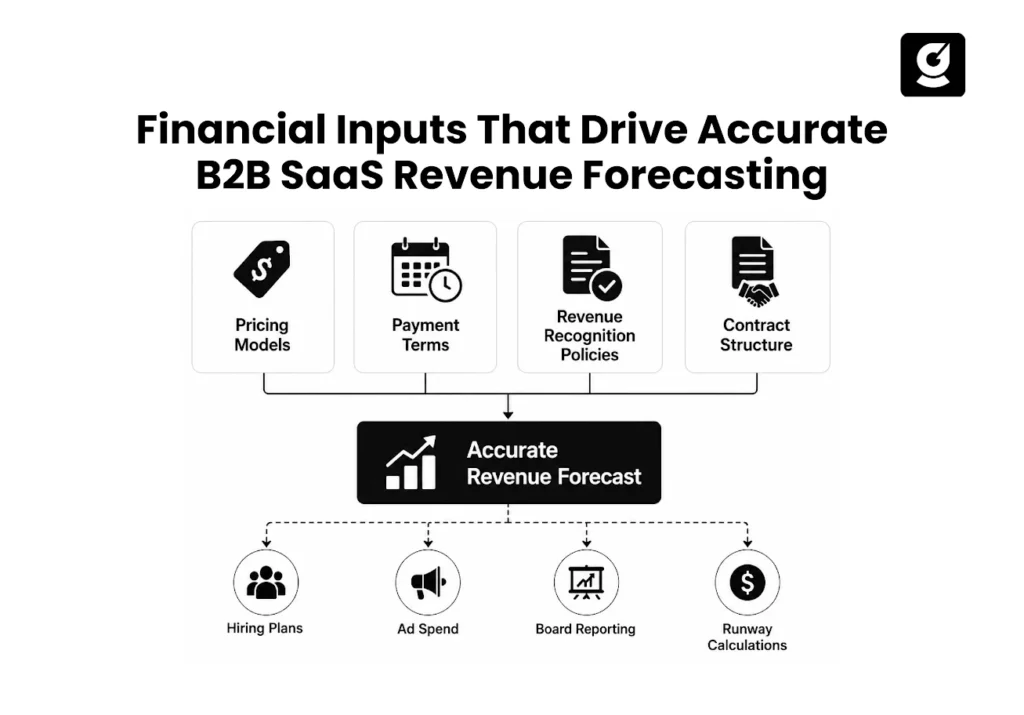
Accurate forecasting starts with fixing inputs, not adopting a new tool. Gartner estimates that improving CRM data hygiene alone can lift forecast accuracy by up to 30%. That is before any new software gets involved.
- Have you defined what each opportunity stage actually means?
Write it down. “Proposal Sent” should require a specific, verifiable action, not a rep’s impression of momentum. Once stages have hard criteria, forecasting stops being a matter of opinion.
- Are you using qualification signals that hold up under scrutiny?
Replace vague notes like “strong interest” with facts: confirmed budget, a named decision-maker, a defined timeline. If a deal cannot answer these three questions, it should not sit in a forecast category above Pipeline.
- Is your marketing, sales, and customer data connected?
This is the single highest-leverage fix. When marketing source data, sales stage data, and customer success data live in one connected system, forecasting can finally account for the full customer lifecycle, not just net-new pipeline.
- Marketing data shows which channels produce deals that actually close, not just leads that get created
- Sales data shows where deals stall and why
- Customer success data flags expansion opportunity and churn risk before renewal
4. Are you reviewing forecast accuracy on a schedule?
Track forecast-to-actual variance every month. A team that never checks its own accuracy has no way to know if its model is improving or getting worse. This single habit, done consistently, closes more of the gap than any software purchase.
Conclusion
Accurate revenue forecasting is not about predicting every deal perfectly. No SaaS company can eliminate uncertainty, and any approach that promises perfect forecasts is missing the reality of complex buying cycles.
The goal is to build a connected GTM system where marketing, sales, and customer data work together to create a reliable view of future revenue. When teams have clear pipeline signals, consistent processes, and trustworthy data, leadership can make growth decisions based on confidence rather than assumptions.
Start with the fundamentals: improve your data quality, define clear pipeline stages, align your teams, and continuously refine your forecasting process. A more predictable forecast starts with a more predictable revenue engine.
This is where growth.cx helps B2B SaaS companies build stronger foundations for revenue growth. Through GTM strategy, demand generation, B2B lead generation, SaaS SEO, and performance marketing, growth.cx helps companies create a qualified pipeline and build marketing systems that sales teams can actually forecast against.
Explore growth.cx’s approach to building predictable revenue growth and discover how a dedicated GTM partner can help strengthen your pipeline.

FAQ’s
What are the best revenue forecasting methods for B2B SaaS companies?
The best method is a hybrid: pipeline data weighted by stage, backed by manager judgment, not either one alone. Pure rep intuition skews optimistic. Pure automation misses context only a human catches. This hybrid approach works the same way for professional services revenue forecasting, where deal cycles and judgment calls matter just as much as SaaS pipelines.
How can AI improve revenue forecasting accuracy?
AI improves forecasting by scoring deals on real signals, engagement history, deal velocity, and stage duration, instead of relying on a rep's manual entry. It spots patterns across hundreds of deals that a person would miss. But AI forecasting fails just as fast as manual forecasting if the underlying CRM data is incomplete.
How can businesses improve revenue forecasting with unified customer data?
Unifying marketing, sales, and customer success data lets a forecast account for the full customer lifecycle, not just the new pipeline. A solid revenue forecast example in a business plan includes expansion and churn signals alongside new deals, since renewal revenue is usually more predictable than net-new. Disconnected data is the most common reason forecasts miss.
What is a revenue forecast example in a business plan?
A revenue forecast example in a business plan shows the path from pipeline opportunities to expected revenue, not just the final revenue number.