What if the fastest path to SaaS growth is not always finding more customers, but building a better system around the customers you already have?
Benchmarkit’s 2025 SaaS Performance Metrics report shows that SaaS companies spend approximately $2.00 in sales and marketing costs for every $1.00 of new customer ARR, compared with around $0.61 per dollar of ACV for expansion revenue.
This gap highlights a larger challenge: growth does not come from one channel or team working independently. It comes from a connected system that improves acquisition, conversion, retention, and expansion.
A revenue growth engine provides that foundation, and this article explains how SaaS companies can build one.
Revenue Growth Engine vs Traditional Revenue Growth Strategy
The growth engine is a holistic model where marketing, sales, customer success, data, and operations. Moreover, work together to create an environment for achieving sustainable and predictable revenue growth.
A conventional growth model does not usually look at the entire customer life cycle but rather individual channels or campaigns.
Factor | Traditional Growth Strategy | Revenue Growth Engine |
Primary Focus | Generating leads and increasing short-term growth activities | Building a repeatable system for predictable revenue growth |
| Growth Approach | Channel-focused (SEO, ads, outbound, campaigns) | Full-funnel approach covering acquisition, conversion, retention, and expansion |
| Team Alignment | Marketing, sales, and customer success often work separately | Teams share revenue goals, data, and accountability |
| Revenue Approach | Focuses mainly on acquiring new customers | Balances acquisition, retention, and expansion revenue |
| Customer Lifecycle | Optimizes early-stage customer acquisition | Supports the entire journey from awareness to renewal and expansion |
| Decision-Making | Based on individual campaign metrics | Based on revenue data, customer insights, and business outcomes |
| Data & Reporting | Tracks activity metrics like traffic, leads, and engagement | Tracks revenue metrics like pipeline, CAC, retention, and expansion |
| Scalability | Growth slows as channels become less efficient | Creates systems and processes that improve as the company scales |
| Business Outcome | Inconsistent growth with unpredictable results | More predictable pipeline, efficient growth, and stronger revenue performance |
What Makes Up a Revenue Growth Engine?
Revenue Growth Engine is a set of people, processes, data, and technology all working together in a coordinated fashion. This is critical for B2B SaaS companies to drive demand, convert leads, retain customers, and grow revenue.
It integrates capabilities such as demand generation, sales operations, customer expansion, RevOps, and analytics into one scalable framework.
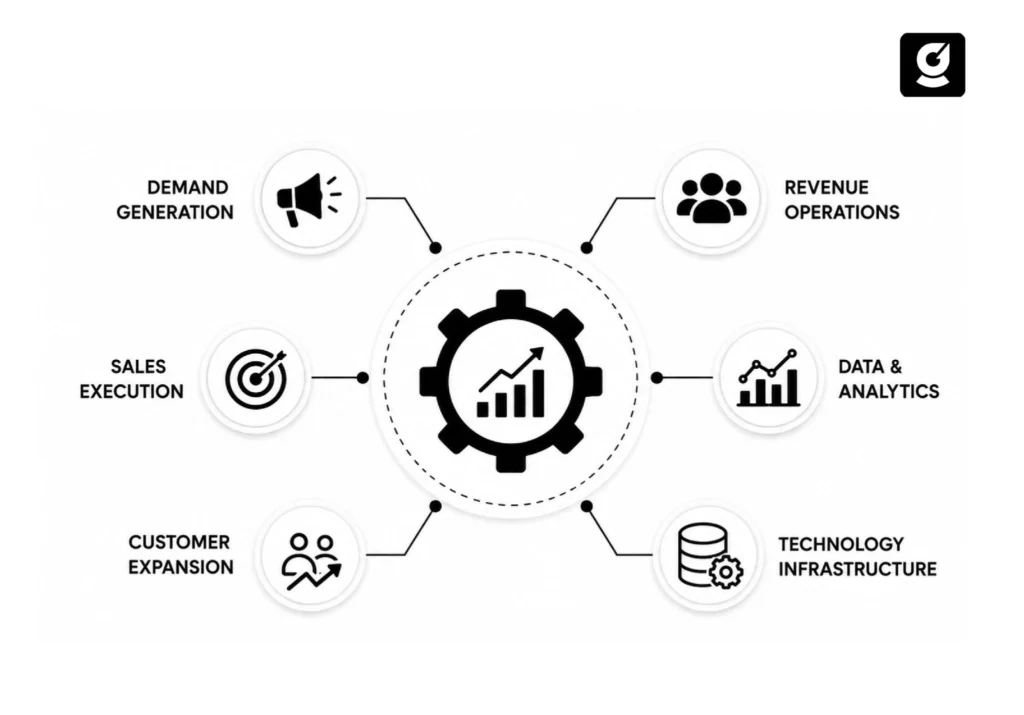
- Demand Generation
Demand generation is about reaching the right buyers with messaging that speaks to their challenges and buying intent.
It combines channels such as SEO, content marketing, paid campaigns, outbound programs, and account-based marketing to build qualified demand.
For example, a B2B SaaS company selling cybersecurity software may create industry-specific reports and comparison pages. Targeted campaigns to engage security leaders who are already evaluating solutions.
- Sales Execution
Sales execution is where opportunities become actual revenue. A sales process gives teams a repeatable way to qualify prospects, manage pipelines, and communicate value.
It requires clear qualification frameworks, effective sales enablement, accurate forecasting, and disciplined follow-up.
For example, an enterprise SaaS company can improve conversion rates by defining its ideal customer profile, building sales playbooks, and helping account executives spend more time on high-value opportunities rather than chasing poor-fit leads.
- Customer Expansion
Customer expansion focuses on growing revenue from customers who already trust and use the product. Retention, upselling, cross-selling, and deeper product adoption.
Create some of the most efficient growth opportunities because existing customers already understand the value of the solution.
For example, a project management SaaS company may increase account revenue by introducing advanced analytics and additional user seats.
- Revenue Operations
Revenue Operations (RevOps) brings marketing, sales, customer success, and technology teams onto the same page.
Instead of each department working with separate goals and disconnected data, RevOps. Creates shared processes, clear ownership, and visibility across the entire revenue lifecycle.
For example, a growing SaaS company can use RevOps to connect marketing attribution data with sales pipeline performance. Helping leadership understand which channels are driving real business impact.
- Data & Analytics
Data and analytics give revenue teams the visibility needed to understand what is working, what is slowing growth, and where improvements are needed.
A revenue growth engine depends on accurate data across every stage of the customer journey, from acquisition costs and conversion rates to retention and expansion metrics.
For example, tracking metrics such as CAC, pipeline velocity, and customer lifetime value supports SaaS companies. Identify whether growth challenges are coming from demand generation, sales execution, or customer retention.
- Technology Infrastructure
Technology infrastructure acts as the foundation that allows the revenue growth engine to operate and scale.
CRM platforms, marketing automation tools, analytics systems, sales engagement platforms, and customer success software. Also, help teams manage workflows, automate repetitive tasks, and access real-time insights.
For example, a B2B SaaS company with connected CRM, marketing automation, and analytics platforms can improve lead handoffs, automate revenue processes, and create better visibility across the entire customer lifecycle.
The Four Pillars of B2B SaaS Growth
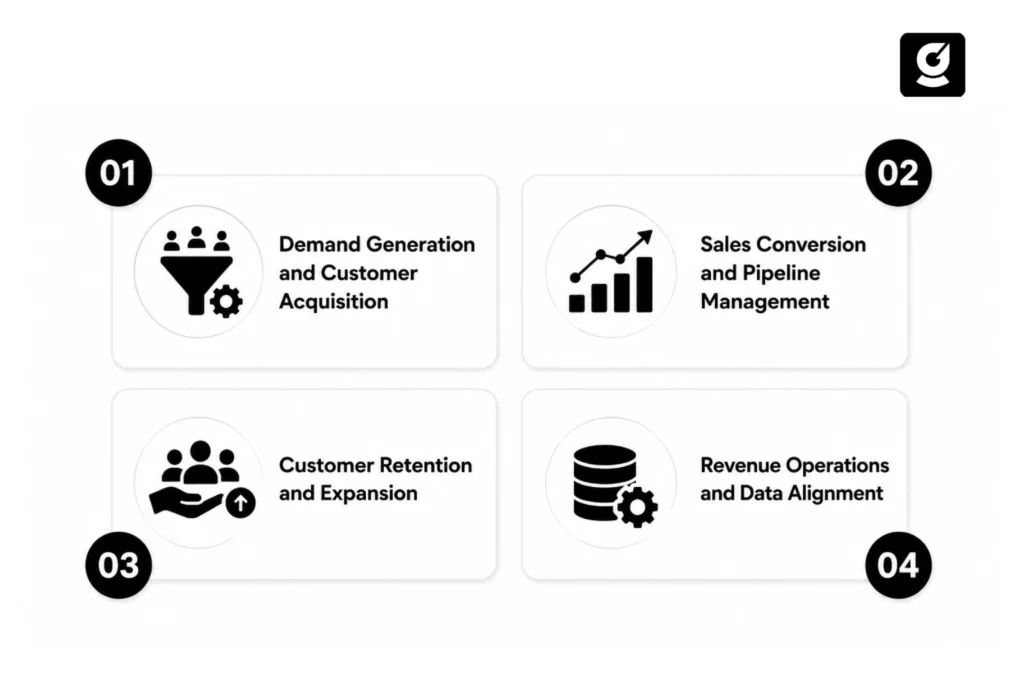
A high-performing revenue growth engine balances customer acquisition, sales efficiency, retention, and operational alignment to create predictable and scalable revenue. These four pillars serve as a practical checklist for SaaS companies looking to improve every stage of the customer journey, from generating demand to expanding customer value.
Pillar 1: Demand Generation and Customer Acquisition
Demand generation for B2B SaaS companies creates consistent demand by reaching the right buyers with relevant messaging and content.
Instead of focusing only on traffic or lead volume, effective acquisition strategies prioritize attracting qualified prospects. These prospects are more likely to convert into revenue opportunities.
Key focus areas:
- Content marketing to educate buyers and build category authority
- SEO strategies targeting high-intent search opportunities
- Paid acquisition campaigns focused on a qualified pipeline
- Outbound prospecting to reach ideal customer profiles
- Partner channels to expand market reach
- Account-based marketing (ABM) for targeted enterprise opportunities
Key takeaway: Sustainable growth starts with building a predictable system for generating qualified demand, not just increasing marketing activity.
Pillar 2: Sales Conversion and Pipeline Management
Sales execution turns qualified demand into revenue by improving how teams manage opportunities, engage prospects, and move deals through the pipeline.
A sales process gives revenue teams better visibility into deal progress and improves conversion rates at every stage.
Key focus areas:
- Lead qualification frameworks to identify high-value opportunities
- Sales velocity optimization to reduce time-to-close
- Clear pipeline stages and opportunity management
- Accurate deal forecasting
- Sales enablement resources and playbooks
Key takeaway: Revenue growth depends on improving conversion efficiency, not simply generating more leads.
Pillar 3: Customer Retention and Expansion
Customer expansion focuses on increasing the value of existing accounts through better adoption, retention programs, and expansion opportunities. For SaaS companies, long-term growth depends on building strong customer relationships that drive renewals, upsells, and cross-sells.
Key focus areas:
- Customer onboarding programs that improve activation
- Product adoption strategies to increase engagement
- Customer success programs focused on retention
- Upselling and cross-selling opportunities
- Net revenue retention (NRR) improvement
Key takeaway: Existing customers are a major growth opportunity, and improving retention can create more efficient revenue growth.
Pillar 4: Revenue Operations and Data Alignment
Revenue operations creates alignment between marketing, sales, and customer success. Technology teams can connect processes, data, and performance insights across the revenue lifecycle. It supports SaaS companies in reducing operational gaps, improving forecasting accuracy, and making better growth decisions.
Key focus areas:
- CRM management and process standardization
- Data accuracy and centralised reporting
- Revenue dashboards and performance tracking
- Workflow automation across teams
- Attribution models to understand revenue impact
Key takeaway: A revenue growth engine requires operational alignment and reliable data to continuously improve performance.
Why Most B2B SaaS Growth Strategies Fail
Most B2B SaaS marketing strategies fail not because companies lack marketing or sales activities. But because those activities often operate without alignment, clear measurement, or a shared revenue goal.
When teams optimise individual channels instead of building a connected growth system, companies often struggle with unpredictable pipelines and inefficient spending. This also leads to inconsistent revenue performance.
#1. Poor Team Alignment Limits Revenue Growth
B2B SaaS companies often experience slower growth when marketing, sales, and customer success teams work toward different goals instead of a shared revenue outcome.
Without alignment, valuable customer insights are lost, and lead handoffs become inefficient. Teams struggle to understand what actions actually contribute to revenue growth.
Common problems include:
- Marketing teams focused mainly on lead volume rather than a qualified pipeline
- Sales teams are lacking context about buyer intent and marketing interactions
- Customer success teams are working separately from acquisition and expansion strategies
- Limited collaboration between teams throughout the customer lifecycle
#2. Growth Teams Focus on Activity Instead of Revenue Outcomes
Many SaaS companies measure success through surface-level metrics that show activity but do not always reflect business impact. While metrics like traffic and engagement provide useful insights, they do not show the full impact of growth efforts.
They cannot explain whether those efforts are generating qualified opportunities, improving conversions, or increasing revenue.
Weak metrics often include:
- Website traffic growth
- Social media engagement
- Content views
- Marketing qualified leads (MQL volume)
Revenue-focused metrics include:
- Pipeline generated
- Customer acquisition cost (CAC)
- Conversion rates across funnel stages
- Sales velocity
- Expansion revenue
- Customer lifetime value (LTV)
#3. Poor Data Visibility Creates Unpredictable Forecasting
A revenue growth engine depends on accurate data to understand what is working, where opportunities are being lost, and how teams can improve performance.
When SaaS companies lack reliable data visibility, leaders often make decisions based on assumptions rather than real customer and pipeline insights.
Common data challenges include:
- Incomplete CRM data and inconsistent reporting
- Incorrect attribution of revenue sources
- Limited visibility into customer journeys
- Difficulty identifying pipeline bottlenecks
- Poor forecasting accuracy
#4. Companies Scale Channels Before Fixing Their Foundation
Many SaaS companies try to accelerate growth by adding more channels, increasing budgets, or expanding teams before addressing underlying process issues. Scaling without a foundation often increases costs without improving revenue efficiency.
Common mistakes include:
- Increasing ad spend without improving conversion rates
- Hiring more salespeople without fixing sales processes
- Publishing more content without understanding buyer intent
- Adding new tools without proper data and workflow integration
- Expanding into new markets without a clear ICP
Developing an Effective Revenue Growth Strategy for SaaS
An effective revenue growth strategy for B2B SaaS companies creates a repeatable system for generating pipeline, converting customers, and increasing long-term revenue. A B2B marketing strategy turns scattered campaigns into a repeatable pipeline engine.
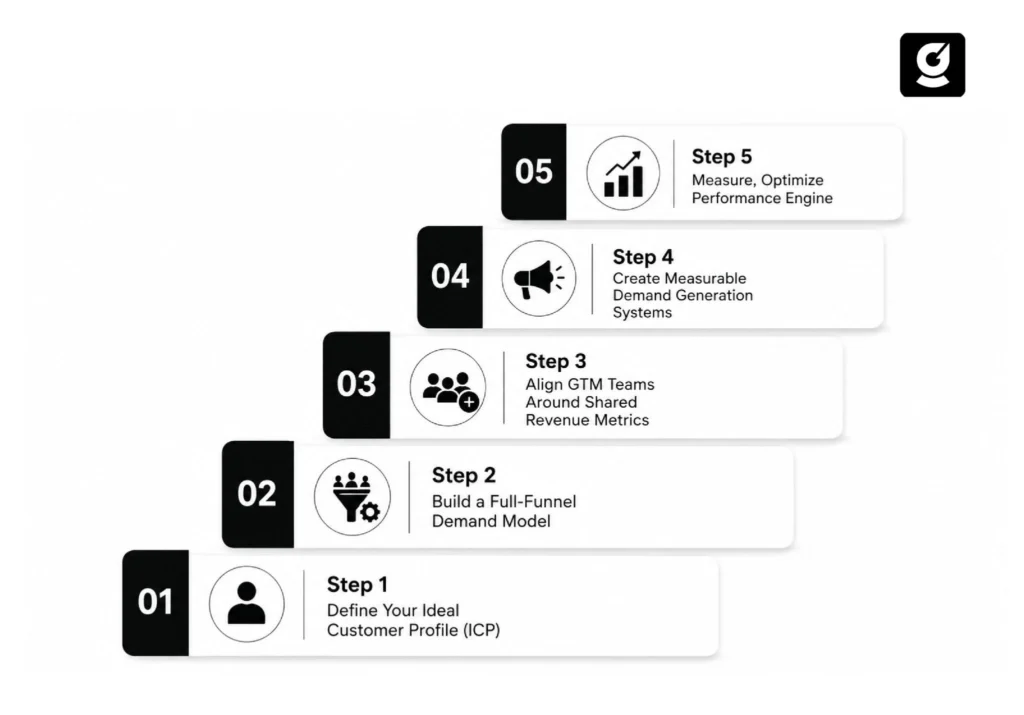
Step 1: Define Your Ideal Customer Profile (ICP)
A revenue growth strategy starts with clearly understanding who your best customers are and why they choose your solution. By defining an ICP, SaaS companies focus resources on prospects with the highest revenue potential instead of targeting broad audiences that may not convert.
Key areas to define:
- Firmographics: Company size, industry, location, revenue range, and technology stack
- Buyer personas: Decision-makers, influencers, users, and their responsibilities
- Buying triggers: Events or challenges that create a need for your solution
- Customer pain points: Business problems your product solves
- Customer success indicators: Characteristics of customers with high retention and expansion potential
Step 2: Build a Full-Funnel Revenue Model
A SaaS growth strategy requires visibility across the entire customer journey, from initial awareness to expansion. A full-funnel revenue model connects marketing, sales, and customer success activities to understand how prospects move through each stage.
Revenue growth framework:
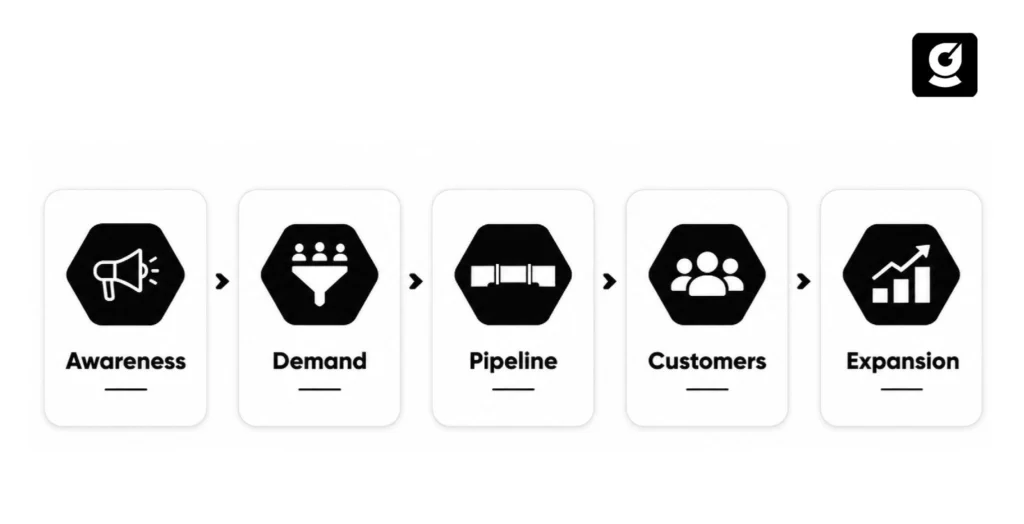
Include measurable goals across each stage:
- Marketing metrics: Organic traffic, content engagement, qualified leads, marketing-sourced pipeline
- Sales metrics: Conversion rates, sales velocity, win rates, average deal size
- Customer success metrics: Retention rate, product adoption, expansion revenue, net revenue retention
Step 3: Align GTM Teams Around Shared Revenue Metrics
Growth becomes more predictable when marketing, sales, and customer success teams operate around shared goals instead of separate targets. Aligning go-to-market teams creates better collaboration, clearer ownership, and stronger visibility into revenue performance.
Recommended shared metrics:
- Pipeline contribution
- Customer acquisition cost (CAC)
- Conversion rates
- Sales cycle length
- Revenue retention
- Expansion revenue
Alignment areas:
- Shared ICP and messaging
- Clear lead handoff processes
- Unified reporting systems
- Common revenue goals
- Regular GTM performance reviews
GTM alignment ensures every team contributes toward the same revenue outcomes instead of optimizing disconnected activities.
Step 4: Create Repeatable Demand Generation Systems
A sustainable SaaS revenue growth strategy requires consistent demand generation systems that attract and engage qualified buyers. Instead of depending on one acquisition channel, companies should build multiple connected programs that create predictable pipeline opportunities.
Key areas to focus on:
- SEO-led demand generation to capture buyer search intent
- Content strategies that educate prospects throughout the funnel
- Outbound systems targeting ideal customer profiles
- Paid acquisition campaigns focused on pipeline quality
- Partnership programs that expand market reach
- Product-led growth channels that improve user acquisition and adoption
Key takeaway: Repeatable demand generation creates a consistent pipeline foundation that supports long-term SaaS growth. Partnering with experienced SaaS Growth Marketing Agencies, B2B companies build data-driven strategies that drive consistent pipeline and revenue growth.
Step 5: Continuously Optimize the Revenue Engine
A revenue growth strategy is not a one-time plan; it requires continuous testing, measurement, and improvement. SaaS companies that regularly analyze performance can identify bottlenecks, improve efficiency, and adapt to changing customer behaviour.
Optimization areas:
- Experimentation across channels and campaigns
- Data analysis to identify growth opportunities
- Customer feedback to improve messaging and product adoption
- Funnel optimization to increase conversions
- Pricing and packaging improvements
- Sales process improvements
Creating a Pricing Experimentation Model For Revenue Operations
As part of a broader Pricing Experimentation Model, optimizing SaaS Pricing Pages for SEO & Conversions ensures that every pricing tier test also captures and converts organic search traffic effectively.
A Simple SaaS Pricing Experiment Framework
A structured pricing framework allows SaaS teams to test changes without negatively impacting customer relationships. The process should focus on customer behaviour, business goals, and measurable outcomes.
Framework:
- Identify the pricing opportunity or hypothesis
- Define success metrics such as conversion rate, ARR, or retention
- Test changes with relevant customer segments
- Analyze results and customer feedback
- Scale successful experiments across the business
Remember This: Continuous pricing experimentation creates a more adaptable and profitable revenue growth engine.
How growth.cx Helps B2B SaaS Companies Build a Revenue Growth Engine
growth.cx works as a strategic growth partner for B2B SaaS companies. Connecting GTM strategy, Revenue Operations, demand generation, SEO, CRO, and AI search optimization.
The saas marketing agency supports SaaS teams in identifying growth bottlenecks, improving funnel performance, and building scalable systems that support a predictable pipeline and long-term growth.
Aligning GTM Strategy With Revenue Goals
A revenue growth engine starts with a clear understanding of the market, ideal customers, positioning, and growth opportunities. By working with experienced SaaS GTM Strategy Agencies, like growth.cx, B2B companies can build a GTM foundation that aligns marketing, sales, and customer success around shared revenue objectives.
Key focus areas:
- Defining ideal customer profiles (ICP) and buyer personas
- Refining positioning and messaging for target markets
- Identifying high-impact growth opportunities across the funnel
- Creating GTM strategies aligned with business goals
- Improving collaboration between marketing and sales teams
Building Full-Funnel Demand Generation Systems
Demand generation is most effective when it creates a qualified pipeline, not just traffic or engagement. growth.cx builds full-funnel demand generation systems that combine SEO, content, outbound, paid acquisition, and conversion optimization to attract and convert high-intent buyers.
Key focus areas:
- SEO strategies designed around buyer intent and revenue opportunities
- Content systems that support awareness, evaluation, and decision stages
- Demand generation programs focused on a qualified pipeline
- Outbound strategies for targeted SaaS buyers
- CRO improvements to increase website and landing page conversions
- AI search optimization to improve visibility across AI-driven discovery platforms
Improving Revenue Operations and Data Alignment
Revenue Operations for SaaS companies creates better alignment between teams, processes, and technology. growth.cx businesses improve revenue visibility by connecting marketing, sales, and customer success workflows with measurable data insights.
Key focus areas:
- Aligning marketing, sales, and customer success processes
- Improving CRM structure and revenue reporting
- Creating visibility into pipeline performance
- Identifying funnel bottlenecks through data analysis
- Establishing measurement frameworks for revenue impact
Turning Growth Activities Into Measurable Revenue Outcomes
growth.cx focuses on building growth systems that connect activities to business outcomes. Instead of measuring success only through traffic, impressions, or lead volume, the focus is on improving metrics that directly influence SaaS growth.
Key focus areas:
- Increasing qualified pipeline generation
- Improving conversion rates across funnel stages
- Optimising customer acquisition efficiency
- Supporting retention and expansion opportunities
- Creating scalable growth frameworks that improve over time
How B2B SaaS Companies Grow With growth.cx
growth.cx B2B SaaS marketing agency grows by building a connected system of SEO, content marketing, and conversion optimization. This approach turns organic traffic into predictable demos, pipeline, and revenue.
The growth.cx Strategy That Got SurveySensum to $135K ARR
- Observations and Analysis
- URLs were not properly formatted (lengthy and many directories).
- There was no appropriate pillar/category for the content.
- The publishing schedule was erratic; there were months without any publications, but on some days, two or three blogs were released.
- On average, they published four new blogs per month.
- Challenges Faced
- They modified the website’s look and content without following correct SEO procedures, resulting in traffic loss.
- Managing SEO was a little difficult because they wanted to have different landing pages for two key regions: North America and Asia-Pacific (APAC).
- Their primary concentration was on bottom-of-the-funnel (BoFu) subjects, which often have low search volume and generate little traffic.
- Strategy & execution
- Audit the website to uncover technical, structural, and content gaps
- Resolve all technical SEO issues to build a strong foundation
- Conduct keyword research, competitor analysis, and ICP search intent mapping
- Build a content calendar aligned with buyer journey stages
- Develop new content pieces targeting high-intent keywords
- Publish new content and optimize existing pages for traffic and conversions
- Execute off-page SEO once on-page and technical foundations are in place
- End Result
- 30-50 demo requests every month, which is 5-6 per week on average.
- Generated $135k ARR.
- There was a 13.5% increase in users and a 13.7% increase in new users, resulting in 295% more impressions.
- 420% increase in clicks.
- 93.03% increase in organic traffic

Final Thoughts
Predictable B2B SaaS growth does not come from adding more campaigns, channels, or tools. It comes from building a connected revenue growth engine where GTM strategy, marketing, sales, customer success, data, and operations work together toward shared revenue goals.
Companies looking to improve growth should evaluate where their current system has gaps, whether it is demand generation, conversion, revenue visibility, or customer expansion.
growth.cx supports B2B SaaS companies in building scalable revenue systems through GTM strategy, Revenue Operations, demand generation, SEO, and CRO frameworks designed to improve growth efficiency and long-term performance.
If you’re looking to move beyond disconnected growth tactics, explore how growth.cx helps B2B SaaS companies build scalable, data-driven revenue engines.

FAQ’s
How does revenue operations support sustainable revenue growth?
Revenue operations (RevOps) aligns marketing, sales, customer success, and technology teams around shared processes, data, and revenue goals. It improves visibility across the customer journey, helps teams make better decisions, and creates a stronger foundation for predictable growth.
What metrics should you track to measure revenue growth performance?
SaaS companies should track revenue-focused metrics such as ARR growth, MRR growth, customer acquisition cost (CAC), LTV: CAC ratio, pipeline velocity, conversion rates, win rates, and net revenue retention. These metrics provide a clearer view of whether growth efforts are creating efficient and sustainable revenue.
How can sales, marketing, and customer success align to drive revenue growth?
Sales, marketing, and customer success teams can align by sharing common goals, using consistent customer data, and creating clear processes across the customer lifecycle. When teams collaborate around pipeline generation, customer adoption, retention, and expansion, they can create a more predictable revenue system.
What are the most common challenges in building a revenue growth strategy?
Common challenges include disconnected teams, unclear target markets, poor data visibility, inconsistent processes, and over-reliance on individual growth channels. Successful SaaS companies overcome these challenges by building a structured revenue growth strategy that connects people, processes, technology, and measurable outcomes.