AI-generated answers are reshaping search behavior by reducing reliance on traditional click-based results, with users increasingly getting direct summaries instead of browsing multiple pages.
This shift means visibility is no longer just about ranking on search engines but also about being cited in AI-generated answers that influence early-stage research and decision-making.
SEO still plays a critical role, but it must now work alongside Answer Engine Optimization (AEO). In this blog, you’ll learn the key differences in AEO vs SEO, how content strategies are evolving, and how to adapt for both.
Why Search Is Shifting From Results to Answers (The Real Change Behind AEO)?
Search is shifting from traditional results to answers because AI-powered tools and assistants now provide users with immediate, synthesized responses. Instead of clicking through multiple websites, users get direct answers, making visibility dependent on being cited in AI-generated responses rather than solely on search rankings.
What Does This Mean For B2B Saas Visibility?
Rankings are no longer the only way for B2B SaaS firms to be visible. The emphasis is shifting to being quoted, referred to, and trusted in AI-generated answers that influence early research and decision-making.
AEO vs SEO in B2B SaaS Marketing: When Each One Matters Most?
AEO matters most for visibility in AI-generated answers and citations, while SEO matters most for search rankings, organic traffic, and clicks; both are essential for full B2B SaaS search visibility.
- SEO is most important for generating search engine ranks, organic traffic, and click-throughs, whereas AEO is more important for being cited and mentioned in AI-generated responses; when combined, they ensure full visibility across both search and AI-driven discovery in B2B SaaS marketing.
- AEO is created to support AI-based discovery environments. It is designed to make the content discoverable within an AI-created response, where the data will be extracted, summarized, and cited.
- AEO does not replace SEO but rather complements it. SEO makes your website discoverable through search engines, whereas AEO makes it discoverable by being included in AI-generated responses.
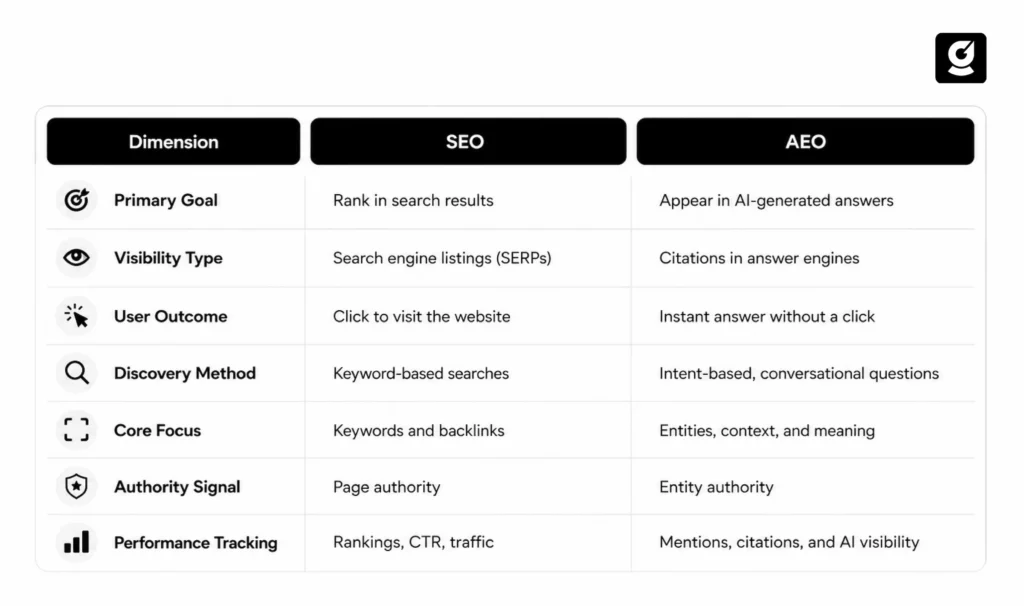
Difference Between AEO and SEO
SEO focuses on improving visibility through search engine rankings and clicks, while AEO focuses on being cited and featured in AI-generated answers and conversational search results.
Why SEO Alone No Longer Works for SaaS Growth?
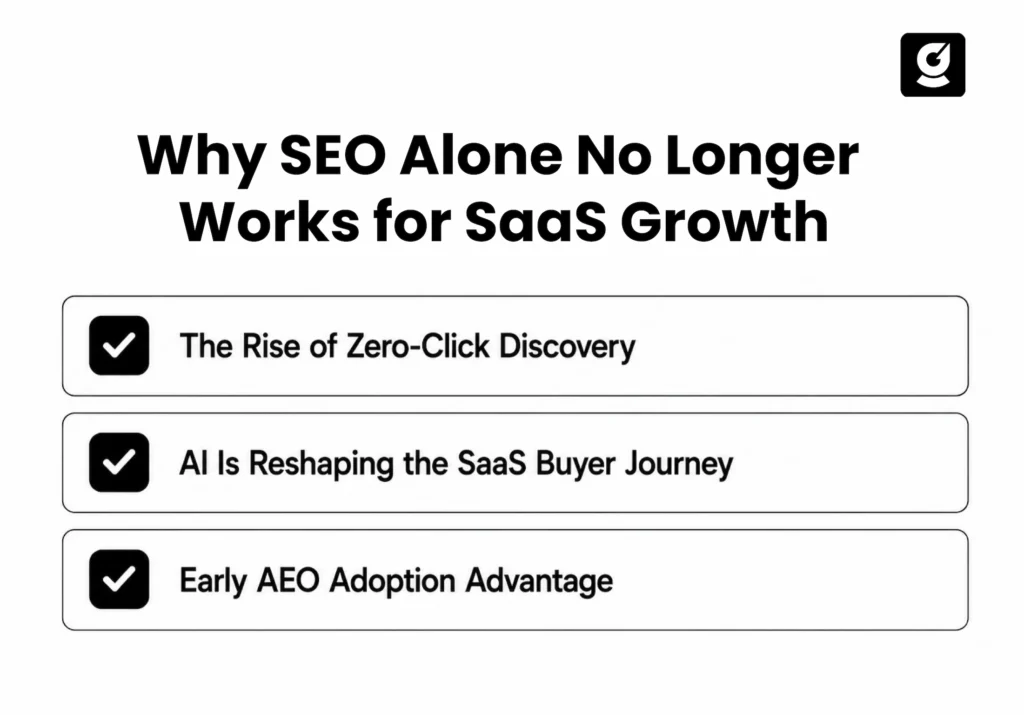
SEO alone no longer works for SaaS growth because AI-driven search reduces click-based traffic and requires brands to also be visible and cited in AI-generated answers through AEO.
- The Rise of Zero-Click Discovery
The trend in search behavior is moving towards zero-click searches, where the user gets an answer straightaway from the search engine and the AI-based tools without having to click on any website. This implies that the dependence on organic clicks is diminishing with featured snippets, summaries of AI and conversational answers.
- AI Is Reshaping the SaaS Buyer Journey
SaaS purchases made by B2B companies are getting initiated within AI-assisted applications more frequently compared to using search engines. The latter offers filtered choices, comparisons, and analysis of the products in question, reducing time spent on evaluation. In other words, brand awareness is achieved earlier, but not through a website visit.
- Early AEO Adoption Advantage
Organizations that are geared towards optimization for answer engines increase their likelihood of being quoted in AI-powered answers, thus creating their authority in the discourse at a category level. Authority is therefore gained not only by ranking but also by consistent inclusion within AI output. Organizations that adopt AEO early on gain a competitive advantage on new discovery fronts, while SEO helps in capturing demand.
What Content Actually Works for AEO (Most Teams Get This Wrong)?
AI answer engines don’t surface content randomly; they prioritize clarity, structure, and direct relevance to user intent. The mistake most SaaS teams make is producing content optimized for search rankings, not for extraction into answers. AEO rewards content that is self-contained, precise, and easy to reuse in responses.
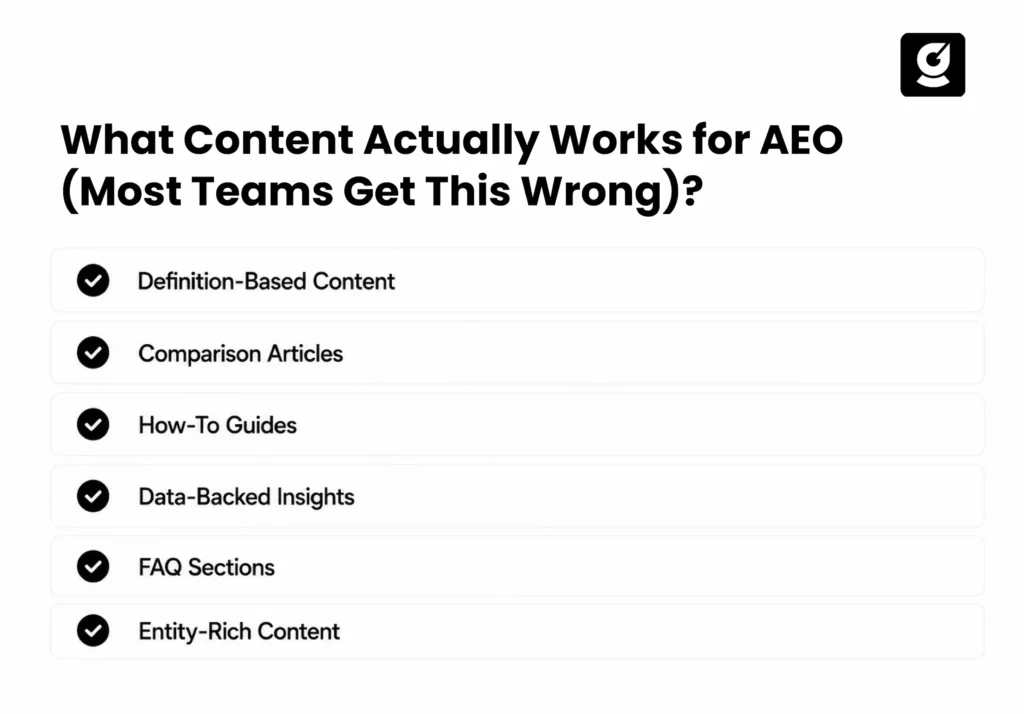
- Definition-Based Content
This works well because it directly answers “what is” questions in a clear, self-contained format. AI systems prefer definitions because they require no additional context and can be safely reused in summaries or citations.
- Comparison Articles
Content like “AEO vs SEO” performs strongly because it mirrors how users evaluate options. AI models can easily extract structured differences between SEO and AEO, making comparisons a natural fit for answer generation.
- How-To Guides
Step-by-step content marketing is highly usable for AI systems because it breaks complex processes into clear actions. This makes it easy for answer engines to reconstruct instructions in a logical sequence.
- Data-Backed Insights
Content with statistics, benchmarks, or research signals higher credibility. AI systems tend to prioritize factual, verifiable information when constructing responses.
- FAQ Sections
FAQs align directly with conversational queries used in AI tools. Since they are already structured as question-answer pairs, they are one of the easiest formats for extraction and citation.
- Entity-Rich Content
Content that clearly references tools, categories, and concepts helps AI systems understand context. Strong entity signals improve topical relevance and increase the chances of being cited in related answers.
How AEO Content Should Be Structured for AI Extraction?
For AEO, structure determines visibility as much as content quality.
- Start by providing direct answers early instead of building up to them. AI systems prioritize content that resolves intent immediately.
- Use question-based headings to mirror how users naturally query AI tools, improving alignment with retrieval patterns.
- Write concise, self-contained paragraphs so each section can stand alone without requiring surrounding context to make sense.
- Organize content using lists, tables, and summaries to improve scannability and make information easier for AI systems to parse and reuse.
- When combined, these practices ensure content is optimized not just for readers, but for how AI systems extract, interpret, and cite information.
How SEO and AEO Work Together in a SaaS Funnel?
SEO and AEO work together in a SaaS funnel by using SEO to capture search traffic at all stages, while AEO increases visibility through AI-generated answers that influence early discovery and decision-making.
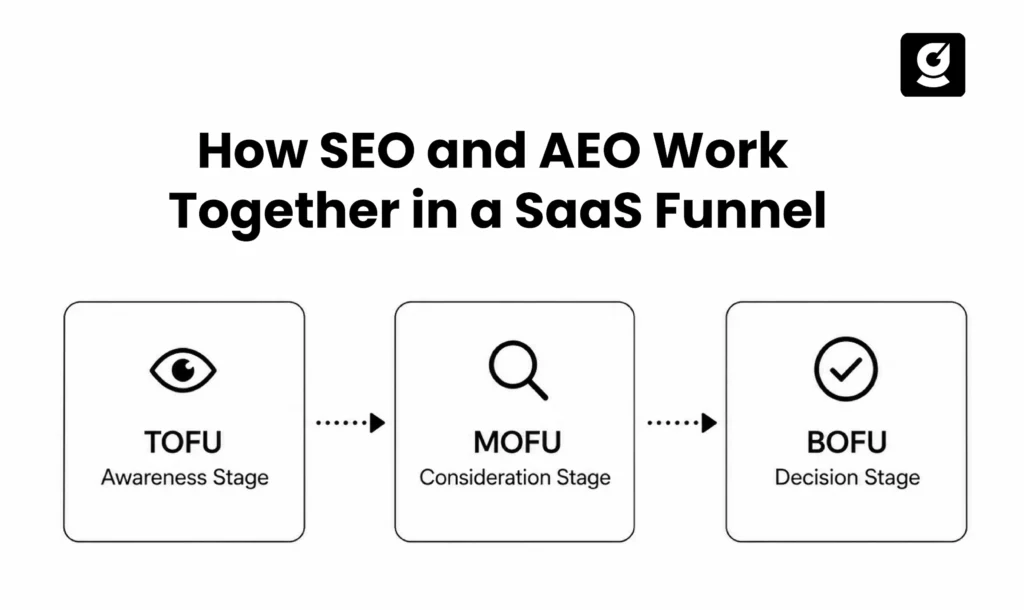
TOFU: Awareness Stage
- AEO drives visibility through AI-generated answers
- SEO supports discovery with informational content
MOFU: Consideration Stage
- AEO helps comparison content get cited in AI responses
- SEO captures users actively researching and evaluating options
BOFU: Decision Stage
- SEO drives high-intent traffic and conversions
- AEO reinforces trust through repeated brand mentions and citations
What Are The Metrics That Actually Matter in AEO vs SEO?
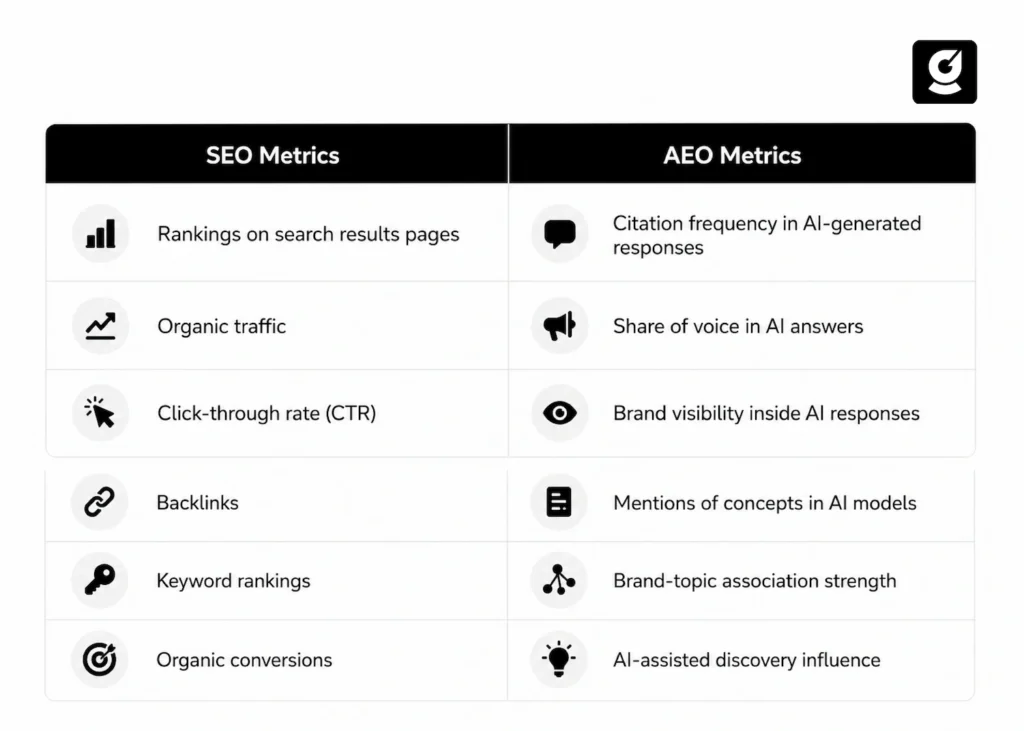
Traditional SEO metrics were designed for a world where visibility meant ranking and clicks. In an AI-driven search environment, that’s no longer enough. Brands now need to measure not just how often they appear in search results, but how often they are referenced inside AI-generated answers that influence early decision-making.
Why Both SEO and AEO Metrics Matter?
For B2B SaaS marketers, relying on SEO metrics alone gives an incomplete picture of visibility. SEO shows how well content performs in traditional search environments, while AEO reveals how often a brand is being surfaced, referenced, and trusted in AI-generated answers.
Together, these metrics help teams understand both demand capture (SEO) and demand influence (AEO). This combined view is essential for measuring true search visibility, strengthening category authority, and improving how content performs across both search engines and answer engines.
How to Build an AEO + SEO Hybrid Strategy (Without Rebuilding Everything)?
1. Strengthen Existing SEO Foundations
- Technical SEO still ensures pages are crawlable, fast, and properly indexed across search systems
- Deep, high-quality content continues to build topical authority and long-term visibility
- Backlinks reinforce credibility and trust, improving both search rankings and potential AI citations
2. Make Existing Content AEO-Ready
- Add FAQ sections to align with real conversational queries used in AI tools
- Include short, direct answer blocks so key information can be extracted easily
- Turn descriptive headings into question-based formats to match user prompts
- Use lists and comparison formats to improve clarity and machine readability
3. Build Content Around Buyer Intent Questions
- Focus on problem-led content that reflects real challenges users search or ask AI about
- Create comparison content that supports evaluation and decision-making stages
- Develop how-to and educational content that answers task-based queries clearly
4. Improve Content Structure for AI Extraction
- Use schema markup (FAQ, Article, Organization) to help machines understand content context
- Maintain a clear H2/H3 hierarchy for logical content segmentation
- Strengthen entity usage (tools, concepts, categories) to improve relevance and AI association
What Are The Common Mistakes SaaS Teams Make with AEO?
Common mistakes SaaS teams make with AEO include treating it separately from SEO, focusing on keywords instead of user questions, ignoring structured content formats, and not tracking visibility in AI-generated answers.
- Treating AEO in SEO as a separate strategy instead of building it on top of existing SEO efforts, which leads to duplicated work and inconsistent visibility
- Writing content primarily around keywords rather than real user questions, reducing relevance in AI-driven search environments
- Ignoring structure and readability makes it harder for AI systems to extract clear, usable answers from the content
- Over-optimizing for search or AI systems without aligning content to actual buyer intent, which weakens real engagement and conversions
- Not tracking AI visibility at all, leaving teams blind to how often their brand is being cited or referenced in AI-generated responses
How growth.cx Helps B2B SaaS Brands Win in Both SEO and AEO?
growth.cx helps B2B SaaS brands win in both SEO and AEO by combining search-optimized content strategies with AI-ready content frameworks that improve rankings in search engines while increasing visibility and citations in AI-generated answers.
Unified SEO + AEO Strategy for Better Visibility
- Combines traditional SEO and AEO into one integrated approach instead of treating them as separate efforts
- Helps SaaS brands improve search rankings while also increasing visibility in AI-generated answers
- Focuses on building topical authority that works across both search engines and answer engines
Content Built for Rankings and AI Citations
- Creates content that performs well in SERPs while also being structured for AI extraction and citation
- Uses clear answers, strong entity signals, and intent-focused topics to improve discoverability
- Ensures every piece of content supports both organic traffic growth and AI visibility
Smarter Visibility Tracking Beyond Traditional SEO Metrics
- Goes beyond rankings and traffic to measure how often brands appear in AI-generated responses
- Tracks entity mentions, topical authority, and share of voice across AI platforms
- Helps SaaS teams understand real visibility across both search engines and answer engines
Adapting to Changing Search Behavior
- Continuously optimizes content based on how users interact with AI-powered search tools
- Aligns strategy with shifting buyer journeys that start in AI environments
- Ensures long-term visibility as search moves toward conversational and answer-first experiences
Why SaaS Brands Choose growth.cx
- Works as a SaaS marketing agency for getting visibility across SEO and AEO together
- Helps teams move from keyword-focused SEO to intent-driven, AI-ready content systems
- Focused on measurable business outcomes like visibility, authority, and pipeline impact
If you’re ready to improve both search rankings and AI-driven visibility, partner with Growth to build a future-ready SEO + AEO strategy that keeps your SaaS brand visible where it matters most.
growth.cx AI SEO Case Studies For B2B SaaS
1. How growth.cx Increased Techmonk’s Organic Traffic by 134% in 6 months.
growth.cx increased Techmonk’s organic traffic by 134% in 6 months by implementing an AI-driven SEO strategy focused on content optimization, keyword targeting, and improved search visibility.
Challenges Faced:
- Broken Links: Every page has broken links.
- Keyword Optimization: Focus and pertinent keywords are absent from every page.
- Both service and blog sites lack schemas, which are crucial for SEO and restrict optimization.
Our Strategy And Execution:
- We worked on AEO and GEO optimization using the most recent LLM improvements, ensuring that content matches user intent and location-based inquiries.
- We improved keyword targeting, structured data, and personalized content to increase visibility in search engine features and local search results.
End Result:
- LLM platforms: Achieved positions for niche-relevant search queries on LLM platforms such as ChatGPT and Gemini, as well as AI-Overview, increasing discoverability and authority.
- Organic Traffic: 134.4% Increase (SEO Improvement)
2. How growth.cx Boosted Visitly’s Organic Visibility with AI SEO
growth.cx boosted Visitly’s organic visibility with AI SEO by optimizing targeted content and improving search relevance, resulting in stronger keyword rankings and an increase in engagement rate from 6.34% to 40.55%.
Challenges Faced:
- Visitly, as a growing platform, lacks the domain authority and backlink power required to compete fast with older competitors.
- There is little content that addresses industry-specific search questions like healthcare visitor management, school visitor check-in, and contractor management procedures.
Our Strategy And Execution:
- Fixed indexing, sitemap, and crawlability SEO concerns.
- Topical authority has been strengthened through the pillar and supporting material.
- Optimized content structure for AI searches and Google AI overviews.
- Improved page content alignment with user search intent and conversion objectives.
End Result
- LLM Visibility: Significant Improvement in Keyword Rankings
- Keyword Ranking: 5 keywords in the top ten.
- Voice share – 22%
- Cited Pages: 212
- Citations – 400+
3. How growth.cx Delivered Explosive Organic Growth for Hellosend in Just 6 Months
growth.cx delivered explosive organic growth for Hellosend in just 6 months by executing a targeted AI-driven SEO strategy focused on content optimization, keyword expansion, and improved search visibility.
Challenges Faced:
- Reduced control over visibility in traditional SERPs: With traffic shifting toward featured snippets, “People Also Ask,” and AI-generated answer boxes, the brand had less direct control over how and where content appeared in search results, making it harder to maintain consistent visibility through standard SEO tactics.
- Difficulty optimizing for AI-driven discovery formats: Existing SEO workflows were not fully aligned with conversational and AI-powered search behavior, creating a gap in capturing traffic from emerging surfaces like answer engines, which required a shift toward AEO and GEO strategies for better discoverability.
Our Strategy And Execution:
- AEO and GEO: Combined Answer Engine Optimization (AEO) and Generative Engine Optimization (GEO) to target featured snippets, People Also Ask, and AI/LLM-powered search experiences.
End Result
- Organic Clicks: +314% (A significant increase in search-driven visits, demonstrating improved engagement and reach).
- Direct traffic: 9,935 sessions (up 296%). Significant increase as greater brand presence and better user experience attract more users to return and access HelloSend directly.
Final Thoughts
SEO is not disappearing, but it is no longer sufficient on its own in an AI-driven search landscape. AEO is becoming essential as buyers increasingly rely on answer engines and AI-generated responses for early research and decision-making.
The real opportunity for B2B SaaS brands lies in combining both SEO for discoverability in search engines and AEO for visibility within AI answers. Companies that adapt early will shape category narratives and capture attention before competitors even appear in consideration. The future of search belongs to brands that are visible everywhere decisions begin.
Take the next step with growth.cx to build a strategy that aligns SEO and AEO for lasting visibility.

FAQ
Where should B2B SaaS companies focus their search marketing efforts: AEO, SEO, or both?
B2B SaaS companies should invest in both because they serve different stages of visibility. SEO captures active search demand, while AEO influences early research inside AI tools.
Will AEO eventually overtake traditional SEO, or will they continue to coexist?
AEO is not replacing SEO but changing how visibility works in search. Both will continue to coexist as search engines and AI systems operate together in the discovery process.
What content changes are needed to optimize for both AEO and SEO?
Content needs to be structured with clear answers, question-based headings, and strong topical depth. Adding FAQs, lists, and entity-rich explanations helps support both ranking and AI extraction.
Can AEO and SEO work together to improve visibility across search and AI platforms?
Yes, when combined, SEO ensures discoverability in search engines while AEO improves inclusion in AI-generated responses. Together they create full-funnel visibility across traditional and AI-driven discovery channels.
Which KPIs should marketers use to compare AEO and SEO performance?
SEO is measured through rankings, traffic, CTR, and conversions. AEO is measured through citations, AI visibility, entity mentions, and share of voice in answer engines.